


TRADING DAY-Markets 'run it hot'

On June 26, global markets saw significant movements as the dollar fell and stocks surged, driven by investor expectations of imminent U.S. interest rate cuts. President Trump's criticism of Fed Chair Jerome Powell and potential plans to replace him have intensified market speculation. World stocks reached record highs, while the dollar hit a three-year low. The outlook remains bullish, with rising U.S. growth forecasts and corporate earnings, but concerns linger about potential market dislocations if the dollar continues to decline.
ORLANDO, Florida, June 26 (Reuters) - TRADING DAY
Making sense of the forces driving global markets
By Jamie McGeever, Markets Columnist
The dollar slid and stocks surged on Thursday as investors ramped up bets that U.S. interest rates will soon be cut, after President Donald Trump, in his latest attack on Fed Chair Jerome Powell, reportedly said he may name his replacement early.
In my column today I look at where the “pain trades” for investors may lie in the second half of the year. More on that below, but first, a roundup of the main market moves.
If you have more time to read, here are a few articles I recommend to help you make sense of what happened in markets today.
- Trump decision on Fed not imminent, source says
- Investors shore up defences against another August market rout
- Wall Street forecasts windfall for big U.S. banks from Fed plan to ease leverage rule
- BoE echoes central banks’ long bond sensitivity: Mike Dolan
- EU leaders meet to decide on whether to back quick U.S. trade deal or seek better terms
Today’s Key Market Moves
- World stocks hit a fresh record peak, the S&P 500 and Nasdaq both get to within a whisker of their all-time highs.
- Dollar index falls to a 3-year low, the euro and sterling hit highest since 2021, the Swiss franc hits a decade high.
- Soaring FX caps stocks in Europe, where indices lag U.S. peers. In Asia, Japanese, Chinese stocks hit 5-month and 7-month highs, respectively.
- U.S. Treasury yields fall to lowest since early May, also pressured by weak U.S. economic data. Curve bull steepens.
- Platinum rises another 4%, now up 34% this month - its best month in nearly 40 years and second best ever.
Markets ‘run it hot’
Juice the economy. That seems to be the Trump administration’s broad plan, which will be achieved in time by tax cuts, deregulation, and loose fiscal policy. And loose monetary policy. Most definitely loose monetary policy.
Pressure from the White House on the Fed to cut interest rates is nothing new. The president has unleashed several verbal tirades towards Chair Jerome Powell for not doing so, branding him “very stupid”, “very dumb” and of “low IQ”.
Powell’s term as chair expires in May next year, and he insists he can’t be fired. So Trump is now considering naming his replacement early, who could operate as a “shadow” Fed chair, undermining Powell’s influence.
It remains to be seen how effective or even viable this would be. But the fact it’s being floated is pouring fuel on market moves that were already beginning to catch fire - the dollar is tumbling, Fed rate cut bets are being ramped up, stocks are flying, and “Big Tech” is getting its mojo back.
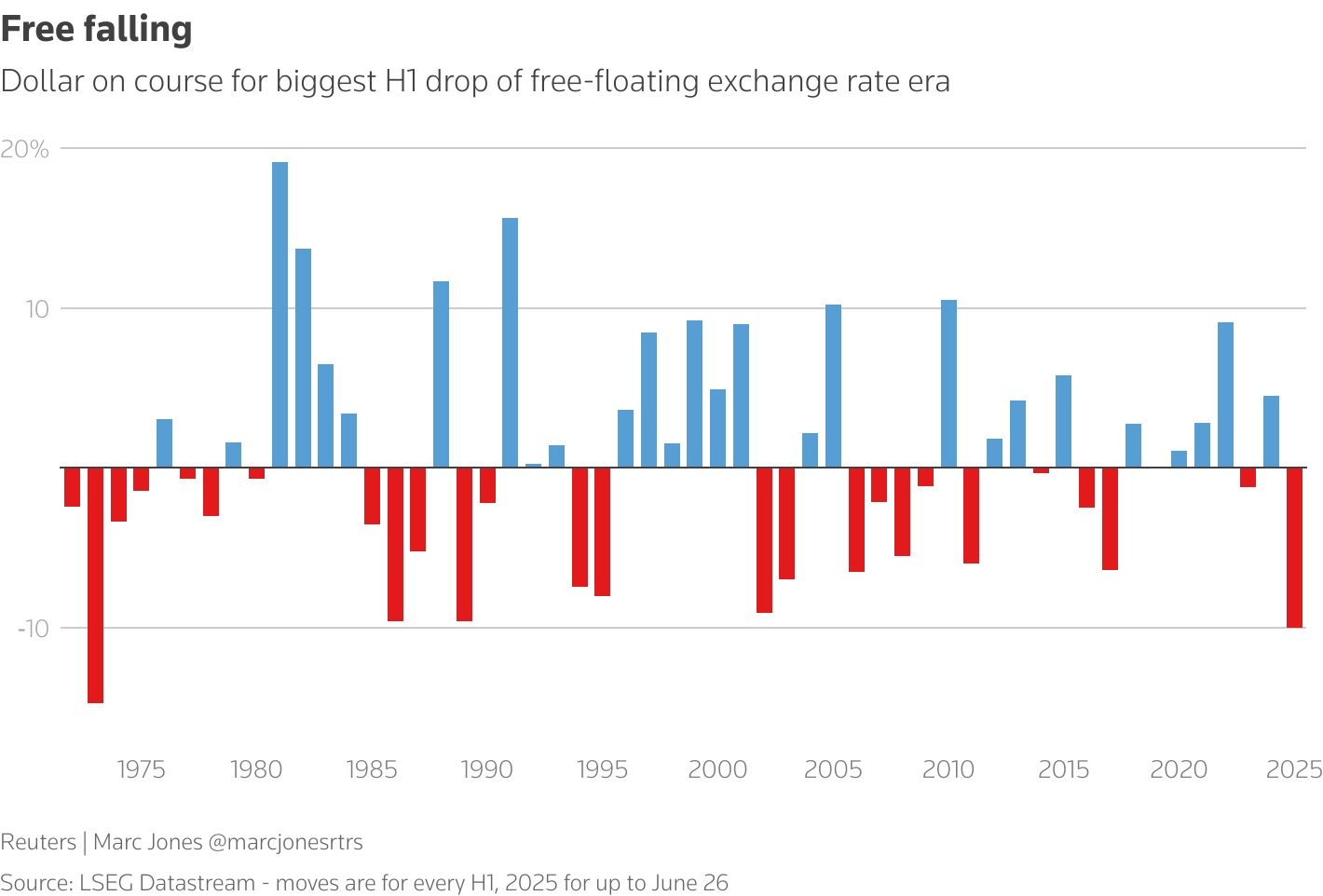
The dollar on Thursday slumped to its lowest in more than three years against a basket of major currencies - performing especially poorly against European currencies - and is on track for its worst first half of any year in over half a century.
The Trump administration will likely be quite happy with the way markets are reacting - a more export-competitive dollar, lower short-term yields, and higher stocks. And if you look further out, higher nominal growth and above-target inflation to inflate away the debt.
The danger is these moves snowball and the dollar goes into a more rapid freefall, triggering widespread market dislocation. But we’re not there yet, and investors are running with it.
Hawkish Fed could inflict markets’ biggest ‘pain trades’
As the first half of the year closes, financial markets are in limbo, waiting to see how the kaleidoscope of global trade deals will – or won’t – come together after July 9, when Washington’s pause on its “reciprocal tariffs” expires. But if investors are wrong-footed, which trades will be the most vulnerable?
The state of suspended animation in today’s markets is remarkably bullish. U.S. growth forecasts are rising, S&P 500 earnings growth estimates for next year are running at a punchy 14%, corporate deal-making is picking up, and world stocks are at record highs.
The uncertainty immediately following President Donald Trump’s April 2 “Liberation Day” tariffs seems a distant memory. The relief rally has ripped for nearly three months, only taking a brief pause during the 12-day war between Israel and Iran.
It’s a pretty rosy outlook, some might say too rosy. If we do see a pullback, what will be the biggest “pain trades”?
The major pressure points are, unsurprisingly, in asset classes and markets where positioning and sentiment are most overloaded in one direction. As always with crowded trades, a sudden price reversal can push too many investors to the exit door at once, meaning not all will get out in time.
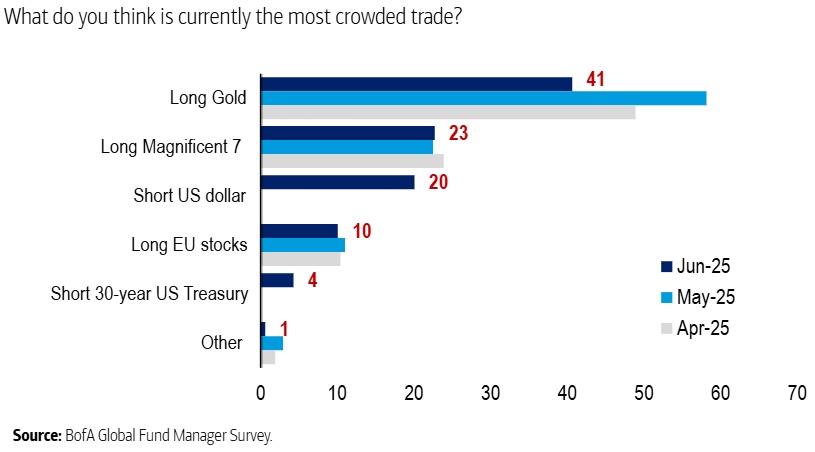
To identify the most overloaded positions, it’s useful to look at the Bank of America’s monthly global fund manager survey. In the June survey, the top three most-crowded trades right now are long gold (according to 41% of those polled), long “Magnificent Seven” tech stocks (23%), and short U.S. dollar (20%).
This popularity, of course, means these three trades have been highly profitable.
The “Mag 7” basket of Nvidia, Microsoft, Meta, Apple, Amazon, Alphabet and Tesla shares accounted for well over half of the S&P 500’s 58% two-year return in 2023 and 2024. The Roundhill equal-weighted “Mag 7” ETF is up 40% this year, and the Nasdaq 100 index, in which these seven stocks make up more than half of the market cap, this week hit a record high.
Meanwhile, the gold price has virtually doubled in the last two-and-a-half years, smashing its way to a record high $3,500 an ounce in April. And the dollar is down 10% this year, on track for its worst first half of any year since the era of free-floating exchange rates was established more than 50 years ago.
SLASH AND … BURN?
In some ways, these three trades are an offshoot of one fundamental bet: the deep-rooted view that the Federal Reserve will cut U.S. interest rates quite substantially in the next 18 months, a scenario that would make all these positions money-spinners.
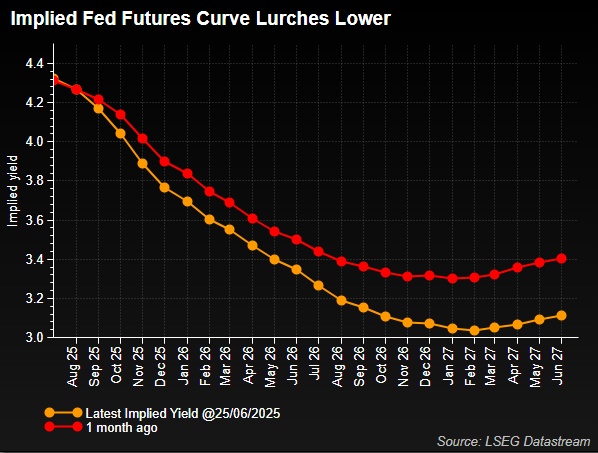
Even though the Fed’s revised economic projections last week were notable for their hawkish tilt, rates futures markets have been upping their bets on lower rates, largely due to dovish comments from several Fed officials and a sharp fall in oil prices. Traders are now predicting 125 basis points of rate cuts by the end of next year.
Economists at Morgan Stanley are even more dovish, forecasting no change this year but 175 basis points of cuts next year. That would take the Fed funds range down to 2.5%-2.75%.
Lower borrowing costs would be especially positive for shares in companies that can expect high future growth rates, like Big Tech. Low rates are also, in theory, good for gold, a non-interest-bearing asset.
But, on the flip side, it’s difficult to construct a scenario in which the economy is chugging along, supporting equity performance, while the Fed is also slashing rates by 175 bps.
Easing on that scale and at that speed would almost certainly signal that the Fed was trying to put out a raging economic fire, most likely a severe slowdown or recession. While risk assets may not necessarily collapse in that environment, over-extended positions would be exposed.
Granted, this isn’t the first time investors have banked on Fed cuts in the past three years, and we have yet to see a major blow-up as a result. Markets have handled “higher-for-longer” rates much better than many observers warned, soaring to new highs in the process.
Still, if “pain trades” do emerge in the second half of the year, it will likely be because of one sore spot: a hawkish Fed.
What could move markets tomorrow?
- Japan retail sales (May)
- Japan unemployment (May)
- Japan Tokyo inflation (June)
- Japan Softbank AGM
- Euro zone sentiment indexes (June)
- U.S. PCE inflation (May)
- U.S. University of Michigan consumer sentiment, inflation expectations (June, final)
- Cleveland Fed President Beth Hammack and Fed Governor Lisa Cook participate in ‘Fed Listens’ event
Want to receive Trading Day in your inbox every weekday morning? Sign up for my newsletter here.
Opinions expressed are those of the author. They do not reflect the views of Reuters News, which, under the Trust Principles, is committed to integrity, independence, and freedom from bias.
Dollar free falling
Most crowded trades - BofA fund manager survey
Implied Fed funds futures curve lurches lower
(By Jamie McGeever)
