Bank of America: The market may no longer believe in "hawkish rate cuts," Hasset brings "buy the rumor, sell the fact" trading opportunities

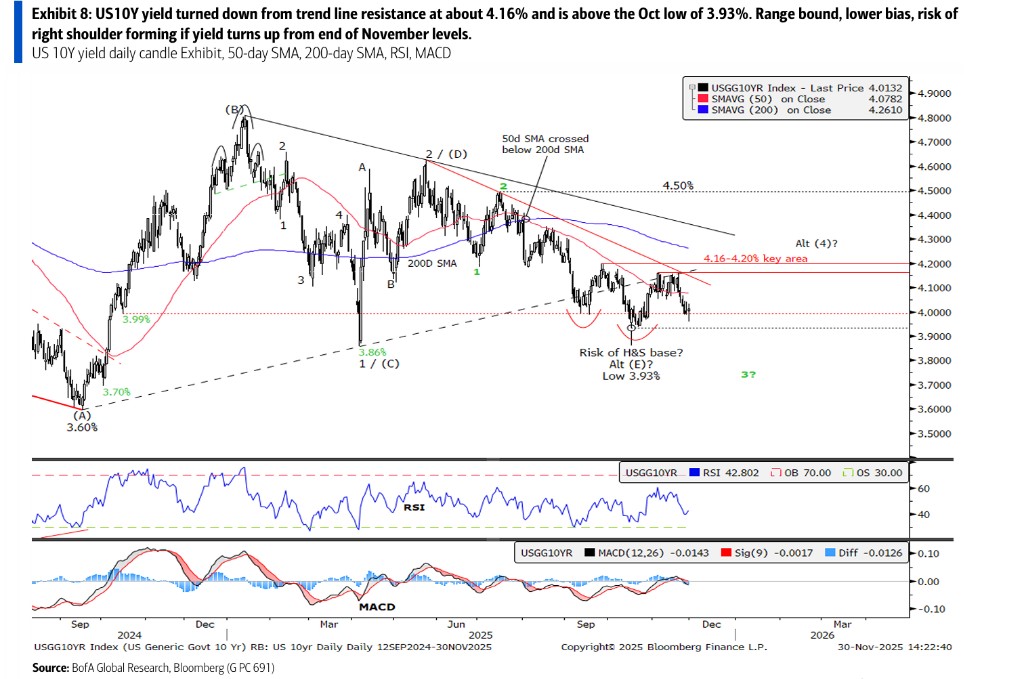
Bank of America pointed out in its report that despite the Federal Reserve signaling a rate cut, the market is skeptical about its "hawkish rate cut." Bank of America advises investors to ignore concerns about Hassett taking over as Fed Chair and to adopt a "buy the rumor" strategy to increase duration exposure. It is expected that the yield on 10-year U.S. Treasuries will fall below 4%. In addition, the Federal Reserve may announce a reserve management purchase program to support arbitrage trading. Powell may find it difficult to maintain a hawkish stance at the press conference, and the market may price in a more aggressive rate cut in January
Bank of America pointed out in its fixed income strategy report on the 8th that although the Federal Reserve has signaled a 25 basis point rate cut in December, the market is skeptical about its ability to convincingly convey a "hawkish rate cut" stance.
According to news from the Chasing Wind trading desk, the market generally expects the Federal Reserve to cut rates at this week's meeting, with pricing showing a probability as high as 95%. Bank of America economists expect the latest Summary of Economic Projections (SEP) to show an upward revision in economic growth expectations for 2025-2026, but the unemployment rate forecast may also be revised upward, while this year's inflation expectations may be lowered by 0.1 basis points. These revised data will provide justification for the rate cut in December, and the median of the dot plot may indicate two rate cuts next year.
Regarding rumors that Hassett may succeed as Federal Reserve Chairman, although Wall Street is concerned that his "too dovish" stance and lack of independence may trigger upward pressure on long-term rates, Bank of America advises investors to ignore this noise. The bank has not turned bearish due to broader market concerns; instead, it recommends adopting a "buy the rumor" strategy to increase duration exposure before the transition of the Federal Reserve Chair in May next year. Bank of America predicts that driven by this expectation, the yield on the 10-year U.S. Treasury bond is likely to fall below 4% in the coming months.
In addition to the interest rate decision, changes in liquidity are also worth noting. Bank of America expects the Federal Reserve to announce a Reserve Management Purchase Plan (RMPs) this week, starting in January with a monthly purchase of $45 billion in Treasury bills. This scale exceeds market expectations and aims to address the natural growth of the Federal Reserve's balance sheet and replenish reserve consumption. This move will further support arbitrage trading and maintain a low volatility environment.
Powell's Difficulty in Maintaining a "Hawkish Rate Cut"
Bank of America believes in the report that, given the large amount of economic data to be released before the January meeting, Powell will find it difficult to maintain a credible hawkish stance at the press conference.
Although Powell may try to emphasize that further deterioration in labor data is needed before another rate cut, or argue that the current policy rate is not restrictive in real terms, he will find it hard to escape the framework of "data dependence." Bank of America believes that if Powell cannot effectively convey a hawkish signal, the market may price in a more aggressive rate cut for January in the short term.
Additionally, Treasury Secretary Basant's recent criticism of the residency of regional Federal Reserve Chairmen has also drawn attention. Basant proposed new rules requiring Federal Reserve Chairmen to reside in their districts for at least three years, which is seen as a signal that the Trump team is attempting to influence the regional Federal Reserve boards and potentially change the seating dynamics. Although this rule does not have retroactive effect, this trend indicates the administration's potential pressure on the central bank.
Trading Logic Triggered by Hassett's Nomination
The market dynamics surrounding Hassett's nomination are changing the return logic of fixed income products. Bank of America strategists point out that although duration assets have performed poorly recently, this precisely provides an opportunity to increase positions. If the market operates according to the "buy the rumor" logic, it is highly probable that the yield on the 10-year U.S. Treasury will fall below 4%. This downward trend in interest rates is expected to push the 30-year mortgage rate below 6%, coinciding with the spring home buying season, supporting Bank of America's judgment that existing home sales and MBS turnover will increase by 5%-10% in 2026

Against this backdrop, Bank of America maintains an overweight recommendation on agency MBS, non-agency MBS, and CMBS. As the MOVE index (bond market volatility index) falls back to 66 and is expected to decline further, the spreads on agency MBS are likely to narrow further in the coming months, from the current 121 basis points down to 100 basis points or even lower.
Liquidity "Gift Package": RMPs Coming Soon
Bank of America predicts that the Federal Reserve will announce the RMPs plan in its implementation statement this week. Key details include:
- Scale and Timing: It is expected to purchase $45 billion in Treasury securities monthly starting in January, continuing for at least 6 months. Of this, $20 billion will be used to address natural balance sheet growth, and $25 billion will be used to replenish reserves.
- Market Impact: This liquidity injection will directly benefit the front-end market. Bank of America recommends going long on the January SOFR/Federal Funds (FF) spread. Historical data shows that increased liquidity typically leads to a rapid decline in SOFR relative to FF, while the response of FF is lagging. Currently, the market is underpricing this risk; if RMPs are implemented as expected, the January SOFR/FF spread is likely to widen to at least -5 basis points.
Credit and Securitized Asset Allocation
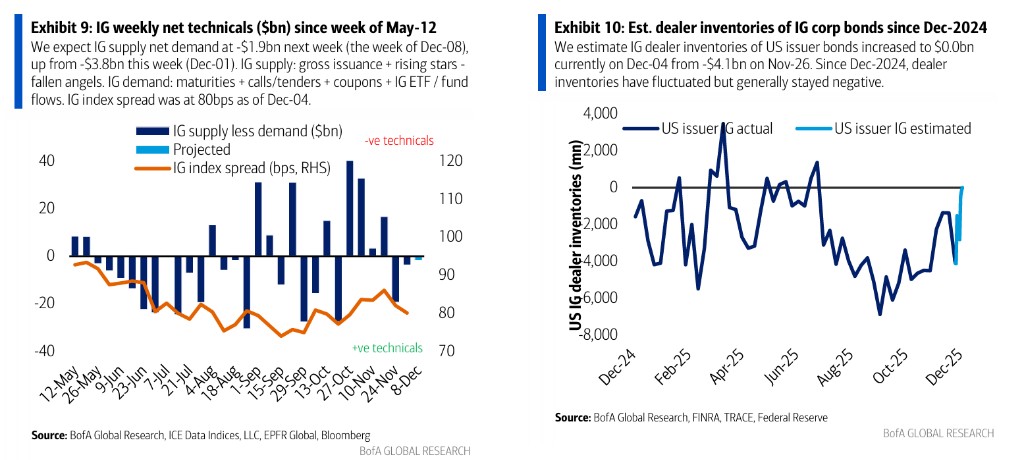
In the credit market, Bank of America believes that if the Federal Reserve becomes "extremely dovish" due to the new chairperson selection, the investment-grade (IG) corporate bond spreads may initially narrow as investors chase duration, leading to a flattening of the 10-year and 30-year spread curve. Bank of America emphasizes that CLOs (collateralized loan obligations) exhibit excellent downside protection and are considered "the most worth buying and the most worth selling" assets—due to their good carry yield and price stability.
In contrast, the high-yield bond (HY) market's anticipated "Christmas rally" faces challenges. Driven by AI-induced volatility, shifts in Federal Reserve expectations, and delayed data releases, December's market is filled with uncertainty. Although it typically shows strong seasonal technicals, the current stock market is performing poorly due to valuation concerns, which may drag down high-yield bond performance.
For the municipal bond market, Bank of America forecasts a total issuance of $640 billion in 2026. Strategically, it recommends buying and holding long-duration, high-rated municipal bonds in the first half of 2026, expecting the AAA yield curve to flatten in the first half.

Risk Warning and Disclaimer The market has risks, and investment requires caution. This article does not constitute personal investment advice and does not take into account the specific investment goals, financial situation, or needs of individual users. Users should consider whether any opinions, views, or conclusions in this article align with their specific circumstances. Investment based on this is at one's own risk