


As silver experiences a historic surge, the Silver Institute has released a "major report"

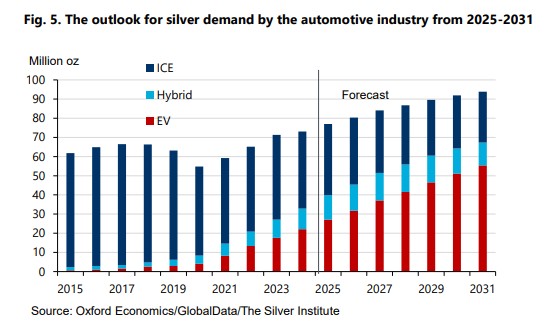
The report points out that the demand in fields such as photovoltaics, electric vehicles, and data centers is surging, and global industrial demand for silver will continue to grow over the next five years. The annual growth rate of global solar installed capacity will reach 17% before 2030, and silver is the preferred material for conductive silver paste in solar cells; the demand for silver in the automotive industry will increase by 3.4% annually between 2025 and 2031, reaching approximately 94 million ounces by 2031; global data centers will grow from 0.93 gigawatts in 2000 to nearly 50 gigawatts by 2025, a 53-fold increase, with core components such as servers, switches, and cooling systems all requiring silver
As silver prices surged past the $60 per ounce mark on Tuesday, reaching a historic high, a recent report released by the Silver Institute indicates that global industrial demand for silver is expected to continue rising over the next five years, driven by accelerating demand in key technological sectors such as solar energy, electric vehicles, and data centers.
The report, authored by the Oxford Economics Institute, is titled "Silver: The Next Generation Metal." It highlights that silver's exceptional performance in electrical and thermal conductivity is increasingly becoming an indispensable key factor in driving the global economic and technological transformation. As countries accelerate their digital innovation and clean energy transitions, silver will continue to play a core role in multiple high-growth industries.
The report focuses on three core areas: solar photovoltaic, electric vehicles and their infrastructure, and data centers and artificial intelligence. The 17% compound annual growth rate in the photovoltaic industry, the 13% compound annual growth rate in the electric vehicle industry, and the explosive expansion of data centers together constitute the three pillars of silver demand growth. The report predicts that these industries will continue to drive industrial demand for silver until 2030.
Here are the key points from the report:
Photovoltaic Industry: Strong Growth Amid Technological Transformation
Silver has become an indispensable material for photovoltaic cells due to three key characteristics: the highest electrical conductivity ensures efficient energy conversion, excellent thermal conductivity prevents performance loss, and high corrosion resistance guarantees long-term operation in harsh environments. These characteristics make silver the preferred material for conductive silver paste on the front and back of solar cells.
Over the past decade, global photovoltaic installed capacity has increased more than tenfold, with China contributing 51% of the increase, while Europe and the United States contributed 15% and 9%, respectively. The share of silver demand from the photovoltaic sector in total industrial silver demand has risen from 11% in 2014 to 29% in 2024. However, it is noteworthy that despite the tenfold increase in installed capacity, silver demand has only tripled, reflecting a significant "de-materialization" effect in technology.
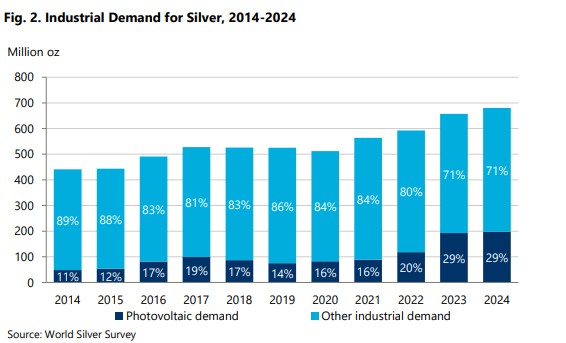
The International Energy Agency (IEA) predicts that new solar installed capacity will account for over 80% of global renewable energy growth before 2030, with a compound annual growth rate of 17% for global solar installed capacity. By 2030, solar energy will become the primary source of renewable energy worldwide.
Looking ahead, the report notes:
Policy Support: The European Union plans to achieve at least 700 gigawatts of solar installed capacity by 2030, requiring an annual growth rate of 13%, supported by tens of billions of euros in funding. India's target is to reach 500 gigawatts of installed capacity by 2030, requiring an annual growth rate of 37%.
Policy Risks: In July 2025, the Trump administration in the United States signed an executive order to cancel green energy subsidies.
Technological Advances: The global levelized cost of electricity (LCOE) for solar energy has decreased by 90% since 2010, with 96% of new solar and onshore wind projects having lower generation costs than coal and natural gas. Bloomberg New Energy Finance predicts that by 2035, the LCOE for photovoltaics will further decrease by 31%
Silver Usage Game: The silver usage in the new generation N-type tunnel oxide passivated contact (TOPCon) and silicon heterojunction (SHJ) solar cells is 50% higher than that of the existing PERC cells. In 2024, TOPCon cell sales are expected to surpass PERC cells for the first time. Although silver usage is expected to decline in the future, the International Photovoltaic Technology Roadmap predicts that the silver consumption of the new generation of cells will still be higher than the current PERC cell levels by 2035.
Alternative Technology Challenges: Silver-coated copper powder technology can reduce silver consumption by 30-50%, with a conversion efficiency decrease of less than 1%. Although copper plating technology currently has a small market share, experts believe it will grow significantly in the coming years.
Automotive and Electric Vehicles: The Electrification Wave Drives Demand Surge
Silver's application in the automotive industry stems from its excellent conductivity, thermal conductivity, and corrosion resistance. According to the Silver Institute's 2021 report, a typical light vehicle contains about 150-250 electrical contacts, and this number is expected to increase further with the trend of vehicle electrification. The silver consumption in battery electric vehicles (BEVs) is estimated to be 67% higher at the lower end and 79% higher at the upper end compared to fuel vehicles. Each fuel vehicle uses 15-18 grams of silver, hybrid vehicles use 25-28 grams, while pure electric vehicles use 34-50 grams.
In 2024, electric vehicles will account for 21% of light vehicle production, up from just 3% in 2019. Although recent reductions in government incentives and concerns about range anxiety have slowed electric vehicle demand, the long-term transformation trend remains unchanged. It is expected that global electric vehicle production will grow at a compound annual growth rate of 13% from 2025 to 2031.
The Asia-Pacific region dominates electric vehicle production, accounting for 76% of global output in 2024, with China contributing 91% of the Asia-Pacific production. By 2031, the Asia-Pacific share is expected to drop to 56%, while Europe and North America will rise to 26% and 17%, respectively.
Forecasts indicate that global silver demand in the automotive industry will grow at a compound annual growth rate of 3.4% between 2025 and 2031, reaching approximately 94 million ounces by 2031. In 2024, fuel vehicles will account for 55% of silver demand, while electric vehicles will account for 30%. Due to the rapid growth in electric vehicle demand and production, it is expected that by 2027, electric vehicles will surpass fuel vehicles as the main source of silver demand in the automotive industry, reaching a 59% share by 2031.
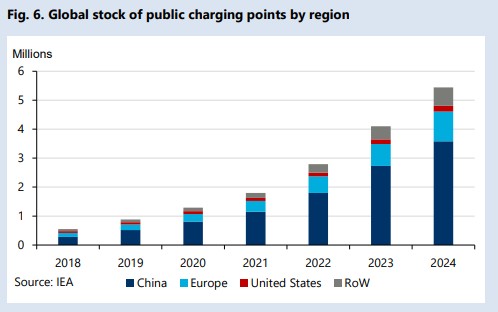
An additional benefit of the electrification of the automotive industry is the demand for charging infrastructure. According to data from the International Energy Agency, the number of public charging stations worldwide is expected to grow by 33% in 2024, with China contributing 21 percentage points. The rising adoption rate of electric vehicles is expected to require sufficient charging infrastructure, further driving silver demand.
 However, the anti-electric vehicle policies of the Trump administration in the United States led to the cancellation of the $7,500 tax credit for new electric vehicle purchases and the $4,000 credit for used cars. In addition, rising global tariff barriers will also increase costs and suppress demand growth. The European Union imposes tariffs of 17.8%-45.3% on Chinese electric vehicles, while the United States imposes a 25% tariff on cars from Canada and a 15% tariff on those from Europe.
Data Centers and Artificial Intelligence: New Opportunities for Exponential Growth
The scale of data centers is experiencing explosive growth, with reports showing that the number of data centers worldwide has increased elevenfold since 2000, with over 4,600 data centers currently in operation globally. More importantly, the IT power capacity of global data centers has grown from 0.93 gigawatts in 2000 to nearly 50 gigawatts by 2025, an increase of 53 times. This exponential growth means more servers, switches, and cooling systems, each of which requires silver for its core components.
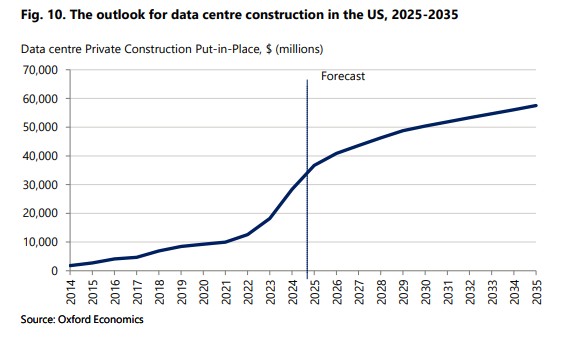
By 2025, data centers in North America, Western Europe, East Asia, and Southeast Asia will account for 88% of global computing capacity. The United States alone will account for over 22.57 gigawatts of IT power capacity. The Oxford Economics Institute predicts that data center construction in the United States will grow by 57% over the next decade.
The application of silver in data centers is based on three key characteristics: the highest electrical conductivity ensures minimal energy loss during power transmission in servers, which is crucial for data centers that require 99.999% uptime; excellent thermal conductivity helps keep devices within safe temperature ranges, reducing cooling energy consumption (cooling systems account for 7-30% of total energy consumption in data centers); and high corrosion resistance protects components in environments with high electrical loads and temperature fluctuations.
Furthermore, artificial intelligence applications are increasingly reliant on specialized hardware, such as Graphics Processing Units (GPUs), Tensor Processing Units (TPUs), and Neural Processing Units (NPUs), all of which depend on high-performance semiconductors that use silver in their internal connections and packaging. Industrial silver demand is expected to reach a record 680.5 million ounces in 2024, primarily driven by the electronic and electrical demand in consumer electronics and hardware related to artificial intelligence applications.
As artificial intelligence expands into consumer electronics, industrial automation, and smart infrastructure, the deployment of silver-rich components in these end-use applications will continue to grow.
Governments around the world are recognizing the strategic importance of data centers. In January 2025, the United States designated AI data centers as a national priority through an executive order, streamlining the permitting process and providing subsidies, tax incentives, and other support. The UK released the "AI Opportunities Action Plan" in early 2025, clearly listing "AI data centers and infrastructure" as a national priority. Ireland officially classified data centers as "core digital infrastructure," offering low corporate taxes, streamlined permitting, and ready-to-use land, attracting investments from companies like Google, Meta, and Amazon In addition, a report from International Data Corporation shows that the growth rate of global public cloud service spending exceeds that of overall IT spending, with global public cloud service spending expected to double by 2028. The training computing power of cutting-edge artificial intelligence models is expected to grow 4-5 times annually from 2010 to 2024. As artificial intelligence applications expand into areas such as media production, design, and simulation, the demand for computing power and data center infrastructure is expected to continue to grow
