Trump disrupts Warner's "century acquisition"! Paramount throws out a cash plan of 100 billion to "intercept", Netflix wants to win "needs to spend more money"

Paramount has thrown out a fully cash offer of 108 billion with a hostile takeover posture. Not only is the price more attractive, but more importantly, its long-standing friendly relationship with the Trump team gives it a natural advantage under the new government's regulatory framework. In contrast, if Netflix wants to turn the tables in a disadvantageous regulatory environment, the only feasible path is to continue raising the price to a level that makes Warner shareholders willing to take regulatory risks
In the power landscape of Hollywood, no week has been more dramatic than the past seven days. Two competing bids, a regulatory shadow war spanning Washington, and the political winds from the White House have all been swept into the "century acquisition" battle for Warner Bros.
With Paramount making a $108 billion all-cash hostile takeover bid, challenging Netflix's previously reached agreement, this melee is no longer just a game of capital: the political resurgence of Trump 2.0 is becoming the most critical variable.
On Sunday, Trump publicly questioned whether Netflix's acquisition proposal might have antitrust issues, stating that its "large market share could be a problem," and unusually indicated that he would "personally participate in the decision-making process."
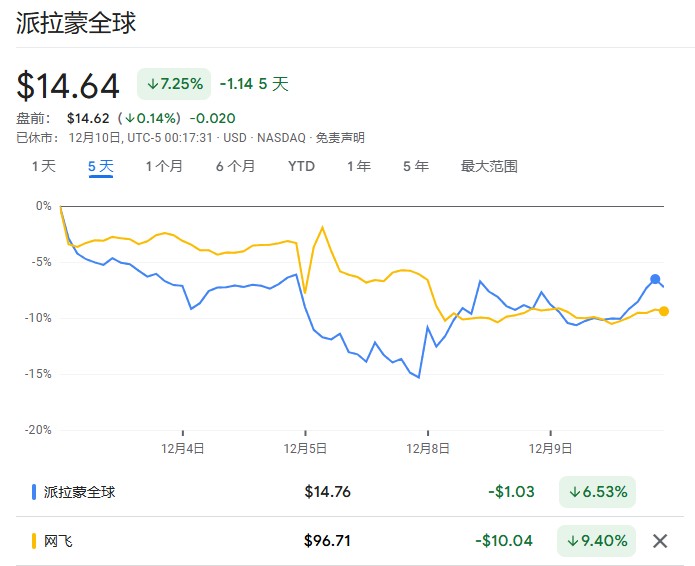
As a result, Netflix's stock price came under pressure this week, while Paramount's stock soared, predicting that Netflix's chances of completing the acquisition have plummeted from 60% to 16%.
Paramount CEO David Ellison directly pitched its all-cash proposal to Warner Bros. shareholders in New York on Tuesday, emphasizing that compared to Netflix's cash-and-stock mixed structure, Paramount's offer provides shareholders with an additional $17.6 billion in cash and carries lower regulatory approval risks. Veteran media investor Mario Gabelli stated after the meeting that if Netflix does not change its bid structure, "my clients might as well accept Paramount's acquisition offer."
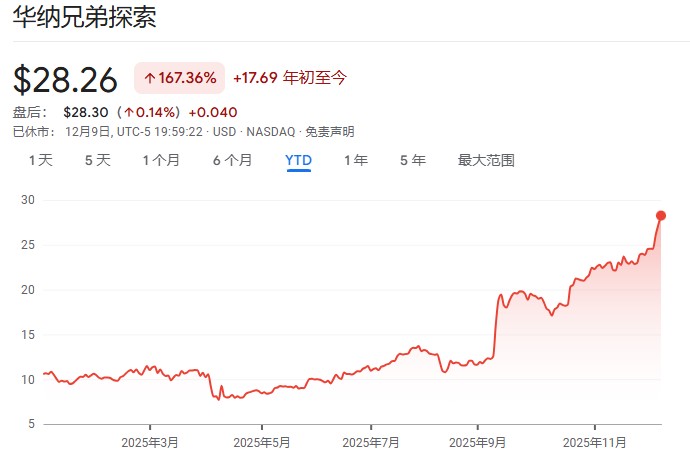
Warner Bros. shareholders now face a critical choice: accept the certainty of cash returns promised by Paramount, or bear the uncertainty brought by stock price fluctuations and lengthy regulatory reviews in Netflix's proposal. This acquisition battle has pushed Warner Bros.' stock price from $12 in September to $28, but the final outcome remains undecided.

Paramount Launches Hostile Takeover Bypass Board
Just after Warner Bros. reached an agreement with Netflix last Friday, Paramount immediately launched a counterattack. Netflix's proposal totals $72 billion, offering $27.75 per share, which includes $23.25 in cash and $4.50 in stock, and only acquires Warner's film production and streaming assets. (Barclays estimates that the total investment for this deal will exceed $80 billion.)
Paramount, on the other hand, proposed an all-cash offer of $30 per share, seeking to acquire all of Warner's assets, including cable networks like CNN and TNT, with a total enterprise value of $108.4 billion. This offer represents a 139% premium over Warner Bros.' undisturbed stock price, gaining support from the Ellison family and private equity firm RedBird Capital, as well as $54 billion in debt commitments from Bank of America, Citigroup, and Apollo Global Management.
In a letter to Warner Bros., Ellison questioned its sale process, accusing the company of "abandoning a fair bidding process and pre-determining Netflix as the winner." He revealed that Paramount submitted six proposals within 12 weeks, but Warner "never engaged in meaningful contact." After Paramount raised its offer to $30 per share, he received no further response from Warner CEO David Zaslav Warner Bros. shareholders must decide whether to accept Paramount's offer by January 8, and the board must respond by December 22. According to regulatory documents, the $30 is not Paramount's "best and final offer," suggesting they are willing to bid higher.
Wall Street's first reaction was very straightforward: Cash is king. This proposal is also extremely attractive to Warner shareholders—there's no need to bet on industry cycles, wait for integration effects, or worry about future market turbulence. Money is just money.
Netflix's offer is not the highest, but the structure is the most appealing:
Partial equity + partial cash, allowing Warner shareholders to share in Netflix's future growth potential
Clear integration logic, with "Harry Potter," "The Lord of the Rings," and "DC" all entering the Netflix IP universe
Huge market value advantage, creating a global content powerhouse upon completion of the deal
But there is one problem—Netflix cannot pass the Washington hurdle. According to the Financial Times, a person close to the regulatory authorities bluntly stated: Netflix swallowing Warner? That would raise red flags at the antitrust hearing.
This is why the industry says: If Netflix wants to win, it can only rely on one method—throwing in more money, enough that Warner shareholders cannot refuse.
Is Trump the Real Disruptor?
On the surface, it seems that Paramount and Netflix are competing, but in reality, the key decision-maker is not in Hollywood, but in the White House.
Behind Paramount stands the world's second-richest person, Oracle co-founder Larry Ellison, who has close ties to the Trump administration. More notably, Trump's son-in-law Jared Kushner is also one of the financial backers of Paramount's acquisition proposal. Trump has publicly praised the acquisition deal that Paramount completed last August, and this political connection provides a natural advantage for their lobbying efforts in Washington.
Trump's chief economic advisor Kevin Hassett further pointed out on Monday that the Department of Justice will review the concentration of the streaming business and the extent to which the merger would reduce competition. He stated, "The president just really wants to ensure a thorough analysis to make sure we make the right choice."
In contrast, although Netflix co-CEO Ted Sarandos recently met with Trump at the White House to lobby, the effect seems limited.
Although Trump referred to Sarandos as a "great guy," he still questioned his acquisition proposal. Netflix has promised to pay Warner Bros. a $5.8 billion breakup fee if the deal fails, one of the largest breakup fees in history, showing its confidence in regulatory approval, but changing political winds are undermining that certainty.
Antitrust Review Becomes the Key to Victory or Defeat
It is worth mentioning that since Trump's election, his team has been re-evaluating antitrust policies, with one clear trend being more leniency towards mergers in the traditional media industry and greater vigilance towards the expansion of tech giants.
Therefore, both acquisition proposals face strict antitrust reviews, but the level of challenge is vastly different. The merger between Netflix and Warner Bros. would create a streaming giant with approximately 430 million subscribers, capturing about 30% of the global streaming market Currently, Netflix has 302 million paid subscribers globally, Warner Bros. has 128 million subscribers, and Paramount has 79 million subscribers. Netflix accounts for 8% of total television usage time, slightly lower than Paramount's 8.2%. However, in the streaming segment, Netflix's dominance is more pronounced.
Ellison views regulatory approval as a core advantage of the Paramount proposal. He stated in an interview, "Allowing the number one streaming service to merge with the number three streaming service is anti-competitive. Our deal is entirely about promoting competition, and merging with Netflix would give them such scale that it would be harmful to Hollywood and consumers."
Netflix is preparing to counter this argument, expecting to assert that market analysis should include other services like YouTube and TikTok, which would significantly narrow its market dominance. Netflix will also argue that over 75% of HBO Max subscribers are already subscribed to Netflix, making them complementary rather than competing products.
EU regulators may also conduct a thorough review of Netflix's proposal. Fordham Law School professor Zephyr Teachout warned, "Concentration in the media sector is particularly dangerous; we are talking about the centralization of cultural lifeblood, which is very dystopian."
Wall Street Votes with Its Feet
The reaction in the secondary market clearly reflects investors' preferences for the two proposals. Paramount's stock surged about 9% on Monday, while Netflix fell about 3.4%. On Tuesday, Paramount continued to rise.

According to Fox Business reporter Charles Gasparino, as Netflix's stock price plummets, the value protection mechanism for the stock portion of its bid faces the risk of failure, meaning Netflix may be forced to raise more cash to maintain the attractiveness of the deal.
Veteran media investor Mario Gabelli stated after attending Paramount's shareholder meeting, "If Netflix does not change the structure of its proposal, it must raise the price." His fund holds approximately $160 million worth of Warner Bros. stock.
Robert Bierig, a portfolio manager at Harris Associates, stated, "When assets like Warner are sold, there is reason to pay a price above their standalone value."
A team of analysts at Barclays questioned why Netflix would spend nearly $80 billion to acquire a traditional production company it has already "disrupted" through its streaming model, pointing out that the expected cost synergies from the deal are only $2 to $3 billion, and the integration process will be unusually slow.
This Hollywood century acquisition battle is far from over. As eMarketer senior analyst Ross Benes said, while Netflix is in a dominant position, it will still face twists and turns before reaching the finish line. If Netflix cannot present a more convincing counterproposal or address regulatory concerns, the scales may tip in favor of Paramount