JP Morgan comments on Sandisk: "Short-term excess profits" do not represent "long-term profitability improvement," and in the medium term, it may return to the historical "boom-bust" pattern

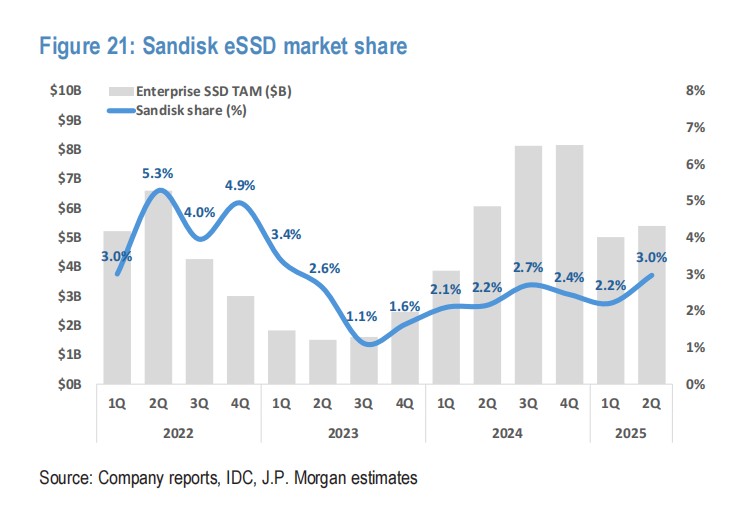
JP Morgan's report pointed out that although SanDisk benefits from the enterprise-level SSD supercycle driven by the AI wave, its market share in this high-growth market is only 2%-3%, placing it in a follower position within the industry. At the same time, the current high-profit environment is essentially a cyclical boom for the industry. As major manufacturers initiate a new round of capacity expansion around 2027, the supply-demand structure will tend to loosen, and the industry may return to a "boom-bust" cycle. Therefore, the company's short-term excess profits are unsustainable, and its long-term profitability is expected to gradually return to historical equilibrium levels
JP Morgan gives SanDisk a "Neutral" rating with a target price of $235. The institution believes that although SanDisk is at a profit peak driven by AI demand and joint venture cost advantages, this more reflects the cyclical prosperity of the industry rather than structural improvement.
According to the Chasing Wind Trading Desk, JP Morgan analyst Harlan Sur stated in a coverage report released on December 8 that the company's long-term profitability faces dual constraints: first, it holds only a 2-3% share in the rapidly growing AI storage market, placing it in a follower position; second, the industry's "boom-bust" cycle is expected to re-emerge after 2027, as new capacity is released, the current supply-demand imbalance and high pricing power will gradually fade.
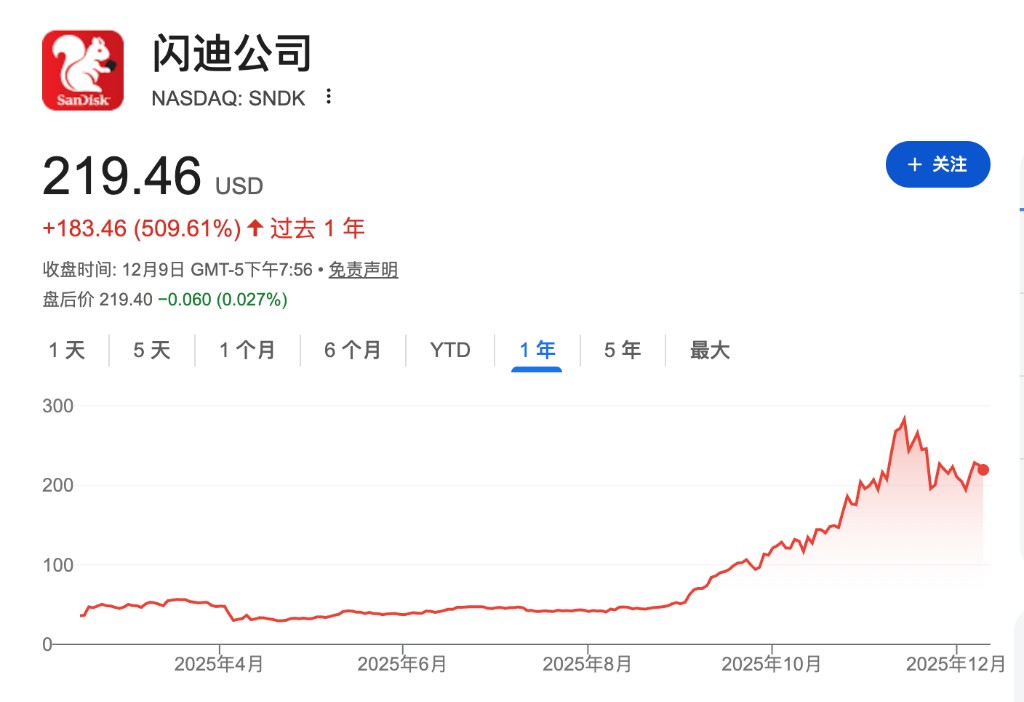
The report points out that considering SanDisk's stock price has risen over 500% year-to-date, the current risks and potential returns are basically matched. Even if significant revenue growth is expected in 2025-2026, with substantial improvements in profitability and cash flow, this reflects a cyclical peak during the industry's upturn phase, which may gradually return to long-term equilibrium levels as supply and demand balance shifts. Therefore, short-term excess profits are unlikely to support long-term valuation increases and may revert to the historical "boom-bust" cycle pattern.
Relative Weakness in the AI Storage Super Cycle
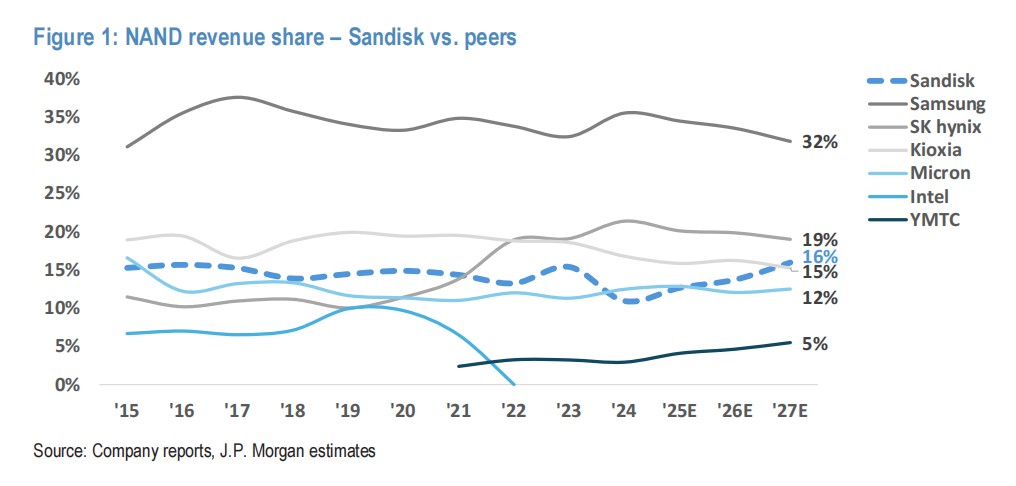
JP Morgan points out that SanDisk is in a relatively weak position in the rapidly growing enterprise SSD market. Although the enterprise SSD market is expected to grow at a compound annual growth rate of 35%, reaching approximately $45 billion by 2027, SanDisk's global market share in this field is only 2-3%, far below its approximately 15% share in the overall NAND flash memory market. 
Analysts believe that SanDisk does benefit from active engagement with the five major hyperscale cloud service providers, with data center business revenue expected to grow nearly threefold in fiscal year 2025. However, compared to leading competitors like Samsung and SK Hynix, SanDisk is still viewed as a follower rather than a leader in the high-performance PCIe 5.0 enterprise SSD sector.
The report emphasizes that while SanDisk has a differentiated advantage in ultra-high-capacity storage through its QLC technology, including a product roadmap for enterprise SSDs of 64TB, 128TB, and even 256TB, these products will not be widely available until late 2026 to early 2027, posing execution and timing risks.
Structural Cost Advantages: The Double-Edged Sword of Kioxia Joint Venture
JP Morgan believes that SanDisk's joint venture Flash Ventures with Kioxia is its core competitive advantage. Through this joint venture, SanDisk can obtain 50% of wafer output at equal costs, leveraging Kioxia's balance sheet, Japanese government subsidies, and shared R&D to reduce capital intensity and achieve superior investment returns.
Analysts point out that this allows SanDisk to mitigate margin erosion during the downturn cycle of the NAND industry while generating relatively better margins during the upturn cycle. Compared to peers that need to fully invest in their own fabs or purchase commercial NAND, SanDisk's model provides a lasting competitive advantage.
However, this joint venture structure also means that SanDisk is largely dependent on Kioxia's health and strategic direction. While this partnership offers advantages in technology roadmaps and cost control, it also limits SanDisk's independent decision-making capabilities in capacity expansion and technological development.
Cyclical Risks: Current Prosperity May Be Unsustainable
JP Morgan emphasizes that the NAND industry has significant cyclical characteristics, and the current supply tightness and high prices are merely an extended peak of this cycle, not a structural reversal. History shows that periods of industry capacity shortages often stimulate aggressive expansions by manufacturers, and once high profits create positive incentives, a new round of capital investment will follow.
The report predicts that around 2027, major suppliers will gradually restart large-scale capacity construction plans and continue to advance higher-layer 3D NAND technology upgrades. This may drive the overall storage capacity (bit supply) growth in the industry to exceed market demand growth.
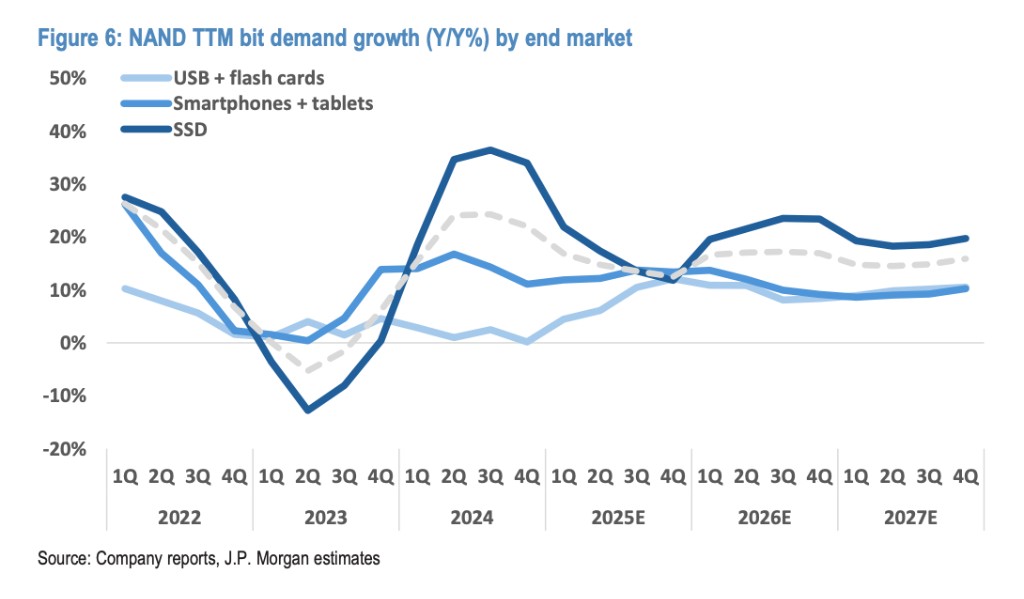
Meanwhile, the growth rate of demand in traditional end markets has significantly slowed: it is expected that from 2025 to 2027, the compound annual growth rate of smartphone storage capacity will be only 10%, far below the 23% compound annual growth rate of the past decade; the compound annual growth rate for client solid-state drives will be 11%, also significantly lagging behind the 35% compound annual growth rate for enterprise solid-state drives. 
In this trend, the gradual release of new capacity combined with the structural slowdown in end demand is expected to gradually erode the industry premium formed due to supply shortages, bringing the market back to its cyclical nature.
Short-term Strength, Long-term Return to Normal
JP Morgan expects SanDisk to achieve revenue growth of 18%/38% in 2025/2026, higher than the overall NAND market growth rates of 2%/27%, pushing its market share to about 16% by the end of 2026, an increase of about 300 basis points from the current approximately 13% share.
However, JP Morgan emphasizes that these strong financial performances mainly reflect cyclical peaks rather than structural improvements in profitability. Analysts suggest that investors should assess the company's value based on the complete cycle, viewing current profitability as peak cycle levels, and assuming that once supply increases and competitive behavior returns to a share defense mode, it will revert to normalized mid-cycle return levels