


The surge in silver prices continues, with New York silver reaching an intraday increase of 6.0%. Is the next stop 100 dollars?

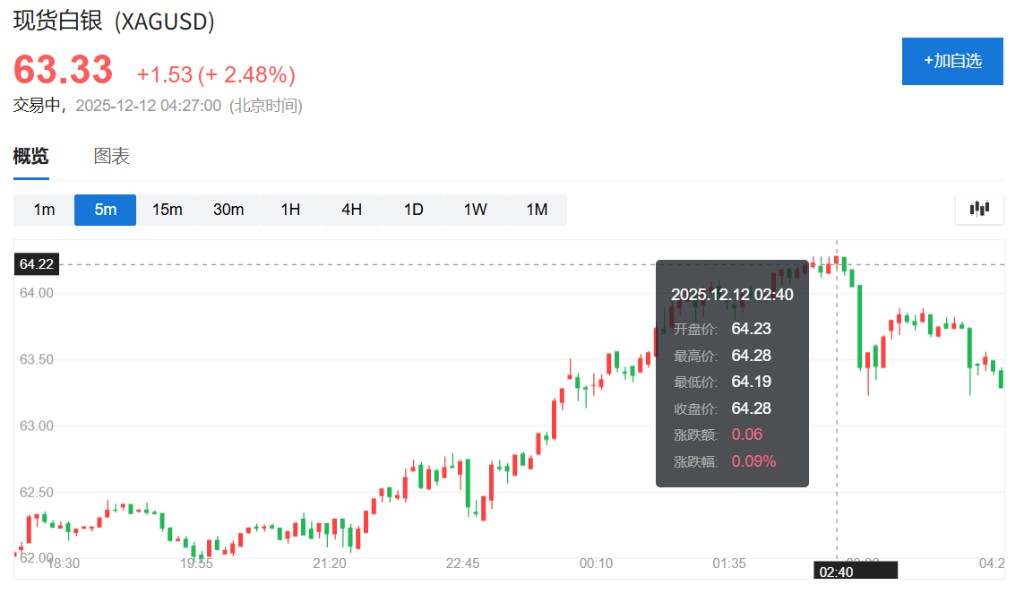
Analysts believe that the supply-demand imbalance and the loose interest rate environment have led to silver's price increase surpassing that of gold this year. On Thursday, the gold-silver ratio reached 67 times, approaching the 2021 low. On Thursday, the spot silver price hit a historical high of $64.28 per ounce, with the New York silver futures rising by 6.0% during the day, closing at $64.69 per ounce
The "crazy" surge of silver continues.
On December 11, silver, an industrial metal and safe-haven asset, extended its strong upward trend, doubling in price since the beginning of the year. The spot silver price reached a historic high of $64.28 per ounce, with New York silver futures rising 6.0% during the day to $64.69 per ounce.
According to the Silver Institute's 2025 World Silver Survey, the global silver market will experience a supply gap for the fifth consecutive year, with an expected shortfall of approximately 117 million ounces (about 3,660 tons) in 2025, one of the largest gaps in recent years.
Mineral supply has stagnated at around 813 million ounces for several years, while industrial demand has reached an all-time high. At the same time, demand for silver in renewable energy, electronics, and green technology has surged, coupled with investors' concerns about inflation and currency fluctuations, making it one of the standout precious metals in 2025.
Wallstreetcn mentioned that several analysts predict silver prices could break the $100 mark next year, although there may be significant volatility in the process. Paul Williams from Solomon Global predicted back in October, when silver was nearing $50, that it would surpass $100 by the end of 2026. Philippe Gijsels, chief strategist at BNP Paribas, also expects silver to enter triple digits by 2026.
However, risks such as slowing industrial demand, interest rate changes, and adjustments on the supply side may suppress the upward trend.
Supply Bottleneck: Mineral Stagnation for Five Years
The silver market is experiencing its longest supply gap cycle in recent years. The Silver Institute's 2025 World Silver Survey indicates that the global silver market will continue to face supply shortages in 2025, marking the fifth consecutive year of structural gaps.
Mineral supply has seen almost no growth. The Institute noted that the total global silver mine supply is expected to remain at around 813 million ounces in 2025, roughly the same as in previous years. While recycled supply can provide some supplementation, it is far from enough to fill the gap.
This persistent imbalance between supply and demand is the main source of upward price pressure. Silver is often a byproduct of mining other metals, so price increases do not always lead to proportional new supply, further exacerbating structural constraints on the supply side.
A recent analyst pointed out that due to the structural gap and rising demand in renewable energy and industrial sectors, silver is "quietly outperforming gold." Elon Gu, a senior analyst at Ultima Markets, noted that since April of this year, the supply-demand imbalance and a loose interest rate environment have allowed silver to surpass gold's gains, with the gold-silver ratio approaching its 2021 low.
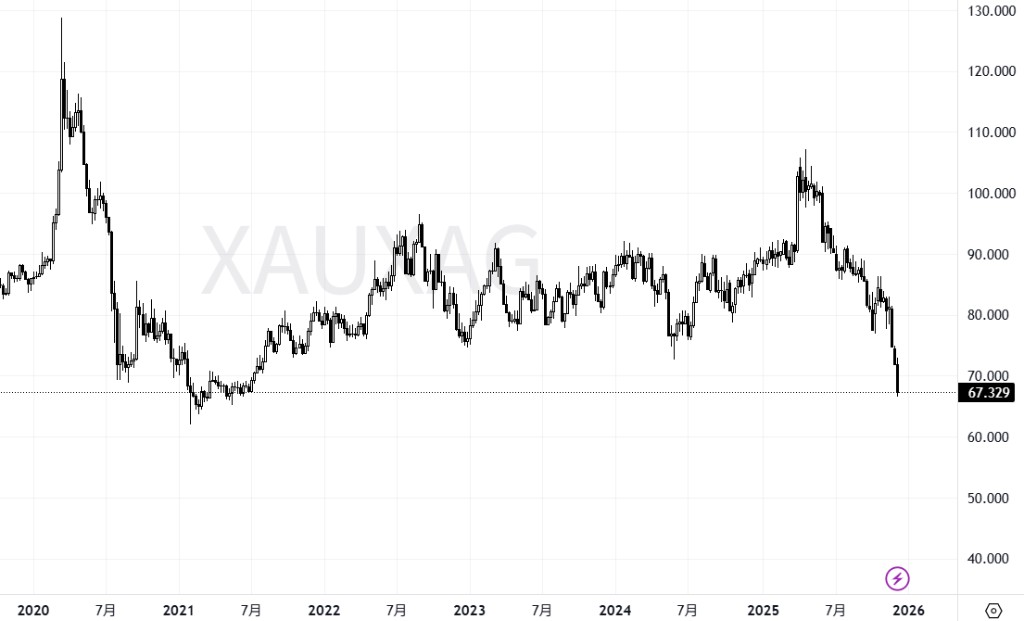 (The gold-silver ratio fell below 70 this week)
Surge in Demand: Dual Drive from Industry and Investment
Silver demand shows a diversified pattern.
Industrial use, particularly in electronics, photovoltaics (solar panels), and green technologies, continues to be a major driving force. According to a 2025 survey report, industrial manufacturing demand has reached a historical high, benefiting from strong demand in the aforementioned sectors.
At the same time, investment demand has also surged significantly. Many investors are reallocating silver, attracted by its dual role as an industrial commodity and a hedging tool, seeking refuge amid macroeconomic uncertainty, inflation concerns, and currency fluctuations.
Compared to early 2025, the value of silver has nearly doubled, with this astonishing return rate surpassing many other precious metals, including gold.
During late November and early December 2025, spot silver traded in the range of over $50, with intraday highs reaching or exceeding $58.84 per ounce. The breakthrough of the $60 mark on December 9 marked a new milestone in silver's upward trend for 2025.
Analyst Outlook: Can Silver Reach $100 in 2026?
Industry forecasting agencies expect the silver supply gap to persist until 2026.
The Silver Institute predicts that the silver gap will continue to exist in 2026. Although some analysts believe the gap may narrow, the ongoing structural imbalance caused by stagnant mining (annual production of about 813 million ounces) and record industrial demand will continue to exert upward pressure on prices.
The growth in demand from green technologies, industrial uses, and investments is driving market rebalancing.
Bank of America has raised its 12-month silver price target to $65 per ounce following a narrowing of real yields and increased ETF inflows.
Major banks are more optimistic, with BNP Paribas believing that as investors seek safe-haven assets amid persistent inflation and geopolitical risks, silver prices could climb to $100 per ounce by the end of 2026.
Market data shows that silver shorts are facing significant losses. The Relative Strength Index (RSI) indicates severe overbought conditions, although not reaching the extreme levels seen in October.
According to LSEG Workspace data, speculators had poorly positioned themselves before the latest surge, while silver volatility has soared since early November, although not reaching the panic levels of the October squeeze.
Additionally, the recent weakening of the dollar has provided extra support for silver's upward trend. Commodity Trading Advisors (CTAs) are also chasing the silver rally, although not as aggressively as in October.
Potential Risks: Challenges Facing the Uptrend
However, the silver market is not without risks.
Industrial demand, particularly in sectors like solar energy, may slow down as companies seek cheaper alternatives or reduce silver usage intensity due to rising prices. In fact, some analysts expect silver demand to decline this year compared to previous years.
If macroeconomic conditions change, investment demand may also weaken, such as with rising interest rates or declining inflation, which could diminish the appeal of non-yielding metals like silver. Market sentiment and speculative capital flows remain key variables. Finally, although the structural supply gap truly exists, the supply-side response (mine expansion, recycling, substitution) may ultimately alleviate the tension. However, since silver mining and processing take time, such adjustments often lag behind price changes.
