Still reeling from last week's financial reports! Broadcom and Oracle continue to decline, and the AI infrastructure sector is still being sold off

Wallstreetcn
2025.12.16 00:31
portai
I'm PortAI, I can summarize articles.

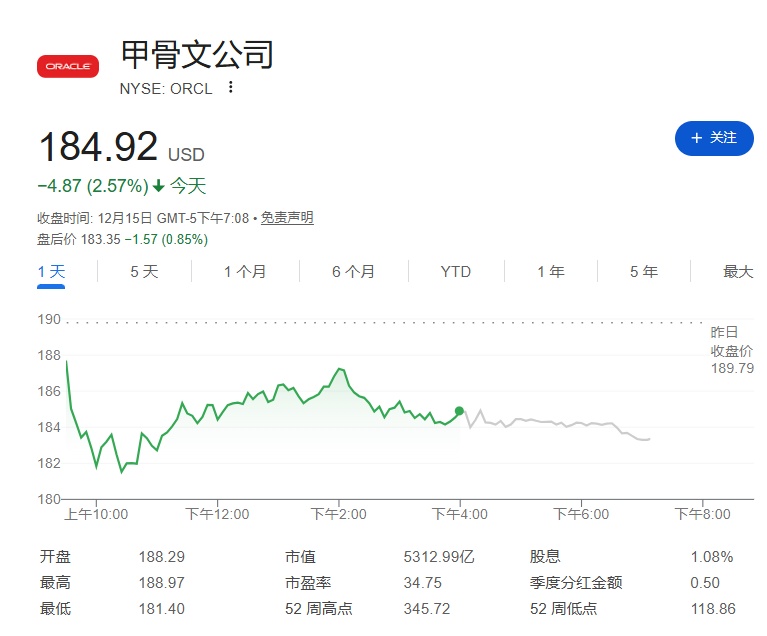
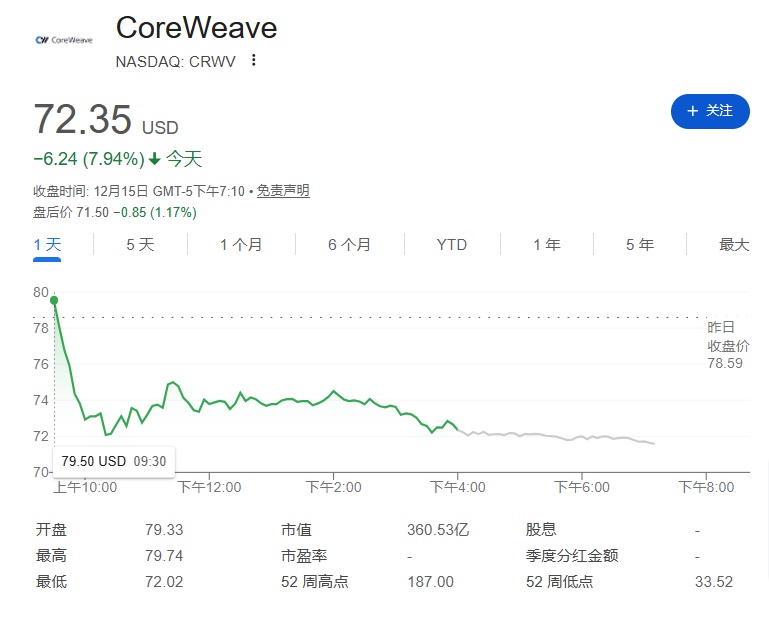
Three companies closely related to AI infrastructure construction—Broadcom, CoreWeave, and Oracle—experienced another decline on Monday after a significant drop last week, highlighting a clear shift in market sentiment towards pessimism. Broadcom's stock price fell 5.6% on Monday, following an 11% plunge on Friday; Oracle dropped 2.7% on Monday, with a cumulative decline of 17% over the past three trading days; CoreWeave's stock price fell about 8% on Monday, after a previous week's drop of 11%

In at least one segment of the artificial intelligence market, market sentiment has clearly turned pessimistic.

Three companies closely related to AI infrastructure construction—Broadcom, CoreWeave, and Oracle—experienced another decline on Monday after a significant drop last week:

Broadcom's stock price fell 5.6% on Monday, following an 11% plunge on Friday, and is currently down 18% from the historical high set last Wednesday.

Oracle's stock dropped 2.7% on Monday, with a cumulative decline of 17% over the past three trading days. Since September 10, the company's market value has evaporated by 46%. On that day, Oracle's stock had its best single-day performance since 1992 due to the disclosure of a massive AI order backlog.

CoreWeave's stock fell about 8% on Monday, having already dropped 11% the previous week, and is down more than 60% from its high in June this year. The company primarily provides cloud computing services around NVIDIA's GPUs.

Although the stock prices of the three companies are still generally up this year (note: CoreWeave went public in March), recent trends indicate that investors are beginning to worry whether such a massive investment can truly yield corresponding returns in the future.

The market reacted poorly last week to the quarterly reports released by Broadcom and Oracle, despite both companies exceeding revenue expectations and providing performance guidance indicating that AI demand is growing rapidly.

Oracle currently relies heavily on the debt market to finance its data center construction, but the company has disclosed little about how it will continue to meet these funding needs in the future. Oracle stated that due to new contracts signed with companies like Meta and NVIDIA, it will raise its capital expenditure for this fiscal year from the previously expected $35 billion to $50 billion.

Meanwhile, Oracle is also significantly increasing its leasing scale. As of November 30, Oracle's total leasing commitments for data center and cloud computing capacity reached $248 billion, with contract terms lasting 15 to 19 years, an increase of 148% since the end of August.

Regarding Broadcom, CEO Hock Tan stated that driven by custom chips and AI network-related semiconductors, the company's AI chip sales are expected to double year-on-year this quarter, reaching $8.2 billion.

However, as the company continues to increase its investment in server rack-related components, investors must accept the reality of pressured profits. Broadcom's CFO Kirsten Spears mentioned during the earnings call that the gross margins of some AI chip systems will decline.

Matt Witheiler, head of late-stage growth investments at Wellington Management, stated on Monday: "For AI investments to continue, the return on investment (ROI) must be real. From what we see currently, that return does exist. The bullish side is that almost every AI company globally is saying, just give me more computing power, and I can generate more revenue."Venture capitalist Tomasz Tunguz, who focuses on enterprise software and AI, wrote on his blog on Monday that Oracle's recent aggressive financing activities have pushed its debt-to-equity ratio to 500%, far exceeding its cloud computing peers. In comparison, this ratio for Amazon, Microsoft, Meta, and Google ranges between 7% and 23%. Another company with a significantly high debt-to-equity ratio is CoreWeave, which stands at approximately 120%