Breakfast | Three major indices closed lower, Tesla rose over 3% against the trend, reaching a new high for the year

Wallstreetcn
2025.12.16 00:13
portai
I'm PortAI, I can summarize articles.

On the eve of the non-farm payroll report, market sentiment is cautious, with the three major indices closing lower. The sell-off of AI concept stocks continues, with Broadcom down over 5%, while Tesla rises against the trend by over 3%, reaching a new high for the year. Most cryptocurrencies are down, with Circle falling nearly 10%. Spot silver rises over 3%, returning to the $64 level

Market Overview

Market sentiment is cautious ahead of the U.S. non-farm payroll report. The sell-off of AI concept stocks continues, with Broadcom and Oracle extending last week's decline, dragging down tech stocks and the overall U.S. stock market.

Tesla rose over 3%, reaching a new high for the year. Broadcom fell 5.7%, with a cumulative drop of 18% over three days, marking the worst three-day performance since March 2020. Coreweave dropped nearly 8%. Circle fell 9.6%. The pioneer of robotic vacuum cleaners, iRobot, announced bankruptcy, plummeting 70%.

Volatility in U.S. Treasuries has dropped to its lowest level since May of last year, with the 10-year Treasury yield slightly down by 0.5 basis points. The dollar has fallen for four consecutive days, with a slight drop of less than 0.1% during the day. The offshore yuan briefly rose above 7.04.

Bitcoin fell over 5% during trading, briefly dropping below $86,000; Ethereum failed to rebound, falling nearly 9% from its daily high, dropping below $3,000.

Gold surged before plummeting, dropping over 1.5% after approaching last Friday's high. Silver outperformed gold, rising 3.7% and returning to the $64 mark.

During the Asian session, AH shares experienced fluctuations and adjustments, with the ChiNext Index down 1.77%. The consumer sector saw a comprehensive surge, the Hang Seng Index fell over 2%, platinum futures hit the limit up, and 30-year government bonds closed down 0.99%.

Important News

The magazine "Qiushi" published an important article by General Secretary Xi Jinping titled "Expanding Domestic Demand is a Strategic Move."

China released November economic data, indicating that industrial production remains resilient, high-tech manufacturing continues to support, consumption fell to a year-low month-on-month, and fixed investment and real estate are under pressure. In November, housing prices in 70 cities: prices in first, second, and third-tier cities fell month-on-month, with a widening year-on-year decline.

China's first batch of L3 autonomous driving has been granted entry permits, marking a new era of "commercial application" for driverless technology.

Hassett's momentum is unstable, with Trump loyalists nominating Walsh as the Federal Reserve Chair, predicting a significant market shift. Hassett has consistently expressed "independence": if selected to lead the Federal Reserve, Trump can offer opinions, but they would have "no weight" on Fed decisions.

Federal Reserve Governor Mulan has again called for accelerated interest rate cuts, asserting that "underlying" inflation is close to target, and mentioned a possible extension of his term. The "third-in-command" of the Federal Reserve: After last week's rate cut, monetary policy is prepared for next year. This year's voting member Collins stated that supporting the rate cut last week was a difficult decision.

An important commodity index rebalancing is imminent, with gold and silver futures facing significant selling pressure.

NVIDIA released the Nemotron 3 open-source model series: hybrid MoE architecture + 1 million token context.

The U.S. government is collaborating with Apple, Microsoft, OpenAI, and other companies to recruit 1,000 engineers to build "technological strength."

The pioneer of robotic vacuum cleaners, iRobot, plummeted over 70%, announcing bankruptcy, with Chinese creditors possibly taking over

Market Closing Report

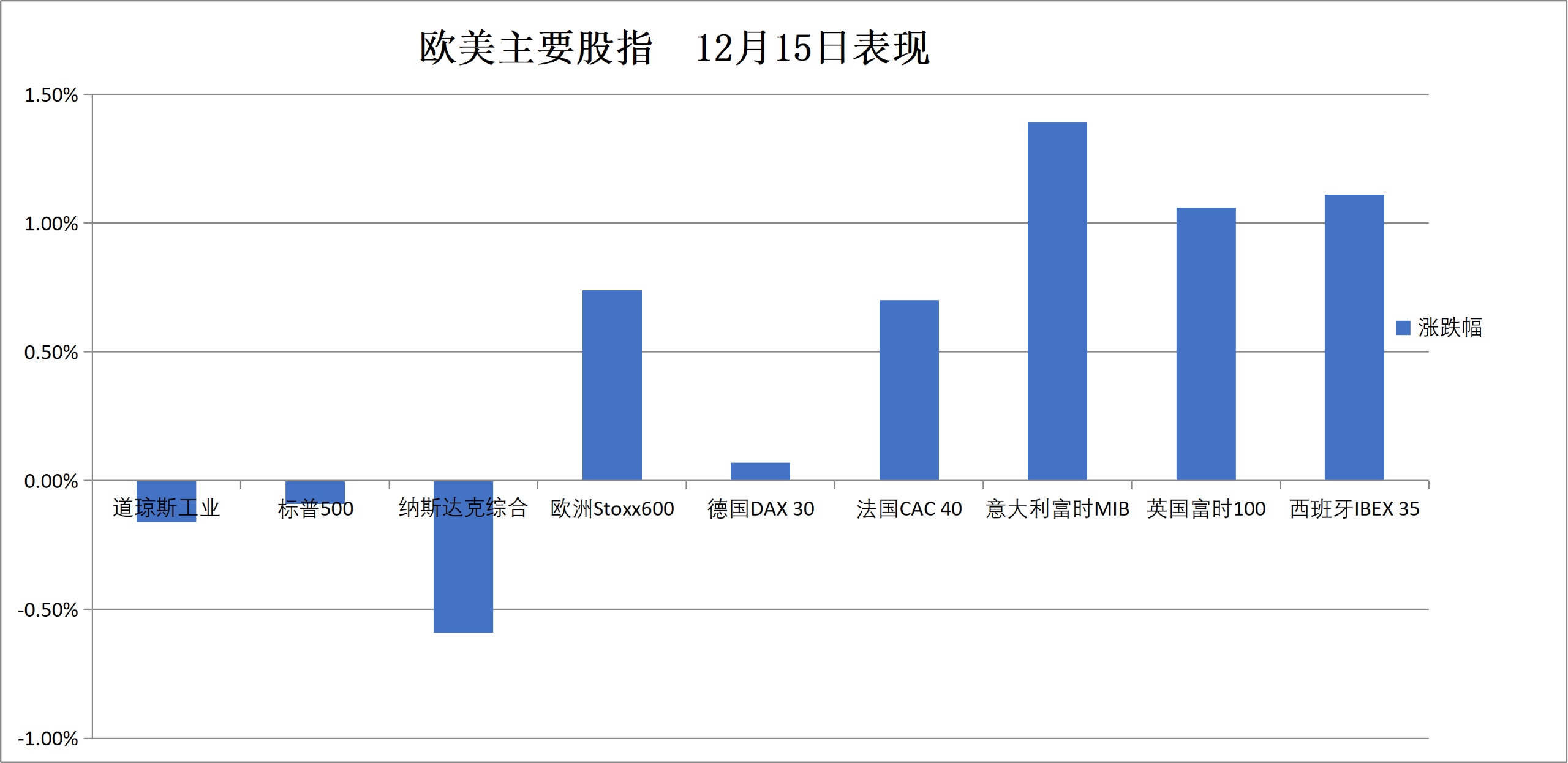
US and European Stock Markets: The S&P 500 index fell by 0.16%, closing at 6816.51 points. The Dow Jones Industrial Average decreased by 0.09%, closing at 48416.56 points. The Nasdaq Composite dropped by 0.59%, closing at 23057.413 points. The European STOXX 600 index rose by 0.74%, closing at 582.54 points.

A-shares: The Shanghai Composite Index closed at 3867.92 points, down 0.55%. The Shenzhen Component Index closed at 13112.09 points, down 1.10%. The ChiNext Index closed at 3137.80 points, down 1.77%.

Bond Market: The yield on the 10-year US Treasury bond fell by 0.78 basis points, closing at 4.1763%. The yield on the 2-year US Treasury bond fell by 2.07 basis points, closing at 3.5015%.

Commodities: COMEX gold futures rose by 0.12%, closing at $4333.30 per ounce. COMEX silver futures rose by 3.25%, closing at $64.020 per ounce. WTI January crude oil futures closed down 1.08%, at $56.82 per barrel. Brent February crude oil futures closed down 0.92%, at $60.56 per barrel.

News Highlights

Global Highlights

"Qiushi" magazine publishes an important article by General Secretary Xi Jinping titled "Expanding Domestic Demand is a Strategic Move". According to Xinhua News Agency, the article emphasizes the need to firmly implement the strategic plan for expanding domestic demand, quickly form a complete domestic demand system, and focus on expanding consumption demand supported by income, investment demand with reasonable returns, and financial demand constrained by principal and debt. Consumption is an important engine for China's economic growth, and the fundamental way to expand consumption is to promote employment, improve social security, optimize income distribution structure, expand the middle-income group, and solidly advance common prosperity. A long-term mechanism for expanding residents' consumption should be established and improved, ensuring that residents have stable income to consume, can consume without worries, and have a strong sense of gain in a favorable consumption environment. The investment expansion mechanism should be improved, effective investment space should be expanded, new infrastructure construction should be moderately advanced, investment in high-tech industries and strategic emerging industries should be expanded, and the vitality of private investment should be continuously stimulated.

China releases November economic data, showing resilience in industrial production, continued support from high-tech manufacturing, a drop in consumption to a year-low, and pressure on fixed asset investment and real estate.

  • In November, the value added of industrial enterprises above designated size increased by 4.8% year-on-year, with crude steel production declining again, new energy vehicles growing by 17%, and high-tech manufacturing growing rapidly. In November, the value added of equipment manufacturing increased by 7.7% year-on-year, and the value added of high-tech manufacturing increased by 8.4%, both exceeding the overall industrial value added growth by 2.9 and 3.6 percentage points, respectivelyIn addition, crude steel production in November decreased by 10.9% year-on-year to 69.87 million tons, marking six consecutive months of decline. The production of new energy vehicles reached 1.841 million units, an increase of 17.0%.
  • In November, the year-on-year growth rate of retail sales of consumer goods dropped to 1.3%, with a widening decline in retail sales of automobiles and home appliances. The total retail sales of household appliances and audio-visual equipment, furniture, and building and decoration materials fell by 19.4%, 3.8%, and 17%, respectively, compared to previous declines of 14.6%, an increase of 9.6%, and a decline of 8.3%. Retail sales of automobiles declined by 8.3%, compared to a previous decline of 6.6%; retail sales of gold, silver, and jewelry increased by 8.5%, compared to a previous increase of 37.6%.
  • From January to November, fixed asset investment decreased by 2.6% year-on-year and 1.03% month-on-month. In the secondary industry, industrial investment increased by 4.0% year-on-year. Among them, mining investment grew by 4.0%, manufacturing investment increased by 1.9%, and investment in the production and supply of electricity, heat, gas, and water rose by 10.7%.
  • From January to November, national real estate development investment was 7.8591 trillion yuan, a year-on-year decrease of 15.9%; the sales area of newly built commercial housing was 787.02 million square meters, a year-on-year decrease of 7.8%; among them, the sales area of residential properties decreased by 8.1%. By the end of November, the area of unsold commercial housing was 753.06 million square meters, a decrease of 3.01 million square meters compared to the end of October, and the funds in place for real estate development enterprises amounted to 851.45 billion yuan, a year-on-year decrease of 11.9%. The real estate development prosperity index continues to decline.
  • In November, the housing prices in 70 cities: housing prices in first, second, and third-tier cities generally declined month-on-month, with a widening year-on-year decline. The sales prices of commercial residential properties in various tier cities generally decreased month-on-month, with a widening year-on-year decline. Among them, the year-on-year decline in second-hand residential sales prices in first, second, and third-tier cities expanded, with first-tier cities experiencing a month-on-month decline, second-tier cities remaining flat compared to last month, and third-tier cities narrowing their decline; in terms of new commercial residential sales prices, first-tier cities saw an expanded month-on-month decline, while second and third-tier cities narrowed their declines, with the year-on-year decline in commercial residential sales prices in first, second, and third-tier cities widening.
  • Guo Lei from GF Securities stated that the economic data for November shows that the supply side is generally stable, industrial production remains resilient, and high-tech manufacturing continues to provide support; however, domestic demand is significantly weak, with consumption falling to a low point for the year, and fixed investment and real estate under deep pressure. Exports remain resilient, becoming a major highlight. Under the constraints of a high base, the necessity to stabilize short-term growth momentum and further strengthen policies is increasing
  • The Guolian Minsheng Macro Tao Chuan team believes that the economy in November shows a pattern of "industrial stability, with investment and consumption slowing." Consumption remains under pressure in the short term due to the advance of major promotions and weakened subsidies. In contrast, on the investment side, although real estate continues to be a drag, the manufacturing sector has shown a turning point, and infrastructure is expected to stop declining with policy support. Under the policy guidance of "promoting investment to stabilize," investment is likely to stabilize ahead of consumption, becoming the main support for the economy's "good start" in the first quarter of next year.

China's first batch of L3 autonomous driving vehicle products has obtained access permits. On the 15th, the Ministry of Industry and Information Technology officially announced the first batch of conditional access permits for L3 autonomous driving vehicles in China. Among them, a model from Changan can achieve single-lane autonomous driving at a maximum speed of 50 km/h on designated congested roads in Chongqing, while a model from BAIC Jihe can achieve similar functionality at a maximum speed of 80 km/h on designated highways in Beijing, marking a new phase for L3 autonomous driving in China to enter designated areas for road testing.

  • The first batch of L3 autonomous driving has obtained access permits, marking a new era of "commercial application" for China's driverless vehicles. The Ministry of Industry and Information Technology has issued the first batch of L3 autonomous driving access permits, allowing Changan and BAIC Jihe to conduct commercial pilot projects on limited roads, marking the formal transition of China's autonomous driving from the testing phase to a new cycle of deliverable, operable, and accountable operations. With the definition of responsibilities in place and regulatory loops formed, L3 commercialization opens up realistic pathways for the industrial chain and Robotaxi scaling.

Hassett's momentum is unstable, Trump's confidant nominates Waller as Fed Chair, predicting a market upheaval. Hassett, once seen by the market as a nearly certain candidate for Fed Chair, is facing resistance from high-level individuals who can directly advise President Trump. There are concerns that Hassett's relationship with Trump is too close; if the bond market perceives him as too obedient to Trump, it may "rebel" after a period of time. Hassett currently has a 51% probability in the prediction market, significantly lower than the over 80% earlier this month. Data from Polymarket predicts that Waller has a greater chance than Hassett of becoming the next Fed Chair.

Hassett continuously expresses "independence": If selected to lead the Fed, Trump can offer opinions, but they carry "no weight" in Fed decisions. Hassett explicitly refuted the notion that the president's opinions hold equal weight to those of FOMC voting members. He stated that policymakers can freely reject the president's opinions and "vote differently." Hassett said, "No, no, he will have no weight at all.""However, if his opinion is good and data-driven, then his opinion is very important."

Federal Reserve Governor Milan calls for faster rate cuts again, asserting that "underlying" inflation is close to target, stating that his term may be extended. Milan believes that "false inflation" distorts Fed decision-making, stating that the current inflation exceeding the target does not reflect the underlying supply and demand dynamics of the economy, and that housing inflation is a lagging indicator, warning that maintaining unnecessary tightening will lead to unemployment; he may remain a governor after his term ends at the end of January until a new governor is appointed to replace him. Meanwhile, the Fed's "third-in-command" Williams stated that after last week's rate cut, monetary policy is "prepared" for next year; this year's voting member Collins said that supporting the rate cut last week was a difficult decision because she still worries about inflation.

Important commodity index rebalancing is imminent, gold and silver futures will face huge selling pressure! JP Morgan warns that due to outperforming the market for three consecutive years, gold and silver have significantly exceeded their weight in the Bloomberg Commodity Index (BCOM). During the index rebalancing in January 2026, passive funds will be forced to conduct "technical sell-offs." It is expected that the futures selling volume will account for 9% and 3% of the total holdings of silver and gold, respectively.

Nvidia releases Nemotron 3 open-source model series: Hybrid MoE architecture + 1 million token context. Nvidia released the latest version of the open-source artificial intelligence model series Nemotron 3 on Monday, along with supporting data and tools, aimed at providing transparent, efficient, and customizable AI development capabilities for various industries. Nemotron 3 includes three versions: Nano, Super, and Ultra, introducing a groundbreaking hybrid latent mixture of experts (MoE) architecture that significantly enhances inference efficiency and reduces operating costs. On Monday, Nvidia's stock opened up nearly 1.7% and closed up 0.7%.

The U.S. government collaborates with Apple, Microsoft, OpenAI, and other companies to recruit 1,000 engineers to build a "Tech Force". The Trump administration launched a talent program called "Tech Force," which will focus on artificial intelligence infrastructure and other technology projects. At the same time, a two-way talent flow mechanism will be established, allowing participants to receive priority employment from cooperating companies after completing a two-year term, and companies can also nominate employees to participate in government rotations. Annual salary ranges from $150,000 to $200,000.

Still reeling from last week's earnings reports! Broadcom and Oracle continue to decline, AI infrastructure sector faces continued sell-off. Three companies closely related to AI infrastructure—Broadcom, CoreWeave, and Oracle—experienced significant declines after last week's sharp drop,This Monday saw another decline, highlighting that market sentiment has clearly turned pessimistic. Broadcom's stock price fell by 5.6% on Monday, following an 11% plunge on Friday; Oracle dropped 2.7% on Monday, with a cumulative decline of 17% over the past three trading days; CoreWeave's stock price fell about 8% on Monday, having already dropped 11% the previous week.

Tesla surged over 3% to reach a new high for the year, AI narrative drives the rally. Analysts believe that Tesla's fundamental business is no longer the main driver, and the stock price trading is more based on investor sentiment, with the AI narrative supporting its trillion-dollar valuation. On Monday, Tesla continued its rally from last Friday, ultimately closing up 3.56%, reaching a new high for the year. During the session, the stock price peaked at $481.77, briefly surpassing the closing record of $479.86 set on December 17, 2024.

iRobot, the pioneer of robotic vacuums, plummets over 70% and announces bankruptcy, with Chinese creditors possibly taking over. iRobot will complete its restructuring through bankruptcy protection, with Shenzhen Yinxing Intelligent Technology acquiring 100% of the equity and canceling the company's $190 million debt. In recent years, iRobot has faced competition from Chinese rivals, tariffs from the Trump administration, and setbacks from failed acquisition deals with Amazon, causing its market value to shrink from a peak of $3.56 billion in 2021 to less than $38 million during Monday's trading session.

Important Research Reports

Morgan Stanley's heavyweight robotics yearbook: AI moves towards physicality, robots usher in a Cambrian explosion, with China's leading advantage evident; Robots "escape the factory," training focus shifts from "brain" to "body," edge computing power expected to explode

  • Morgan Stanley predicts that by 2050, global sales of robotic hardware will surge from about $100 billion in 2025 to $25 trillion, with sales volume increasing from 24 million units to 1.4 billion units. China shows a clear leading advantage, particularly in policy, control of key materials, and manufacturing capabilities, with an expected 26% share of global robot sales by 2050.
  • Morgan Stanley points out that AI robots are moving from factories to complex real-world scenarios, with training focus shifting from optimizing AI models to executing physical actions. Robots need to collect real physical data through remote operation, simulated training, and video learning. As application scenarios expand, the demand for real-time decision-making becomes prominent, making edge computing power a necessity. The firm predicts that by 2050, 1.4 billion robots will be sold globally, driving the demand for edge AI computing power to reach the equivalent of millions of B200 chips, reshaping the distribution pattern of global computing infrastructureDomestic Macro

CSRC: Strengthen the reputation management responsibilities of industry institutions and listed companies, and continue to tell the "stock market narrative". Wu Qing, Secretary of the Party Committee and Chairman of the China Securities Regulatory Commission (CSRC), presided over an expanded meeting of the Party Committee, proposing to strengthen policy interpretation and expectation guidance, respond promptly to market concerns, and reinforce the reputation management responsibilities of industry institutions and listed companies, continuing to tell the "stock market narrative." The implementation of deepening the GEM reform has been initiated, and the "1+6" reform measures of the Sci-Tech Innovation Board will be accelerated. Promote the high-quality development of the private equity fund industry, expedite the pilot of commercial real estate REITs, and study the introduction of new key futures varieties. Adhere to supporting the strong and limiting the weak, and accelerate the creation of first-class investment banks and investment institutions. Steadily expand institutional opening-up, optimize the Qualified Foreign Institutional Investor (QFII) system and the mutual access mechanism, and improve the quality and efficiency of overseas listing filings.

Overseas Macro

New York State manufacturing activity unexpectedly shrinks, orders stagnate, price index hits lowest since January. Due to stagnant orders and a decline in shipments, manufacturing activity in New York State unexpectedly shrank in December after two months of steady growth, recording -3.9, significantly below expectations. However, there are also bright spots in the data: the outlook index rose to its highest level since the beginning of this year, the price paid index fell to its lowest since January, and employment indicators slightly rebounded.

Market underestimates the probability of a rate cut in January? This week's employment and CPI data will be key variables. UBS believes that Powell has not ruled out the possibility of a rate cut in January, as his concerns about the labor market have surpassed his concerns about rising inflation. If this week's data confirms continued weakness in the labor market (the key is whether the unemployment rate rises to 4.5%) while inflationary pressures remain controllable, the FOMC may reconsider a more accommodative policy stance. The non-farm payroll reports for October and November will be released on Tuesday, and CPI data will be announced on Thursday.

The number of rate cuts by the Fed in 2026, will Tuesday's non-farm payrolls be decisive? Divergence in the bond market intensifies. The U.S. Treasury market shows increasing divergence regarding the rate cut path in 2026. Optimists believe that Tuesday's non-farm payrolls could become "the most important data point of next year," determining the pace of rate cuts and validating expectations for early easing; the cautious side argues that the data may be distorted, and true pricing should wait for early next year's data and the Fed meeting on January 28, with high short-term volatility risks in the bond market.

The Fed's RMP + U.S. Treasury bond issuance management ≈ QE?. Bank of America believes that the Fed's Reserve Management Purchase (RMP) plan, combined with adjustments in the Treasury's bond issuance strategy, forms a "quasi-QE combination." The Fed is expected to purchase $560 billion in short-term bonds in 2026, while the Treasury simultaneously increases the issuance of $500 billion in short-term bonds and reduces the issuance of $600 billion in medium- and long-term bondsThis shift in supply structure will effectively reduce market duration risk and is expected to exert a downward pressure of 20-30 basis points on the 10-year U.S. Treasury yield.

If AI fails to deliver on productivity promises, will the U.S. face a more devastating "destructive depression" than in 2008? The U.S. government is betting on AI productivity improvements to resolve the imbalance of federal debt and welfare commitments. Prominent investment institutions warn that if AI fails to deliver, the U.S. will fall into a deep recession and sovereign debt crisis, with destruction far exceeding that of the 2008 financial crisis. As the government, acting as the last buyer, finds itself in trouble, the entire financial system will lose its safety net.

Japanese manufacturing confidence hits a four-year high, adding "weight" to December rate hike. The business confidence of large Japanese manufacturing companies rose to a four-year high in December, coupled with strong capital expenditure and stable inflation expectations, clearing a key obstacle for the Bank of Japan to raise interest rates this week. The market has highly priced in the central bank raising the benchmark interest rate to 0.75%, and this rate hike is seen as a continuation of the monetary policy normalization process rather than an endpoint.

The Bank of Japan may start ETF reductions as early as January, selling only 330 billion yen per year. According to reports, the Bank of Japan may start reducing its 83 trillion yen ETF holdings as early as January next year, selling only 330 billion yen per year, which would take 112 years to fully liquidate. The central bank is adopting an extremely slow pace to avoid shocking the market, referencing the experience of bank stock sell-offs in the 2000s, and may pause if a financial crisis occurs. Analysts believe that moderate reductions will have limited impact on the market, reflecting the central bank's strategy of trading time for stability.

Overseas Companies

SpaceX begins preparations for next year's "super IPO," initiating investment bank selection, with Google as a key shareholder? Although the IPO has not been finalized, SpaceX's valuation is rapidly climbing in secondary market trading, with estimates pushing it to around $800 billion, doubling from $400 billion this summer. As an early investor holding SpaceX shares since 2015, Google's parent company Alphabet is expected to record substantial paper gains due to SpaceX's new round of valuation surge.

Led by Musk, Bezos, and Jensen Huang, the U.S. tech circle suddenly sees a flood of discussions on space data centers. In response to the surge in AI computing power demand and ground power bottlenecks, U.S. tech giants are collectively turning to the concept of "space data centers." Google plans to launch prototype test satellites in 2027, and companies like SpaceX and Blue Origin are also accelerating their layouts. This trend is being driven by declining launch costs and a reshaping of capital narratives, pushing the field from technological vision into early validation stagesBear Market Cohesion Embraces Investors! Crypto Tycoons Gather in Abu Dhabi, Claiming UAE is the "New Wall Street of Crypto". Amidst the sluggish crypto market, industry leaders are pinning their hopes on UAE investors. During multiple meetings last week, from the Bitcoin Middle East Conference to the "Whale Exclusive" beach club night banquet, and champagne parties on super yachts, cryptocurrency executives actively sought to engage with representatives from UAE sovereign wealth funds. The UAE's interest in cryptocurrencies continues to rise, with Binance receiving full approval from Abu Dhabi's financial regulatory authority last week to operate a global trading platform from the region.

The Three Stocks that Suffered the Most in the 2022 US Stock Bear Market—Carvana, Robinhood, Coinbase, Have All Entered the S&P 500 This Year. Carvana, Robinhood, and Coinbase, which were on the brink of bankruptcy in 2022, achieved full profitability in 2024 through stringent cost-cutting and strategic transformation, subsequently being included in the S&P 500 index, marking an astonishing turnaround from market outcasts to core assets. This shift not only signifies a mainstream recognition of their business models but also resulted in heavy losses for investors who had previously shorted these stocks, highlighting the dramatic rotations in the market during macroeconomic cycles.

SK Hynix Internal Analysis Exposed: DRAM Shortage Will Last Until 2028! SK Hynix predicts that the AI server market share will soar from 38% in 2025 to 53% in 2030, driving a robust 24% growth in DRAM demand. On the supply side, the fundamental limitation lies in the lengthy capacity expansion cycle. It takes several years for new DRAM factories to be built and reach normal operations, with new capacity expected to be released only by 2028. This expectation is more severe than UBS's forecast (which anticipates supply tightness to last until Q1 2027), raising the question of whether this indicates a price increase cycle or an overshoot.

OpenAI Strikes Again, Luring Albert Lee from Google to Lead Company Development. Albert Lee previously oversaw company development for Google Cloud and Google DeepMind, participating in several high-profile acquisitions by Google, including the $32 billion acquisition of cloud security startup Wiz announced by Google in March this year.

Industry/Concept

  1. Lithium Iron Phosphate | According to Sina Finance, since early December, the new energy industry chain has experienced price fluctuations, with lithium iron phosphate cathode material manufacturers initiating a collective price increase. From various sources, it has been learned that as 2026 approaches, several lithium iron phosphate companies have begun discussions with customers regarding prices, with some leading companies proposing price increases concentrated between 2,000 yuan and 3,000 yuan per tonSome companies have even stated that the trend of price increases is expected to continue until the fourth quarter of 2026.

Commentary: Miao Min, a lithium battery analyst at Zhuochuang Information, stated that current orders for lithium iron phosphate companies have been scheduled until the first quarter of 2026, with some companies even suspending order acceptance. The supply-demand structure for high-end products such as high-pressure solid continues to be tight. On the supply side, the release of new production capacity will take some time, while low-end capacity is being rapidly cleared, unable to quickly fill the market gap. At the same time, there is further room for price increases for lithium iron phosphate in 2026, with cost support still in place, thus the trend of processing fees maintaining an upward trajectory is quite evident in the short term.

  1. Carbon Fiber | According to Shanghai Securities News, global carbon fiber industry giant Toray Industries announced that starting from January 2026, the global prices of its flagship product—carbon fiber "Torayca" and its intermediate products (such as prepregs, fabrics, and laminates) will be raised by 10% to 20%.

Commentary: Research institutions believe that the carbon fiber industry is currently in a recovery phase at the bottom of the cycle. After a period of deep price adjustments and capacity clearance, the supply-demand pattern of the industry is gradually recovering, and prices have shown signs of stabilizing. With the "anti-involution" policy promoting supply contraction and increased concentration in the industry, the industry's prosperity is expected to continue improving. On the demand side, there is a structural recovery, with strong growth in the wind power sector, continuous recovery in aerospace, and the low-altitude economy (such as eVTOL and drones) becoming a new growth point.

  1. Autonomous Driving | On December 15, the Ministry of Industry and Information Technology officially announced the first batch of L3-level conditional autonomous driving vehicle access permits in China. Two models, adapted for urban congestion and highway sections, will conduct road trials in designated areas of Beijing and Chongqing, marking a key step for L3-level autonomous driving in China from the testing phase to commercial application. The two models announced are the Changan SC7000AAARBEV pure electric sedan and the ZEEKR BJ7001A61NBEV pure electric sedan.

Commentary: CITIC Securities believes that high-level autonomous driving is showing positive changes in multiple scenarios, with leading companies accelerating commercialization. Nationwide, the development of related products and technologies is leading in super first-tier cities, and the supporting policies and incentive measures in these cities are key driving factors. Since the beginning of this year, both Beijing and Guangzhou have implemented new policies encouraging innovative applications of high-level autonomous driving. With the gradual improvement of relevant laws and regulations for autonomous driving, various links in the industrial chain are expected to accelerate technological research and product launch, benefiting the automotive intelligence industry chain.

  1. Manganese | According to Global Ferroalloy Network, the domestic electrolytic manganese market price has surged recently. On the 15th, the manganese triangle price range was quoted at 15,600-15,800 yuan/ton, an increase of 300 yuan compared to the previous trading day; the prices in Jiangsu, Zhejiang, and Shanghai were 16,000-16,200 yuan/ton, also up by 300 yuan. The mainstream retail spot price with tax was mostly quoted at 15,800-16,000 yuan/ton, with some traders quoting as high as over 16,000 yuan/ton. The cumulative increase over the past month has reached 1,800 yuan/ton. Last weekend, the new round of bidding for spherical electrolytic manganese and low-carbon metallic manganese spheres by steel mills set the tax-inclusive factory acceptance price at 16,600 yuan/ton, an increase of 2,102-2,420 yuan/ton compared to the previous round, supporting market price stability and further heightening optimistic sentimentCommentary: Shanghai Nonferrous Metals Analysis pointed out that under the resonance of multiple favorable factors such as rising raw material costs, supply contraction, stocking up during the peak demand season, and rigid procurement by steel mills, the current spot circulation volume in the electrolytic manganese market continues to sharply decrease. The pattern of supply not meeting demand and difficulty in sourcing goods is becoming increasingly clear, directly driving spot prices to rise significantly. Looking ahead, the tight balance between supply and demand in the industry is unlikely to ease in the short term. Coupled with positive market sentiment and low spot inventory, electrolytic manganese prices are likely to continue their upward trend. Although there may be a willingness to lower prices downstream, it is expected to be difficult to hinder the upward price trend under the strong supply-demand fundamentals and cost support, and the market as a whole will maintain a strong operational pattern.

  2. Brain-Computer Interface | According to a report from Xinhua News Agency on the 15th, Beijing recently held the "2026 China Academy of Information and Communications Technology Deep Observation Report Conference." The conference mentioned that by 2025, China's brain-computer interface industry will achieve significant development results, making important progress in core technology breakthroughs, multi-scenario application implementation, and industrial ecosystem construction, laying a solid foundation for the large-scale development and high-quality upgrade of the industry.

Commentary: Analysts believe that currently, China's brain-computer interface technology has made gratifying breakthroughs in core components and decoding algorithms. For instance, the number of channels for several self-developed brain-computer interface chips and implanted electrodes continues to increase, and stability is gradually improving; the rapid application of artificial intelligence technology has greatly enhanced decoding accuracy, successfully achieving the decoding of fine motor intentions of subjects, etc. In terms of scenario implementation, invasive brain-computer interfaces are centered around medical scenarios, with clinical cases reaching dozens. Non-invasive brain-computer interfaces focus on consumer and industrial fields, with several non-invasive complete devices already achieving mass production, gradually building a multi-scenario application ecosystem, paving the way for future large-scale commercialization. The continuous breakthroughs in "core components + algorithms" are driving the rapid improvement of China's brain-computer interface technology industrial chain. Key components are independently controllable, providing support for the large-scale clinical and consumer-grade product implementation.

  1. Outsourcing Services | The Ministry of Commerce and six other departments issued the "Action Plan for Promoting High-Quality Development of Service Outsourcing," which mentions that by 2030, a number of internationally competitive leading service outsourcing enterprises will be cultivated, a number of service outsourcing aggregation areas with strong innovation capabilities and obvious characteristic advantages will be built, and the level of digitalization, intelligence, greening, and integration of service outsourcing will be significantly improved, greatly increasing employment numbers, making service outsourcing an important component of innovating and enhancing service trade and innovating and developing digital trade.

Commentary: Analysts believe that service outsourcing is an important component of service trade and a significant means of realizing digital trade, playing an important role in constructing a new development pattern. Emerging technologies such as cloud computing, big data, artificial intelligence, and the Internet of Things will be deeply integrated into the service outsourcing industry, promoting the industry's transformation towards digitalization, intelligence, and high-end development. In particular, the application of generative AI technology will greatly enhance the efficiency and quality of service outsourcing, driving the industry towards intelligent and platform-based transformation. Traditional service models will upgrade to the "industry empowerment + ecological service" model, and service outsourcing will shift from being a mere "cost center" to a "value center." The service outsourcing industry will achieve high-quality development under digital transformation, technological innovation, and policy support, becoming an important engine for promoting service trade and digital trade7. Elderly Care | Recently, the National Health Commission, the National Medical Insurance Administration, the National Administration of Traditional Chinese Medicine, and the National Center for Disease Control and Prevention jointly issued the "Action Plan for Enhancing Elderly Care Service Capacity." The plan proposes that by 2027, there will be an effective expansion of elderly care resources, establishing a service system that covers institutions, communities, and home-based care. The service capacity of practitioners will be significantly improved, and the continuity, accessibility, and standardization of services will continue to enhance, effectively increasing the sense of gain for the elderly.

Commentary: Analysis indicates that China has entered a stage of deep aging society. In light of the accelerated arrival of an aging society and the rising awareness of retirement among the middle class, China's elderly care industry has been growing steadily in recent years. It is predicted that by 2025, the population aged 60 and above in China will exceed 300 million, accounting for over 21% of the total population. By 2029, the market size is expected to surpass 19.5 trillion yuan. The silver economy has become one of the most certain emerging industries. From the perspective of service models, home-based care and community care will become mainstream. With the advancement of technology, smart elderly care will become an important trend. The application of high-tech products such as smart wearable devices, AI health monitoring systems, VR technology, and elderly care robots will significantly enhance the precision and technological level of elderly care services. At the same time, the integrated medical and elderly care model will also be further promoted, achieving a deep integration of medical resources and elderly care services.

Today's News Preview

U.S. November Non-Farm Employment.

Manufacturing, Services, and Composite PMI for the U.S., Eurozone, UK, and Japan in December.

U.S. October Retail Sales.