


Building small nuclear reactors on Earth is "extremely foolish," says Musk: The sun is the "free ultimate nuclear reactor."

"The sun is a gigantic, free fusion reactor in the sky. It is extremely foolish to create miniature fusion reactors on Earth." Musk is urging companies to stop wasting funds on "trivial" reactor projects. His viewpoint stands in stark contrast to the investment frenzy in Silicon Valley, where tech giants like NVIDIA and Google are leveraging AI technology to accelerate nuclear fusion research. Meanwhile, the U.S. government has proposed a roadmap to integrate fusion energy into the grid by the early 2030s
Elon Musk publicly condemned efforts to build small nuclear fusion reactors on Earth as "extremely foolish" and reiterated his support for solar energy, stating that the sun is the ultimate "free fusion reactor."
On December 15, Musk, in a post on the X platform, did not hide his disdain for Earth’s nuclear fusion projects. He wrote: “The sun is a gigantic, free fusion reactor in the sky. Creating mini fusion reactors on Earth is extremely foolish.”
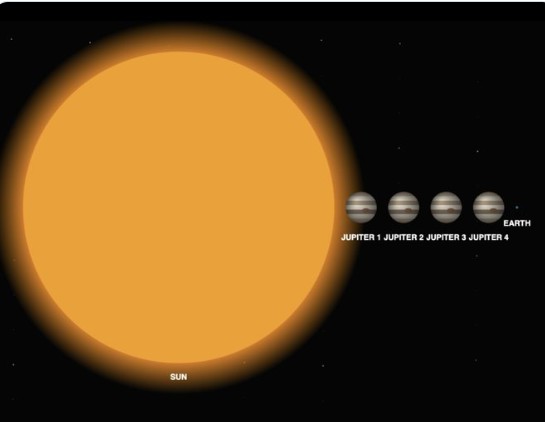
To emphasize the unparalleled energy advantage of the sun, he used a striking metaphor: “Even if you burned 4 Jupiters, the sun would still account for 100% of all energy output in the solar system, rounded!”
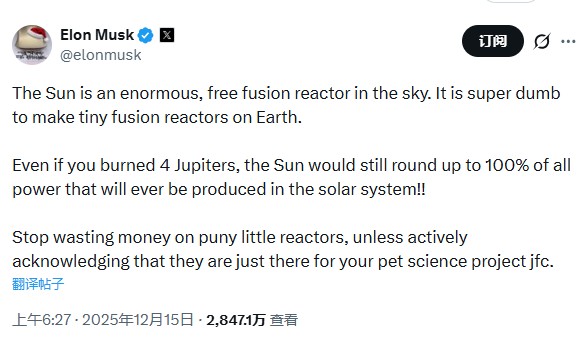
Musk even directly called out companies involved in the clean energy debate, urging them to stop investing. He stated: “Stop wasting money on these trivial small reactors unless you admit they are just your pet science projects.” This statement defined nuclear fusion research on Earth as an expensive and unnecessary "sideline."
Another user on X provided a scale reference for Musk's metaphor: the sun's mass accounts for 99.86% of the entire solar system. He noted, “Compared to Earth, Jupiter's volume is 11 times that of Earth. Compared to Jupiter, the sun's volume is 10 times that of Jupiter. The sun contains 99.86% of all mass in our solar system.”
Musk's statement stands in stark contrast to the growing investment frenzy in nuclear fusion in Silicon Valley. At the time he made his comments, tech giants including NVIDIA and Google were heavily betting on nuclear fusion energy through direct investments and technological collaborations, hoping to leverage artificial intelligence to accelerate its commercialization.
Silicon Valley's "Reverse Bet": AI Accelerates the Fusion Race
In stark contrast to Musk's views, other major players in Silicon Valley are betting real money on fusion technology. Recently, Commonwealth Fusion Systems announced it secured $863 million in investments, with chip giant NVIDIA being one of its investors.
Artificial intelligence is seen as a key variable to accelerate this process. Google’s AI company DeepMind has announced a partnership with Commonwealth Fusion Systems, aiming to use AI technology to accelerate the development of commercial fusion energy solutions that can be integrated into the power grid. The fusion team at Google DeepMind stated in a blog post: “Our AI expertise combined with CFS's cutting-edge hardware is an ideal partnership to drive foundational discoveries in fusion energy.” U.S. Secretary of Energy Chris Wright also emphasized the potential of AI, stating that it "has great promise in facilitating breakthroughs in areas such as materials research, stellar nuclear fusion digital simulation, and molecular dynamics." He added, "The catalytic role of artificial intelligence cannot be overstated."
In addition to commercial investments, nuclear fusion technology has also received significant official support. The International Atomic Energy Agency (IAEA) recently pointed out that "global fusion projects aimed at unlocking safe, abundant, and zero-carbon energy have now entered a critical phase."
In the United States, government-level initiatives are more specific. Reports indicate that the U.S. Department of Energy released a new "Fusion Roadmap" in October, outlining how to incorporate such energy into the U.S. energy structure by the early 2030s. Jean Paul Allain, Deputy Director of the Department's Fusion Energy Sciences Office, stated, "Fusion is real, imminent, and ready for collaborative action."
