


Tesla's stock price hits a new high! Investors are excited about Robotaxi, but Goldman Sachs asks: Can it make money?

Tesla's stock price reached an all-time high due to its key progress in the Robotaxi field, but Goldman Sachs raised critical questions in a recent report: How will this highly anticipated technology achieve scalable expansion and ultimately profitability in an increasingly competitive landscape? The firm remains cautious about Tesla's ability to convert its technological advantages into substantial profits, maintaining a "Neutral" rating and a target price of $400, below the current market price
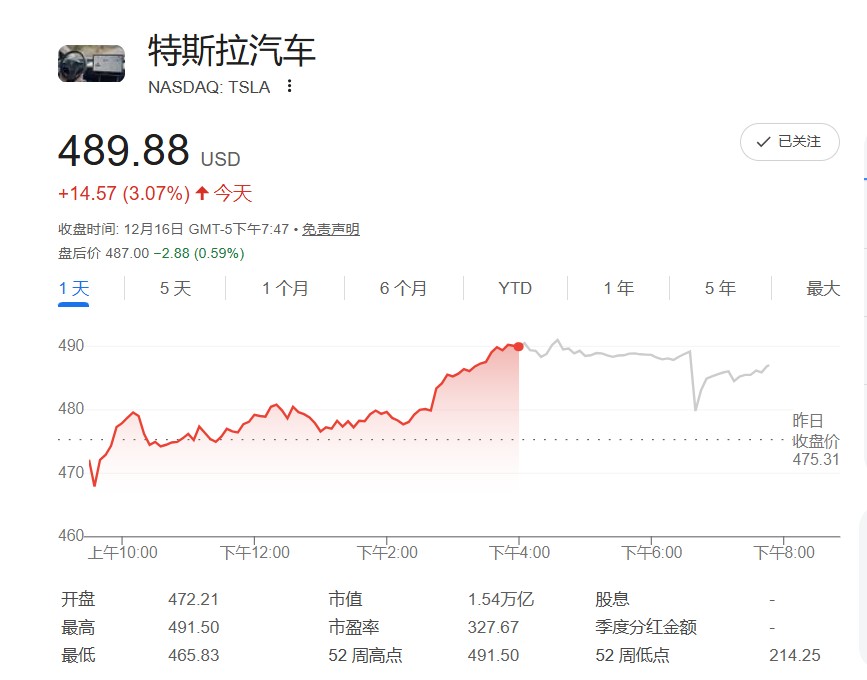
Tesla's stock price rose 3.07% on Monday, closing at $489.88, surpassing the previous all-time closing high of $479.86 set on December 17, 2024. The direct catalyst for this milestone was the revelation by Tesla executives on social platform X that the company launched its unmanned Robotaxi testing in Austin over the weekend.
However, according to reports from the Wind Trading Desk, Goldman Sachs stated in a research report released on December 15 that the removal of safety drivers in testing indicates that Tesla is making progress in autonomous driving technology. However, the team led by analyst Mark Delaney believes that the market's focus will shift from technological breakthroughs to two core challenges of commercialization: the speed of scaling up and profitability.
Although investors are excited about the commercial prospects of Robotaxi and view it as a key driver of Tesla's future profits, Goldman Sachs maintains a "neutral" rating on the stock and sets a target price below the current stock price. The report emphasizes that intense market competition, especially from rivals like Waymo and Uber, may limit Tesla's profitability in this field.
Scaling and Profitability as New Focus
Goldman Sachs clearly pointed out in the report that as Tesla begins unmanned Robotaxi testing in Austin, the focus of investors should shift. The report argues that from a technical perspective, how quickly it can expand its operational design domain (ODD), which refers to the service area and applicable weather conditions, will be crucial.
Interestingly, Goldman Sachs believes that the cost of the vehicle itself is a "relatively less important" variable for profitability. This is because, in commercial operations, autonomous driving operators have the potential to absorb this expense by spreading vehicle costs over a large number of miles driven. Therefore, the ability to quickly occupy and operate in more areas is more critical than the cost per vehicle.
Intensifying Competitive Landscape
Goldman Sachs believes that a key factor determining whether autonomous driving technology can be successfully monetized is competition. The report notes that competition in the Robotaxi sector is already fierce, both in the U.S. and international markets.
According to Goldman Sachs' forecasts, the U.S. autonomous ride-hailing market is expected to reach approximately $7 billion by 2030. However, there are many contenders for this market share. The report details the expansion plans of major competitors:
-
Uber expects to cover at least 10 cities with its autonomous driving services by the end of 2026.
-
Waymo is already operating in several cities, including Phoenix and San Francisco, and plans to deploy in more cities such as Los Angeles, Atlanta, and Houston.
-
Lyft is also making inroads in cities like Nashville and Dallas.
Additionally, the report cites research from its team indicating that the Chinese market is also experiencing rapid growth, driven by lower costs, an expanding fleet size, and increased public acceptance For example, Pony.ai expects its fleet size to reach 1,000 vehicles by the end of 2025, with a target of over 3,000 vehicles by the end of 2026; WeRide also plans to have 1,000 Robotaxis by the end of 2025. All of this indicates that Tesla will face a global market share battle.
FSD software continues to improve, but there may still be distance to "let go"
In addition to the dedicated Robotaxi business, Tesla's fully autonomous driving (FSD) software technology aimed at consumers is also continuously advancing. A Goldman Sachs report mentioned that Tesla's CEO recently stated on the social platform X that the current FSD v14.2.1 version allows drivers to send text messages while the system is activated under certain traffic conditions.
Nevertheless, Goldman Sachs emphasized that in these situations, drivers still need to be responsible for the vehicle, meaning that the system is essentially still at L2 level assisted driving. The report also mentioned that version v14.3 "may" be the version where customers can "sleep while driving."
According to crowdsourced data, the v14.x version can currently achieve approximately 2,000-3,000 miles (about 3,200-4,800 kilometers) of driving without "serious" takeovers, but Goldman Sachs also cautiously pointed out that this data has limitations, such as control over data collection and unclear classification of some takeover reasons.
Huge uncertainty in profit prospects
Goldman Sachs expects that autonomous driving technology (including consumer-facing FSD and Robotaxi) will be a key driver of Tesla's future profit growth, but there is significant uncertainty regarding its profit prospects.
The report provided a broad forecast range for earnings per share (EPS) in 2030: from about $2-3 to $20. Among them, revenue from Robotaxi-related businesses is expected to be between $2 billion and $10 billion. Goldman Sachs anticipates that by 2030, the U.S. autonomous ride-hailing market will reach approximately $7 billion.
Goldman Sachs believes that a "middle-ground" scenario is for Tesla to achieve an EPS of about $7-9. This requires the company to gain a balanced market share in the electric vehicle and Robotaxi sectors, while its high-margin software/FSD business can achieve considerable penetration in its own fleet.
Maintaining a neutral rating, target price implies downside potential
Based on a cautious assessment of the competitive landscape and profitability, Goldman Sachs maintains a "neutral" rating on Tesla stock and sets a 12-month target price of $400. Based on the stock price at the time of the report's release, this target price implies approximately 15.8% downside potential.
Goldman Sachs analysts summarized in the report: "We continue to expect that autonomous driving will be a key driver of Tesla's growth, but we expect competition to limit the level of improvement in its profitability."
The report also listed potential risks. Downside risks include vehicle price reductions exceeding expectations, intensified competition in electric vehicles, and delays in products or technologies such as FSD. Upside risks include faster-than-expected adoption of electric vehicles, Tesla launching new products earlier, or AI products such as FSD, Optimus robots, and Robotaxis having commercial impacts sooner or on a larger scale The above wonderful content comes from Chasing Wind Trading Platform.
For more detailed interpretations, including real-time interpretations, frontline research, and other content, please join the【 Chasing Wind Trading Platform ▪ Annual Membership】.
