Challenge OpenAI for months! Google releases the more efficient Gemini 3 Flash, the default model for apps, enhancing search capabilities upon launch

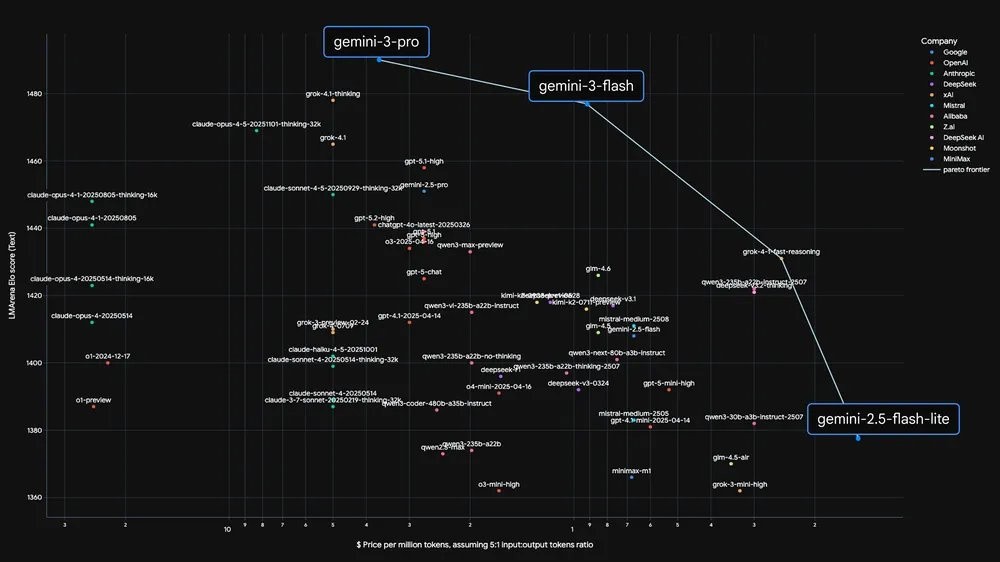
In the benchmark test assessing agent programming capabilities, Gemini 3 Flash scored even higher than Gemini 3 Pro. The new Flash model maintains reasoning capabilities close to Gemini 3 Pro while achieving a speed three times that of Gemini 2.5 Pro, at only a quarter of the cost of Gemini 3 Pro; priced at $0.50 per million input tokens and $3.00 per million output tokens, slightly higher than Gemini 2.5 Flash, but outperforms 2.5 Pro with a speed three times that of the latter
Just a month after the release of its strongest model Gemini 3 Pro, Google has further challenged OpenAI.
On Wednesday, the 17th of Eastern Time, Google announced the launch of a new member of the Gemini 3 family, Flash. This new model, which focuses on speed and efficiency, replaced Gemini 2.5 Flash as the default model for the Gemini App on the day of its release and simultaneously became the default driving system for Google Search's AI mode, marking a significant market offensive as Google converts its distribution advantage in the AI race into tangible results.

Google is delivering its strongest AI capabilities to millions of users worldwide at a lower cost and faster speed. Tulsee Doshi, Senior Director of Product Management for Gemini at Google DeepMind, stated that Google positions Flash as a workhorse model. This model maintains reasoning capabilities close to Gemini 3 Pro while achieving a running speed three times that of Gemini 2.5 Pro, with costs only a quarter of Gemini 3 Pro.
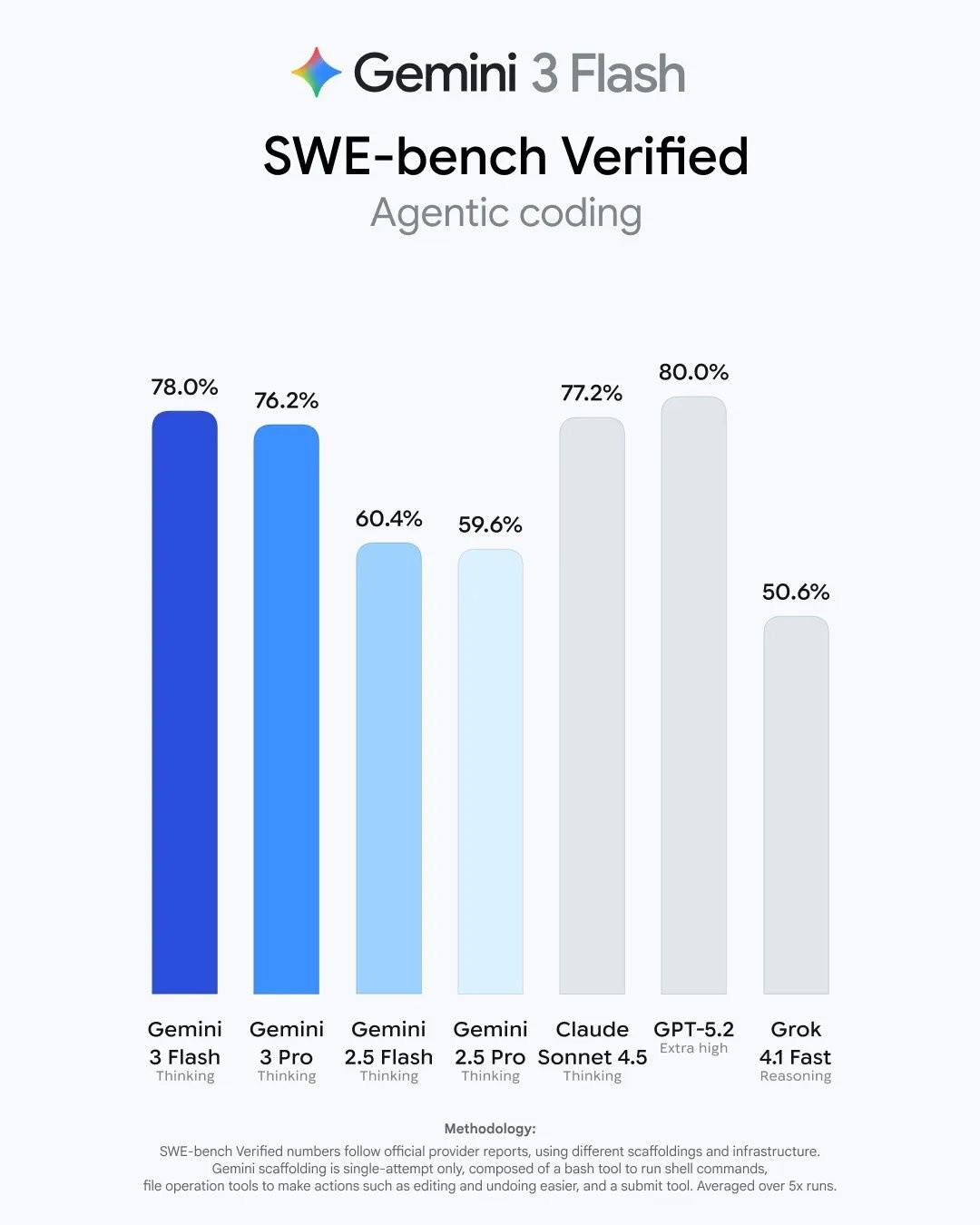
Doshi said, "We were excited about the market response when we released Pro a few weeks ago. With Gemini 3 Flash, we are bringing this model to everyone." He also mentioned that the benchmark test for evaluating agent programming capabilities, SWE-bench Verified, shows that Gemini 3 Flash outperforms Gemini 3 Pro.
The release of Gemini 3 Flash comes as competition between Google and OpenAI intensifies. The Gemini 3 series released by Google on November 18 prompted OpenAI to sound the alarm earlier this month. Last week, reports indicated that Gemini's growth rates in weekly mobile app downloads, monthly active users, and global website visits have recently surpassed those of ChatGPT, although ChatGPT still dominated 90% of mobile conversations in late November. Last week, OpenAI launched GPT-5.2 in response, and this Tuesday released a new image generation model GPT Image 1.5.
Industry insiders believe that this increasingly binary competition between Google and OpenAI in the AI race has significant implications not only for artificial intelligence (AI) technology itself but also for the entire economy. This ongoing release cycle reflects the brutal competitive nature at the forefront of model competition, where any company can quickly fall from leader to also-ran Although OpenAI has a first-mover advantage, Gemini has broader distribution capabilities in search and Google's core applications. Since the release of Gemini 3, the number of tokens processed by the Google API has exceeded 1 trillion daily.
Performance on Par with Flagship Models, Programming Ability Surpasses Peers
Gemini 3 Flash has demonstrated performance close to or even surpassing larger models in multiple benchmark tests.
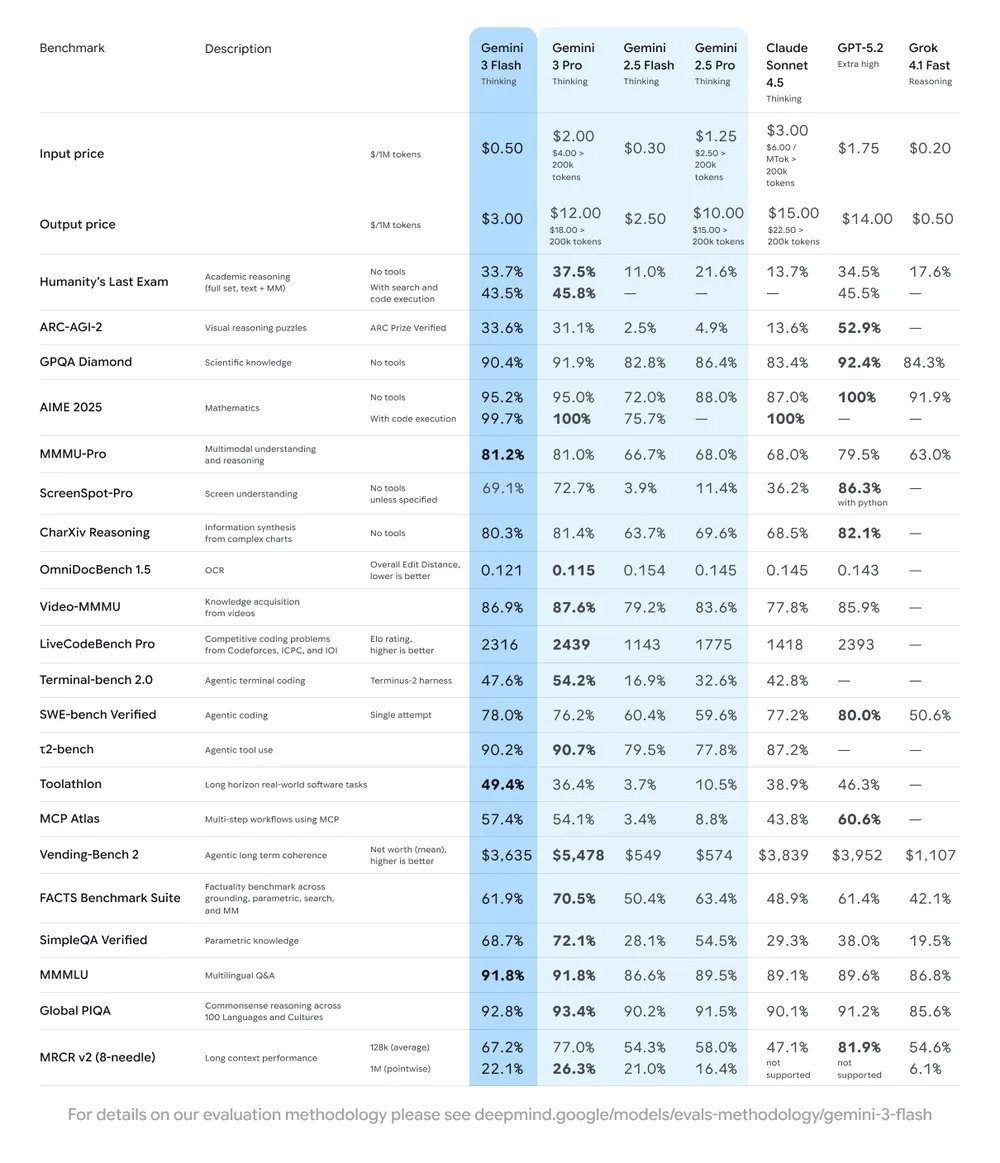
In the SWE-bench Verified benchmark test, Gemini 3 Flash achieved a solution rate of 78%, second only to GPT-5.2's 80%, surpassing not only the Gemini 2.5 series but also its peer, Gemini 3 Pro, which had an accuracy rate of 76.2%.

In the cross-domain expertise test, Humanity's Last Exam, Gemini 3 Flash scored 33.7% without using tools, which, although lower than Gemini 3 Pro's 37.5% and GPT-5.2's 34.5%, far exceeded Gemini 2.5 Flash's 11%.
In the multimodal reasoning benchmark MMMU-Pro, Gemini 3 Flash scored 81.2%, surpassing all competitors, including Gemini 2.5 and Gemini 3 Pro.
In the doctoral-level reasoning and knowledge benchmark GPQA Diamond, Gemini 3 Flash scored 90.4%. Although lower than GPT-5.2's 92.4% and Gemini 3 Pro's 91.9%, other competitors scored below 90%.

Doshi stated to the media: "We position Flash more like an old workhorse model. From the perspective of input and output pricing, Flash is a much cheaper product in terms of cost, which actually allows many companies to perform bulk tasks."
Significant Cost Advantage, Speed is Three Times that of 2.5 Pro
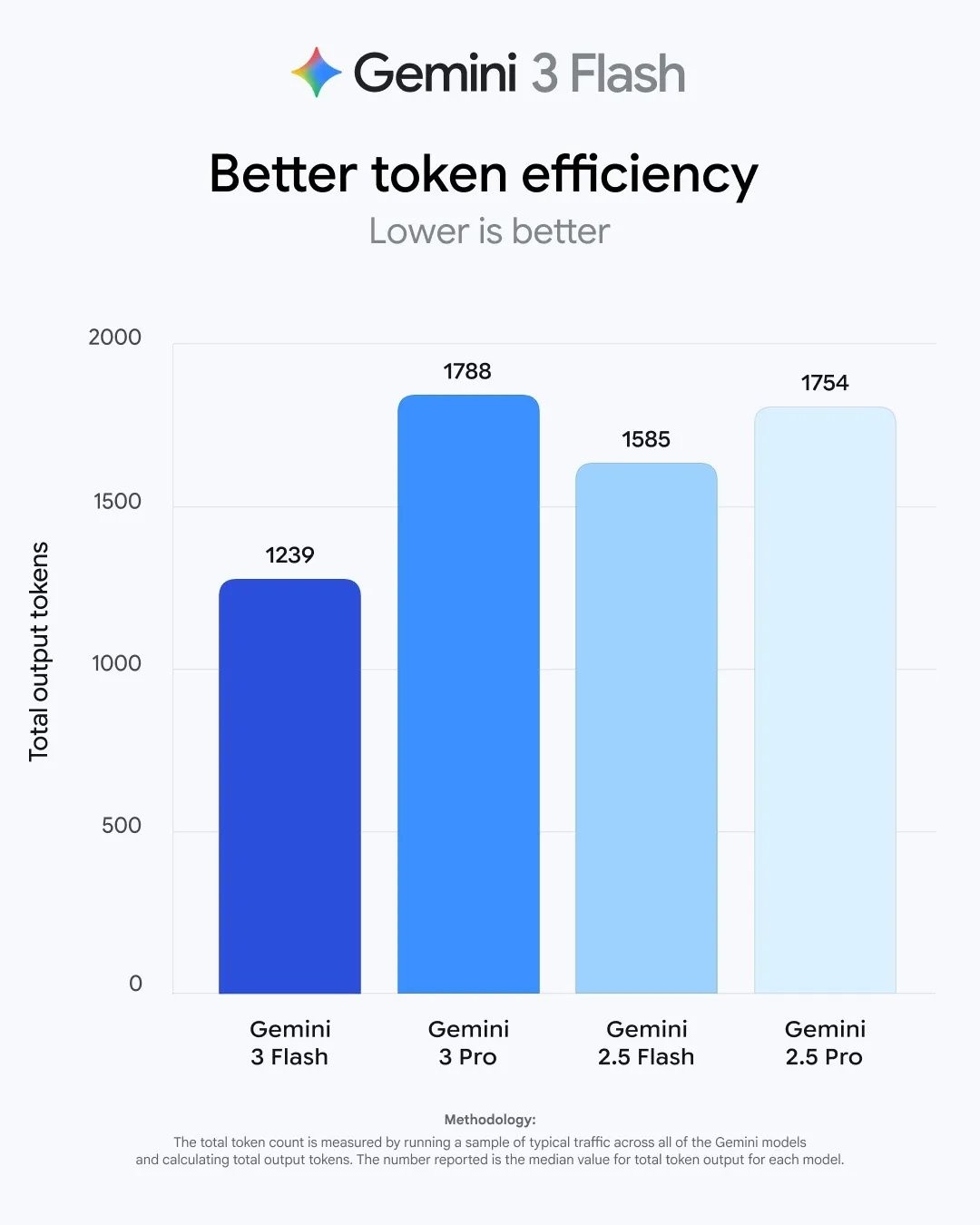
Gemini 3 Flash is priced at $0.50 per million input tokens and $3.00 per million output tokens. Although slightly higher than Gemini 2.5 Flash's $0.30 per million input tokens and $2.50 per million output tokens, Google stated that the new generation Flash model outperforms Gemini 2.5 Pro while achieving speeds three times that of the latter More importantly, when handling tasks that require thinking, the average number of tokens used by Gemini 3 Flash is 30% less than that of 2.5 Pro. This means that although the unit price is slightly higher, the overall token consumption for users in certain tasks will decrease, ultimately achieving cost savings.

Gemini 3 Flash is also equipped with standard context caching capabilities in the Gemini API and Vertex AI platform, enabling up to 90% cost reduction in applications where token reuse reaches a certain threshold.
Google emphasizes that Gemini 3 Flash can support AI agent workflows at less than a quarter of the cost of Gemini 3 Pro while providing higher rate limits.

Comprehensive Product Line Coverage: Bridgewater, Salesforce, and other enterprise clients have already "tasted" it
Gemini 3 Flash is now available to global users, covering three major groups: consumers, developers, and enterprises. In the Gemini App, all global users can use this model for free, and users can still switch to the Pro model from the model selector for handling mathematical and programming problems. In the AI mode of Google Search, Gemini 3 Flash becomes the default model, and users in the United States can also access the more powerful Gemini 3 Pro for deep thinking tasks.
For developers, the model has been made available in preview versions through Google AI Studio, Gemini CLI, Vertex AI, and the newly released code tool Antigravity last month, and can also be accessed through development tools like Android Studio. Enterprise users can obtain services through Vertex AI and Gemini Enterprise.
Google introduced that several well-known companies have begun using Gemini 3 Flash for business transformation and have received enthusiastic feedback, recognizing the model's reasoning speed, efficiency, and reasoning capabilities, believing it is on par with larger models.
According to Google, Denis Shiryaev, head of the AI tools ecosystem at software development company JetBrains, stated: "In our JetBrains AI Chat and Junie agent programming assessments, Gemini 3 Flash provides quality close to Gemini 3 Pro, while significantly reducing reasoning latency and costs."
Jasjeet Sekhon, head of AIA Labs and chief scientist at the world's largest hedge fund Bridgewater Associates, stated: "At Bridgewater, we need models that can handle large amounts of unstructured multimodal datasets without sacrificing conceptual understanding." Gemini 3 Flash is the first model to provide Pro-level depth at the speed and scale required by our workflows."
Companies such as Salesforce, Workday, Figma, Cursor, Harvey, and Latitude have also adopted the model. Robby Stein, Vice President of Google Search Products, stated that the new Flash model will help users perform more refined searches with multiple conditions, such as finding evening activities suitable for parents with toddlers