


Fu Peng: The key to determining the rise and fall of global assets in 2026—Is there really a car running on the AI "highway"?

Fu Peng stated that the current core contradiction in the AI industry is "the road is built, waiting for the car to run." The upstream computing power infrastructure investment has been basically completed, and 2026 will enter the "year of falsification" for whether downstream enterprise-level applications can land and realize profits. If AI is falsified, global stock markets will face severe fluctuations. Currently, the U.S. stock market (especially the AI sector) is the core of global "productivity," and the volatility of major global assets is highly bound to it. If AI is ultimately proven to be a bubble, not only the U.S. stock market but also global stock markets, including Japan and Europe, will collapse, "this is a grasshopper on the same rope."
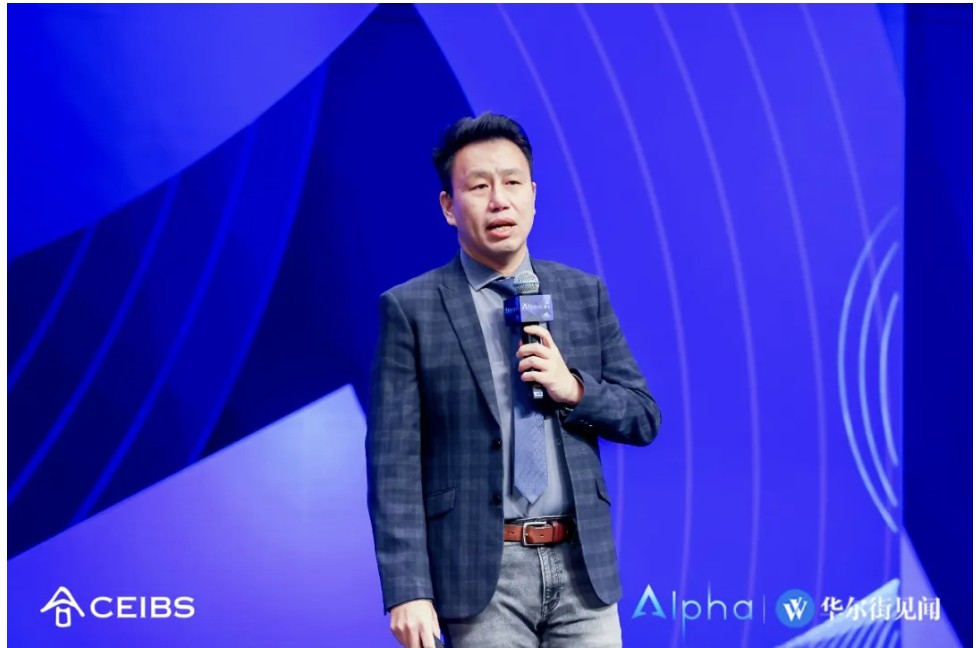
On December 20th, at the "Alpha Summit" co-hosted by Wall Street Insights and the China Europe International Business School, renowned economist Fu Peng delivered a speech titled "Reconstructing Order in the AI Era."
Fu Peng stated that the core contradiction of the current AI industry lies in "the road is built, waiting for the cars to run." The upstream investment in computing power infrastructure has been basically completed, and 2026 will be the "year of falsification" for whether downstream enterprise-level applications can land and realize profits.
He also mentioned that investors should focus on Tesla in 2026. It will face a moment of "verification" similar to what NVIDIA experienced years ago: is it merely a car company, or a true enterprise-level "heavy AI application" carrier? Fu Peng pointed out that this is akin to testing "whether there are cars running after the highway is built." If Tesla can prove its value as an AI application, the market value potential will be enormous; otherwise, based on the current logic of being an automotive stock, its valuation is not attractive.
Fu Peng emphasized that if AI is falsified, global stock markets will face severe fluctuations. Currently, the U.S. stock market (especially the AI sector) is the core of global "productivity," and the volatility of major global assets is highly correlated with it. If AI is ultimately proven to be a bubble, not only the U.S. stock market but also global markets, including Japan and Europe, will collapse, "this is a grasshopper on the same rope."
He believes that whether to raise or lower interest rates is no longer important; the core issue is whether the asset side (AI) can generate real returns. If there are problems on the asset side, adjustments on the liability side will be futile.
The following is the transcript of the speech:
The Linkage of Productivity, Production Relations, and Institutional Order
The underlying logic of this topic is discussed in the chapter "Witnessing the Countercurrent," and corresponds to the AJR model of the 2024 Nobel Prize winner Daron Acemoglu—focusing on the interaction between productivity and production relations, especially emphasizing the special production relations of "institutions and order."
"Order" is often used in the context of relations between countries (such as the trade, finance, and security dimensions referred to in Kissinger's "World Order"), while "institutions" are commonly seen in internal rules of enterprises (such as attendance tracking). Both are essentially special forms of production relations. Today, we are discussing the linkage among productivity, production relations, and institutional order. Many people mistakenly believe that macroeconomic indicators are the "barometer" of the stock market. However, in my view, the stock market truly reflects total factor productivity (TFP)—the efficiency with which the economic system transforms production factors into output.
This process is like a set of gears: productivity drives production relations, production relations reshape institutional order, and institutional order, in turn, promotes productivity. The efficiency of the gear rotation is TFP.
A large number of studies (including papers from the Federal Reserve) have confirmed that the long-term trends of most countries' stock markets are highly matched with the changes in TFP.
Taking the U.S. stock market as an example, from 1929 to the present, the core driving force behind its long-term upward trend has always been the improvement of economic efficiency, rather than short-term economic fluctuations. This improvement can come from any link in the gear: technological breakthroughs, optimization of production relations, or institutional adjustments (such as reforms in corporate governance of listed companies) In my commonly used "numerator and denominator multiplied by G" stock market model, G represents the dimension of systems and order. The development of the U.S. capital market also confirms that from the Sarbanes-Oxley Act to shareholder activism, institutional optimization has always been the key to the long-term health of the market.
It should be emphasized that no part is perfect. Technology is a double-edged sword, and productivity, production relations, and institutional order all have dual aspects. The true "perfection" is the evolution mechanism that allows good money to drive out bad money: good institutions can eliminate bad ones, and the system moves forward through error correction.
Industry Lifecycle Perspective: From Broad Net to Distilling the True from the False
Returning to the topic of AI. The years 2015 and 2016 were critical junctures: not only did the U.S. stock market break out of a decade-long wide fluctuation and start a trend, but it was also the turning point when the market realized that U.S. economic efficiency would leap forward.
At this time, Cathie Wood left her institution to start her own firm. She is often referred to as the "female version of Warren Buffett," but her logic is completely different—she operates a growth stock investment strategy in the secondary market that is akin to that of the primary market. This involves Perez's "industry lifecycle" theory: true industry investment often starts in the primary market, while the secondary market sees the future performance of the primary market.
In the early stages of an industry, no one can predict which technological path will prevail. Therefore, the optimal strategy is to broadly diversify—like Cathie Wood's approach, incorporating all technological paths into the portfolio. This is the core logic of venture capital: invest in 100 projects, lose 90, and if 10 succeed, that is a success.
This strategy is very effective in the early valuation expansion phase of an industry, allowing one to enjoy the dividends of all tracks. However, when the industry enters the maturity phase, the market will inevitably distill the true from the false: capital will concentrate from the 90 eliminated projects to the 10 true winners that have emerged. At this point, continuing to invest diversely will inevitably lead to lagging returns.
The market's valuation cuts in 2022 were precisely this "distilling the true from the false" process. NVIDIA fell 70%, Bitcoin dropped from 80,000 to 20,000, and all valuation-type assets underwent deep adjustments. The core of this round of adjustments was to force the industry to deliver answers: for example, NVIDIA must prove that it is not just a gaming graphics card company, but an AI computing power infrastructure provider.
The emergence of ChatGPT at the end of 2022 and the beginning of 2023 marked the market's clarification of a few viable tracks among numerous technological paths. NVIDIA provided the answer in its subsequent financial reports, establishing its core position in the AI era—"To get rich, first build the road; to build the road, first buy the shovel," and NVIDIA's shovel became a certain target.
Volatility and Market Risk: The Higher the Certainty, the Greater the Risk
When analyzing the market, volatility is a core indicator. It is the opposite of certainty: the higher the uncertainty, the greater the volatility; the stronger the certainty, the smaller the volatility. 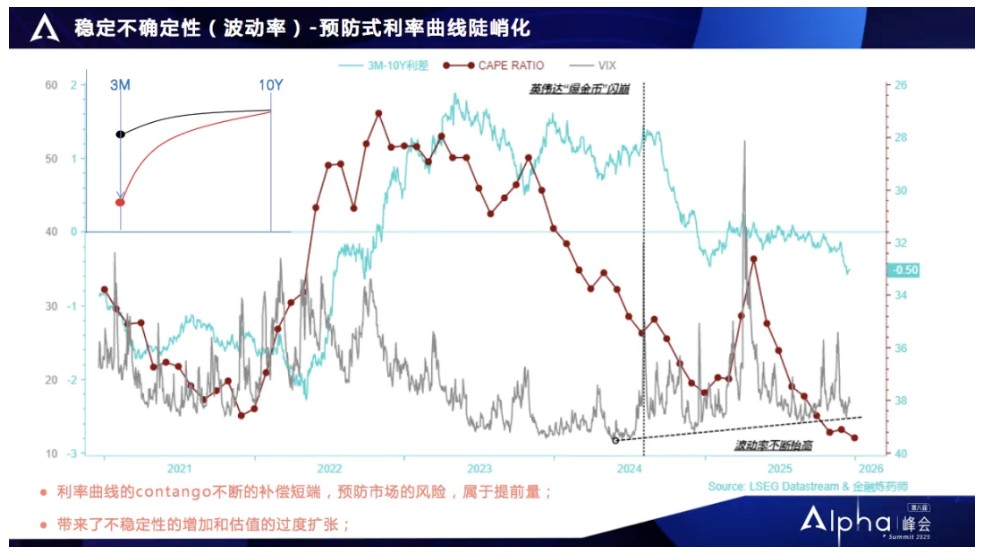
After NVIDIA fell 70% in 2022, the market gradually confirmed that AI would bring significant capital expenditures, and its performance began to materialize. From then until 2023 and 2024, volatility continued to decline—indicating that market consensus was becoming stronger and certainty was extremely high. However, the problem lies precisely in the "too high certainty": high certainty breeds greed, and phenomena such as off-market leverage, private financing, and all-in bets on real estate and vehicles are becoming increasingly common
On June 14, 2024, Fu Peng reminded in the 20th issue of the "Fu Peng Says" column on Wall Street Insights that NVIDIA should consider buying insurance. After the market volatility increased in August, Fu Peng immediately shared coping strategies.
This can be understood as follows: Much of the content in the "Fu Peng Says" column is specifically aimed at ordinary investors. They are not financial institutions and cannot participate in offline exchanges through brokerage channels every quarter. Fu Peng's professional content is mainly concentrated in this column, rather than on short video platforms—short videos are merely casual discussions, while in-depth analysis and opinion output are found here.
As expected, NVIDIA's "flash crash" in 2024 confirmed this logic. At that time, many analyses attributed it to "yen carry trade unwinding," but in my view, there is only one core reason: global assets are all tied to AI as a "productive asset." When the certainty of the asset side is over-leveraged, any change on the liability side is merely a trigger.
This is also what I have always emphasized: Don't focus on the liability side; look at the asset side. If AI is proven to be a bubble, the global market will collapse, and at that time, both interest rate hikes and cuts will be futile; if AI can deliver productive value, then the market's rise will have a solid foundation.
The "Road Construction" and "Traffic" of AI—The Transmission from Productive Forces to Production Relations
After NVIDIA's flash crash, the market has been asking: Is AI a bubble? The essence of this question is akin to the debates by Xie Guozhong about China's infrastructure in 2002 and 2003.
Back then, some believed that building highways was wasteful and a debt burden; but the facts proved that "to get rich, one must first build roads," as infrastructure drove urbanization and economic growth. The current AI industry is at a critical juncture of "the roads are built, but are there vehicles to run on them?"
In the past few years, tens of trillions of dollars have been invested in AI upstream infrastructure, and the "highways" of computing power and electricity are basically in place, but true enterprise-level AI applications—the "vehicles"—have not yet started running on a large scale. Current applications like ChatGPT, text-to-image, and image-to-text are merely superficial applications, far from being the core applications that can drive productivity transformation.
The market's doubts and waiting are essentially waiting for an answer: Are these AI infrastructures assets that can drive economic growth, or debts that cannot generate returns? The answer will determine the future direction of global assets.
From the structure of the interest rate curve, we can also see the Federal Reserve's "preventive actions": After NVIDIA's flash crash, the U.S. Treasury's "three-month minus ten-year" yield spread quickly inverted, and each inversion corresponds to a decrease in volatility. Behind this is the Federal Reserve's adjustment of short-term liquidity to avoid the spread of systemic risks, buying time for AI applications to land.
However, this operation is also a double-edged sword: the benefit is to delay a rapid market collapse, while the downside is that it makes valuations more expensive. By the end of this year and early next year, this issue will no longer be suppressible.
Next year will be the year to prove or disprove the transmission of AI from productive forces to production relations.
Tesla is the key asset in this proving process. Just as NVIDIA in 2021 and 2022 needed to prove itself as a computing power provider rather than a graphics card company, Tesla next year needs to prove: Is it a car company, or an enterprise-level heavy AI application platform? The answers are vastly different in terms of valuation. If it's just an automotive company, a trillion-dollar market value has already been overdrawn; if it's an AI application platform, a trillion-dollar market value is just the starting point.
Currently, the U.S. stock market (especially the AI sector) is the core of global "productivity," and the volatility of major global assets is highly correlated with it. If AI is ultimately proven to be a bubble, then not only the U.S. stock market but also global markets including Japan and Europe will crash, "it's grasshoppers on the same rope."
At present, whether to raise or lower interest rates is no longer important; the core issue is whether the asset side (AI) can generate real returns. If there are problems on the asset side, adjustments on the liability side will be of no use.
Two Paths and Opportunities of the Era
Returning to the initial question: Is AI a bubble? The interest rate curve trend for next year has only two paths:
The first is the falsification path: If the upstream infrastructure of AI cannot be transformed into downstream application productivity, the investments of the past few years will turn into debt, and the global market will collapse, with no asset able to stand alone.
The second is the verification path: If AI successfully completes the transition from "building roads" to "driving cars," and productivity truly drives the transformation of production relations, we will welcome a second wave—one that not only creates wealth through productivity but also presents systemic opportunities for optimizing production relations and innovating institutional order.
In every long cycle, there are three major opportunities: improving productivity, changing production relations, and reconstructing institutional order. In a lifetime, being able to catch one gear cycle is already quite good. NVIDIA has proven itself to be a certain productivity target and will become a mature growth stock in the future; the next opportunity lies in the transformation of production relations—specifically, the implementation and popularization of AI applications.
This is the era node we are currently in: either witnessing the collapse of a productivity revolution or experiencing the rise of a reconstruction of production relations. The answer lies in next year's market validation
