


How to view Trump's "2000 USD dividend"?

Trump proposed providing a tariff dividend of $2,000 per person to low- and middle-income families, attracting market attention. This move may be aimed at pressuring the Supreme Court, securing votes for the midterm elections, or stimulating the economy. The form of the dividend could include cash payments or tax deductions, with specific plans yet to be clarified
On November 8, 2025, Trump announced that he would provide a tariff dividend of $2,000 per person to low- and middle-income families, attracting market attention. How should we view the prospects and impacts of this fiscal stimulus?
(1) What is the purpose of Trump's proposal for a "tariff dividend"?
The proposal for a $2,000 tariff dividend is somewhat sudden, as it was not included in the tariff plan from April this year, nor in the Inflation Reduction Act passed in July. Coupled with the Supreme Court's questioning of the use of IEEPA, and with the midterm election cycle approaching in 2026, there is some skepticism in the market regarding his demands.
Several possibilities include:
First, to pressure the Supreme Court and provide more "political correctness" for his tariff policy. On November 5, the Supreme Court held a hearing on tariffs, and just three days later, Trump proposed the "tariff dividend," which may be aimed at shaping public opinion. If the tariffs are ruled invalid, the $2,000 "checks" will also be nullified, putting additional political pressure on the Supreme Court during its ruling.
Second, to compete for votes in the midterm elections. Trump's poll numbers are declining, the Democrats have recently gained momentum in local elections, and the Republican Party is facing increased pressure in the 2026 midterm elections.
Third, concern over a weakening economy and the need for additional stimulus. Since the third quarter, the job market has deteriorated significantly, and additional income stimulus could help the economy. However, this reason is less likely.
(2) In what form will the "tariff dividend" be distributed?
Potential methods may include: (1) full cash payment; (2) tax refunds or tax credits; (3) full coverage under the Inflation Reduction Act. If it is the first two, it means there is new fiscal stimulus; if it is the latter, there are no incremental measures, just "new wine in old bottles."
Currently, there is no further clarification on the specific plan, and we can only wait. From statements by the White House and Bessent, they are mainly based on speculation and personal interpretation. For example, the White House press secretary stated that the $2,000 dividend checks would be distributed from tariff revenues (implying cash payments); Bessent indicated that this subsidy might only refer to tax-saving provisions specified in the Inflation Reduction Act, such as tip exemptions and overtime tax exemptions (leaning towards the third option).
(3) What is the total scale of funding?
According to Federal Reserve data, about 60% of American households have an annual income below $100,000. If relevant individuals each receive $2,000, with lower subsidies for children and non-working individuals, the total scale may be in the range of $300 billion to $400 billion.
(4) What obstacles exist for implementing the plan?
If it is merely a rephrasing within the framework of the Inflation Reduction Act, there are no obstacles. However, if it involves new tax refunds or check distributions, there are still some obstacles to the policy's implementation:
First, new government spending requires Congress to pass relevant legislation, with uncertainties in both timing and scale. Although the Republican Party currently controls both houses of Congress, theoretically they could use budget reconciliation tools to force spending legislation, but historically, this frequency has not been very high (it has already been used in the Inflation Reduction Act this year) In addition, due to the deficit rate soaring significantly, it is uncertain whether the Republican Party will fully agree internally.
Second, the IEEPA ruling outcome. If the Supreme Court rules against Trump, he will temporarily lose the operational premise (of course, Trump can impose tariffs again through other legal provisions and then push for dividend distribution).
Third, the potential distribution amount is far higher than current tariff revenue, and the final plan may shrink. The increase in tariffs for the fiscal year 2025 is only over 100 billion, and it may exceed 200 billion in 2026, with the total likely being less than the potential distribution amount of 400 billion. Even if implemented, the final policy threshold may be stricter than currently disclosed.
(5) What favorable factors exist to help advance the plan?
First, Trump and the Republican Party's willingness. Under the pressure of the midterm elections, the likelihood of Trump adopting extreme measures is not low. Therefore, the timing may not be too early, aiming to create momentum for the elections.
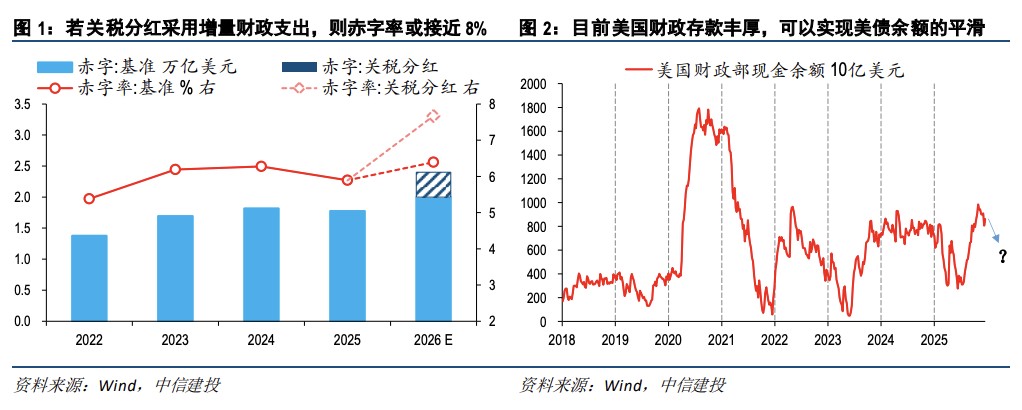
Second, the Treasury's deposits are very high, and it is not ruled out that some will be used to pay dividends. The current cash deposits of the Treasury are around 850 billion dollars. If reduced by 200-300 billion, it seems to have little short-term impact. Once the tariff dividend money is paid from the Treasury's deposits, it does not involve an increase in the scale of U.S. debt, significantly reducing the resistance to the plan.
As long as Trump and the Republican Party have a strong willingness, the aforementioned obstacles are not hard constraints.
(6) Were there similar policies during the trade war of 2018-2019?
There were no tariff dividends for all residents, but there were targeted subsidies for farmers. In 2018-2019, Trump did not use tariffs to directly distribute dividends to residents, but he authorized the Department of Agriculture to provide subsidies to farmers affected by foreign tariff countermeasures through a "Market Facilitation Program (MFP)," with amounts of 9.4 billion and 14.5 billion dollars, respectively, but the overall scale was much smaller than the tariffs increased at that time (approximately 40 billion in total over two years).
(7) If the incremental policy is implemented, what impacts will it bring?
Overall, the current mainstream expectation is that the U.S. economy will continue to soft land next year. If Trump insists on pushing for incremental fiscal expansion, the short-term upward risk for the U.S. economy will surge, but it may not be a positive for the market.
First, on the fiscal side: the deficit rate will soar to 7.5-8%, but debt may not necessarily rise (payments from Treasury deposits).
In the baseline scenario, it is expected that the U.S. fiscal deficit in 2026 may increase by about 200 billion compared to this year, with the overall deficit rate rising to around 6.4%. If the tariff dividends are fully adopted through incremental policies, the deficit will significantly rise to about 2.4 trillion, corresponding to a deficit rate approaching 8%.
However, if the related deficit is not financed through U.S. debt but is directly paid using Treasury deposits, the balance of U.S. debt will not increase as a result (assuming a one-time stimulus in 2026, which will not continue in subsequent years).
 Second, in terms of the economy: both growth and inflation face upward risks, and the 2026 fundamental assumptions need to be recalibrated.
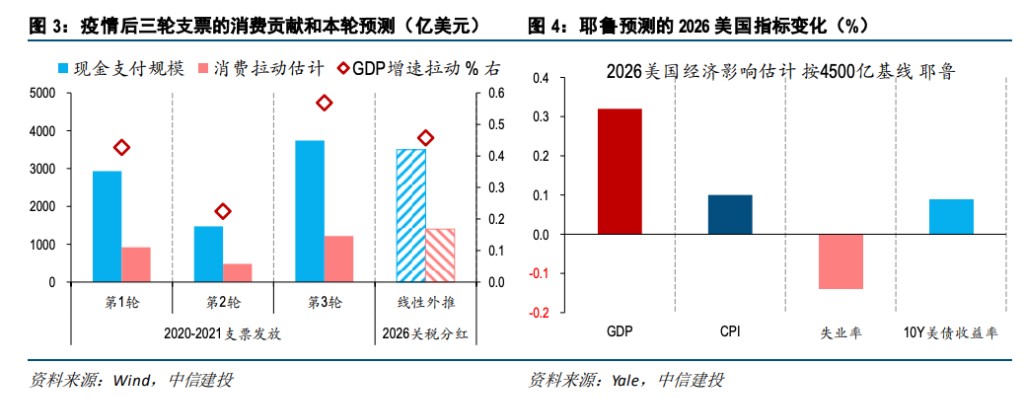
The most similar case is the cash transfer payment program in the United States during the pandemic, which issued three rounds of checks, with an overall scale comparable to this tariff dividend. By linearly extrapolating based on the median impact of previous rounds of checks, combined with the fact that this dividend is concentrated among low- and middle-income households, these groups may have a higher marginal propensity to consume. It is estimated that the consumption boost in 2026 will be between USD 100 billion and USD 200 billion, with GDP growth driven by 0.4% to 0.5%.
In addition, Yale University's forecasting model also shows that the tariff dividend will bring significant positive boosts to the U.S. economy next year, including: an additional GDP growth of over 0.3%, an additional CPI increase of about 0.1%, a decrease in the unemployment rate by 0.14%, and a rise in the 10Y U.S. Treasury yield close to 10 basis points.
Third, market response: will it replay the triple kill of stocks, bonds, and currencies? Beware of the risk of negative pricing.
Under traditional narratives, fiscal expansion leads to economic and inflationary upswings, which is bearish for U.S. Treasuries but bullish for U.S. stocks and the dollar. However, in recent years, due to developed economies in Europe and the U.S. facing high deficits, high debt, and high interest rates, the market's pricing of fiscal expansion has been negatively biased, often interpreting it as unsustainable fiscal policy and inflation leading to tightening, resulting in a triple kill of stocks, bonds, and currencies.
For example: In September 2022, the UK announced a tax reduction plan, leading to a triple kill of stocks, bonds, and currencies; in October 2025, after Japanese Prime Minister Fumio Kishida took office and advocated for expansionary fiscal policy, a triple kill occurred again.
Currently, concerns about inflation and fiscal issues in the U.S. remain strong. If Trump aggressively pushes for incremental policies and inflationary pressures return, the Federal Reserve's subsequent space for interest rate cuts may be hindered, and U.S. stocks (monetary tightening), U.S. Treasuries (inflation rising), and the dollar (fiscal mismanagement) may all face pressure.
Fourth, in terms of geopolitics: if this move significantly improves the election situation, the probability of Trump exhibiting extreme behavior in foreign policy may decrease.
Risk warning and disclaimer
The market has risks, and investment requires caution. This article does not constitute personal investment advice and does not take into account individual users' specific investment goals, financial situations, or needs. Users should consider whether any opinions, views, or conclusions in this article align with their specific circumstances. Investing based on this is at one's own risk
