


SanDisk makes a strong comeback: AI drives flash memory demand, with revenue expected to surge by 76% in two years

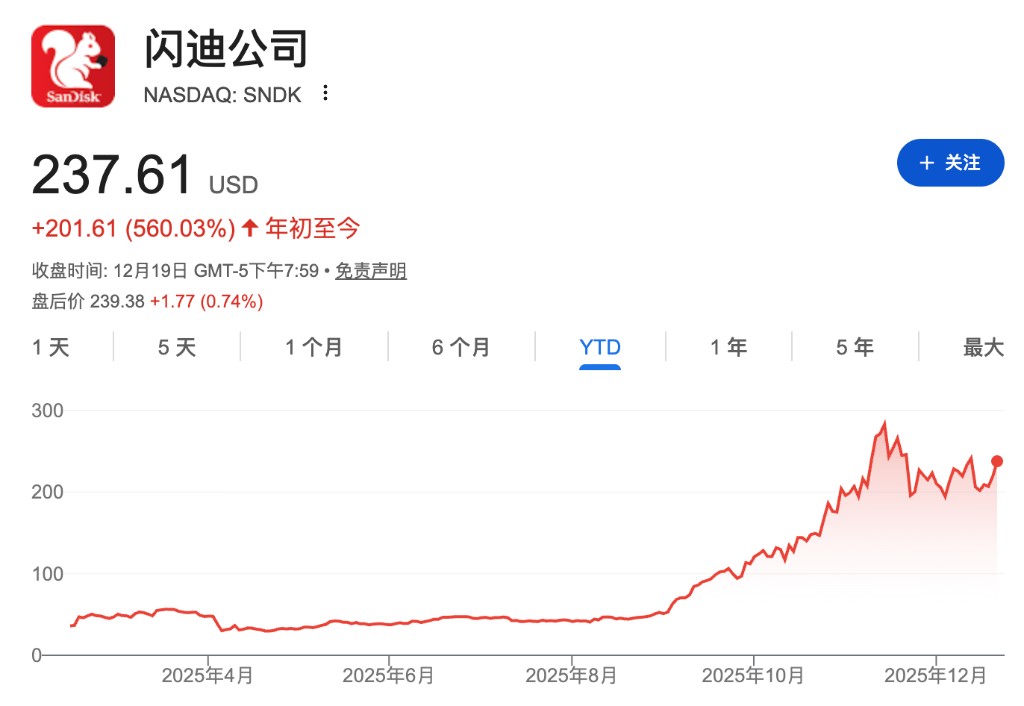
Since returning to the public market in February of this year, Sandisk's stock price has increased by approximately 560% and has been included in the S&P 500 index. Independent research firm Benchmark predicts that its revenue is expected to grow by 76% within two years, primarily driven by the demand for AI-driven high-performance flash memory. Its BiCS8 technology is accelerating penetration into the data center market, while the edge business is also benefiting from the PC replacement cycle and the popularity of AI terminals, with consumer gaming storage partnerships growing simultaneously
Since returning to the public market in February this year, Sandisk has experienced explosive growth driven by strong demand for artificial intelligence. Institutions predict that its revenue is expected to achieve up to 76% growth within two years, with stock performance far exceeding the industry average. This flash memory manufacturer, which spun off from Western Digital, is fully benefiting from the structural opportunities brought by AI data-intensive workloads and a relatively constrained market landscape.
Since the beginning of this year, Sandisk's stock price has risen by approximately 560%. Recently, buoyed by Micron Technology's better-than-expected earnings report, its stock price trend has further strengthened. The company was officially included in the S&P 500 index last November.
Benchmark research analyst Mark Miller pointed out in a recent report that the current AI-driven high-demand supply-demand pattern is expected to continue until after 2026. Based on this judgment, the institution maintains a "buy" rating for Sandisk with a target price of $260, while also raising its earnings forecasts for fiscal years 2026 and 2027.
Sandisk's performance growth prospects highlight the strong pull of the AI infrastructure investment boom on the upstream storage industry chain. It is expected that by 2030, investments in data centers and AI-related infrastructure will exceed $1 trillion, providing continuous and broad market space for Sandisk's high-capacity, high-efficiency solid-state drive (SSD) products.
BiCS8 Technology Builds Competitive Barriers
Although Sandisk's enterprise solid-state drive (eSSD) business is still in its early development stage, its BiCS8 technology is gradually building differentiated competitiveness. Citigroup analysis points out that such products, as mainstream flash memory solutions for data centers, will continue to benefit from the overall tight supply in the industry, especially the strong demand from hyperscale cloud service providers for generative AI training and inference services, which will strongly support the long-term growth of the eSSD market.
In the first quarter of fiscal year 2026, BiCS8 technology accounted for 15% of the company's total shipped storage capacity and is expected to become the dominant part of capacity before the end of this fiscal year. The commercialization of this technology has directly driven growth in the data center business, which generated revenue of $269 million in the quarter, a 26% increase quarter-over-quarter. Currently, there is a growing interest in BiCS8 products globally, including from hyperscale cloud service providers, emerging cloud service providers, and OEM customers.
Looking ahead, Sandisk's high-performance SSD product line Stargate, designed specifically for data centers, is expected to further expand its adoption among existing customers. In addition, the high-bandwidth flash memory technology being advanced in collaboration with SK Hynix will provide higher performance storage support for AI inference scenarios in data centers and edge devices.
PC Upgrade Cycle Boosts Edge Business
The edge business has become an important growth driver for SanDisk. In the first quarter of fiscal year 2026, this business achieved revenue of $1.39 billion, a quarter-on-quarter increase of 26% and a year-on-year increase of 30%. The growth is mainly attributed to the PC replacement cycle driven by the upgrade to Windows 11. It is expected that global PC shipments will maintain low single-digit growth from 2025 to 2026, while the average storage capacity per device is expected to achieve a mid-single-digit increase.
At the same time, the accelerated adoption of generative AI on PCs and smartphones has opened up new growth space for SanDisk. It is expected that the average storage capacity of smartphones will maintain high single-digit growth in the next two years. The company believes that as the pace of terminal device upgrades accelerates, the edge business will continue to expand and further drive the increase in NAND storage capacity per device.
The consumer business also performed well. In the first quarter, sales in this segment reached $652 million, a year-on-year increase of 27% and a quarter-on-quarter increase of 11%. The growth is mainly due to the collaboration with Nintendo—the co-branded Switch 2 microSD Express card sold 900,000 units in the first quarter. In addition, the company recently launched dedicated storage cards for ROG Ally and Xbox, further consolidating its competitiveness in the gaming storage market
