Why did the yen fall instead of rising after the interest rate hike?

On December 19, 2025, the Bank of Japan raised interest rates to 0.75%, but the yen fell 1.45% against the US dollar. Reasons include market expectations being fully priced in, fiscal stimulus plans diluting the effects of the rate hike, and negative real interest rates limiting yen appreciation. In the medium term, fiscal easing will exacerbate inflationary pressures, and the yen may continue to depreciate. In the short term, attention should be paid to the risk of intervention by the Japanese Ministry of Finance
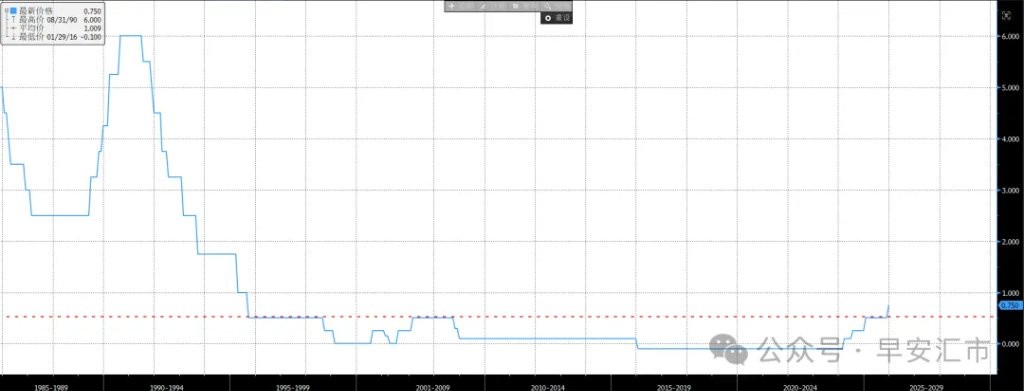
On December 19, 2025, the Bank of Japan unanimously passed a rate hike decision, raising the benchmark interest rate by 25 basis points to 0.75%, the highest level in 30 years since 1995. However, the yen depreciated directly by 1.45% against the US dollar to 157.5 after the decision.
Figure 1: Bank of Japan Benchmark Interest Rate

I. Why did the yen fall instead of rise after the rate hike?
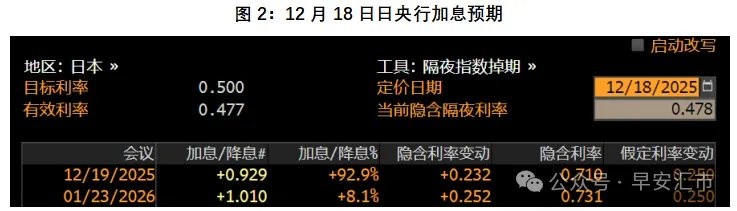
- From a trading perspective, the market had already priced in the decision sufficiently before the meeting (with a 93% probability expectation), and JPY bulls showed signs of selling against the trend on the day of the US CPI. Additionally, the flow side maintained a buy side, making the post-decision movement understandable.

- From a fundamental perspective, the "invisible negative value" trap of real interest rates remains the main reason limiting the appreciation of the yen.
On one hand, "tight monetary policy" clashes with "loose fiscal policy." On the eve of the rate hike, the cabinet of Prime Minister Fumio Kishida approved a massive fiscal stimulus plan of up to 18.3 trillion yen, and Japan's long-term inflation pressure remains high, diluting the policy tightening effect of this rate hike.
On the other hand, real interest rates remain at a "significantly negative value," constraining the exchange rate from rising.
With current inflation expectations at 2.5%-3%, the real interest rate of the yen is at a deeply negative level of -1.75% to -2.25%, facing significant pressure for rate hikes. However, the Bank of Japan, led by Governor Kazuo Ueda, remains reluctant to make a strong statement, and the expression of next year's policy path still heavily relies on data. The ambiguous attitude has led the market to have low expectations for the Bank of Japan's rate hikes next year, with only one expected 25 basis point hike after the third quarter of 2026. In contrast, although the Federal Reserve is in a rate-cutting cycle, the actual benchmark interest rate is about 1.39% under an inflation expectation of 2.25%, and the actual interest rate differential fundamentally constrains the yen's exchange rate.
After all, exchange rate trading emphasizes expected trading; if the Bank of Japan continues to lag behind the curve, it will only dilute the purchasing power of the yen. The market has also seen through the Bank of Japan's bottom line.
II. Outlook
In the medium term, as the global economy and inflation stabilize, coupled with Japan's high sensitivity to import prices, continued fiscal easing will only further increase inflation pressure. The Bank of Japan's hesitation is like a frog in warm water, which will only lead to continuous depreciation of the yen, and breaking 160 may just be a matter of time.
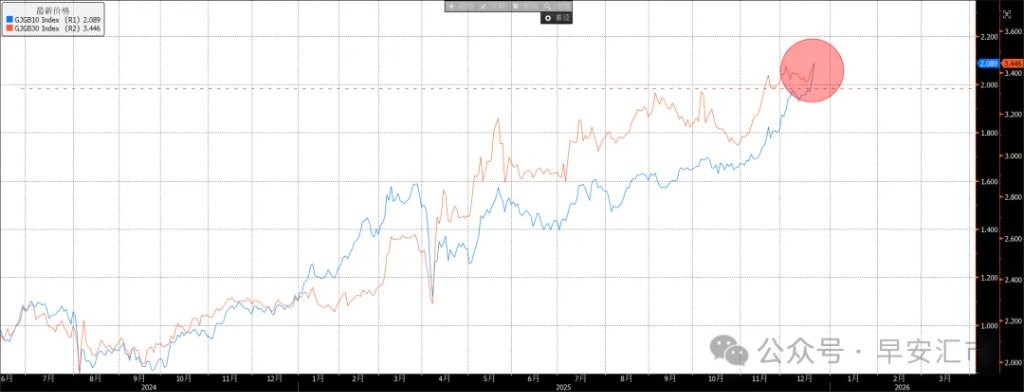
However, in the short term, it is necessary to pay attention to the risk of intervention by the Japanese Ministry of Finance at the current level. In recent days, investors have continued to vote with their feet, with Japanese 10Y and 30Y government bond yields reaching new highs, and the yen exchange rate approaching its yearly high. Under such a consistently unfavorable expectation, there is a significant risk of intervention. Last week, Reuters reported that Prime Minister Fumio Kishida has begun to realize that the depreciation of the yen could affect political stability From an absolute point of view, the current USDJPY is also at a level comparable to the Ministry of Finance's purchase of yen after the BOJ meeting in April last year. Will there be a surprise during the Christmas holiday week? It is worth looking forward to. However, if there is indeed one, buying on dip would still be a more appropriate choice.
Figure 3: New highs for Japan's 10Y and 30Y government bond yields

Risk Warning and Disclaimer
The market has risks, and investment requires caution. This article does not constitute personal investment advice and does not take into account the specific investment goals, financial situation, or needs of individual users. Users should consider whether any opinions, views, or conclusions in this article are suitable for their specific circumstances. Investment based on this is at one's own risk