Professor Fang Yue: If AI cannot be scaled and implemented, the market may repeat the internet bubble of 2000 | Alpha Summit

Fang Yue, director of the China-Europe AI and Management Innovation Research Center, believes that AI belongs to technology, but technology does not equate to value; the key is large-scale implementation. If AI technology can generate value from large-scale applications, it can bring about significant changes in productivity. Future competition will not be merely about efficiency, but rather about the degree of "human-machine integration."
Exciting Insights:
"Technology does not equal value." The real value lies in how companies transform this technology into a structural revolution in productivity, which is key to global economic growth in the coming years.
Significant investments in AI, including models, computing power, data centers, electricity, and talent competition, can lead to disruptive productivity improvements if they achieve large-scale implementation on the application side, and if businesses and society are willing to pay for their value. Conversely, if there is a lack of actual value support, the market may repeat the internet bubble of 2000.
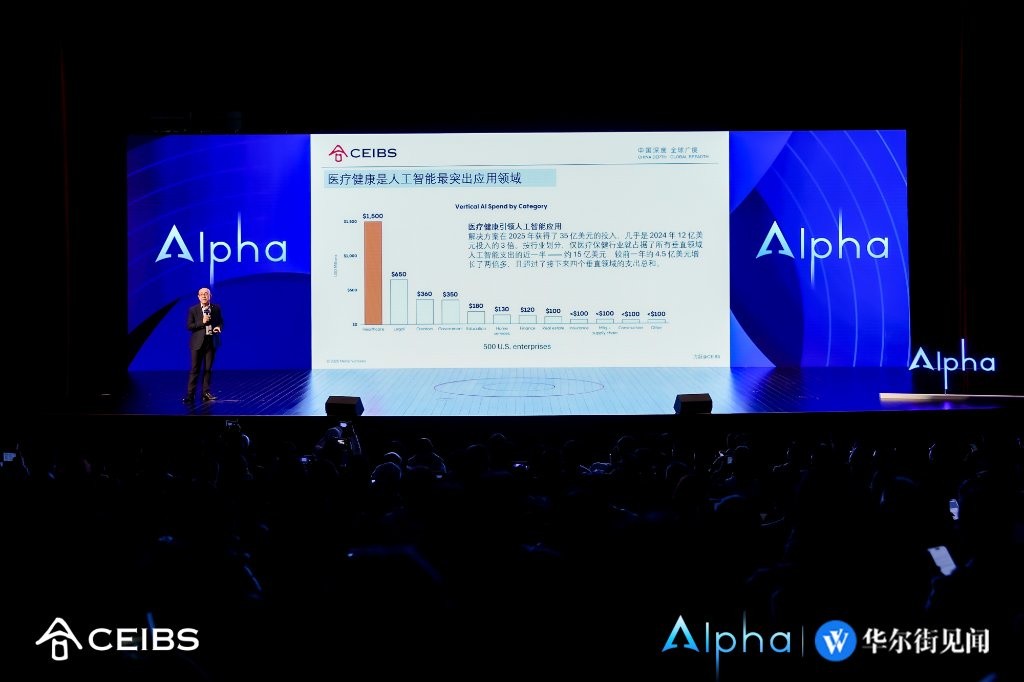
Coding and healthcare are currently the most prominent areas for AI in terms of scenarios and applications. The value of AI in coding has begun to emerge; in vertical sectors, the healthcare industry accounts for nearly half of all AI spending in vertical fields.
The future trend is that AI, as a technology, still possesses characteristics of a production tool, but it has also begun to exhibit characteristics of labor (such as intelligent assistants and digital employees participating in management decisions). AI further reinforces the characteristic of data as a production material. This means that future competition will not merely be about efficiency, but also about the transformation of productivity and the nature of the resulting production relationships, fundamentally reshaping innovation, knowledge, and value creation. Future work will evolve from human-centric organizations to human-machine collaboration and integration.
The structure of productivity in the AI era will be rewritten. The core of industrialization is division of labor and organizational collaboration. Although subsequent information and digitalization have greatly promoted the boundary-less nature of enterprises, leading to the formation of ecosystems and industrial value chains, breaking down internal organizational boundaries has always been a management challenge hindering organizational growth and development. AI has the opportunity to truly break down internal organizational boundaries, enabling effective human-machine collaboration and integration, leading enterprises towards becoming "super intelligent bodies," fundamentally addressing organizational ailments, and achieving data and intelligence-driven agility and flattening, especially in large organizations.
Over the past few decades, "agility and flattening" have been the keys to responding to a fast-paced world, emphasizing small teams and iteration. However, AI is now shortening decision-making cycles, and traditional agile and flat frameworks are no longer sufficient. Future organizations will no longer be centered around positions or hierarchies; positions will gradually disappear, evolving into an intelligent collaborative network dynamically composed of human capabilities, AI capabilities, and organizational mechanisms.
Please do not treat artificial intelligence as a technology to be deployed; instead, treat artificial intelligence as "talent" to be cultivated. This requires enterprises to achieve "organizational co-intelligence"—enabling organizations to possess a "smart brain" like a large model, with the core being to allow the enterprise's "wisdom" to be accumulated, self-learned, and self-grown. To become a truly "learning organization," it is currently difficult to rely on human-centric frameworks and methods.
The role of human employees will shift from "collaborative division of labor" to "human-machine symbiosis," transitioning from merely using AI to "carrying" AI and "creating" AI. Humans will no longer play the role of control and execution; instead, business will be driven by the "enterprise intelligent brain," cultivating AI-qualified personnel as much as possible, with AI teams working, while humans transition to leaders responsible for "defining" value and managers for "accepting" results
This AI competition, while not a zero-sum game in the strict sense, will certainly have winners and losers. The key lies in the foresight of leaders and the organization, innovation, and execution capabilities of enterprises—only those companies that truly integrate AI into their business, driving efficiency and innovation, can fully unleash the potential of AI. Only by achieving structural productivity transformation can they succeed in the competition of the future AI era.
Don't just enhance work with AI, but "reshape work." Enterprises have only two paths: "either become natively AI-driven or fully AI-integrated." This requires managers to conduct a true "whiteboard simulation," rethinking what the company should look like in the AI era, rather than simply grafting AI onto existing businesses.

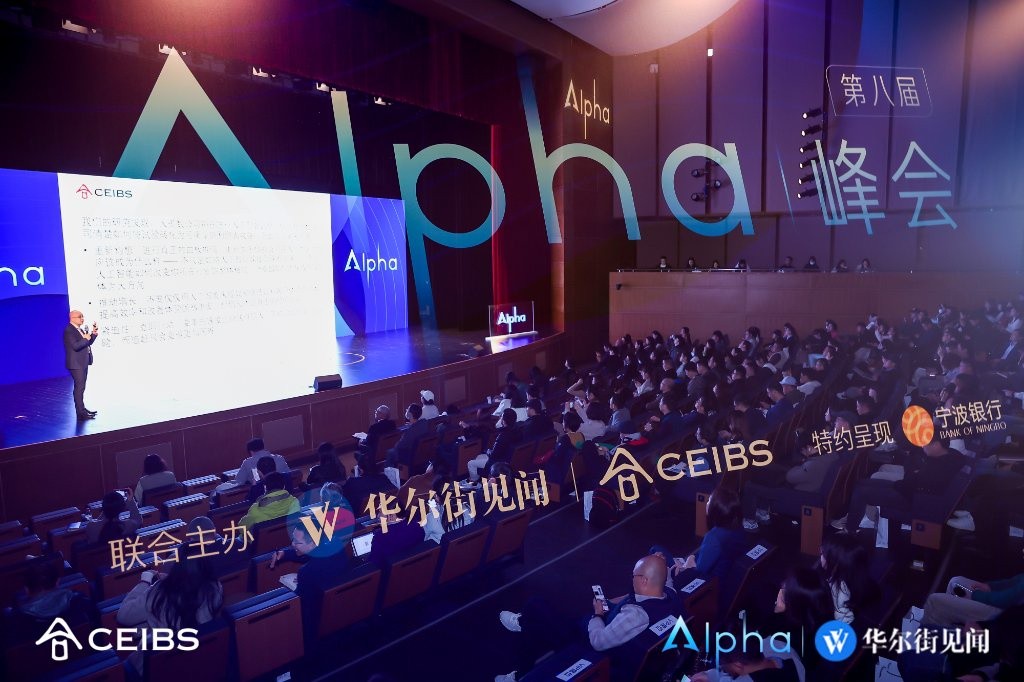
On December 19th, the 8th "Alpha Summit," co-hosted by Wall Street Insights and China Europe International Business School, was held at China Europe International Business School (Shanghai).
Professor Fang Yue, Chair Professor of Economics and Decision Sciences at China Europe International Business School and Director of the AI and Management Innovation Research Center, profoundly analyzed how artificial intelligence is reshaping the global business landscape in his presentation titled "The Next Growth Engine of the Global Economy: Intelligent Organizations and Structural Productivity Revolution."
Professor Fang pointed out that the current market is indeed pricing for a future defined by large-scale productivity improvements and organizational restructuring. Although giants like OpenAI are still in the "burning money" phase, and Bloomberg even predicts that it will not achieve positive cash flow until 2029, this is different from mere speculation.
He compared the current AI boom to the "internet bubble" rather than the "tulip mania." While there may be overvaluation in the short term, it is driven by a genuine technological revolution. Professor Fang emphasized:
Technology does not equal value.
The real value lies in how enterprises can transform this technology into a structural productivity revolution, which is key to global economic growth in the coming years.
Here are the highlights compiled by Wall Street Insights:
Today, I want to discuss AI from a micro perspective. When we mention AI, we often think of specific companies and industries related to knowledge productivity. But a key question is: can the impact of this wave of AI be broader? Will it also bring new opportunities to traditional industries such as manufacturing and services?
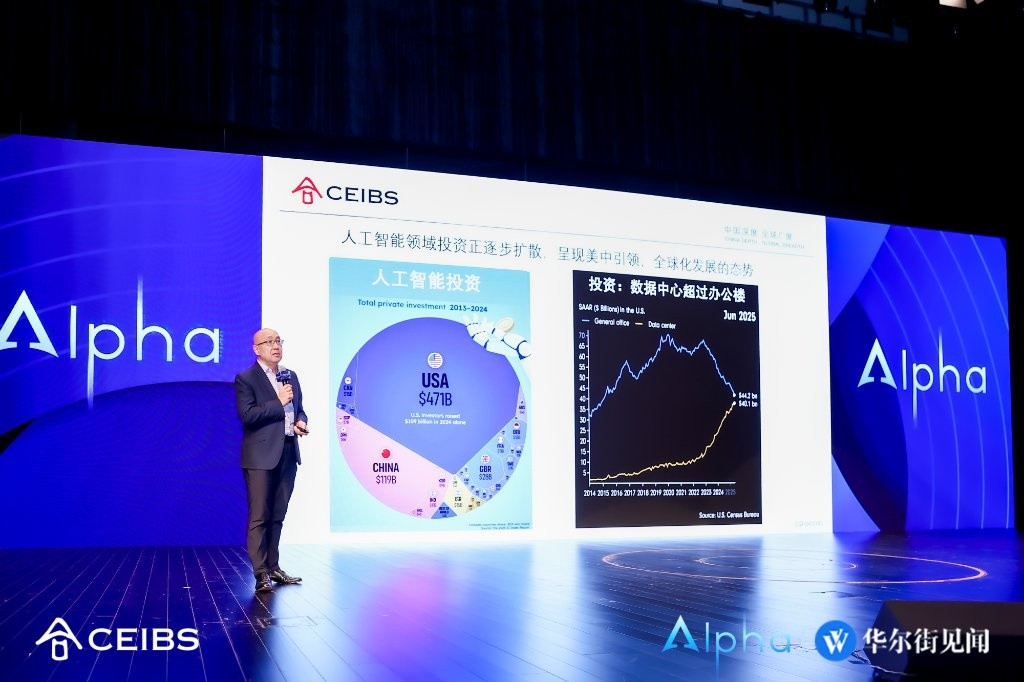
From a macro investment perspective, the investment heat in the AI field in recent years has been unprecedented and mainly concentrated in the United States and China. Investment is an important component of economic development, and another more forward-looking indicator is also worth paying attention to. In the past, we focused heavily on commercial real estate as an important predictive indicator of economic growth.
However, in June of this year, global investment in data centers has already surpassed that in commercial real estate. This indicates a significant shift in the focus of future competition, and there is great hope for the future.
Of course, this also brings new challenges. The construction of such a large number of data centers is currently mainly used for model training and has not yet entered the stage of large-scale application in enterprises, but its electricity consumption already occupies a considerable proportion. It is predicted that in the future, the power consumption for AI training and applications will soon exceed the total of all other electricity consumption.
Is AI a Bubble or a Revolution?
Can AI truly bring about an increase in productivity? What does it mean for enterprises and industries? Especially after the release of OpenAI 5.0, some may feel a bit disappointed, as it seems we are still some distance away from Artificial General Intelligence (AGI).
The discussion about whether "AI is a bubble" generally falls into two categories of viewpoints:
- A True Bubble: Like historical speculative frenzies, where value and price are severely decoupled.
- A Future Revolution: Like the internet bubble, where there may be valuation issues in the short term, but it will inevitably lead to a significant increase in productivity in the long term.
For enterprises, the internet bubble ultimately was just a matter of timing. However, for the enterprises and individuals involved, how to seize the opportunity is crucial. The development speed of AI technology is extremely fast, as it has the ability to self-iterate; AI is participating in its own development, which will accelerate the development of large models.

From a traditional valuation perspective, what scale of applications and value does AI need to generate to recoup such a massive investment? This is indeed a question mark. Even OpenAI itself predicts that its cash flow may not turn positive until 2029.
However, the stock market reflects expectations for the future, and the basis of this expectation is that artificial intelligence can bring productivity improvements and be widely applied by enterprises.
Although the arrival of AGI may be slower than expected, leading some enterprises to make strategic adjustments between lofty ideals and current market competition, I believe that Mark Zuckerberg's statement from Meta fundamentally expresses the sentiments of many tech giants:
If we mistakenly invest a huge amount of money, it is unfortunate; but if we do not invest, the risk may be greater.
This also explains why major manufacturers are sparing no effort to engage in this competition.
Technology ≠ Value: From the Laboratory to Scalable Implementation
Strictly speaking, any invention in the laboratory that cannot be implemented and bring value cannot be called "technology." I personally feel that AI is at a critical stage of moving from the laboratory to large-scale application.
"We have produced a large number of jeans and shovels, but that does not mean that digging for gold will necessarily yield results." This statement reminds us that technology itself does not equal value.
Looking back over the past 25 years (1997-2022), it was a period when the internet and mobile internet brought disruptive impacts. The global median GDP per capita has increased sixfold, while China has grown sixteenfold, largely relying on the technological disruption brought about by the digital economy However, if we observe the growth rate curve, we find that many countries, including China and India, show a "reverse U-shape" in per capita GDP growth—initially high productivity growth, followed by a gradual disappearance of dividends.
This indicates that the dividends brought by the internet and mobile internet "redoing existing businesses" have basically been exhausted. If technology can generate large-scale application value, it will inevitably lead to a leap in productivity. So, where are the current application scenarios for AI?
- Most mature applications: Programming and IT construction. Any field that has been digitized may ultimately be AI-enabled.
- Rapidly developing applications: Marketing, as content generation and customer interaction are strengths of generative AI. Additionally, many procedural and standardized jobs, such as human resources and finance, have also begun to generate value.
- Most invested industry: Healthcare, including pharmaceuticals.
We can see that the impact of AI is cross-industry, and in the future, almost all scenarios can be assisted by AI to some extent.
The Key to AI Implementation: From Technical Issues to Organizational Capability Issues
The key to moving AI from the laboratory to large-scale implementation lies in enterprise-level scalable applications.
What we see now is that many companies are conducting pilot projects, easily finding several scenarios for small teams to try, but how to promote it on a large scale? This tests the organizational capability of the enterprise.
I often ask companies undergoing digital transformation: If you were to score yourself, what are the reasons for a high or low score? Do the factors that hinder your digital transformation still exist? If these questions are not clearly understood, this wave of AI may also struggle to truly help you.
Technology is just a starting point; implementation requires tremendous effort.
It is foreseeable that this wave will cause some companies to exit the market while others become new leaders. In this process, simply imitating cases is not the best path, as AI is entirely new for all companies, and each company's situation is different.
Reconstruction of the Three Elements of Productivity: The Core of AI Disruption
To find the direction of AI transformation, we must first clarify where AI's disruptive nature lies. Traditional productivity consists of three main elements: labor, production tools, and production materials.
In the industrial and even internet era, these three elements were clearly defined. But which part does today's AI belong to?
It is still a production tool. It also begins to exhibit characteristics of labor (digital employees, embodied intelligence). It can also generate data, possessing characteristics of production materials.
The most core disruption of this wave of AI is the complete breakdown of the boundaries between these three elements. This is unprecedented in human history and will inevitably lead to significant changes in production relations A simple example: In a company, HR manages people (labor force), and IT/CTO manages technology (production tools). Now the question arises, who should manage digital employees? How can HR help AI become compliant employees? How should IT assess it and enable it to collaborate with humans?
This is the beginning of the transformation of production relations.
New Forms of Labor and Organizational Evolution
In the past, the improvement of productivity relied mainly on division of labor, while the core of organizational research focused on collaboration. As companies grow in size, collaboration becomes exceptionally difficult.
Although the internet has improved information communication, decision-making, execution, and learning still heavily rely on human labor, leading many internet-native companies to encounter organizational issues similar to traditional enterprises after reaching a certain scale. The arrival of AI may bring fundamental changes:
From Division of Labor to Human-Machine Integration:
- In the future, positions may no longer be fixed but organized by projects. A project can dynamically combine human employees and digital employees, fundamentally changing the original division of labor model and moving towards "human-machine collaboration."
Accumulation of Corporate Wisdom:
- In the past, knowledge and wisdom mostly resided in the minds of experts, and personnel turnover could cause significant losses. AI can accumulate this knowledge into an "enterprise wisdom brain," providing support whether for new employees onboarding or making judgments on forward-looking issues.
- An entrepreneur even envisions that after his passing, he can still participate in the board through the "wisdom brain" and provide advice.
Therefore, do not treat AI as a technology to be deployed, but as "talent" to be cultivated.
What does it take to cultivate talent? It requires understanding the business, allowing for mistakes, and providing training. The same goes for cultivating AI. For AI to become a qualified "employee," it needs to understand the business, solve problems, have values, and collaborate with humans and other AIs.
The Ultimate Form of Enterprises: Super Intelligence
We believe that future enterprises will evolve into the form of "super intelligence." This includes three parts:
- Humanizing Machine Intelligence: AI evolves from a tool to an employee, even an expert.
- Intelligent Humanization: The standard for excellent employees will shift from "being good at using AI" to "being able to cultivate qualified AI experts." Since AI experts are replicable, this creates the concept of "infinite labor force," which signifies tremendous changes for all enterprises, including traditional ones.
- Collective Intelligence of Organizations: The knowledge of the enterprise ultimately accumulates into a "wisdom brain," enabling the enterprise to self-learn and self-evolve like AI.
To cultivate AI talent that understands the business, high-quality business data is essential, meaning that the enterprise's informatization and digitalization foundation must be solid.
I often tell enterprises: First, if you have survived until today despite poor informatization and digitalization, congratulations on your good luck. Second, the opportunity has come; the lessons still need to be learned, but AI can help you take shortcuts to catch up with this lesson at a lower cost and faster speed.
How to Evolve into a Superintelligence: The Evolution Trilogy
The evolutionary path of enterprises can be roughly divided into three stages:
- AI Ready: Most enterprises are currently at this stage, conducting pilots, experimenting, and even catching up.
- All in AI: Scaling successful pilots is quite challenging.
- Superintelligence: Achieving the ultimate organizational evolution.
Regardless of the stage, several points need to be emphasized:
- Reimagine: It is essential to break free from the old mindset of "people + tools."
- Focus on Growth: AI brings not only cost reduction and efficiency improvement but also a new growth model driven by "unlimited labor" and breaking organizational boundaries. The internet has broken the boundaries between enterprises, while AI will truly break the boundaries within enterprises.
- Maintain Urgency: The time for observation is shorter than in the internet era; immediate action is necessary.
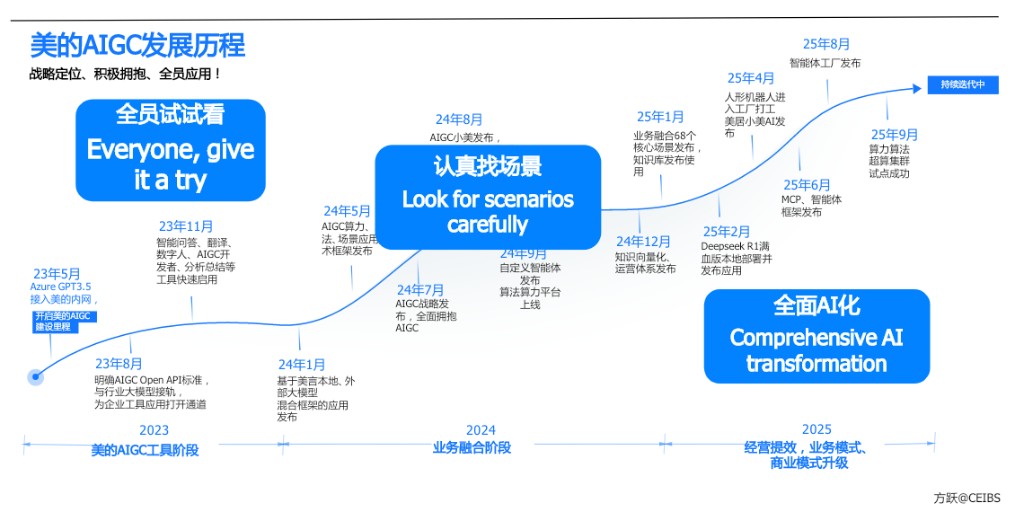
Case Study: Midea Group's AIGC Transformation Journey
Before the arrival of AI, Midea had already been deeply engaged in information technology and digitalization for over a decade, laying a solid foundation. After AI arrived, it generally took three steps:
Year One: Everyone Try It Out
Encourage employees from all business departments—whether frontline, R&D, or marketing—to try using AI.
Second Stage: Seriously Find Scenarios
This is a large-scale bottom-up process. Once employees understand AI's capabilities, they look for application scenarios related to their own business. Midea identified over 10,000 scenarios within two years.
Third Stage: Fully Embrace AI
The technology department intervenes to select over 100 truly valuable and replicable projects from the vast array of scenarios as key focuses, promoting comprehensive AI integration.
This wave of AI is different from previous information technology. In the past, business and technology were "two separate skins." Now, AI has, in a sense, achieved "technological equality."
Any employee, after simple training, can use AI tools to build applications and solve problems. AI has become your technical partner, greatly assisting you in completing your work.
Conclusion: Embrace Organizational Change and Create Chinese Wisdom
This is not merely a technological transformation but a profound organizational transformation. The "tuition" paid during past digital transformations should not be in vain.
Successful transformation requires a combination of top-down and bottom-up approaches, with middle managers playing a crucial role as the core in building "human-machine collaborative teams."
For most enterprises, competing for top AI talent is not the primary task. What we need more are talents who understand the business, are willing to embrace and cultivate AI, and can collaborate with AI. Therefore, team building is more important than high salaries to poach talent In the face of a complex international and domestic environment, as well as the fading of traditional growth dividends, comprehensively promoting digital and intelligent transformation is our strategic focus. The technological equality and the possibility of infinite labor brought by AI provide us with new opportunities.
This competition is not entirely a zero-sum game, but there will definitely be winners and losers. China, in this wave, should be able to highlight its own wisdom and practices. Thank you all.