


The GDP of the United States grew by 4.3% in the third quarter, marking the fastest growth rate in two years, with the PCE price index at 2.9%

The actual GDP of the United States grew significantly by 4.3% in the third quarter, marking the fastest growth rate in two years, primarily due to strong household consumption expenditure. The data release process was shortened due to the government shutdown. Although core inflation remains high at 2.9%, expectations of a loosening in tariff policies have made the market optimistic, and the Federal Reserve may slow down the pace of interest rate cuts next year due to economic overheating
Benefiting from strong consumer and business spending as well as more stable trade policies, the U.S. economy showed its fastest expansion pace in two years in the third quarter.
On the 23rd, the Bureau of Economic Analysis (BEA) released preliminary data showing:
- The U.S. third-quarter real GDP annualized quarter-on-quarter growth was 4.3%, expected 3.3%, previous value 3.8%;
- The U.S. third-quarter core Personal Consumption Expenditures (PCE) price index annualized quarter-on-quarter growth was 2.9%, expected 2.9%, previous value 2.6%.
The release of this data comes in a unique context. The preliminary GDP estimate originally scheduled for release on October 30 was canceled due to the government shutdown, which also set a record for the longest shutdown in history. As a result, the data release process was adjusted. The BEA typically releases quarterly growth estimates in three phases and makes adjustments as more data comes in, but for this cycle affected by the shutdown, the agency will break from tradition and only release two estimates.
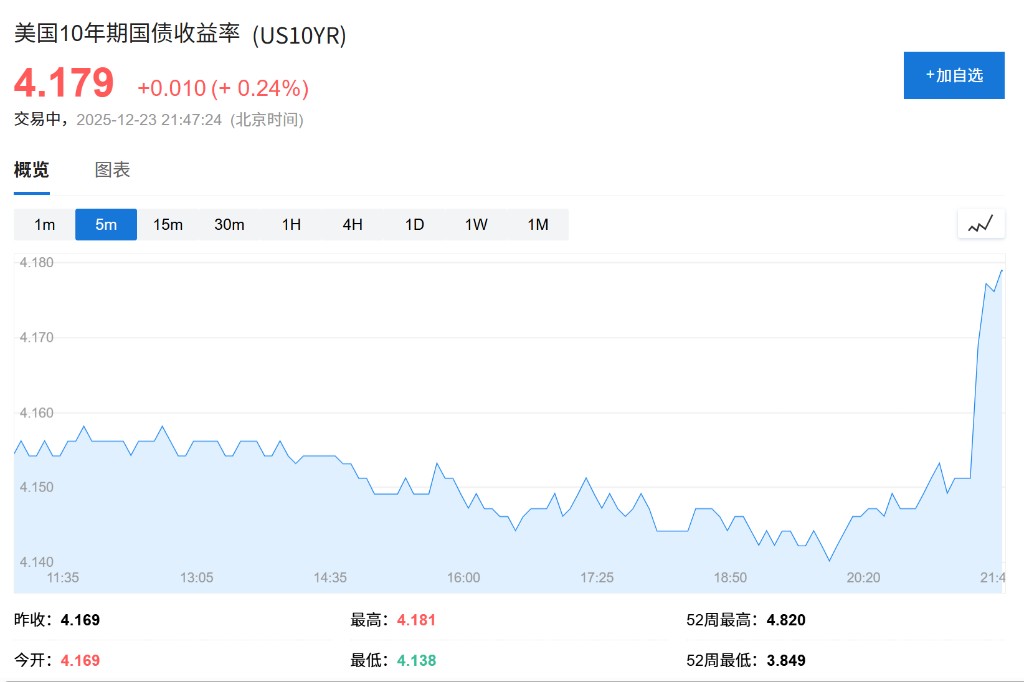
After the data release, the U.S. dollar index briefly rose about 10 points, currently reported at 97.99. U.S. stock futures showed little short-term volatility, with the Nasdaq 100 index futures maintaining a decline of about 0.15%. The yield on the U.S. 10-year Treasury bond briefly rose, currently reported at 4.149%. Spot gold briefly fell about $4, currently reported at $4485.51 per ounce.
Consumer Spending Leads Economic Growth
The detailed data in this report shows that consumer spending, the largest pillar of the U.S. economy, performed particularly well in the third quarter, growing by 3.5%, significantly higher than the 2.5% in the second quarter. This indicates that despite facing pressure from borrowing costs, American households' willingness to spend remains strong, directly driving the acceleration of overall economic expansion.
In contrast, the investment side showed mixed performance. Non-residential investment continued to grow, but the growth rate slowed from 7.3% in the previous quarter to 2.8%. Residential investment continued to drag down the economy, declining by 5.1% in the third quarter, consistent with the decline in the second quarter.
Meanwhile, Gross Domestic Income (GDI), which measures income from the production side, grew by 2.4%, down from 3.8% in the previous quarter.
Policy Disruptions and Future Outlook
This delayed economic "report card" reveals that the economy successfully maintained its growth momentum as Trump’s tariff policies were rescinded. Due to the record-long government shutdown, the BEA canceled the preliminary GDP estimate originally scheduled for release at the end of October. Typically, the agency releases three quarterly growth estimates and makes adjustments as data is refined, but due to the shutdown, only two estimates will be released this quarter.
Although economists expect the government shutdown to put pressure on growth in the fourth quarter, the market holds a cautiously optimistic outlook for 2026. Analysts anticipate that as households receive tax refunds and a ruling from the Supreme Court—which is expected to overturn Trump’s extensive global tariff policies—the economy is likely to see a moderate rebound next year
The Federal Reserve Maintains a Cautious Stance
Strong economic data aligns with the Federal Reserve's latest forecasts. Federal Reserve Chairman Jerome Powell pointed out that supportive fiscal policies, spending on artificial intelligence data centers, and sustained household consumption are the main reasons the central bank predicts an acceleration in economic growth next year.
However, some officials have shown hesitation about further significant reductions in borrowing costs, primarily because the inflation rate remains above the Federal Reserve's 2% target. Reports indicate that the Federal Reserve's preferred inflation measure—the Personal Consumption Expenditures (PCE) price index excluding food and energy—rose by 2.9% in the third quarter.
Due to the shutdown, the BEA has not yet rescheduled the release dates for the October and November PCE monthly data. Based on the current inflation and growth trends, policymakers currently expect that after three consecutive rate cuts before the end of this year, there will be only one rate cut in 2026.
