RMB appreciation, a boost from the "foreign exchange settlement wave"?

Wallstreetcn
2025.12.24 10:10
portai
I'm PortAI, I can summarize articles.

Recently, the rapid appreciation of the renminbi has been attributed by the market to the "year-end settlement rush," but the Shenwan Hongyuan report points out that during the fastest appreciation period in October and November, the bank settlement rate actually declined, and multiple market indicators did not show characteristics of a settlement rush. The report believes that the initial phase of this appreciation was mainly guided by the central bank's counter-cyclical adjustment, while recently it has synchronized with the weakening of the US dollar. Although seasonal settlement patterns may still provide support in January, the risk of a US dollar rebound and the central bank's intention to "smooth" the exchange rate may affect the pace at which the renminbi breaks through the "7" level

Since mid-October, the US dollar has depreciated slightly, while the Chinese yuan has appreciated significantly. The market attributes this asymmetric rise in the yuan to the "year-end settlement rush," which refers to the behavior of companies concentrating on selling foreign exchange earnings at the end of the year, thereby driving up the exchange rate.

However, the latest report from Shenwan Hongyuan states: The main driving force behind the recent appreciation of the yuan is not the year-end settlement rush as commonly believed, but rather the proactive adjustments by the central bank and changes in the external US dollar environment.

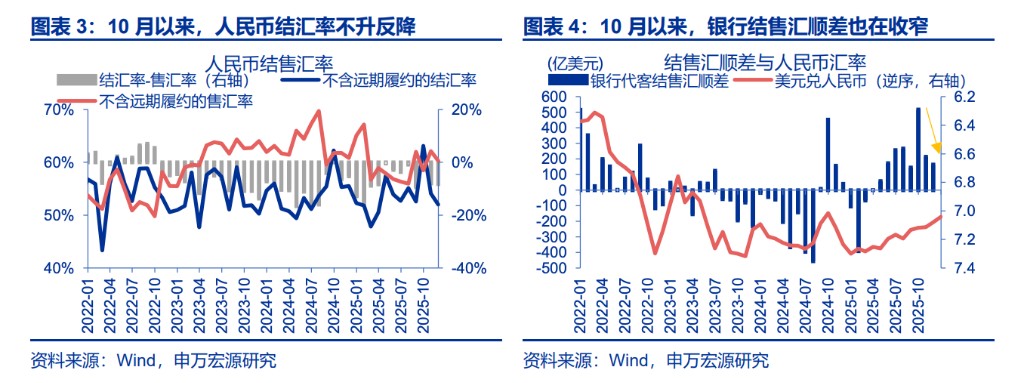
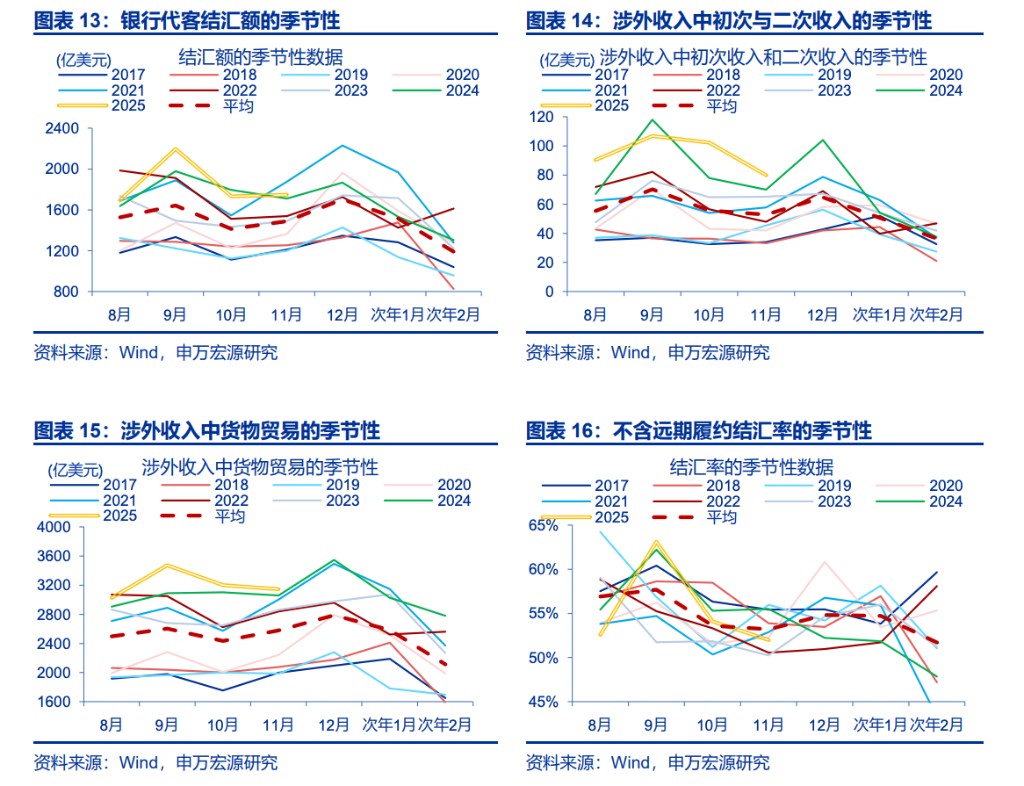
The report points out that the core indicator reflecting companies' willingness to settle foreign exchange, the bank's customer settlement rate (excluding forward contracts), reached a high of 63.1% in September, but has significantly declined for two consecutive months in October and November, dropping to 54.1% and 52.0%, respectively. This indicates that during the fastest appreciation phase of the yuan, companies' actual willingness to settle foreign exchange has not only not strengthened but has significantly weakened.

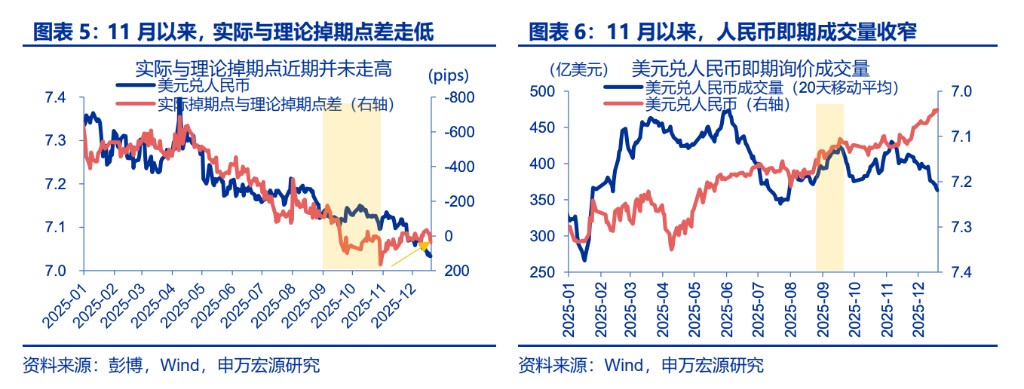
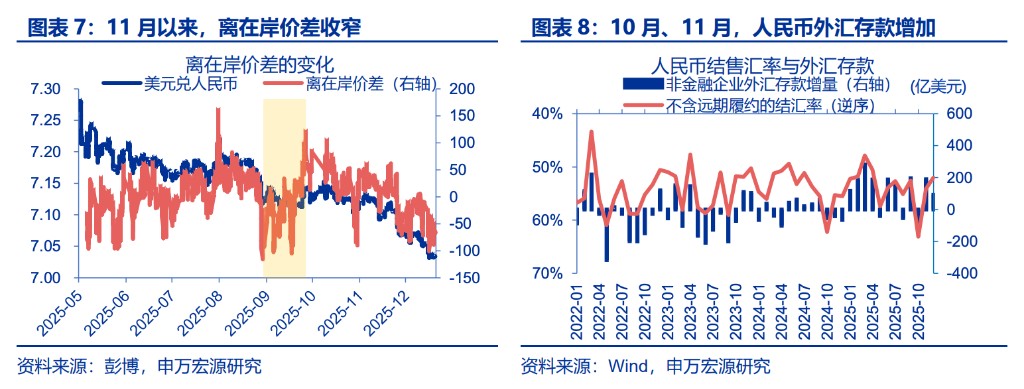
In addition, multiple high-frequency market indicators also support this judgment. If there were indeed a large influx of settlement funds, the foreign exchange market would typically show characteristics such as rising swap points, widening offshore-onshore price differentials, and increased spot trading volume. However, the actual situation is quite the opposite: relevant swap spreads have continued to narrow, yuan trading volume has shrunk, and the offshore-onshore price differential has not widened. These micro signals indicate that the appreciation from late October to November is closely related to the guidance of the central bank's counter-cyclical adjustment factors; while the trend since December has shown a higher correlation with the weakness of the US dollar index itself.

Recent appreciation is not driven by settlement, and the weakness of the dollar may still provide support

Settlement rate data disproves the "settlement rush." Although the yuan has appreciated rapidly, data from the State Administration of Foreign Exchange shows that after reaching a high of 63.1% in September, the settlement rate fell to 54.1% and 52.0% in October and November, respectively, with the net settlement rate dropping from 4.6% in September to -8.3% in November. The bank's customer foreign exchange settlement surplus also narrowed from $51.8 billion in September to $16.4 billion in November.

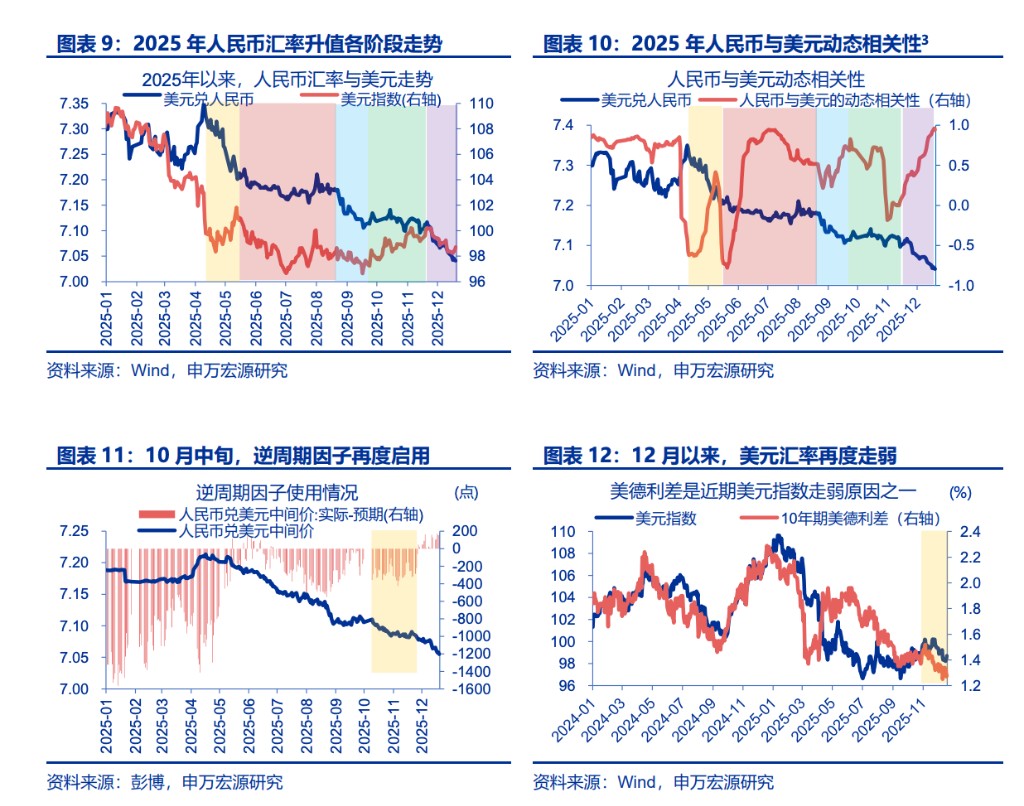
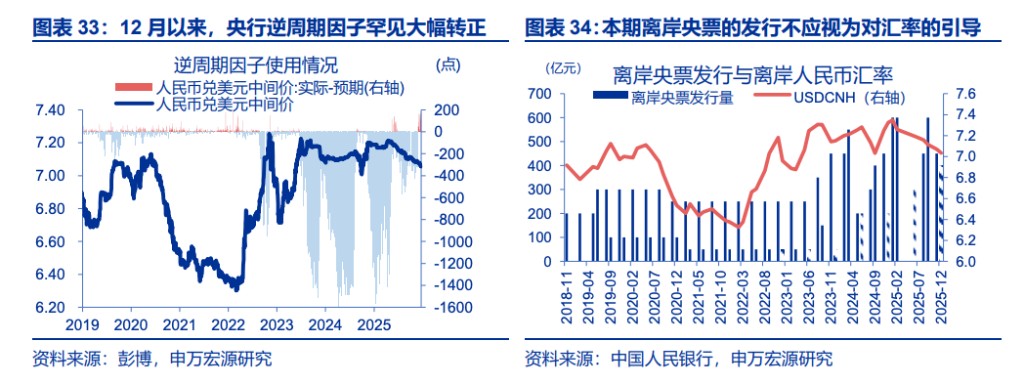
Multi-dimensional auxiliary indicators do not show accelerated settlement. Historical experience indicates that a settlement rush is usually accompanied by four major characteristics: rising swap points, increased inquiry trading volume, widening offshore-onshore price differentials, and reduced foreign exchange deposits. However, the actual situation since November has been quite the opposite, with swap spreads narrowing from 97 pips to 36 pips, yuan spot inquiry trading volume shrinking from $45.3 billion to $25.3 billion, the offshore-onshore price differential narrowing, and foreign exchange deposits still increasing by $9.2 billion in November. The central bank's counter-cyclical adjustment and the weakening of the US dollar are the real drivers. Analyzing the phased appreciation of the renminbi in 2025, it can be seen that from mid-October to late November, under the background of "three prices unified," the central bank restarted the counter-cyclical factor, and the continuously rising midpoint price guided the appreciation; since December, the US dollar has weakened again, and the one-month dynamic correlation between the renminbi and the US dollar has rapidly rebounded to 0.95, indicating that the exchange rate trend has returned to the US dollar-dominated logic.

The "year-end settlement" pattern is partially valid: trade settlement increases but the settlement rate improvement lags behind

There is indeed a regular increase in trade settlement in December. Data since 2017 shows that the amount of bank customer settlements in the fourth quarter has shown an upward trend, with average settlement amounts in October, November, and December being USD 141.4 billion, USD 148.9 billion, and USD 170.4 billion, respectively. The increase in settlements mainly comes from three aspects: first, export receipts are concentrated in the fourth quarter, with the average foreign income from goods trade in December being USD 279 billion, the highest for the year; second, initial and secondary income in December significantly increase due to financial settlements and dividend needs; third, the settlement rate in December rises slightly, but this characteristic is not very obvious.

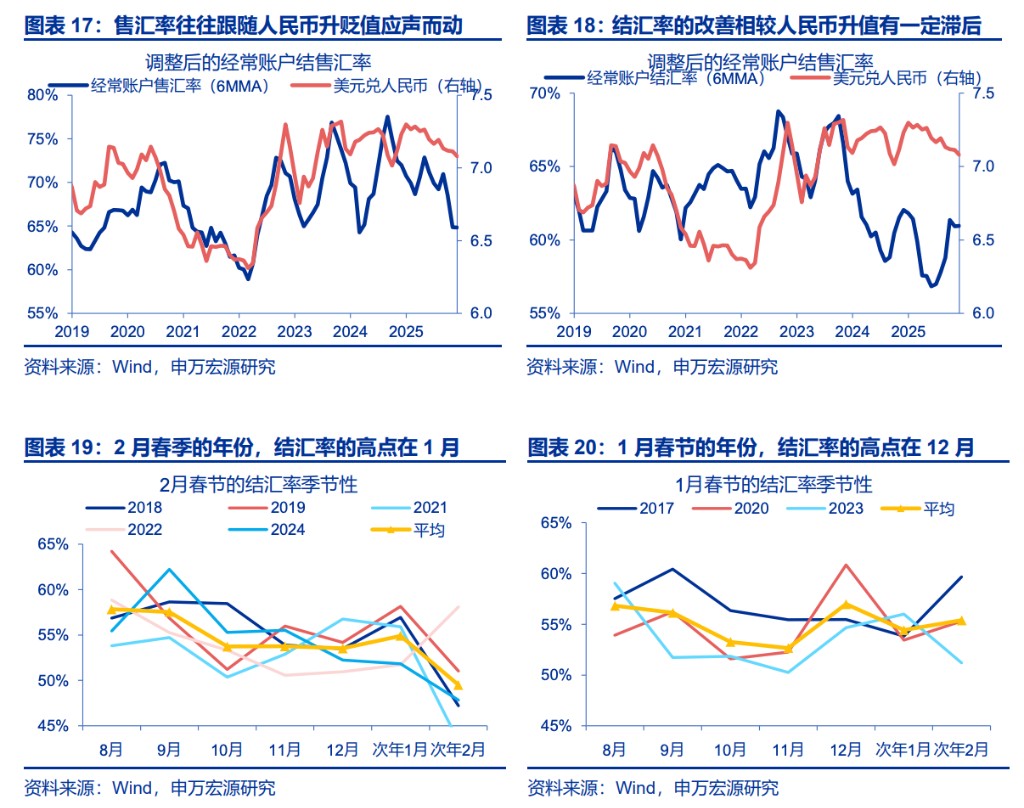
The improvement in the settlement rate lags by 1-2 quarters. Historical data shows that once the renminbi strengthens, the selling rate often falls in response; however, the improvement in the settlement rate usually lags by 1-2 quarters. This is because speculators react quickly, while traders can hedge exchange rate risks through hedging contracts, often accelerating settlements only after the renminbi has appreciated for 1-2 quarters.

The timing of the Spring Festival affects the peak settlement time. In years when the Spring Festival falls in February, the significant improvement in the settlement rate will shift to January of the following year; while in years when the Spring Festival is in January, the peak of settlements occurs in December. The Spring Festival in 2026 is in February, which means the improvement in settlements may continue into January.

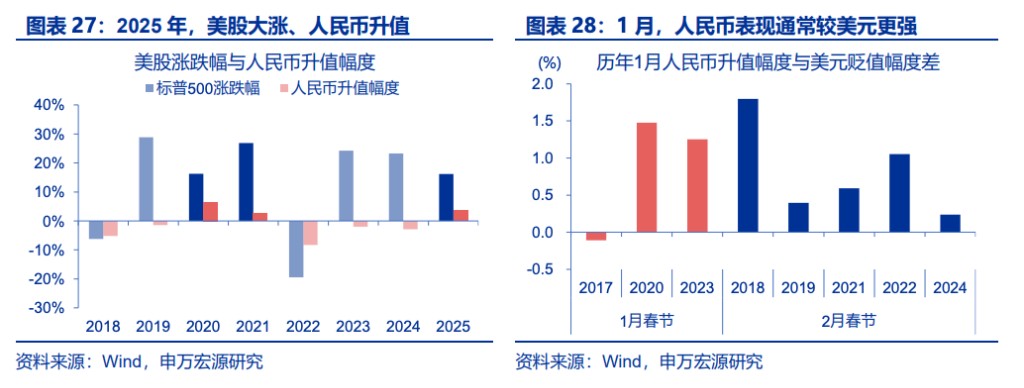
Net settlements also need to pay attention to the situation of service trade and capital account settlements. Service trade settlements are the main drag, related to the update of personal exchange quotas at the end of the year and the beginning of the year. Although the capital account has a year-end effect in terms of averages, it is mainly due to the contribution of large securities investment settlements in December 2020 and 2021. The securities account settlements in December 2020 and 2021 may be related to the significant rise in US stocks throughout the year and the significant appreciation of the renminbi at that time.

Breaking "7" has support but three major risks must be guarded against

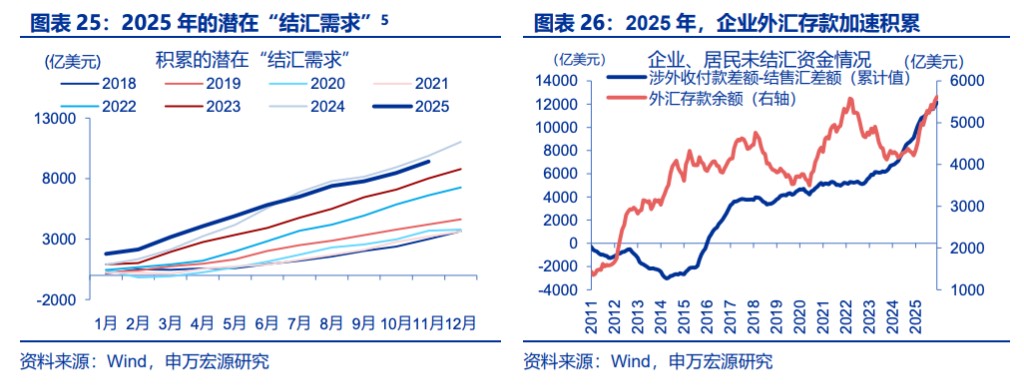
The "delayed" wave of foreign exchange settlement may still provide some support for the short-term appreciation of the RMB. Historical experience shows that after the RMB appreciates for two consecutive quarters, the settlement rate often improves. From 2025 to the present, the "pending settlement demand" estimated by the trade surplus minus the foreign exchange settlement surplus is second only to the same period in 2024; the foreign exchange deposit balance of non-financial enterprises has exceeded February 2022, reaching a historical high of USD 561.8 billion. At the same time, the US stock market surged 16.2% in 2025, and the RMB appreciated by 3.7%, similar to the situation in 2020 and 2021, which may also improve the settlement of securities accounts. Historical data shows that under the support of the settlement wave, the RMB exchange rate in January is expected to appreciate by about 0.8% compared to the changes in the US dollar index.

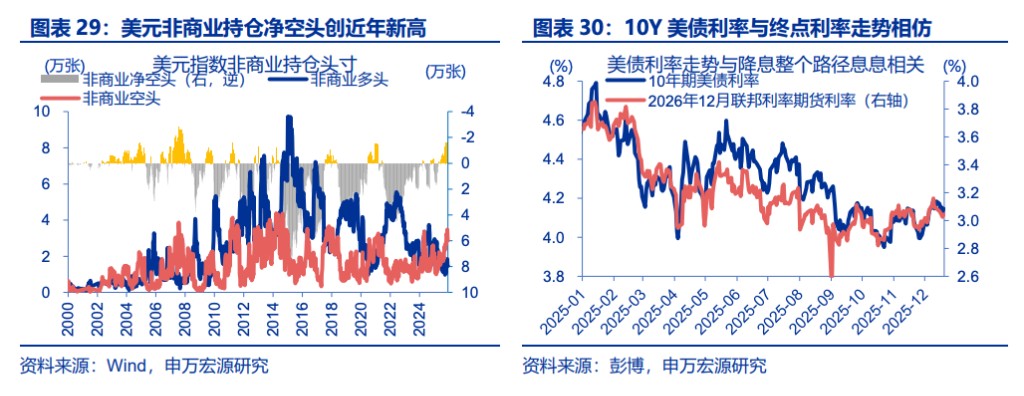
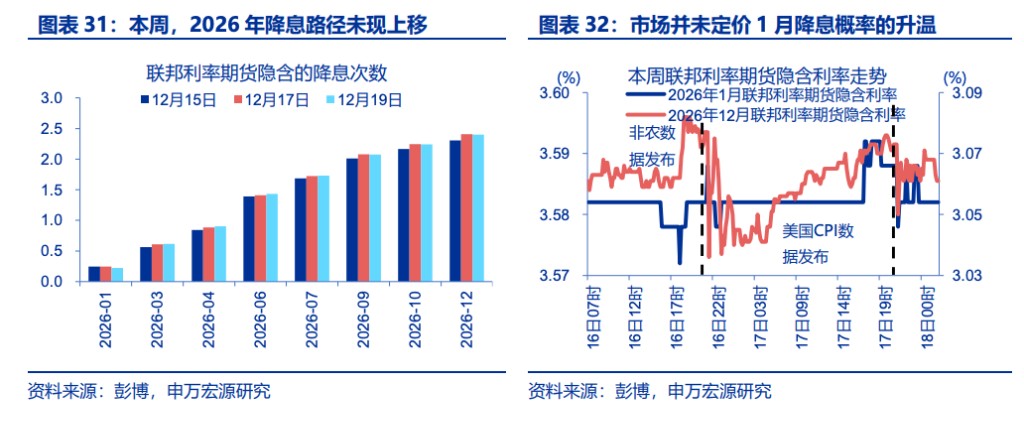
The risk of a dollar rebound cannot be ignored. Currently, the net short position of non-commercial dollars has reached a new high since 2008, and extreme short positions carry a risk of reversal. Although recent US non-farm payrolls have weakened and CPI has fallen significantly below expectations, the credibility of the November labor and inflation data is low (due to the government shutdown, the household survey response rate was only 64%, and CPI used a rare "carry-over method" for interpolation), which has not increased the probability of a rate cut in January. If the rate cut in January does not materialize, the dollar may rebound slightly.

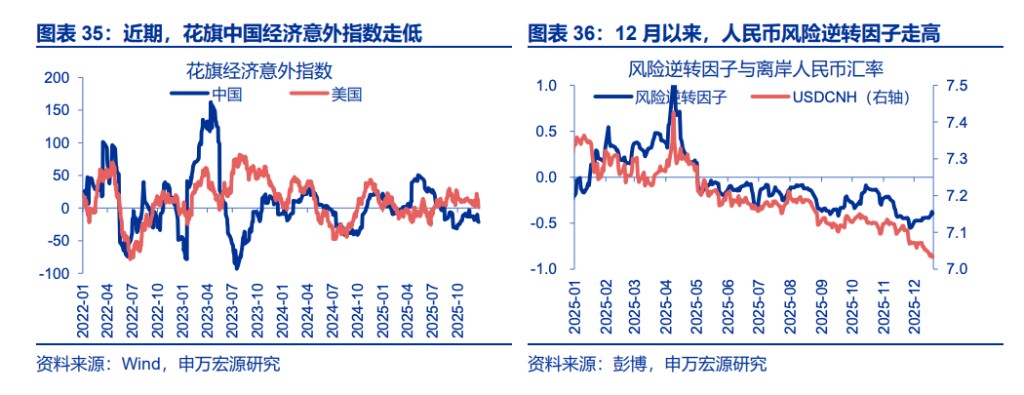
The central bank's "smoothing" of excessive exchange rate fluctuations will also have some impact on the pace of rapid appreciation of the RMB. Since the end of November 2025, against the backdrop of rapid appreciation of the RMB, the central bank's counter-cyclical factor has quickly exited, and the midpoint rate has even been significantly weaker than the offshore and onshore rates. As of December 19, the actual midpoint rate of the USD against the RMB was 172 points higher than the theoretical midpoint rate, the largest margin since 2022, indicating that the central bank has no intention of guiding the RMB to appreciate too quickly. In addition, the Citigroup China Economic Surprise Index has declined, and factors such as the expectation gap for the "New Year" in January and the rising RMB risk reversal factor also need attention. !