


Trump's "deregulation" has driven Bank of America’s market value to increase by $600 billion this year

This year, U.S. regulators have proposed to relax bank regulations, allowing large banks to increase leverage, comprehensively reform stress tests, and withdraw high-risk loan guidelines. As of Wednesday, the total market capitalization of the six largest banks, including JPMorgan Chase and Bank of America, reached $2.38 trillion, a significant increase from $1.77 trillion at the end of last year, and is expected to outperform the S&P 500 index for two consecutive years
The financial deregulation promoted by the Trump administration and the recovery of investment banking have driven the market value of the six largest banks in the United States to increase by a total of $600 billion this year.
As of Wednesday's close, the total market value of the six largest U.S. banks—JP Morgan, Bank of America, Citigroup, Wells Fargo, Goldman Sachs, and Morgan Stanley—has exceeded $2.38 trillion, a significant rise from $1.77 trillion at the end of last year, and is expected to outperform the S&P 500 index for the second consecutive year.
In contrast, the total market value of the six largest banks in Europe is only $1 trillion, highlighting the growing divergence between the U.S. and European banking sectors since the 2008 financial crisis.
The shift in regulatory policies has become a key factor driving stock price increases. This year, U.S. regulators have proposed allowing the largest banks to increase their leverage ratios, comprehensively reforming the annual bank stress tests used to determine capital requirements, and rescinding lending guidelines for high-risk loans.
The strong recovery of investment banking further boosts market confidence. Citigroup's stock price has risen over 70% this year, leading the six major banks. Goldman Sachs' stock price has climbed nearly 60%, reaching an all-time high. Industry forecasts indicate that bank stocks and fixed income trading revenues will surpass historical peaks this year.
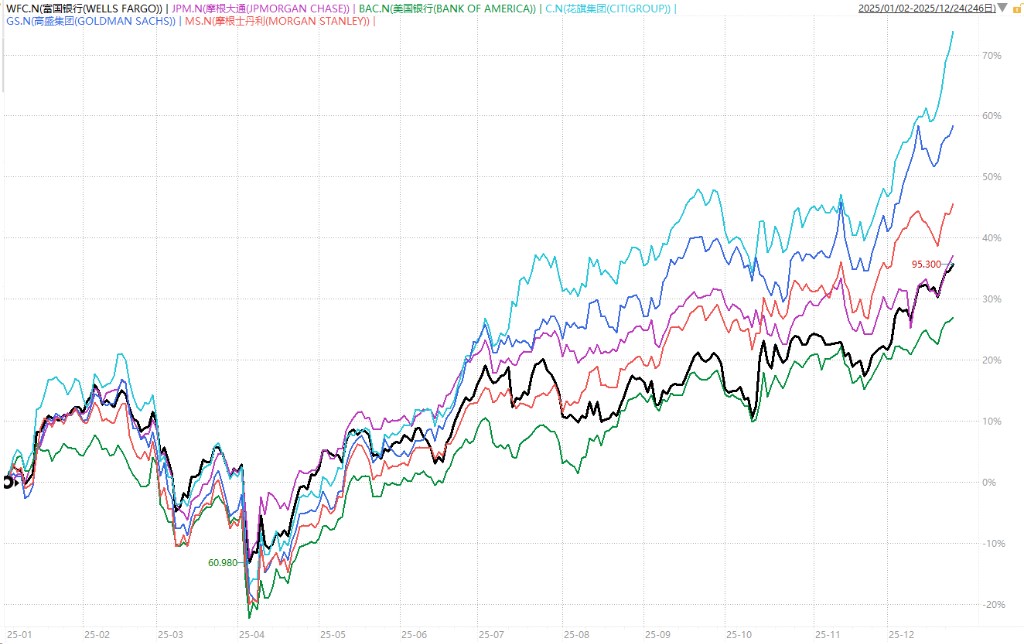 (Citigroup's stock price has risen over 70% this year, leading the six major U.S. banks)
Deregulation Releases Capital Space
A series of deregulation measures introduced by the Trump administration this year have directly boosted bank stock performance.
RBC banking analyst Gerard Cassidy stated:
The importance of regulatory changes on stock prices cannot be underestimated. After the financial crisis, bank profitability was severely weakened because they had to hold more capital, which was indeed necessary.
More importantly, the banking industry expects that the final implementation version of the Basel III global capital rules will be much more lenient than the Biden administration's initial proposal in 2023. Cassidy pointed out:
They all hold excess capital because they have already reserved according to the previous proposal.
This capital can not only absorb potential losses but can also be used for business expansion, as well as stock buybacks and dividends for shareholders. HSBC's head of U.S. financial stock research, Saul Martinez, stated:
Given the slow growth of bank balance sheets, the market believes there is room to take on more risk.
Despite concerns from opponents like Democratic Senator Elizabeth Warren regarding large-scale financial deregulation, investors have shown little worry about the increased risk-taking by banks so far.
The Gap Between U.S. and European Banking Continues to Widen
Citigroup has become the best-performing stock among the six major U.S. banks by 2025, with its stock price rising about 70%.
The efforts the bank has made over the years to streamline operations and cut costs have paid off. This month, Citigroup's stock price surpassed the sum of its valuations for each of its divisions for the first time since 2018 Goldman Sachs' stock price has also risen nearly 60% this year, reaching an all-time high. This is attributed to the recovery of its core investment banking business and the continued prosperity of its trading operations. Bankers expect the momentum of the investment banking recovery to accelerate further in 2026.
Industry tracking agency Crisil Coalition Greenwich predicts that this year, bank equity trading revenue will reach $92 billion, and fixed income trading revenue will reach $163 billion, both surpassing previous peaks.
The market capitalization growth of the U.S. banking industry has further widened the gap with its European counterparts. Martinez stated:
The current situation feels almost unreal. The fundamentals are good, but the question is how much has already been priced in
