Has the RMB appreciated significantly?

Wallstreetcn
2025.12.26 00:30
portai
I'm PortAI, I can summarize articles.

Guolian Minsheng's Tao Chuan believes that the recent appreciation of the RMB is a reasonable release of previous pressure against the backdrop of a weakening US dollar and improving trade expectations. Although there is a risk of overshooting in the short term due to concentrated foreign exchange settlement, a comprehensive analysis of multiple dimensions such as finance, trade, and inflation indicates that the current exchange rate fluctuations are overall within a reasonable range, and the medium to long-term trend still needs to be observed for support from economic fundamentals

The "surprise attack" of Christmas has seen the RMB exchange rate break 7 again after 14 months. However, times have changed; 14 months ago, the dollar was around 100, with the shadows of Trump’s inflation and tariffs looming large; now, just before Christmas, the dollar index has fallen below 98, and the risks of Trump’s tariffs are also fading (at least temporarily), making the appreciation of the RMB seem quite natural. However, since late November, the continuous appreciation of the RMB despite fluctuations in the dollar seems a bit too rapid, raising the question: has the RMB exchange rate risen too much?

In fact, assessing whether the RMB exchange rate has risen too much or too little has always been a complex issue. From different dimensions, we can provide three different answers:

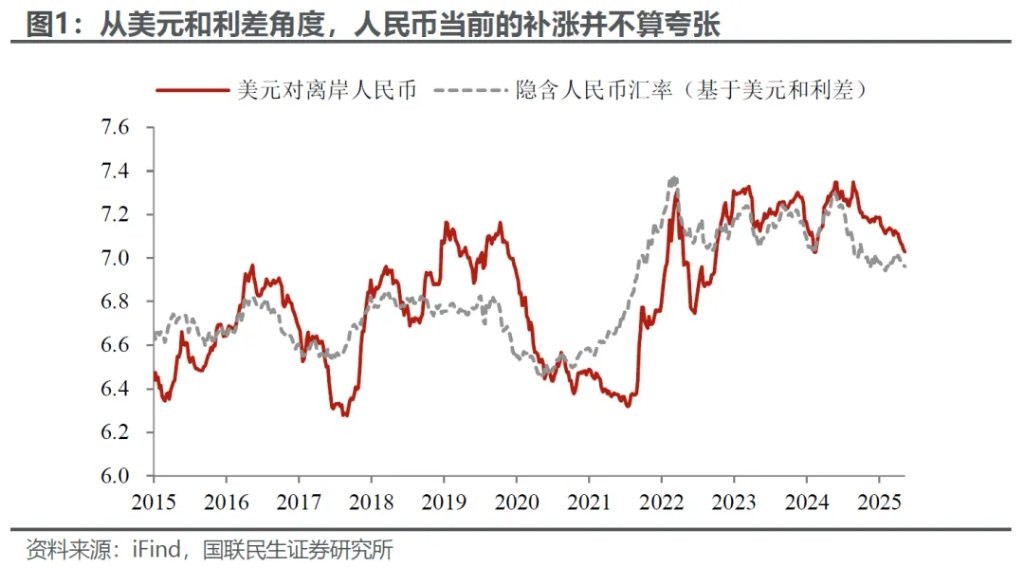
From the perspective of financial markets and asset prices, the current appreciation of the RMB can be considered a catch-up, and the increase is not excessive (from the perspective of the dollar and interest rate differentials, see Figure 1);

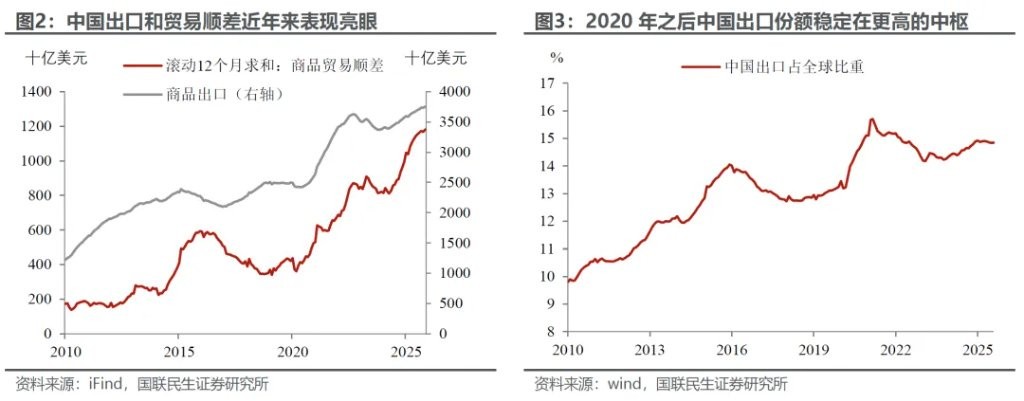
From the trade perspective, China's (goods) trade surplus (rolling 12-month sum) continues to set historical highs, and one possible reason behind this is that the RMB has appreciated too little (undervalued);

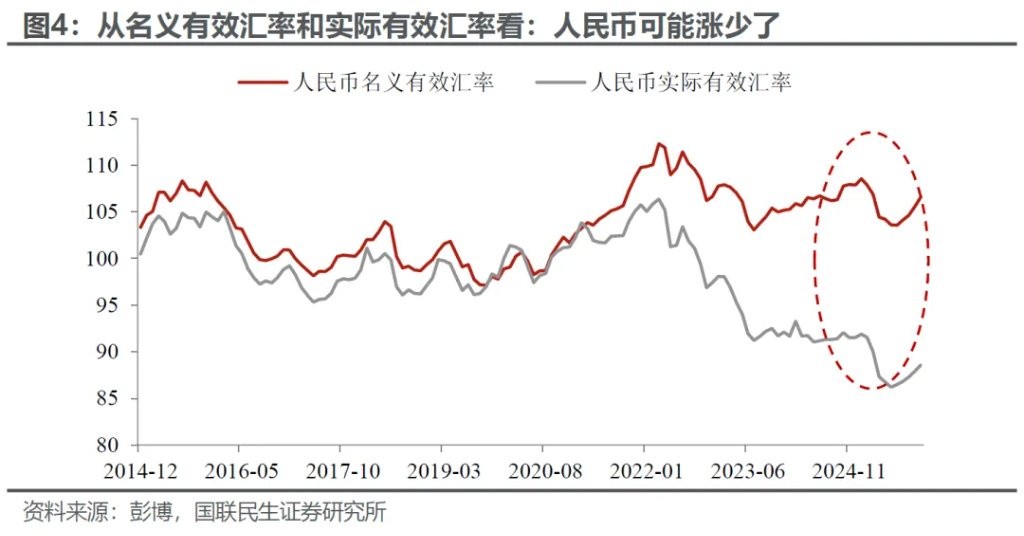
From the inflation perspective, in recent years, the "gap" between the nominal and real exchange rates of the RMB has been widening, indicating that the RMB has depreciated too little, with the lesser depreciation being compensated by low domestic inflation.

So how should we view this issue? Pay attention to timing and the main contradictions of the phase, and do not easily link phase fluctuations in exchange rates with macro narratives.

We tend to believe that the current fluctuations in the appreciation of the RMB exchange rate are reasonable. There are three main factors behind this: the weakness of the dollar, catch-up under changing expectations, and concerns about the seasonal pattern of concentrated foreign exchange settlement at the end of the year and the beginning of the next year:

The dollar index peaked on November 21 and has since weakened, while the RMB began to appreciate rapidly during the same period;

After high-level meetings between China and the U.S. in South Korea, a one-year trade easing period was reached, releasing the risk of the RMB and changing expectations;

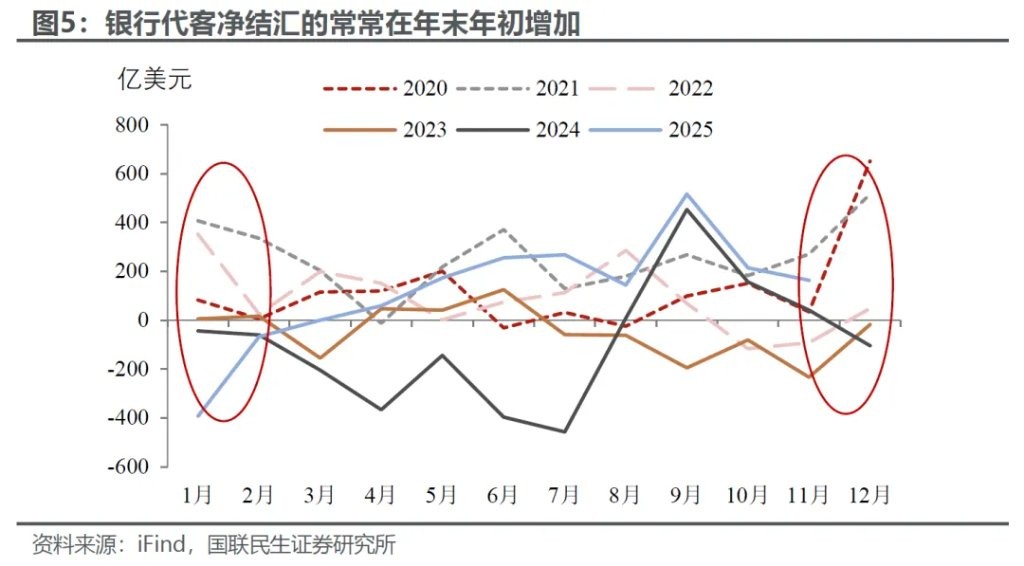
Additionally, based on the experience of normal years, generally, the scale of net foreign exchange settlement at the end of the year and the beginning of the next year tends to rise regularly (in 2024, influenced by tariff shadows, this is relatively unusual).

Trade and inflation are both medium- to long-term economic issues, and their weight in short-term market fluctuations is not that high. We do not deny that the exchange rate is a very important macro variable, but like other policy variables, the exchange rate takes time to impact the economy, and during this process, policies may respond to changes in the exchange rate, such as implementing appropriate easing measures to hedge Therefore, further observation is still needed.

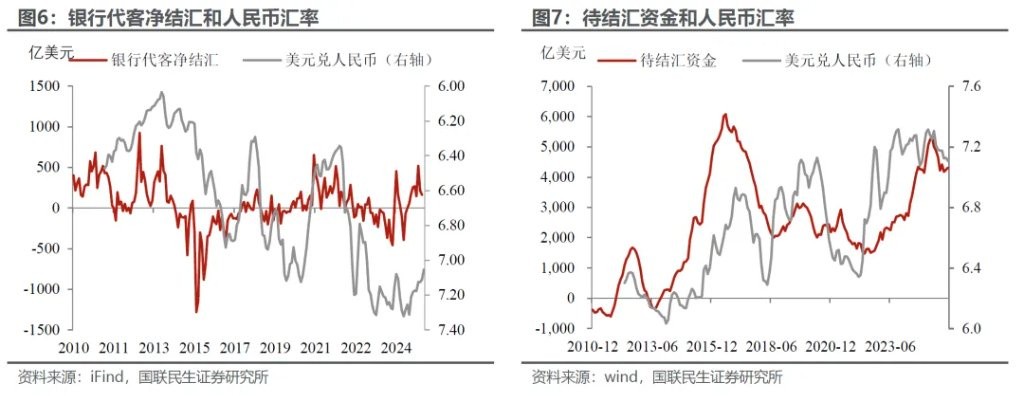
Of course, this does not mean that we are completely unconcerned about appreciation. What we are more concerned about is the risk of overshooting appreciation brought about by subsequent "panic currency settlement." The fluctuations in the RMB exchange rate can easily form a consensus expectation and a self-reinforcing market trend. Currently, it is particularly important to be wary of the risk of panic currency settlement of the funds accumulated for settlement in previous years: on one hand, the weak expectation for the RMB has reversed this year; on the other hand, the interest rate differential between China and the U.S. has narrowed this year, and under the expectation of exchange rate appreciation, the attractiveness of overseas financial products such as the U.S. dollar has rapidly declined. The last time the expectation of "currency settlement-appreciation-currency settlement" was reinforced, the RMB exchange rate once broke through 6.3; if a similar situation occurs, the impact on the economy cannot be ignored.

So how do we view the future? We will answer two questions:

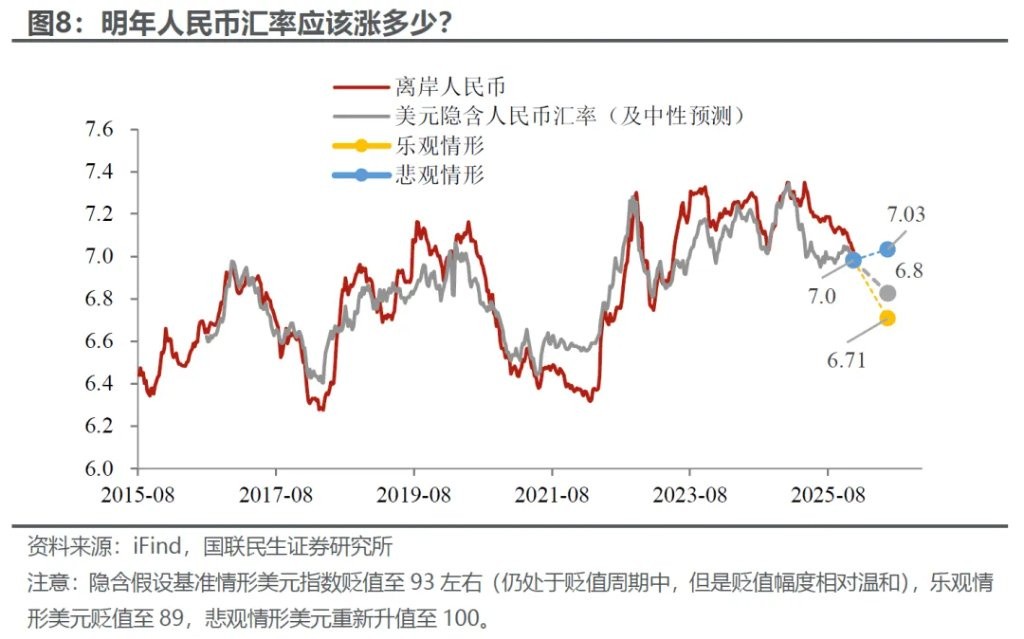
How will the exchange rate rise? Based on expectations for the U.S. dollar and the China-U.S. interest rate differential next year, we estimate that a relatively reasonable potential level for the U.S. dollar against the RMB next year is around 6.8 (Figure 8, where we also consider that the central bank's control over the exchange rate will be more flexible than in previous years).

However, the exchange rate market has always been difficult to be "reasonable." What factors could lead to further appreciation of the RMB? In addition to the potential concentrated currency settlement mentioned above, the central bank's unexpected significant reduction in control over the exchange rate, as well as unexpected progress in China-U.S. trade negotiations that significantly reduce export risks.

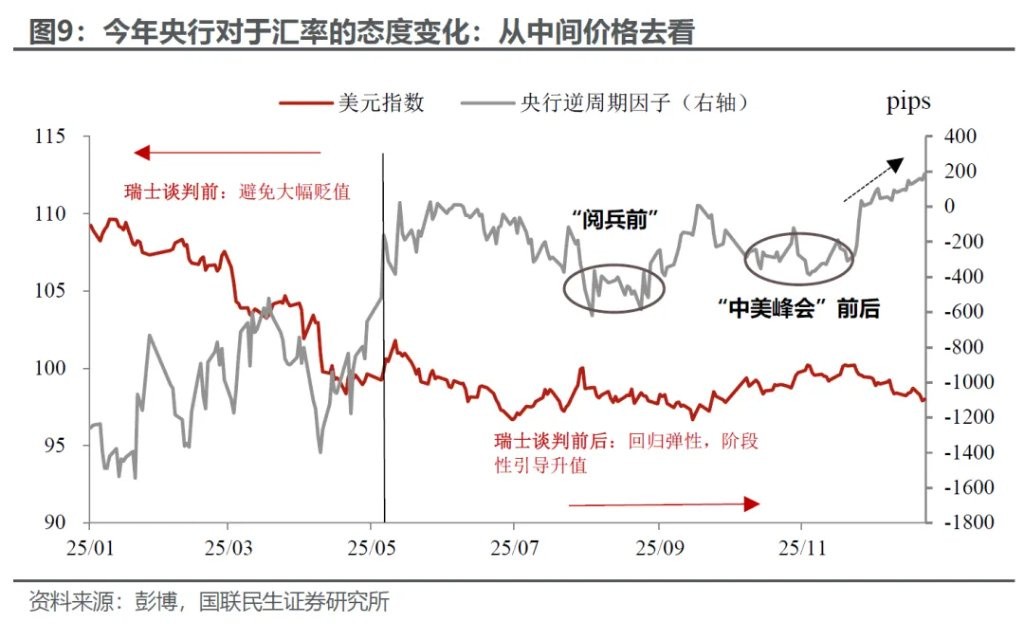
How does the central bank manage? The recent adjustment of the RMB central parity rate towards depreciation has already reflected the central bank's intention to cool down appreciation, but it is still at a relatively preliminary stage. As appreciation pressure increases, the official toolbox mainly has two aspects:

Exchange rate tools: For example, guiding expectations through official media, discussions by self-regulatory organizations, influencing the market through buying and selling actions of commercial banks, and adjusting the macro-prudential coefficients for cross-border investment and financing.

Other tools: Implementing necessary reserve requirement ratio cuts, interest rate cuts, and other easing measures (after all, the Federal Reserve has continuously cut interest rates).

For next year, we tend to believe that appropriate regulation of appreciation by the central bank may be necessary, mainly based on the consideration of symmetrical management principles. In the past few years, when there was significant depreciation pressure on the RMB, the central bank emphasized the "stability" of the exchange rate; similarly, under the growing expectation of appreciation, the central bank should also pay attention to "stability," which can more balanced and reasonably distribute the macroeconomic impacts brought by the exchange rate.

Source: Chuan Yue Global Macro