


Behind the 145% Surge in Silver: Retail Investor Frenzy is Driving the Market to Extremes

Since the beginning of this year, silver prices have soared, breaking through $75 per ounce, far exceeding the increase in gold. This round of market activity is driven by strong industrial demand and tightening supply, further amplified by a surge of retail investors. From physical silver bars to silver ETFs, the enthusiasm of ordinary investors has boosted trading volumes and intensified market volatility. Analysts warn that the silver market is prone to sharp rises and falls, and the current frenzy led by retail investors is pushing prices to the brink of risk
Since the beginning of this year, silver prices have soared by 145%, breaking through $75 per ounce. After reaching a 45-year historical high in October, the upward momentum remains strong, significantly outperforming gold, which has risen about 70% during the same period. The enthusiasm of retail investors is pushing the silver market to extremes.
The upstream mining sector has benefited significantly, with major mining companies such as Hochschild Mining and Coeur Mining seeing their stock prices double this year. Meanwhile, retail investors are accelerating their entry into the market. Their participation includes physical silver collection, silver ETFs, and derivatives trading across multiple dimensions, involving both traditional precious metal allocators and a large number of sentiment-driven short-term traders.
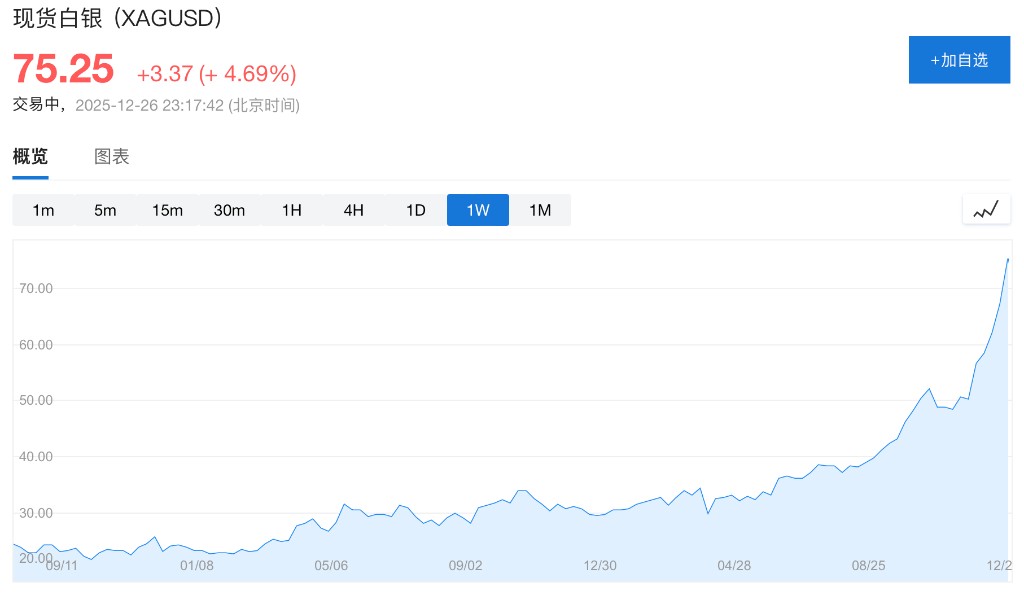
The current rise in silver prices is driven by a combination of tightening supply and increasing industrial demand. The global supply of independently mined silver is becoming increasingly scarce, while the consumption of silver in green industries such as solar energy continues to rise, putting pressure on market inventories. At the same time, the concentrated buying behavior of retail investors in silver assets further widens the supply-demand gap.
However, the extreme excitement in the market has raised overheating alarms. Bloomberg data shows that the trading volume of options for the world's largest silver ETF, iShares Silver Trust, has recently surged, approaching the high levels seen during the retail trading frenzy triggered by Reddit forums in 2021. Brent Donnelly, president of market research firm Spectra Markets, pointed out that silver prices often exhibit characteristics of rapid rises and falls, with sharp increases typically followed by significant corrections. The current market driven by retail sentiment and industrial concepts is exposing the silver market to increasing volatility risks.
Retail Investors Turn to Physical Silver Investment
Jay Moorer's shift in investment is a representative snapshot of the current silver craze. The 33-year-old truck transportation manager from Arizona has primarily invested over the past decade through trading stocks and cryptocurrencies on mobile applications. About two months ago, influenced by online video content and the rapid rise in silver prices, he began to shift towards purchasing physical silver.
Moorer's first purchase was three ounces of silver for about $150. Subsequently, he gradually accumulated around 60 ounces of various silver jewelry and coins using idle funds, storing them in a safe at home. "I know the current price is rising rapidly, but I don't plan to sell," he stated.
Compared to investing in silver through ETFs, purchasing physical assets requires investors to conduct more detailed research. Due to the current shortage of high-precision metal detection equipment online, Moorer mainly relies on stores equipped with professional testing tools for transactions and carries a small magnet for basic authenticity checks. Last December, he made his first purchase of one ounce of gold, reasoning that physical precious metals are easy to store, verify, and pass on, maintaining value even during financial market turmoil or when access to digital systems is restricted Chris Pollock, the founder and managing partner of the Canadian retail chain Canada Gold, revealed that the silver sales at its stores increased by approximately 150% year-on-year in December last year. He stated that a single-day sales record was set on a Monday this year, marking the highest in the chain's history, with a further increase of about 50% compared to the previous peak.
Supply and Demand Structure Supports Prices
The rise in silver prices is strongly supported by the supply side. Globally, high-quality silver resources that are independently mined are becoming increasingly scarce, while industrial demand from manufacturing sectors such as solar panels remains robust. The concentrated hoarding behavior of individual investors towards physical silver has further diverted metal supplies originally intended for industrial production, exacerbating market tensions.
Similar to gold, silver has long been favored by some investors due to its traditional attributes of hedging against inflation, avoiding sovereign debt risks, and mitigating uncertainties in the financial system. This year, the macro environment of declining bond yields and high stock valuations has provided additional impetus for investors to allocate more to precious metal assets.
Bullish investors emphasize that considering inflation factors, silver prices need to rise above $200 per ounce to break through the historical real high of 1980, indicating that there is still upward potential at current price levels. In contrast, cautious views argue that the relatively limited scale of the silver market and its weaker liquidity compared to gold make it more susceptible to rapid surges followed by significant pullbacks in the short term.
Rising Speculative Activity Raises Concerns
Market speculation is significantly heating up, with some investors buying silver at high prices solely due to rapid price increases. The trading volume of options contracts related to the world's largest silver ETF, iShares Silver Trust, has recently surged, reaching the highest level since the Reddit retail trading frenzy in 2021.
Due to the relatively limited market size, silver prices are more prone to dramatic fluctuations. Some analyses point out that silver prices often exhibit characteristics of rapid surges followed by quick pullbacks. This high volatility presents trading opportunities but also carries significant risks, requiring investors to remain vigilant about market cycle transitions.
Currently, gold prices have risen to about $4,500 per ounce, setting multiple historical highs in both nominal value and inflation-adjusted terms. Although silver has seen a more significant increase during the same period, its price volatility is also much higher than that of gold, necessitating more cautious risk management strategies for investors participating in the silver market
