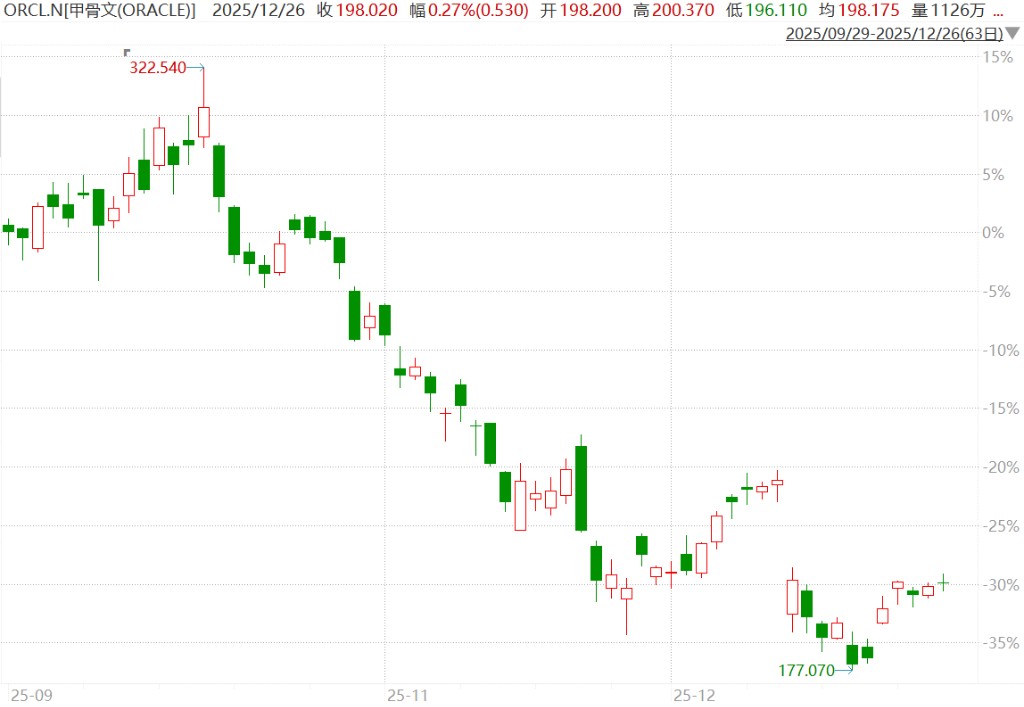
Oracle's quarterly plunge of 30%, analysts say: "If the agreement with OpenAI is not adjusted, Oracle may be unable to fulfill its obligations."

Wallstreetcn
2025.12.27 01:58
portai
I'm PortAI, I can summarize articles.

Oracle's stock price may see its largest decline since the internet bubble in the fourth quarter. Despite securing over $300 billion in orders from OpenAI, concerns have been raised over its aggressive expansion plans. Analysts warn that its investment-grade rating is at risk, and there is a danger in being overly reliant on a single client like OpenAI. However, some investors remain optimistic about founder Larry Ellison's long-term vision

Database software giant Oracle is experiencing its most severe quarterly decline in over twenty years.

In the fourth quarter, Oracle's stock price has plummeted by 30%. If there is no significant reversal in the next four trading days, it may set the largest quarterly decline since the burst of the internet bubble in 2001, when the stock price fell nearly 34%.

In September this year, OpenAI committed to paying Oracle over $300 billion, a deal that was seen as a significant endorsement of Oracle's cloud business. However, earlier this month, Oracle reported quarterly revenue and free cash flow that fell short of expectations, exacerbating market concerns.

Wall Street Journal mentioned that Oracle's performance in the second fiscal quarter of 2026 was below expectations, with capital expenditures exceeding expectations by about $15 billion. Additionally, Oracle plans to sign a $248 billion leasing agreement to enhance its cloud computing capabilities.

Aggressive expansion has raised concerns about credit risk. D.A. Davidson analysts wrote in a client report on December 12:

Given that Oracle is barely maintaining its investment-grade rating, we are concerned that Oracle may not be able to fulfill these obligations if it does not adjust its agreement with OpenAI.

The Frenzy and Retreat Brought by the OpenAI Agreement

New CEOs Clay Magouyrk and Mike Sicilia just took office three months ago, at a time when the market was unprecedentedly optimistic about Oracle.

About two weeks before they took over from Safra Catz, Oracle announced a 359% increase in revenue reserves, primarily from OpenAI's commitment.

After the report on the OpenAI agreement was released on September 10, Oracle's stock price soared nearly 36%, marking the third-largest single-day increase since its IPO in 1986, reaching an intraday high of $345.72.

For a company that failed to make it into Gartner's list of the top five global cloud infrastructure providers for 2024, this deal is significant.

However, the optimistic sentiment quickly dissipated as the market realized that Oracle's growth ambitions require substantial debt support.

In September, the company completed one of the largest debt financings in tech history by issuing $18 billion in bonds. Kehring promised to maintain the investment-grade rating during the earnings call, but some investors were skeptical, driving up the price of Oracle's credit default swaps.

In addition to $50 billion in capital expenditures, Oracle also plans to sign a $248 billion leasing agreement to expand its cloud capacity.

This pace of expansion far exceeds industry norms, while Oracle still lags significantly behind Amazon, Microsoft, and Google in the cloud infrastructure market, failing to make it into Gartner's top five cloud infrastructure providers by revenue for 2024

The Difficult Trade-off Between Growth and Profitability

In October of this year, Sicilia, Magouyrk, and Kehring outlined a blueprint for rapid growth.

By fiscal year 2030, revenue is expected to leap from $57 billion in fiscal year 2025 to $225 billion, with growth primarily driven by AI infrastructure business centered around NVIDIA GPUs.

However, this "hyper-growth" will come at the expense of profitability.

In fiscal year 2021, Oracle's gross margin was as high as 77%, but analysts surveyed by FactSet expect it to drop to about 49% by 2030.

Cumulative negative free cash flow over the next five years is expected to reach about $34 billion, turning positive only by 2029. Analysts believe this decline in profit margins reflects the painful transition from high-margin software business to low-margin infrastructure business.

Eric Lynch, Managing Director of Suncoast Equity Management in Florida, stated that it is difficult for investors to feel reassured about Oracle's plans. He said:

Four to five years is too long; it does not align with our investment discipline.

The Risk of Over-reliance on a Single Client

Lynch is also concerned about Oracle's heavy reliance on OpenAI.

Wells Fargo analyst Michael Turrin estimates that by 2029, OpenAI could account for more than one-third of Oracle's revenue. However, OpenAI itself is rapidly burning cash, having committed over $1.4 trillion to AI construction and investment. Lynch questioned:

Will the demand for OpenAI continue to exist?

Another challenge Oracle faces is enhancing market recognition.

Despite a client list that includes Meta, Uber, and Musk's xAI, data processing giants Databricks and Snowflake do not offer services on Oracle's cloud platform.

Databricks CEO Ali Ghodsi stated in an interview:

When customers start knocking on my door saying 'you need to run on Oracle,' we will do so. We may be getting close to that point, but we haven't heard that call yet.

Long-term Believers Still Bet on the Founder

Not all investors are bearish.

Zachary Lountzis, Vice President of Lountzis Asset Management, stated that his team has held Oracle stock since 2020, when the share price was below $60. They also increased their holdings by about 30,000 shares in the first quarter of this year. As of September 30, the firm holds $25 million worth of Oracle shares.

Lountzis said:

We think $340 is indeed scary, but we are tolerant of short-term overvaluation as long as the business economics do not change. A drop from $340 to $180 is actually a very healthy correction.

His confidence largely stems from founder Larry Ellison. According to Bloomberg data, the entrepreneur who founded Oracle in 1977 is currently the second richest person in the world. Lountzis said:

Shorting Larry over the past 50 years would have bankrupted you 40 times; he can see the future.

Earlier this month, Wells Fargo's Turrin gave Oracle an equivalent buy rating with a target price of $280. He believes that if Oracle delivers on its promises to OpenAI, industry perception may improve