"The Hidden Corner": The Returns of High-End Wealth Management Channels in the Era of Low Interest Rates "Innovation"

For a product that has been repeatedly emphasized as providing a "near cash experience," the operation of this "Cash Treasure" cannot be simply applied using the logic of traditional money market funds or single private equity products; it is more like a cash solution aimed at a specific customer group
After low interest rates gradually became the norm, a somewhat "strange" phenomenon in the industry began to emerge.
On one hand, cash-like tools aimed at the public are seeing returns that are increasingly similar, with functions becoming more and more homogeneous.
On the other hand, some products that only appear on the high-end wealth management shelves of large brokerages, primarily targeting private equity clients, have taken a completely different path in the matter of "holding cash."
What should originally be simple and transparent "cash" is now being placed into more complex arrangements.
This change is not ostentatious and is rarely discussed separately, yet it is quietly happening.
For a portion of funds, "where to place them" is no longer just a choice of yield but has entered another operational system.
The "Exception" in Idle Money Products
In the current low interest rate environment, the returns on funds that are temporarily unused but can be withdrawn at any time are now quite similar across various products.
Zhi Shi Tang has noted that a product called "Cash Treasure" under the wealth platform of CICC stands out among similar cash products.
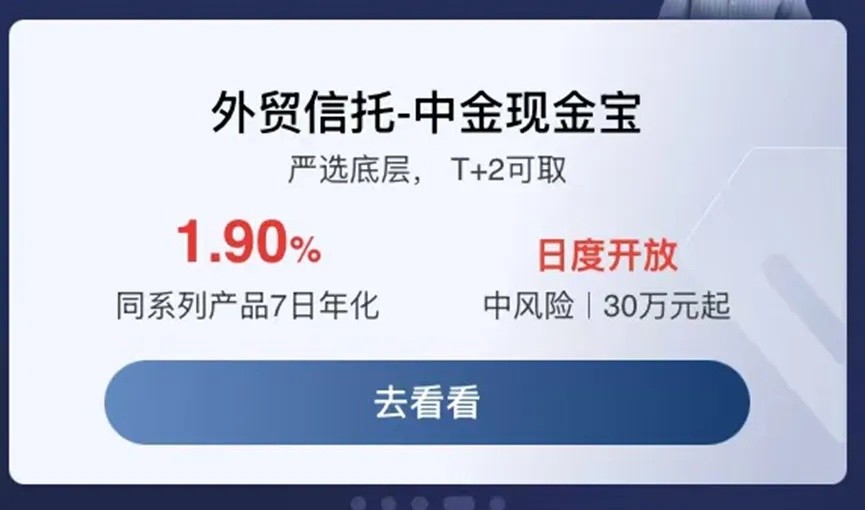
The full name of this product is "Foreign Trade Trust - CICC Cash Treasure XX Collective Fund Trust Plan," hereinafter referred to as "CICC Cash Treasure." Public information shows that this product is open to high-net-worth clients in the private equity sector, with a seven-day annualized yield of up to 1.9% (as of December 25, 2025).
This "outstanding" performance in returns comes from a direct comparison with current mainstream cash management tools.
As of now, the one-year fixed deposit rate of state-owned banks has fallen below 1%, and the five-year fixed deposit rate is about 1.3%. During the same period, the yield on ten-year government bonds is running around 1.80%, while the annualized yield of most "baby" money market funds remains around 1%.
In this context, the difference between CICC Cash Treasure and traditional fixed deposits, government bonds, and money market funds mainly lies in its relatively higher yield, and the product's clientele does not cover all ordinary investors.
How This Money Is Placed
From its name, "CICC Cash Treasure" is not a fund but a trust product, and its full name includes "collective fund trust plan," which determines its basic form.

In simple terms, investors do not directly hand their money to CICC but instead pass their funds through a trust channel to be managed uniformly by China Foreign Economic and Trade Trust Co., Ltd. (referred to as "Foreign Trade Trust").
CICC's role in this is to provide investment advice and specific operations for this trust, commonly referred to as "managing."
As shown in the image above, this product deliberately promotes an experience that is close to "holding cash":
The product supports daily open subscriptions and redemptions, and after investors submit a redemption request, funds are generally available within T+2 trading days.
In other words, this product does not require long-term locking of funds and has liquidity arrangements that are quite similar to most cash-like products
It Looks Like a Money Market Fund, But It Is Not
Since the user experience is so close to cash, why didn't CICC Cash Treasure directly create a money market fund?
From the usage perspective, CICC Cash Treasure is relatively close to money market funds in terms of liquidity arrangements: it supports daily open subscriptions and redemptions, mainly used to place funds that are temporarily unused but still wish to maintain a certain degree of flexibility for withdrawal.
However, unlike most money market funds that can be credited on T+0 or T+1, the redemption of CICC Cash Treasure is credited on T+2 trading days, which still belongs to the operational rhythm of trust products.
In terms of product form, it has not adopted the more common money market fund format in the market, but has taken the trust channel.
This arrangement is different from cash management products that ordinary investors are more familiar with: trust products are not open to everyone, and the participation threshold is relatively high. The subscription starting point for CICC Cash Treasure is 300,000 yuan, and investors still need to complete the qualified investor certification (meeting the private placement client admission standards), so whether one has the qualification to participate is not solely determined by the initial investment amount.
Because of this, while CICC Cash Treasure is "close to cash in terms of user experience," it still maintains a clear distinction from ordinary money market funds in terms of crediting rhythm, product carrier, and operational methods.
According to Zhitang, private placement products often take the trust channel mainly to concentrate dispersed funds for unified management, which is also more flexible in operation.
Layer Upon Layer
When this product, originally just used to "hold cash," requires multiple layers of arrangements to operate, things become less straightforward.
Underneath CICC Cash Treasure, the funds do not directly enter specific bonds or money market instruments.
According to the product prospectus, the funds subscribed by investors in CICC Cash Treasure are mainly directed towards the shares of another trust product.
Yes, you read that right!
The full name of this cash treasure is itself a trust plan, but the funds raised are directed towards another trust plan.
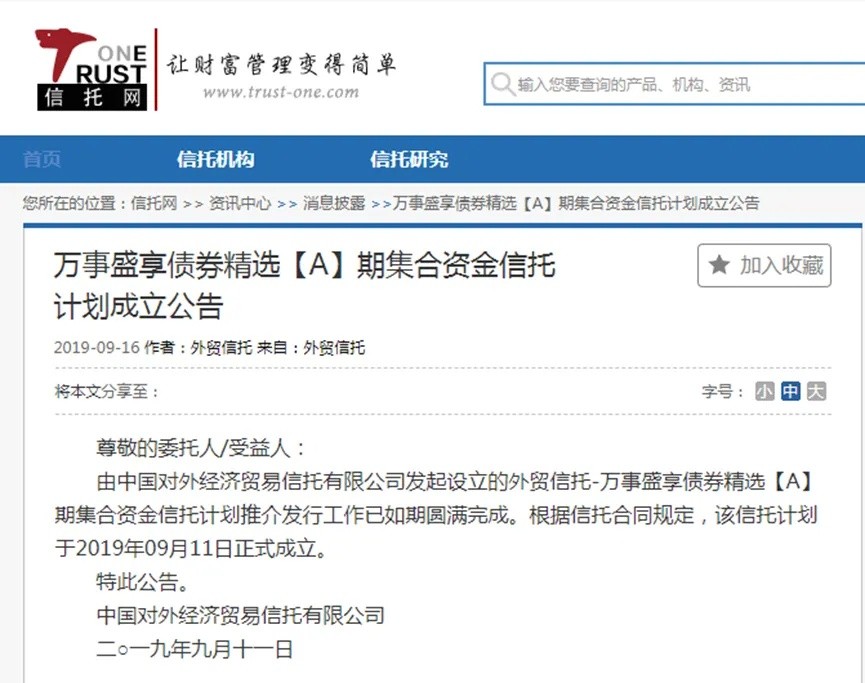
Specifically, the relevant funds are mainly invested in the "Foreign Trade Trust - Wan Shi Sheng Xiang Bond Selection [A] Phase (Ri Ri Xin) Collective Fund Trust Plan," with China Foreign Economic and Trade Trust Co., Ltd. acting as the trustee.
This arrangement constitutes the most intuitive "layer upon layer" structure of CICC Cash Treasure:
The first layer is the cash treasure product purchased by investors.
The second layer is the underlying trust plan it is directed towards, while the real asset allocation occurs in the deeper layer.
In the underlying trust, funds are mainly allocated to standardized fixed-income assets, along with high liquidity tools such as reverse repos and interbank certificates of deposit, to meet the overall subscription and redemption arrangements.
By this point, the "complexity" of the product has begun to emerge.

Limited by publicly available information, we cannot further ascertain the specific operational details of the "Foreign Trade Trust - Wan Shi Sheng Xiang Bond Selection [A] Phase (Ri Ri Xin)," but it can be confirmed that this underlying trust was established on September 11, 2019 From the name and investment direction, this is a product primarily focused on bond-type assets, and its risk level is correspondingly higher than that of ordinary money market funds.
"Unconventional" Commission Structure
What is truly noteworthy is the "unconventional" fee structure under this arrangement.
According to the product documents, the underlying trust has set a clear performance benchmark, and the portion exceeding the benchmark will be charged as a floating management fee, with a charging ratio of 100%, calculated on a daily basis.
This practice is distinctly different from most private equity products in the market.
Whether it is private equity securities funds or hedge funds, the extraction ratio of excess returns is usually around 20%. Some high-performing or strong-negotiating quantitative private equity funds can charge 25%-30%, and most settle on an annual or periodic basis, rarely adopting an "all-inclusive" charging method.
In the structure of CICC Cash Treasure, excess returns are not shared between investors and the management party but are fully included in management fees.
This arrangement is more "direct" in form, breaking through the more common profit distribution practices in the private equity industry.
It is important to note that this fee mechanism does not occur in a high-volatility, high-risk offensive product but is embedded within a cash-type product structure that is repeatedly emphasized for "liquidity" and "ease of access."
Where Exactly Is This Money?
Finally, we need to return to the actual performance of the product itself.
From the yield curve of CICC Cash Treasure, its yield per ten thousand shows a highly regular distribution characteristic over a long period, with the yield level concentrated in a similar range on most trading days, only showing significant increases at certain points in time.

At the same time, the evolution of the identification numbers of CICC Cash Treasure on the platform also provides another detail worth noting.
Public information shows that this product has appeared successively in the form of numbers 1 to 11, followed by the emergence of a sub-number plan 151.
When observing these phenomena together, some questions arise:
Is CICC Cash Treasure a product that operates independently around a single asset and a single account? Or is it closer to a continuously operating fund collective?
It is important to emphasize that this understanding does not equate to a judgment on the product's compliance.
In the actual operation of trusts and private equity products, it is not uncommon to manage funds in layers through multiple sub-plans.
However, for a product that is repeatedly emphasized as providing a "cash-like experience," the existence of such an operating method is difficult to simply apply using the logic of traditional money market funds or single private equity products.
CICC Cash Treasure resembles a cash solution aimed at a specific customer group······