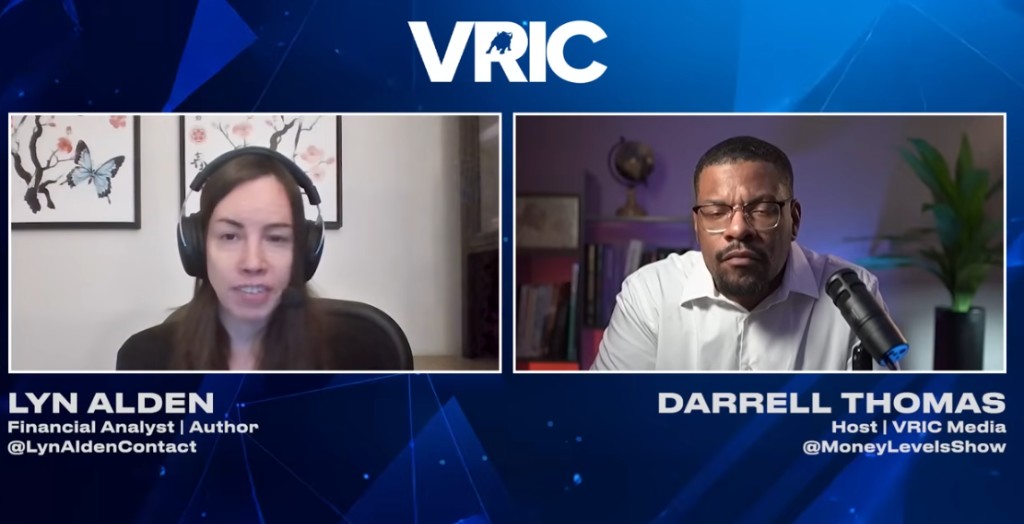
Lyn Alden: Silver may hit $100 in 2026, but it is no longer a "low-risk, high-reward" opportunity

Macroeconomic strategist Lyn Alden pointed out that driven by fiscal dominance and currency depreciation, silver is expected to challenge the $100 mark in 2026, but its era of "low-risk high-return" asymmetric trading has come to an end. As valuations gradually repair, silver has currently entered a "symmetric phase" where the probabilities of rising and falling are more balanced. She emphasized that whether silver surges to $100 or pulls back to $40 next year, it would not be surprising
Silver has surged, and a three-digit price is not out of reach, but its era of "low risk and high return" may have come to an end.
On December 28, renowned macro strategist and founder of the investment newsletter "Lyn Alden Investment Strategy," Lyn Alden, revealed to investors in a recent interview with VRIC Media the key drivers that could push this precious metal to $100 by 2026. However, she also calmly warned that, given silver's significant rise from low levels, "it no longer has the asymmetry it had when silver was at $20 an ounce or even lower," indicating that its era of "low risk and high return" may have ended.
Lyn Alden admitted that, for some time, gold has performed strongly, while silver and platinum have "remained stagnant," but now they are "finally starting to explode." She stated, "I am currently enjoying the rise of silver," but also revealed her cautious stance as a "contrarian investor": "When I see people on Twitter saying 'silver at $60,' 'silver at $61,' 'silver at $62,' my contrarian thinking gets nervous... I wouldn't be surprised by a pullback in silver." Nevertheless, she still believes that "gold and silver have not been overvalued in the recent enthusiasm," and their rise is more about "making up for previously undervalued worth."
Regarding whether silver can reach three digits, Lyn Alden gave an affirmative answer: "I think it can." She believes that the recent rise in silver is a "combination of valuation recovery and overshooting." Historical experience shows that "mean reversion often overshoots," whether upwards or downwards. She pointed out that silver is currently at a "reasonable price level," but "that does not mean it won't overshoot." However, she also reminded investors that silver's current trading "no longer has the asymmetry it had when silver was at $20 an ounce or even lower." In other words, its opportunity attributes of "low risk and high return" have weakened. "Now I think this is a more symmetrical trade; if it rises to $100 next year or falls to $40 next year, I wouldn't be surprised." She emphasized that she still "holds a long position in silver," but is "lowering her future expectations" because it "has already realized most of her previous theories."
Lyn Alden delved into the macro backdrop supporting the strength of hard assets. She pointed out that the Federal Reserve announced the end of quantitative tightening at the end of 2020 and stated that it would reinvest the proceeds from maturing mortgage-backed securities into short-term Treasury bills while injecting funds into the repurchase market. She bluntly stated: "This is functionally very similar to quantitative easing... I think this is money printing, and it is very similar to quantitative easing." She explained that this is more of a "semantic distinction," and essentially still involves "structural gradual money printing" to ensure "market liquidity and functionality for the Treasury" and the "normal operation of the core repurchase market and all interbank lending," even if inflation is "above target." This means that the Federal Reserve is entering a "fiscal-dominant" phase. When discussing the future of the US dollar and real assets, Lyn Alden cites Ray Dalio's viewpoint, pointing out that when central banks prioritize supporting government deficits over controlling inflation, it often accelerates currency depreciation. She believes that sovereign economies facing high debt "rarely solve problems through nominal defaults or spending cuts; they typically default through loss of purchasing power." Therefore, she expects "inflation to remain sticky," and the purchasing power of the dollar to continue declining. In this "fiscal dominance" context, she holds a "fairly optimistic" view on most commodities and emphasizes that investors should "think in terms of purchasing power rather than just nominal returns." She uses emerging markets as an analogy, suggesting that in the current environment, even if the US stock market reaches new nominal highs, its real purchasing power may continue to weaken relative to hard assets like gold and silver.
In summary, Lyn Alden's analysis outlines a macro picture where hard assets continue to strengthen under fiscal dominance. Silver, as an important player in this trend, has a valuation rebound and potential future highs worth looking forward to, but investors should also be wary of its short-term volatility and asymmetric risk decline.
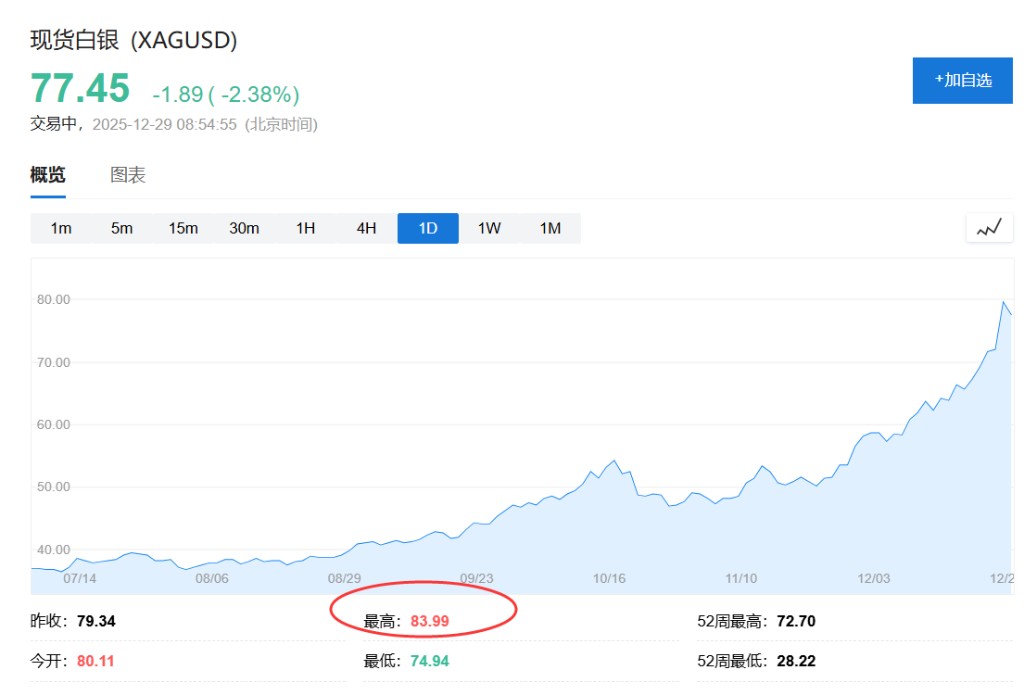
Today, after spot silver surged to a historic high of $83, it has retreated and is currently down over 2%, but the price remains in the historical high range.
Key Points:
- Silver Valuation Rebound and Overshoot: As a hybrid of industrial and precious metals, silver has been undervalued for a long time, and its recent rise reflects a valuation rebound, but it may overshoot in the short term, necessitating caution regarding pullback risks. Lyn Alden predicts that silver could hit $100 by 2026 but emphasizes that it is no longer a "low-risk, high-return" asymmetric trade.
- Federal Reserve Policy Shift: The Federal Reserve has "quietly" ended quantitative tightening and shifted to "structural gradual money printing," marking a new phase of fiscal dominance, ensuring liquidity in the bond market even if inflation exceeds expectations.
- Declining Dollar Purchasing Power: Under fiscal dominance, government debt will be resolved through loss of purchasing power rather than nominal defaults, putting long-term weakening pressure on the dollar, which benefits hard assets and demand for emerging market commodities.
- Hard Assets Outperform Risk Assets: In the context of fiscal dominance and currency depreciation, nominal assets like stocks may rise, but their real purchasing power relative to hard assets like gold and silver will continue to decline.

The full translation of Lyn Alden's interview is as follows (slightly abridged) :
Host Darrell Thomas 00:00
Hello everyone, welcome to VRIC Media, your most trusted voice in the metals and mining investment space. I am your host, Darrell Thomas. Today, we are pleased to have Lyn Alden from Lyn Alden Investment Strategy with us. How are you today, Lyn?
Lyn Alden 00:12
I'm good, how about you?
Darrell Thomas 00:13
I'm good. You are one of my favorite macro analysts, one of the greatest analysts of all time (GOAT). I think you are one of the greatest analysts, one of the greatest in history. This might be a bit offensive to some in the field, but at least, at least you are one of the greatest of our generation, assuming you and I are both millennials.
Lyn Alden 00:32
I am a millennial. Yes, but I wouldn't call myself "the greatest of all time," but I do my best. So thank you for the compliment.
Darrell Thomas 00:36
Yes, yes. I started subscribing to your service and newsletter around 2020. So I've been following your latest articles and interviews. Recently, you published a public newsletter about currency devaluation trades. So I want to start with the Federal Reserve and connect it to devaluation trades. In late October, the Federal Reserve announced it would end quantitative tightening on December 1, and they have done so. The Federal Reserve also stated that it would reinvest about $15 billion in Treasury securities using the proceeds from maturing mortgage-backed securities. Since then, we have also seen the Federal Reserve inject about $40 billion into the repo market. So they are buying these short-term Treasury bonds, but they are carefully not calling it quantitative easing, instead labeling it as reserve management purchases. So from your perspective, is this functionally quantitative easing? Does it signify a significant shift in monetary policy?
Lyn Alden 01:41
Well, good question. I would say it is functionally very close to quantitative easing. You know, my stance is that this is money printing. It is very similar to quantitative easing. And I have even said before that when they start expanding the balance sheet, they won't call it quantitative easing because they are not focused on buying long-term bonds and not for the purpose of economic stimulus. But this is largely a semantic issue, not entirely, but largely a semantic one. So I think it is very close to quantitative easing. And this has largely been anticipated. You know, the New York Fed even mentioned it in their annual report on the state of the balance sheet and expectations. They believe that by around 2025 or 2026, the balance sheet will eventually bottom out and then begin to rise roughly in line with normal GDP growth. They even predict that by then they will continue to accumulate Treasury securities but will allow mortgage-backed securities to naturally mature off the balance sheet, trying to normalize in this way so that they do not have a real impact on the real estate market like they did after the global financial crisis and during the COVID pandemic
So, I think this is quite a significant shift. This isn't something that has a major impact every week, but when you move from a structural reduction in base liquidity and a quantitative tightening environment to stability, and then to a gradual expansion of the balance sheet, it really matters over a few months. Before the global financial crisis, the Federal Reserve's balance sheet was indeed gradually expanding over time. That wasn't really quantitative easing; it was just a kind of gradual printing at the base level. Now, the future situation is similar, with the key difference being that due to all these post-global financial crisis regulatory requirements, banks have higher liquidity and capital requirements. Therefore, the proportion of the balance sheet relative to the size of the economy is higher, and now it is structurally growing roughly in sync with the economy. What I mean is, this is a key difference between the fiat currency system and things like gold or Bitcoin. That is to say, if there are too many IOUs (I Owe You) of hard currency, these IOUs must collapse back to the actual base level. In the fiat currency system, if there are too many IOUs relative to the base level, they can directly adjust the base level up or down. That is what is happening.
Darrell Thomas 03:58
I'm curious, so in your recent article, you mentioned that you think this is gradual printing. I know some people believe the scale of printing will be much larger, like the Federal Reserve opening the floodgates, almost similar to what happened during the COVID-19 pandemic. You know, that's also one of the reasons I enjoy reading your work, because you do take a more balanced approach, trying to weigh all the different possible outcomes. Obviously, if some kind of crisis or black swan event occurs, I believe the Federal Reserve would open the floodgates. But how do you see the interaction between this gradual printing and the market in the coming years?
Lyn Alden 04:45
You're right. So I agree with your point that the Federal Reserve will do almost anything they need to do. I think in most cases, most scenarios do not point to large-scale printing. Of course, there is the possibility of war or other crises that could trigger larger-scale printing. But, you know, my high-probability baseline scenario is more gradual printing. I think they will basically take the minimum required, or slightly above the minimum, to maintain: first, the liquidity and functionality of the government bond market; second, the core repurchase market, all interbank lending, etc., which are the real core markets. Because if the stock market drops 20%, the Federal Reserve doesn't really care. They really don't care. You know, if gold rises 20% or more, many investors might think they care, and they do pay attention to that. But what they really cannot allow to be paralyzed for a long time is the government bond market and the adjacent markets that use these government bonds as liquidity collateral, like the repurchase market
Therefore, I do believe we are moving towards a more gradual environment, which I think is characterized by fiscal dominance. Essentially, the Federal Reserve will support the bond market. They won't say it, but that's what they're doing, even as we have inflation above target; they are selling mortgage-backed securities and buying government bonds. Even when the Fed makes balance sheet forecasts, they aren't really talking about the inflation of the past few years. What I've been saying is that around this time, we will see balance sheet expansion. I've said that regardless of what the headline CPI is, they will resume balance sheet expansion because they need to maintain liquidity in the bond market and keep the repo market functioning, no matter what the CPI data is. They can take other measures to try to curb inflation within their capabilities. But I think, fundamentally, they are now in a position where they need to respond to these core markets.
Next year, when we may have a different Federal Reserve Chair and slightly different board members, we might see the Fed behaving a bit more dovishly, with a closer connection between the central bank and the government, whereas typically this should be a relationship that maintains distance. But I still believe that there won't be a huge shift in policy. I think we will see more gradual changes, and they can pull many different levers, and they have already started pulling some of them. For example, they adjusted the supplementary leverage ratio rules, which sounds like a bunch of jargon, but is essentially a very slight easing of regulations on banks, allowing them to hold a bit more government bonds within given liquidity and capital requirement levels. There are also some proposals within the Fed and elsewhere to further relax these rules, essentially allowing large banks to hold more government bonds, and they already have regulations in place to reduce the risk of government bonds. So, fundamentally, they are either providing liquidity with their own balance sheet (like creating base reserves to buy government bonds) or allowing private banks to take on these on their balance sheets. So, several different levers working together can put them in a fairly accommodative position without appearing overly dovish.
Darrell Thomas 08:07
Yes, so. How dovish does the Fed need to be to... First of all, we have different agendas like rebuilding manufacturing and resuming mineral extraction, which will require billions, even trillions of dollars to restart. So I'm a bit curious, well, where do we get this money from? Obviously, tariff revenues are currently under review by the Supreme Court. President Trump said we brought in trillions of dollars in revenue; I mean, I don't know if he was just speaking off the cuff or really believes that, or what. Just curious about your thoughts.
Lyn Alden 08:55
Yes, so what I mean is that before tariffs, our structural deficit was about $2 trillion. Roughly speaking, we spend $7 trillion and take in $5 trillion, so we have about a $2 trillion gap. Tariffs brought in about $400 billion in annualized revenue. You know, this number may change over time
So what we are seeing is a form of deficit reduction that is equivalent to a tax increase, by about 20%. As you pointed out, this is currently under scrutiny by the Supreme Court. There are lawsuits against this policy, not questioning the legality of the tariffs, but questioning whether the president can simply use emergency powers to bypass Congress and impose taxes of any size and duration on any country indefinitely. This is being challenged. It may not eliminate the tariffs entirely, but if the Supreme Court rules in a specific direction, it could substantially reduce that $400 billion annual figure, which is a significant number; $400 billion is quite meaningful.
But again, we are talking about a $2 trillion deficit. This is just one of many variables, and it could slow down economic growth. So sometimes you can increase revenue through tax increases, but that could weigh down parts of the economy. Subsequently, due to lag effects, you might see a decrease in economic activity and a decline in tax revenue elsewhere. So it’s not even clear if this is the $400 billion that is directly injected into the federal treasury.
But in any case, I think where the money will come from, in part... I tend to think this won’t happen on a large scale, at least not strategically. Some parts could happen, such as rare earths. That’s actually not a very large number, but it’s an important part of rebuilding the industrial base, which is a trillion-dollar level issue. If you look at the data so far this year, I mean, industrial output is roughly flat, the manufacturing Purchasing Managers' Index is roughly flat, and manufacturing employment is flat or even slightly down this year. I think this, I mean, this is a problem that has accumulated over decades, related to issues like the Triffin dilemma and structural factors of our status as a reserve currency. These issues are difficult to resolve, and they cannot be solved without making certain trade-offs, and so far no administration has been willing to make those trade-offs. No one even acknowledges the existence of these problems. So I think this will be a very slow process. Right now, most of the fiscal deficit is flowing more into insurance and defense areas. They are going into Social Security, Medicare, military spending, veterans' benefits, and debt interest. Currently, the vast majority of deficit spending is going into these areas. This does help certain areas and nominally keeps the economy running hot overall, even if it squeezes other parts of the economy.
So on average, we are in this K-shaped recovery or dual-speed economy: generally speaking, if you are older or wealthier, you are doing pretty well right now—not everyone is, but statistically that’s the case. And if you are younger or poorer, if you are a young family trying to buy a house and you are not on the side benefiting from fiscal spending, but rather on the wrong side of higher interest rates and higher mortgage rates—part of the reason is that fiscal spending has pushed up these rates—then overall, you are not doing well right now. So I think the money will come from the Federal Reserve's support of the bond market when necessary. Other than that, we might be in this more moderate environment where we may not see these massive trillion-dollar plans in the short term. But the overall economy is still running above baseline. There is still time, but between now and the midterm elections, they might try to push through some relatively large bills, like numbers around $500 billion You know, due to all the inflation, these numbers are no longer considered huge. But after the midterm elections, we might see similar situations depending on the election results. There could be a more polarized political landscape. So I think, from a fiscal perspective, this is challenging. I believe we will continue to operate in a slightly overheated manner. But my baseline scenario is not super overheated unless I start seeing specific legislation gaining significant momentum.
Speaker 3 13:27
(Advertisement content, unrelated to the interview subject, omitted)
Darrell Thomas 14:06
Okay, there are a few points regarding this. First, all these large AI tech companies have committed to investing billions of dollars in building data centers and so on. So I'm curious how this will affect things like our grid upgrades? Additionally, there is discussion that due to data centers, electricity costs for people in certain areas of the U.S. may increase.
Also, I'm curious about your thoughts on the "Fourth Turning." I interviewed Neil Howe not long ago, and he mentioned that natural resources will be one of the biggest investment areas coming out of the Fourth Turning. My thought is, well, we will have a major crisis, and then we may have to significantly cut spending. I mean, this might be the only... I'm trying to imagine a scenario where commitments like Social Security, Medicare, pensions, and those that the government cannot afford could be cut. I'm thinking maybe it would only be possible when a crisis occurs? Just curious what your thoughts are on this.
Lyn Alden 15:25
Yes, I think these questions, some of them could fill an entire podcast episode.
Certainly. I think regarding data centers, yes, there is clearly a lot of capital expenditure right now, combined with the fiscal deficit I mentioned earlier. AI capital expenditure is another major pillar of the economy. So if there is any difference, it is actually on the side benefiting from the fiscal deficit, or the AI capital expenditure side, which is currently performing quite well. Meanwhile, most other industries are on the moderate to weak side.
But I do think this is an ongoing issue. How do we power them? I think natural gas and nuclear energy are the main long-term ways. So this is a rapidly evolving field. I also believe we will eventually see a decline in capital expenditures because while I think AI is certainly a real business that people are using today, and I believe it will be used even more in the future, there may be localized bubbles where spending is pulled forward, and people expect profits to be higher than they actually are, and then have to go through a round of consolidation before the next rise. So I think this won't be a straight line.
As for the Fourth Turning. Yes, I believe we are in a Fourth Turning period. This is typically associated with sovereign debt bubbles, significant rotations of debt and currency, potential reshuffling of national laws and norms, and the redefinition of the social contract (sometimes for the better, sometimes for the worse). So I do believe we are experiencing this period
During this period or afterwards, I am very optimistic about most commodities. In particular, considering the Federal Reserve's shift towards sustained balance sheet expansion that we just mentioned, while this won't have an impact as immediate as flipping a light switch, I do believe it lays the groundwork for a potential moderate weakening of the dollar—though the dollar index may not necessarily reflect this, as a large part of it is the euro, which I am not particularly optimistic about. However, if we look at the dollar relative to some reputable emerging market currencies, I think they may find some breathing room here, as overall, we will facilitate dollar liquidity. Generally speaking, a weaker dollar is quite favorable for emerging markets.
Emerging markets are the main source of marginal demand for energy and many other commodities. In places where energy and commodity demand has largely been met, the pace of change in commodity consumption is quite slow. In developing countries, demand is far from satisfied, and when conditions improve slightly, they will significantly increase energy and commodity consumption from a lower baseline, and they have large populations. So overall, I believe that once we get through the current difficult phase, I will be very optimistic about energy and commodity producers on a case-by-case basis.
Darrell Thomas 21:00
Understood. So, considering this fiscal dominance and monetary risk, Ray Dalio published an article about the Fed's stimulus creating bubbles. Historically, when central banks prioritize supporting government deficits over managing inflation, it often accelerates currency depreciation.
I am thinking about the Fed's fiscal dominance. Clearly, the government is on the fiscal side, and the Fed is on the monetary side. Now, the fiscal side dominates in terms of policy and other aspects. So I am curious about what this means for the dollar and physical assets in the medium to long term.
Lyn Alden 21:50
Yes, whenever sovereign economies find themselves in such high debt situations, especially if the debt is denominated in their own currency, they rarely default nominally or cut spending. They typically default through loss of purchasing power. So basically, the government has several options; they can try to cut social security, defense, or Medicare, but these are very popular. So the public or Congress does not have the authorization for that. They may even need to undertake more structural reforms. For example, to fix healthcare, you have to address issues like food, which people do not want to do. So this is a complex set of issues that need to be resolved, and perhaps at some point, we will see substantial cuts to these programs, but I don't think that will happen in the foreseeable future.
Another lever for default is through the loss of purchasing power of existing debt or by cutting some ongoing expenditures through purchasing power loss. So I do believe they will continue to run hot. I think the Fed will never allow the bond market to lose liquidity or default. They will do what they must to provide support, regardless of the inflation situation. They will try to shift the blame. When inflation occurs, they will say what caused the inflation, just like during the COVID pandemic when they said: oh, it wasn't due to money printing, it was supply chain issues or something else Then, even if all these issues are resolved, overall price levels will mostly remain at higher levels, except for specific bottlenecks like oil.

Because it is essentially the result of money printing. I believe we will see a similar environment in the future. So I think this will lead to an increase in dissatisfaction, a deepening of political polarization, both in the United States and much of Europe, as they are also in similar dynamics, although with some differences. I think this situation will persist until more decisive changes occur, which may not happen until the 2030s. It is difficult to predict the specific sequence of political events, as some things may emerge suddenly, while others may slowly unravel and then collapse instantly, triggering significant changes. So I won't try to predict specific events, but from a mechanism and quantitative perspective, this situation could last until the 2030s, not without consequences, but it won't completely collapse.
This means inflation will continue to trend upward. The economy will be in a dual-speed state, with some people believing the economy is fine, and nominal figures looking good. While others feel terrible. Just like now, consumer confidence is near historical lows, even though the stock market is near historical highs. We haven't seen such a degree of divergence in 40 years. This is largely because, in a sense, both sides are right. If you are on the disadvantaged side, it feels terrible. This has, to some extent, fueled the polarization of the public, politicians, and culture.
Darrell Thomas 24:57
Yes, indeed. In your newsletter about devaluation trades, you mentioned that devaluation trades have been ongoing for about fifty years, and you just mentioned nominal new highs and some assets, etc. So, I'm curious how investors should think about their assets? Because in this environment, assets seem to perform well when priced in dollars, but when measured against physical assets like gold, they are quietly losing purchasing power. We can also see this from the ratio of the S&P 500 index to gold. So, I'm curious about your thoughts on how investors should consider their assets when nominally they are growing, but in terms of purchasing power, they are not growing much at all.
Lyn Alden 25:48
Yes. I think this is a case where you can infer general rules from extreme situations. That is to say, if you observe how assets perform in emerging markets experiencing a currency crisis, it can give you a directional judgment of what might happen. You will see an emerging market where the money supply is growing very rapidly. They are in a period of economic weakness, and due to the large amount of money printing, it feels more like stagflation for them. You will see an environment where stocks priced in local currency perform well, even though these companies are struggling in many cases. However, when you measure them in dollars or gold, their performance is quite poor.
So, when a developed market experiences a similar situation—fiscal dominance similar to what emerging markets experience, just not as extreme—they begin to exhibit some characteristics similar to emerging markets. Therefore, you may encounter a situation where stocks look decent when priced in local currency. But when you measure them against gold, the top standard of hard currency, their performance is not good What I mean is that even when looking back several decades, compared to the bubble peak in 2000, stocks priced in gold are down on certain metrics. That was roughly the peak period for the United States. At that time, we had the highest labor participation rate, which was the peak of our demographic structure.
That was before political polarization really began to widen, before these "forever wars" escalated, and before Europe temporarily rose and China began to compete with the United States on a large scale. So the stock market has never returned to those highs priced in gold. Today, 25 years later, maybe one day it will, but it hasn't yet. Moreover, in the past few years, priced in gold or silver, the stock market has started to decline again. This is exactly what you would expect to see in emerging markets: the stock market performs reasonably well when priced in dollars, but is quite weak when priced in gold or silver. Given the disconnect between the stock market and consumer confidence, when we look at this chart, this is exactly what you would expect to see when consumer confidence is weak: stocks falling relative to hard currency. I think this actually reflects quite accurately what is happening.
Darrell Thomas 28:37
In fact, I'm glad you mentioned this because I wanted to bring up this chart. We see that during the internet bubble, it took about 5 ounces of gold to buy one share of the S&P 500 index. Then, during the gold bull market, it dropped to about three-quarters of an ounce of gold to buy one share of the S&P 500 index, and then reached a lower (relative to gold) peak. So I'm just curious, do you think it's possible for us to return to that level (requiring less gold to purchase the S&P 500)? Or do you think this (stocks falling relative to gold) is basically a done deal and will continue to decline?
Lyn Alden
So my expectation is that this ratio will level off or decline over the coming years until the 2030s. I think we will eventually reach another local low and then possibly start to climb again from there. I mean, I don't expect it to return to those highs within any investable time frame.
However, to be fair, that chart does not include dividends. In that very long-term chart, if you held stocks over a very long period (not starting from the internet bubble peak, but from many other points on the chart), if you look back 30, 40, 50, 60, 70, 80 years, over a long enough time, plus reinvested dividends, stocks can outperform gold.
The question now is that stock valuations are too high, and dividend yields are very low. So even with dividends included, stocks are still declining relative to gold. When you no longer have that core growth that the U.S. had in the second half of the 20th century, this is usually to be expected. Of course, many other stock markets are performing worse than the U.S. market, so they are overall underperforming gold even more.
So, while I have some hesitation about the currently temporarily overbought state of gold and silver — it is becoming increasingly popular, so as a contrarian investor, I am always a bit cautious — I do believe that the structural story behind it still exists. When you compare the risks of the U.S. stock market to gold (and silver), both have risks; they both carry risks. But I still think that five years from now, we are likely to see stocks set another low relative to precious metals, that is my guess
Darrell Thomas
I hold much more gold and silver than Bitcoin, and I have more confidence in these two assets.
However, I want to turn to silver. If I remember correctly, a few years ago you did an interview where you were asked a hypothetical question. If I recall correctly, the question was: if you were to be in a coma for several years and then wake up, which asset would you want to own during that time? I believe you said silver at that time. This memory just resurfaced recently, and I think you mentioned silver in that interview, though I don't even remember which interview it was; it was years ago. You've done a lot of interviews.
But fast forward to today, with silver prices hovering around $65 to $66 per ounce, how do you view silver now? I estimate that you did that interview about four years ago. Silver has clearly performed well since then. So I'm just curious about your current thoughts; what do you think the future of silver is?
Lyn Alden 42:48
Yes, good question. I, I, I believe I remember that interview. I think the reason at that time was that, while my strategy was somewhat diversified and not all-in, I had convictions in certain areas, and then I diversified that conviction to some extent. So, I tend to diversify.
But the question is, if I could only choose one asset and couldn't touch it for many years, like being in a coma or stranded on an island or something, what would I choose? The thought process at that time was: well, maybe within that timeframe, Bitcoin would perform better, but there was also a non-zero possibility that it could be severely damaged in some way, as it was still in the technical launch phase. So I didn't necessarily want to put all my eggs in that basket. And precious metals, well, you might not hit a home run, but they also won't go to zero. Plus, compared to stocks, you can self-custody them to some extent.
Between the two, I thought silver was more undervalued at that time, and it also has many applications in the tech industry. So it counts as a metal that combines industrial and monetary properties. Interestingly, I have allocations of gold, silver, and platinum in my portfolio; gold performed quite well for a while, but I looked at the silver and platinum portion and thought, can you two do something? Finally, they both started to explode almost simultaneously.
Yes, so I am finally enjoying the rise of silver now. As I mentioned before, as a contrarian investor, when I see people on Twitter saying, well, $60 silver, $61 silver, $62 silver, I get nervous. When we see people on social media starting to count these new higher price levels, it indicates market sensitivity. So if there is a pullback, I wouldn't be surprised. Silver, I don't know, it's a very volatile metal. I don't try to trade it much. I just try to operate in reverse during extremes
So personally, I won't be buying more right now. In terms of my investment portfolio, I won't sell the physical silver I hold; I will rebalance when I think it's reasonable. So, I have a cautious attitude towards silver in the near term when the current momentum trend is broken. I never stand in the way of a momentum market. But if you start to see it peak, I would be nervous for a while. However, I don't think gold or silver are overvalued in the current craze; I believe they were both undervalued before. In a sense, they have rebounded to more reasonable valuation levels. So I think most of the gains may have been made. But as I said before, I think if you look back five years from now, will the U.S. stock market index outperform gold and silver? My guess is probably not. So I still consider them strong contenders for a portfolio, especially since they also have the additional benefit of being self-custodial. So I try to increase or decrease my holdings in extreme times, but I still like these metals.
Darrell Thomas 45:58
Yes, I might be labeled as a "silver bull fanatic" because I feel that triple-digit prices are achievable, especially considering the massive deficit expectations accumulated over the past four or five years. Additionally, as a byproduct of mining other metals, along with the increasing demand from solar energy and many other technologies, etc. So I've been thinking that silver might... I used to think that people saying silver would reach triple digits were crazy, you know, it felt like a dream.
Lyn Alden 46:36
It could get there by doubling.
Darrell Thomas 46:38
Yes, of course. In fact, I remember not long ago I did a show with Rick Rule, and I told him, "Man, I'm getting out of silver. I'm done. This stuff is too volatile and does nothing. I'm going to buy gold directly." Then over time, after my emotional outburst, I eventually readjusted my position. But I can imagine silver reaching triple digits. So, you know, I'm thinking about this current wave of increase, which clearly has momentum support. But I'm wondering, is this a "repricing"? Because this metal has long been one of the most undervalued commodities. Looking at the gold-silver ratio, I think it's currently around the 60s. It was as low as around 30. So, I'm a bit curious about this, or how do you see it ? Do you think silver could reach triple digits in the future?
Lyn Alden 47:32
Yes, I think it's possible. I think this is a repricing, but repricing often overshoots. Whenever this mean reversion happens, you rarely just return to the mean. You usually overshoot or undershoot. So, you know, I think it's roughly at a reasonable price level now, but that doesn't mean it won't overshoot. Even in terms of the gold-silver ratio, I think the current ratio makes sense. I'm not really expecting the gold-silver ratio to return to very low levels. I mean, anything is possible, especially temporarily, but I wouldn't bet on that
Another challenging thing is, you know, for something like doubling, it's not even that impressive anymore. So someone has $60 in silver, expecting it to rise to $120. That's just a double, which is not bad. But it could also be cut down to $40 at some point. So, compared to when silver was at $20 or even lower, its asymmetry has decreased. So, I'm not too fond of it... I now see it as a more symmetrical trade, meaning that if it rises to $100 next year, or falls to $40 next year, I wouldn't be shocked by either. Neither would surprise me. So personally, in assessing the risks accordingly, I still hold silver, but I'm lowering my future expectations for it. It's not that I'm bearish, but rather that, well, most of my arguments before have finally, I mean, finally come to fruition, although it took some time. So that doesn't mean it won't overshoot, but it has basically met my arguments. Because I expect fiscal dominance to last for 5, 10 years or more. I think especially nominally, many assets can continue to rise, but not in a straight line. So, silver is just one of the areas I'm increasing my holdings in. Right now it's performing really well, I might be slightly reducing my holdings, but still holding because I don't want to block the precious metals bull market.
Darrell Thomas 49:35
I'm curious about your thoughts on this. Obviously, we have big banks like Goldman Sachs, JP Morgan, etc. The Chief Investment Officer of Morgan Stanley came out and said to allocate 60% of the portfolio to stocks and 40% to bonds, changing it to 60% stocks, 20% bonds, and 20% gold. And now these institutional investors are seeing silver and gold outperforming the S&P 500, Nvidia, and Google among some other well-known quality stocks. So, I'm thinking, there is some data indicating that, well, we haven't really seen too much retail money or larger scale funds flowing into these markets. So I'm wondering, well, I don't know if we've reached the "euphoria" stage, you know, in terms of how many investors are still invested in the S&P 500 and so on. The ratio of the S&P 500 to gold is still declining, etc. So I'm curious about your thoughts on this?
Lyn Alden 50:41
So I don't think we're as euphoric as we were in 2011. The only time I sold physical precious metals was in 2011. I was very concerned about market sentiment at that time, I didn't know that was roughly the top. I just felt that the environment was very euphoric. And this bull market is quieter. I think part of the reason is that in 2011, that was after the global financial crisis, and there were the initial rounds of quantitative easing. The stock market was still far below its peak. At that time it had also come off its lows, but was still far below its highs. So precious metals were the strongest bull market at that time. So gold and silver were the stars back then.
And now, while precious metals are performing very well, the stock market has also performed well over the past few years. Obviously, there has been some volatility recently, but overall it's a strong stock market environment. So gold and silver are not the only choices in town. Many retail investors would say, wow, I hold chip stocks, I'm in AI, I'm in all these other areas So, this enthusiasm has been dispersed, and I think that has prevented it from reaching the level of 2011. Now, if the stock market turns and precious metals continue to rise, perhaps then you will see real frenzy. That would be a time when I would be more vigilant than now, and right now I am more... symmetrically minded. I think the asymmetry of this situation is not as attractive to me as it was a few years ago because I can see both upside and downside risks. But I haven't reached the stage of being super worried like in 2011, because it is just one of many strong markets. So yes, I agree with your view that, at least in the precious metals space, there is currently no extreme frenzy, that is my perspective.
Darrell Thomas 52:29
Yes, yes, of course. Thank you for your insights.
So continuing along the line of "unpopular assets" and "hated assets," we see that some of these hated assets have turned around, like lithium. I mean, platinum prices have doubled compared to a few years ago. Silver obviously has too. But one asset that investors have not really adjusted their positions in is oil. It has been out of favor for quite a long time. Recession fears loom over this industry like a cloud. Discussions about oil oversupply keep recurring. We recently saw signals, such as one ounce of silver can buy more than one barrel of oil. So, for years you have been allocating to oil companies, including midstream companies, etc. Respected voices in this particular resource space, like Rick Rule and Bill Bonner, have also been actively allocating to this industry. So, considering market sentiment, valuations, and the macro backdrop, how do you view oil right now?
Lyn Alden 53:45
Yes, good question. I think I have held a lot of assets. The rise in gold and silver has exceeded my expectations, which is a surprise. Oil has been a bit weaker than I expected, which is a small disappointment. My usual approach is to avoid oil futures. I have generally been bearish on oil futures, so I have stayed away from them. But I have been positive on larger, safer producers, as well as the midstream companies you mentioned. Overall, they have performed better than oil prices themselves or compared to small-cap stocks.
Looking ahead, there are a few dynamics here. First, yes, the global economy is somewhat weak. So this has suppressed demand for many commodities. There are demographic issues.
The U.S. is not booming right now, and neither is Europe. Other economies, like India, can only have a limited impact. So the demand side is somewhat weak. On the supply side, I don't think there is a very large oversupply, but... let's just say there is no shortage. Offshore discoveries and some growth. Shale oil growth is not much, but it is not declining rapidly either. So there are no sharp issues. I think the future issue is that U.S. shale oil, broadly speaking, is peaking. Essentially, drilling efficiency is declining. In the future, the consumption rate is likely to accelerate. Current price levels do not really encourage rapid new investment expansion and drilling.
So the situation I am optimistic about is holding companies with longer-lived assets. For example, offshore oil fields, oil sands, and such longer-lived assets, allowing U.S. shale oil to gradually, not collapse, but gradually decrease, thereby tightening the market to some extent when demand sparks I think this puts you in a favorable position. What I mean is that many of these large oil companies and pipeline companies have strong balance sheets. They can wait for the market to stabilize. They can reduce investments and tighten their belts to get through tough times.
I think one of the catalysts, as we discussed before regarding balance sheets, is that as we shift from balance sheet tightening to structural balance sheet easing, this could alleviate dollar tightness over time, benefiting emerging markets, and then demand may rebound over months, quarters, and years. By then, you no longer have the offset of U.S. shale oil. So I think you should invest in companies that have good long-term oil and gas assets.
Darrell Thomas 56:45
Hmm. What are your thoughts on the Canadian oil industry?
Lyn Alden 56:51
I mean, throughout the COVID bear market, I became quite bullish on Canadian oil sands companies. That thesis has largely played out. I mean, they have performed quite well and have been paying dividends.
So I still have a long-term bullish outlook. For me, it’s now a matter of valuation and timing. I’m not as explosively bullish as I was in 2020 or 2021. But in the long run, that’s one of the potential long-term sources. I think offshore oil fields might be the most interesting area in the market right now. But you know, there are many areas where you have to give them proper valuations. You have to consider all the political risks in these different regions, including Canada.
Darrell Thomas 57:37
Yes, of course. I have a lot of friends who are very bullish on Transocean (an offshore drilling company), which is very volatile. So I’ve tended to favor companies like Noble Energy and Valaris. But thank you for sharing this.
There’s a lot of valuable content in today’s discussion. Thank you for your time, Lyn. Where can people learn about your work? Obviously, you’re on X, and you’re growing rapidly.
Lyn Alden 58:04
Yes, people can check out lynalden.com for my research. You can find me on X at @LynAldenContact. You can check out my book "Broken Money" on Amazon or elsewhere. Thank you for the interview; I really enjoyed this discussion.
Darrell Thomas 58:16
Yes, indeed. Please make sure to hit the subscribe button if you haven’t already. Click the pinned link in the comments, which is about the Vancouver Resource Investment Conference. I will be attending in person next month in Vancouver, and I hope to see everyone there. Lyn, thank you for coming on the show