


One ounce of silver is rarely more expensive than a barrel of oil! Has the "new 霸主" of the commodity market arrived?

Silver prices broke a 45-year record in 2025, with the price of one ounce of silver exceeding that of a barrel of crude oil. Since the launch of WTI crude oil futures trading in 1983, the situation where silver prices consistently exceed those of crude oil has been extremely rare, occurring only briefly twice during the pandemic in 2020. Silver has shown strong performance driven by both industrial and investment demand, while the crude oil market continues to be weak due to oversupply and pressures from energy transition
Silver prices have broken a 45-year record and are expected to double, creating a rare phenomenon in the commodity market: the prices of both spot silver and silver futures have exceeded that of a barrel of crude oil. Precious metals continue to strengthen due to safe-haven demand and structural supply tightness, while the crude oil market is under pressure during the rebalancing of supply and demand.
As of December 29, at the time of writing, the COMEX silver price was $75.75 per ounce, the spot silver price was $75.89 per ounce, and WTI crude oil was $57.39 per barrel. Since the launch of WTI crude oil futures trading in 1983, the situation where silver prices consistently exceed those of crude oil has been extremely rare, occurring only briefly twice during the pandemic in 2020.
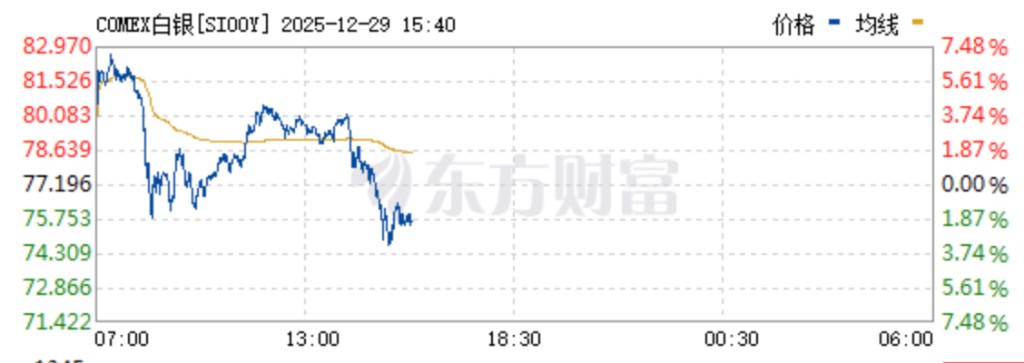
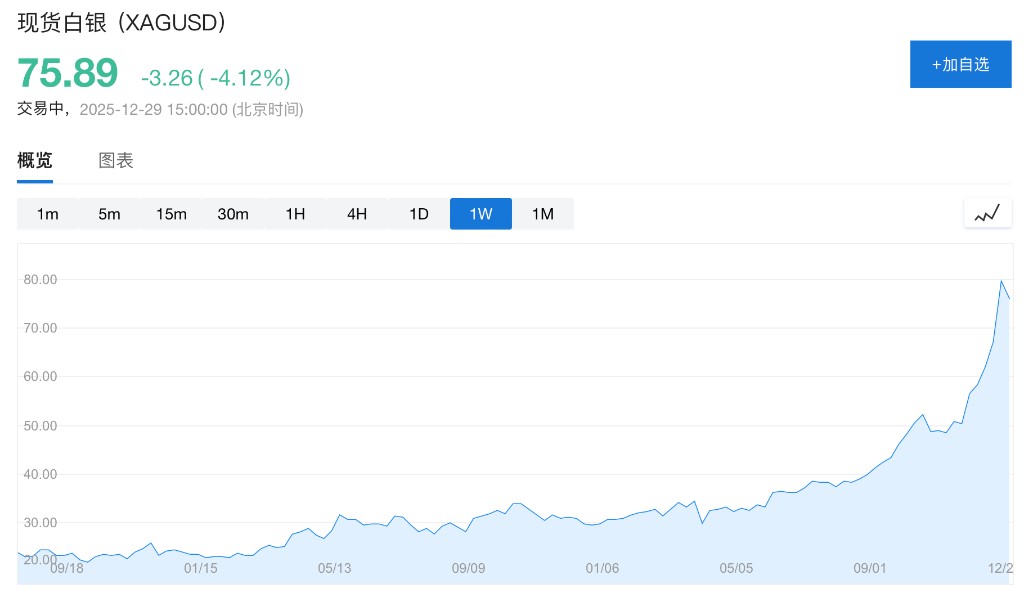
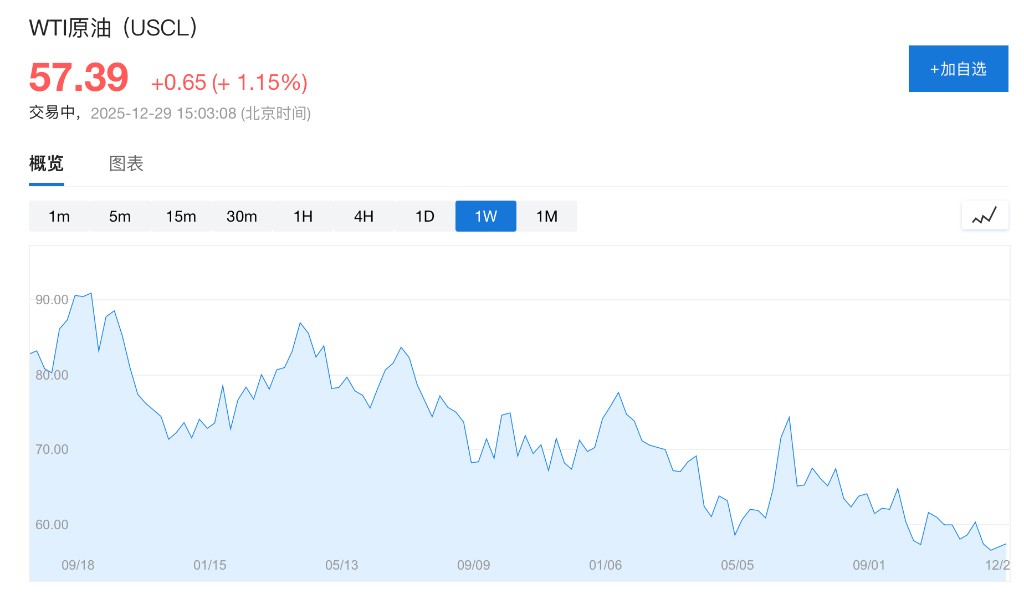
The strong rise in silver prices is primarily driven by both investor and industrial demand. In terms of industrial applications, the consumption of silver in clean energy sectors, from solar panels to electric vehicles, continues to rise, providing solid long-term demand support. Meanwhile, the global crude oil market faces dual pressures of oversupply and a structural shift in demand, with international oil prices cumulatively falling 21% since 2025, returning to low levels after the pandemic recovery.
Current institutional judgments on the future trend of silver still show divergence, but it is generally believed that crude oil prices are unlikely to improve in the short term.
The Dual Drivers Behind the Surge in Silver Demand
The explosive growth in silver prices stems from the combined effects of investment demand and industrial demand. Similar to gold, which has risen 72% this year and reached an all-time high, silver is being used by investors as a wealth preservation tool and a means to hedge against currency depreciation risks.
In terms of industrial applications, silver, due to its excellent conductivity and antibacterial properties, has become a key material in the energy transition and technology industries. Demand comes not only from traditional jewelry and medical device manufacturing but is significantly driven by rapidly growing sectors such as photovoltaics, electric vehicles, and data centers. Citigroup analysis points out that the solar industry alone has consumed nearly 30% of the global annual silver production, highlighting the rigidity of its structural demand gap.
John Ciampaglia, CEO of Sprott Asset Management, stated:
"Although the U.S. is pushing to reduce solar energy usage, countries like Europe have not slowed down the installation of solar capacity, which consumes a large amount of silver."
Price factors are also reshaping investment behavior. After gold prices surpassed $4,500 per ounce, some investors have turned to silver as a cheaper 'precious metal alternative.' ** The recent surge in silver imports in India is an example, as local savers have significantly increased their silver allocations due to high gold prices. The ETF market also reflects this trend, with iShares Silver Trust (SLV) showing a significant "cost-performance advantage" compared to SPDR Gold ETF (GLD), attracting funds for sector rotation.
Supply Constraints Intensify Price Pressure
The supply constraints in the silver market are becoming a key structural factor supporting its price. Global pure silver deposits have nearly been depleted, and silver is now typically produced as a by-product of mining other metals such as copper, gold, and zinc. This means that silver output is primarily driven by the mining development cycles and prices of other metals.
Silver bulls argue that the current gold-silver ratio is around 60, which still has significant room for narrowing compared to the approximately 30 high reached during the silver bull market in 2011, indicating that silver prices have stronger upward momentum relative to gold. Another argument supporting the potential for silver to rise further is that, when adjusted for real purchasing power, silver prices need to break through $200 per ounce to surpass the inflation-adjusted historical peak of 1980.
However, market divergence remains significant. Analysts at Capital Economics expressed a cautious view in a recent report: "Current precious metal prices have deviated from fundamental support." They predict that as market risk aversion towards gold gradually cools, silver prices may pull back to around $42 per ounce by the end of next year.
Oil Market Deeply Trapped in Supply Surplus Dilemma
Market analysis suggests that to restore the historical price relationship between oil and silver, a more likely path may be a significant correction in silver prices, rather than relying on a strong rebound in the oil market. Since 2025, international oil prices have fallen by a cumulative 21%, currently trading at low levels since the pandemic recovery period, with price levels approaching the breakeven point for most producers, indicating significant pressure on the industry.
Market expectations are generally conservative. Goldman Sachs' latest report predicts that the average annual price of U.S. WTI crude oil will be around $52 per barrel in 2026; a survey of energy executives by the Dallas Federal Reserve this month also showed that the average oil price assumption for 2026 capital planning was only $62 per barrel, a significant downward revision from last year's planning price of $71 for 2025.
The continued expansion on the supply side has intensified market imbalance pressures. U.S. crude oil production has risen to a historical high of about 13.5 million barrels per day, and the Organization of the Petroleum Exporting Countries (OPEC) is also maintaining an increase in production. Analysts point out that unless major oil-producing countries coordinate to implement substantial production cuts, the global crude oil market's supply surplus will further deteriorate. Additionally, if geopolitical tensions ease, it may release more oil production capacity, further exacerbating supply-demand conflicts
