The AI pharmaceutical company praised by Jensen Huang, INSILICO, today IPOs on the Hong Kong stock market

Wallstreetcn
2025.12.30 02:24
portai
I'm PortAI, I can summarize articles.

AI is transforming an experimental science that relies on trial and error into a predictable and programmable data science

"In the future, all biology will largely start in 'in silico' and largely end in 'in silico.'" (Almost everything will largely start in silico, largely end in silico)

When Jensen Huang, founder and CEO of NVIDIA, repeatedly mentioned this assertion under the spotlight of the J.P. Morgan Healthcare Conference and GTC Conference, biology was transforming from an experimental science reliant on trial and error into a predictable, programmable data science.

And Insilico is precisely the "first principles" practitioner that Huang has repeatedly named.

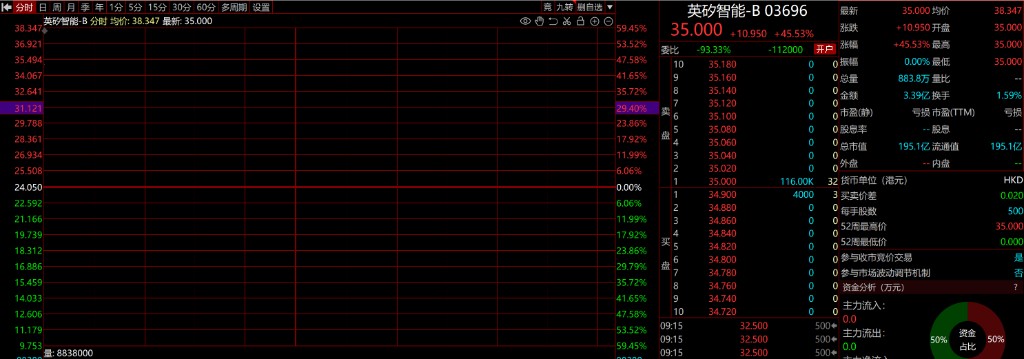
On December 30, 2025, Insilico (3696.HK) officially listed on the main board of the Hong Kong Stock Exchange, opening at HKD 35, up 45% from the issue price, with a market capitalization of HKD 19.5 billion.

This is the largest IPO event in the Hong Kong biopharmaceutical sector in 2025, raising a total of HKD 2.277 billion; it is also a capital market test of the "AI + Biotech" business model.

Unlike many unprofitable biotech companies that rely on Chapter 18A for listing, Insilico is the first AI biopharmaceutical company to be listed under Rule 8.05 of the Hong Kong Stock Exchange main board—this means the company not only has future pipeline expectations but has also passed strict profitability or revenue tests, demonstrating the feasibility of commercialization.

The listing of Insilico marks a watershed moment for the AI pharmaceutical industry, moving from "proof of concept" to "industrial output."

01 Capital Market's "Voting with Feet": A Luxurious Cornerstone Lineup Represented by Eli Lilly + Tencent

According to the IPO results, the Hong Kong public offering portion recorded an oversubscription of approximately 1,427.37 times, locking in subscription funds exceeding HKD 328.349 billion; the international placing portion also recorded an oversubscription of 26.27 times. Both figures set records for non-18A Hong Kong healthcare IPOs this year.

In Hong Kong IPOs, the list of cornerstone investors reflects institutional judgments on the issuer's fundamentals. Insilico introduced 15 global cornerstone investors this time, with a total subscription amount of approximately USD 115 million.

The most shocking names on the list are Eli Lilly and Tencent.

This time, as cornerstone investors, it is Eli Lilly's first bet on the AI pharmaceutical track in this capacity. This sends a strong signal: MNCs (multinational pharmaceutical companies) not only recognize Insilico's technology platform but are also paving the way for future pipeline collaborations Similarly, this is Tencent's first time participating as a cornerstone investor in a Biotech IPO. This represents the tech giant's affirmation of the trend of "AI + Science" cross-industry integration. The demand for computing power and cloud infrastructure in AI-driven pharmaceuticals is enormous, and Tencent provides not only capital but also potentially deep collaboration on computing infrastructure.

On the other hand, Oaktree Capital has also made its first return to the Hong Kong Biotech market this year. Oaktree Capital is known for its expertise in distressed investing and value discovery. INSILICO was chosen as its "first shot" upon returning to the market, which may indicate that the company's risk-reward ratio is sufficiently attractive.

In addition, Temasek, Schroders, UBS, E Fund, and Taikang Life are also on the cornerstone list.

This "frenzied" subscription enthusiasm has confirmed its AI premium. Since ChatGPT ignited the wave of generative AI, AI concept stocks have enjoyed extremely high premiums, and INSILICO has taken on this premium expectation.

On its first day of listing, INSILICO's opening price rose 45% compared to the issue price, indicating that even in the capital winter of biomedicine, the market is still willing to grant high valuation tolerance for "hard technology."

02 Business Model Reconstruction: "Dual Engine" Driven Flywheel Effect

The market's enthusiasm for INSILICO is primarily based on its unique "dual engine" business model: Artificial Intelligence + Innovative Drug Discovery.

INSILICO licenses its proprietary generative AI platform Pharma.AI to pharmaceutical companies and charges a subscription fee. This not only brings predictable recurring revenue (ARR) but, more importantly, establishes extremely high customer stickiness.

Once pharmaceutical companies become accustomed to using Chemistry42 for molecular generation, the switching costs are very high. This provides a natural customer pool for subsequent pipeline collaborations. At the same time, the widespread deployment of the software allows INSILICO to collect a large amount of external user feedback data, which feeds back into the algorithm model, forming a closed loop of "data-algorithm-product."

Since 2020, the Pharma.AI platform has been launched in a modular software form and has achieved commercialization, with a collaborative network spanning the globe. As of the last feasible date, it has reached software licensing agreements with 13 of the top 20 pharmaceutical companies worldwide.

Innovative drug discovery is the true engine of explosive growth.

This is a typical Biotech model, but more efficient. INSILICO develops innovative drugs using its own platform and generates revenue through licensing out or independently developing to the clinical stage.

This segment currently contributes over 90% of its revenue.

The core logic lies in: leveraging AI's high success rate to mass-produce preclinical candidate drugs (PCC) and monetizing at high-value points. This hybrid of "SaaS + Biotech" addresses the pain points of traditional Biotech companies that face zero revenue and high risks in the early stages of listing while retaining significant valuation elasticity.

This is the key source of valuation premium that distinguishes INSILICO from traditional CXOs and pure Biotechs

03 The Power of AI in Pharmaceuticals: 12-18 Months vs 4.5 Years

The AI pharmaceutical track is not short of stories, but it lacks clinical data validation. The biggest moat of INSILICO is that it has proven the effectiveness of AI with clinical data.

According to a Frost & Sullivan report, the traditional drug discovery process from target identification to PCC nomination takes an average of about 4.5 years. INSILICO, using its Pharma.AI platform, has significantly compressed this process to 12-18 months, requiring only the synthesis and testing of 60-200 molecules for each project.

With the same funding and time budget, INSILICO can attempt more targets and have more opportunities for trial and error. In the high-risk, high-reward gamble of drug development, AI is systematically changing the odds by increasing the number of bets and improving the win rate for each bet.

ISM001-055 (Rentosertib) is the best footnote for this logic.

As the world's first candidate drug discovered by AI that has entered clinical phase II, ISM001-055 targets idiopathic pulmonary fibrosis (IPF). PandaOmics identified TNIK as a potential target, and Chemistry42 generated a brand new molecular structure, forming a complete closed loop.

The top-line data from the phase IIa trial, to be announced in October 2024, shows that the drug exhibits positive efficacy signals in patients and performs excellently in a dose-dependent manner. The improvement trend in FVC (forced vital capacity) validates the accuracy of AI predictions.

The success of ISM001-055 has completed the "Turing Test" for the AI pharmaceutical industry—proving that AI can not only generate molecular structures but that the drugs generated are indeed safe and effective in humans.

In addition, the company has built a strong pipeline.

ISM3091 (USP1 inhibitor) has been licensed to Exelixis, with a total transaction value of $955 million; ISM5043 (KAT6 inhibitor) has been licensed to Stemline, a subsidiary of Menarini; and ISM5411 (PHD1/2 inhibitor), as an independently developed IBD drug, is also in clinical phase I. These pipelines not only demonstrate the replicability of the AI platform but also provide the company with continuous hematopoietic capabilities.

04 Conclusion

In the past decade, we have witnessed the miracle of Moore's Law in the chip industry. In the next decade, we may witness the "Eroom's Law" (the anti-Moore's Law, which states that drug development costs increase exponentially over time) being broken by AI.

Under Jensen Huang's prophecy of "In Silico," INSILICO has taken a crucial step. This step can bring truly accessible, affordable, and groundbreaking treatment options to patients worldwide, and time will provide the answer