


Goldman Sachs hedge fund head: US stocks in 2025 will be "very good," and the market will be even more "wild" in 2026

In 2026, the market faces higher stakes: historically high price-to-earnings ratios, extremely narrow corporate credit spreads, ever-expanding sovereign debt, and astronomical AI capital expenditures
When it comes to defining the U.S. stock market in 2025, Tony Pasquariello, head of Goldman Sachs' global hedge fund business, hesitated.
In his annual review, Pasquariello stated that after much consideration, he chose to describe the past year as "Very Good"—
After all, the S&P 500 not only achieved double-digit returns but also set an astonishing record of rising for eight consecutive months for the first time since 2017; the Nasdaq 100 index soared 21%, and the Dow Jones index recorded a 15% increase.
However, for investors on the front lines, it was not a year of "lying down to win."
Behind the glamorous indices was a volatility rate as high as 19%, the shocking moment when Nvidia evaporated a trillion in market value in seven weeks, and the severe turbulence caused by several liquidity crises.
If 2025 is a dance of high returns and high volatility, then in Pasquariello's view, 2026 will become even "Wilder":
"I don't think next year will be dull. Although the overall trend is favorable, I have a gut feeling that next year will be wilder."
The Dance of High Returns and High Volatility
From the data perspective, 2025 is undoubtedly a feast for bulls.
The Nasdaq 100 index (NDX) surged 21% for the year, the S&P 500 index recorded an 18% total return (including dividends), and the Dow Jones index and Russell 2000 index rose 15% and 13%, respectively. The S&P 500 even ended with a rare "8-month winning streak," a strong performance not seen since 2017.
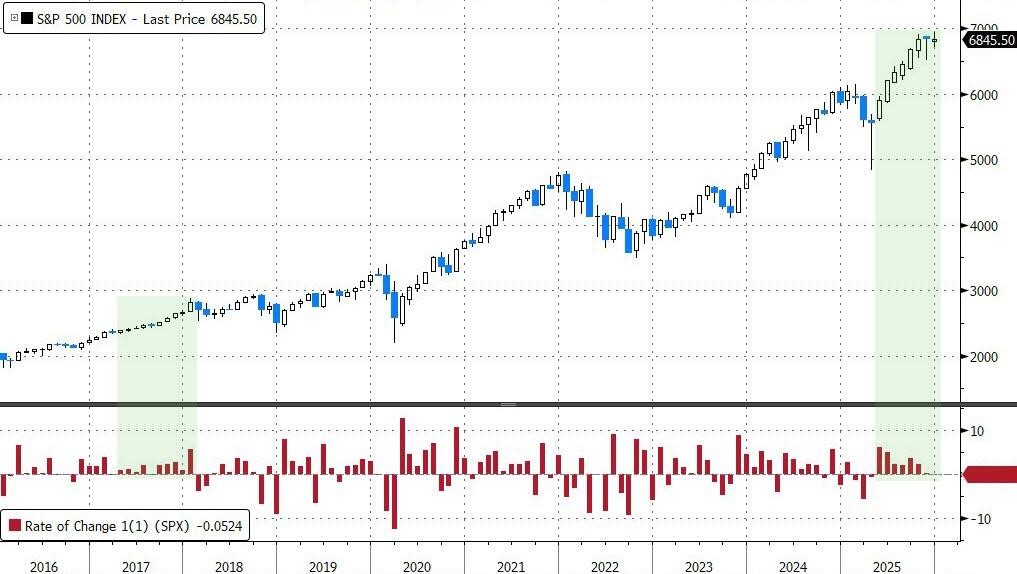
However, the price of achieving this return was a significant increase in market volatility. Pasquariello pointed out that the characteristics of the 2025 market were typical of "high returns, high volatility":
-
Actual volatility soared: The annual realized volatility reached 19%, placing it at the 83rd percentile historically.
-
Sharpe ratio halved: The return/volatility ratio of the S&P 500 was only 1.0. Compared to the "steady happiness" of over 2.0 in 2023 and 2024, in 2025, investors had to endure double the turbulence for every point of profit.
-
Deep pit shock: The maximum drawdown of the S&P 500 during the year reached 19%, nearly double the historical annual median (10%).
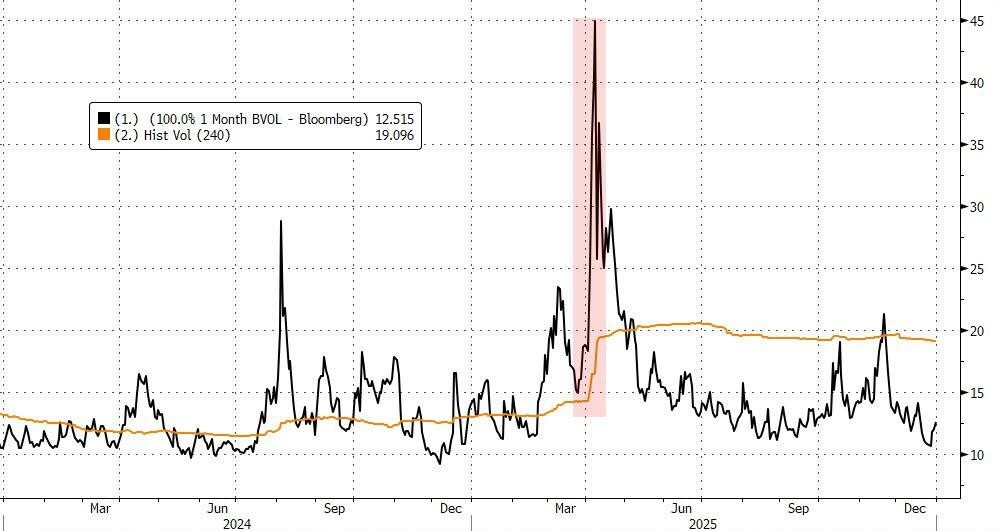 The market is not calm. Whether it is the flash crash in the AI sector triggered by DeepSeek (which caused the AI leading basket to plummet by 18% at one point) or the severe market fluctuations following Trump's tariff policies (with the S&P dropping over 9% and the VIX fear index touching 60), the operational difficulty this year has increased exponentially.
Pasquariello stated:
"History books will record 2025 as a good year for the US stock market, but this is a superficial conclusion. For traders in the midst of it, the difficulty level of this year has exceeded expectations multiple times."
Cracks in Tech Giants: The Law of Large Numbers and Nvidia's "Roller Coaster"
Tech stocks remain the absolute protagonists of 2025, but the script has begun to be rewritten.
The Nasdaq 100 index has recorded positive returns in 16 out of the past 17 years, a long-term dominance that is astonishing. However, the sense of internal division is intensifying: in 2025, about one-third of the Nasdaq component stocks ultimately closed lower, and the divergence in individual stock performance has significantly increased.
The marginal effect of the "Magnificent 7" is diminishing. While Google leads with a 65% increase and Nvidia records a 39% increase, the overall market capitalization increment of the entire portfolio is narrowing:
-
2023 increment: $5.1 trillion
-
2024 increment: $5.6 trillion
-
2025 increment: $4.0 trillion
For any other sector, $4 trillion is an astronomical figure, but for this super-weighted portfolio, the gravitational pull of the "Law of Large Numbers" seems to be manifesting, making it increasingly difficult to achieve incremental gains.
The best representation of the market's split characteristics in 2025 is Nvidia. Pasquariello depicted this AI giant with a set of contradictory data:
-
Miracle: Nvidia's market capitalization increased by another $1 trillion (in the words of his former boss, "the important thing is the fourth comma"), contributing 15% of the S&P 500 index's total return for the year.
-
Collapse: The stock peaked in late October, and in just seven weeks thereafter, its market capitalization evaporated by $1 trillion.
Since the advent of ChatGPT, Nvidia's earnings and stock price have both increased by about tenfold, a rare miracle in financial history. However, it has also triggered Wall Street's deepest anxieties: how long can extremely high profit margins and extremely high market shares be sustained?
Pasquariello noted that what is more noteworthy is the internal division: despite the Nasdaq's surge, about one-third of the component stocks closed lower for the year.
Perhaps this data suggests that the era of "mindlessly buying tech stocks" to win easily is coming to an end.
Driving Forces Breakdown: EPS Reigns, Options Gambles
What supports the bull market of 2025? The answer is fundamentals, not bubbles.
Pasquariello analyzed that in the S&P 500 index's total return of 18%, EPS (earnings per share) growth contributed the vast majority (14 percentage points), while valuation expansion contributed only 3 percentage points. Despite a temporary dip in CEO confidence, American companies have once again demonstrated their astonishing ability to defend profit margins amid a 75bp rate cut and a wave of deregulation At the same time, the options market has become the "hidden hand" influencing short-term trends.
Data shows that nearly 90% of the trading volume in listed SPX options is concentrated in terms of less than one month, with about two-thirds of the trades being 0DTE (zero-day-to-expiration options).
While this tool provides convenience for institutions to manage risk, it has also raised concerns about "excessive retail participation," becoming a core engine that exacerbates intraday volatility—when most market participants are engaged in ultra-short-term speculation, sudden liquidity shortages become the norm.
The Throne of "Safe Assets" Changes: Gold Soars, Bitcoin Falls
If there is one asset in 2025 that not only outperformed inflation but also surpassed faith, it is gold.
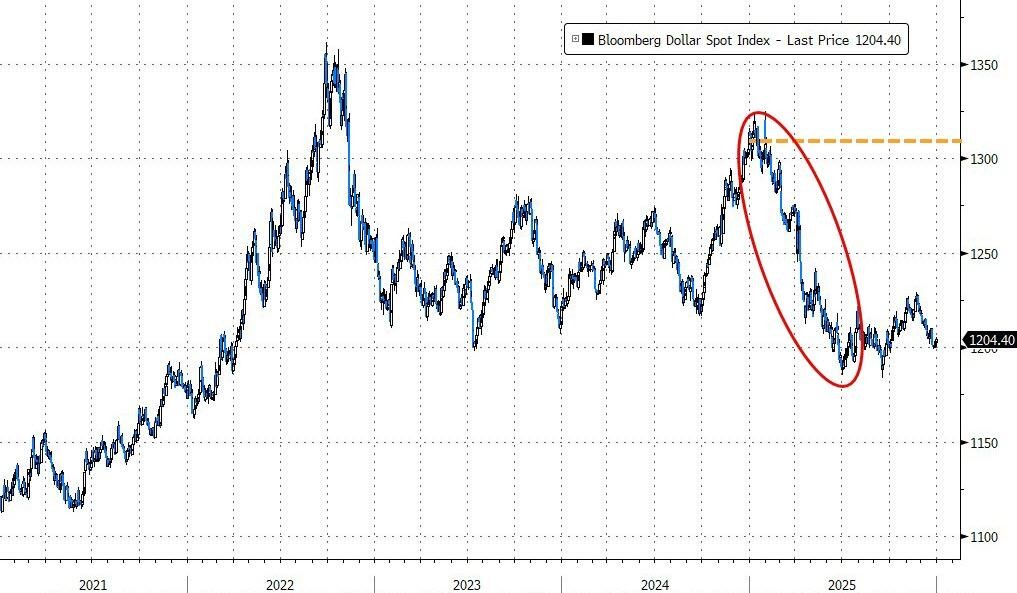
The dollar has had a tough year, with the trade-weighted dollar index falling by 7%. Against the backdrop of shaken fiat currency credibility, funds did not flow into Bitcoin as expected but instead surged into precious metals.
Gold has become one of the biggest winners of the year, soaring 65% throughout the year. Silver recorded an astonishing increase of 148%, while industrial metals like copper (+43%) and platinum (+127%) also performed impressively. Pasquariello points out that the rise in gold reflects the ongoing demand from structural investors like global central banks, serving as the ultimate hedge when investors "cannot choose which currency to hold."
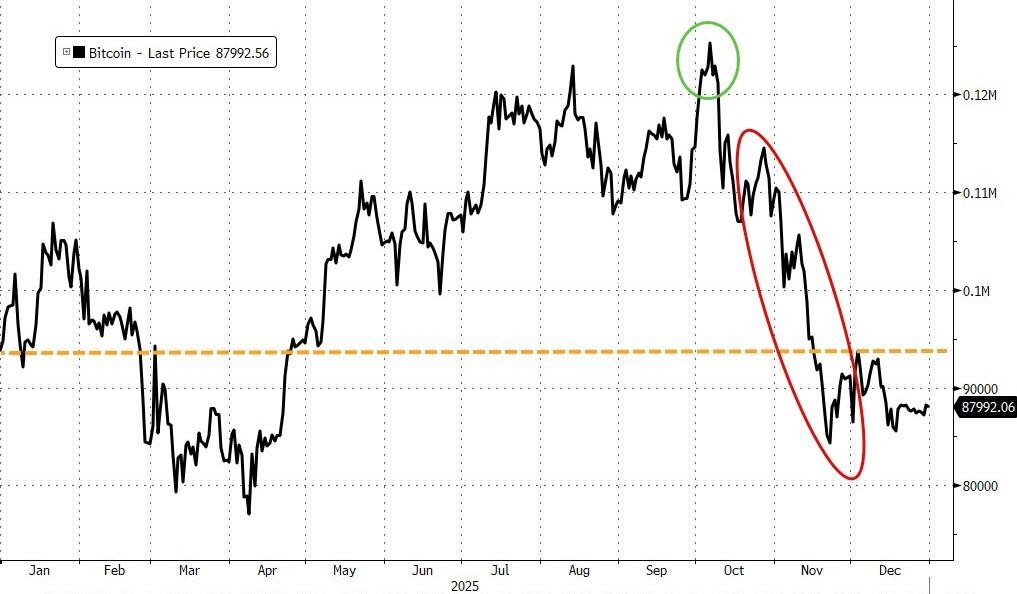
In contrast, Bitcoin (BTC) has had a disappointing year.
Despite briefly breaking the $125,000 mark, BTC ultimately fell 6% for the year, retreating over 30% from its peak. Pasquariello believes:
"Bitcoin has no yield and no intrinsic value; it is primarily driven by narrative and capital flows."
He argues that unlike gold, which is supported by structural buyers like central banks, Bitcoin faced significant profit-taking and liquidation in 2025.
Looking globally, opportunities are no longer limited to the United States.
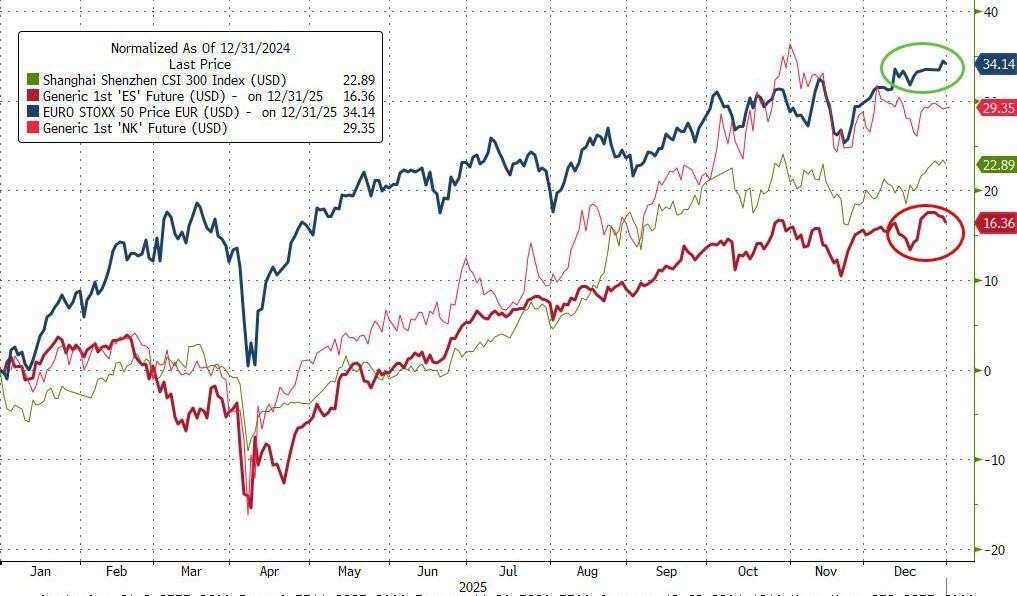
European stock markets unexpectedly recorded a return of 21% (in local currency) under a weak macro backdrop of only 1.5% GDP growth, with bank stocks surging by 80%.
In the Asian markets, South Korea (+79%) and Japan (+29%) performed excellently, especially those assets linked to AI, advanced manufacturing, and defense strategies, providing investors with valuable convex returns.
2026 Outlook: Embrace the "Wild"
Standing on the threshold of 2026, the market faces higher stakes: historically high price-to-earnings ratios (rising from 21.5 times to 22.0 times), extremely narrow corporate credit spreads, ever-expanding sovereign debt, and astronomical AI capital expenditures.
Pasquariello predicts that 2026 will certainly not be a dull year. While the baseline expectation remains net positive, the market will become more "wild." In an era where high valuations coexist with significant technological transformation, a simple "buy and hold" strategy may face challenges, and tactical flexibility will become crucial.
As the saying goes when evaluating financial mogul Soros:
"The secret to investing is to preserve capital, plus a few home runs."
At the end of the article, Pasquariello writes:
Perhaps 2026 will be the best year to validate this wisdom. Happy New Year, and may you have a successful hunt in 2026!
