


The first trading day of the New Year in the US stock market: Defensive sectors such as energy lead the gains, while technology stocks decline

On the first day of 2026, U.S. stocks continued to rotate sectors, with investors accelerating their exit from technology stocks to invest in defensive sectors. Tesla fell for seven consecutive days, setting a record, and the valuation bubble in the AI sector has raised ongoing concerns. Analysts warn that before the AI profit model becomes clear, the market may fall into a sideways deadlock, and the frenzy in technology stocks may have reached an inflection point
On the first trading day of 2026, the U.S. stock market continued the market rotation trend from the end of 2025, with investors shifting from last year's leading technology stocks to defensive sectors such as energy and utilities. The Dow Jones Industrial Average outperformed the Nasdaq and S&P 500 indices.
On Friday, the S&P 500 index rose by 0.2%, the Dow Jones Industrial Average climbed by 0.7%, while the Nasdaq Composite Index fell by 0.1%, marking its fifth consecutive trading day of decline. Technology stocks such as Palantir Technologies, AppLovin, and Microsoft dragged down the performance of major indices, while stocks in the energy, materials, and utilities sectors saw price increases.
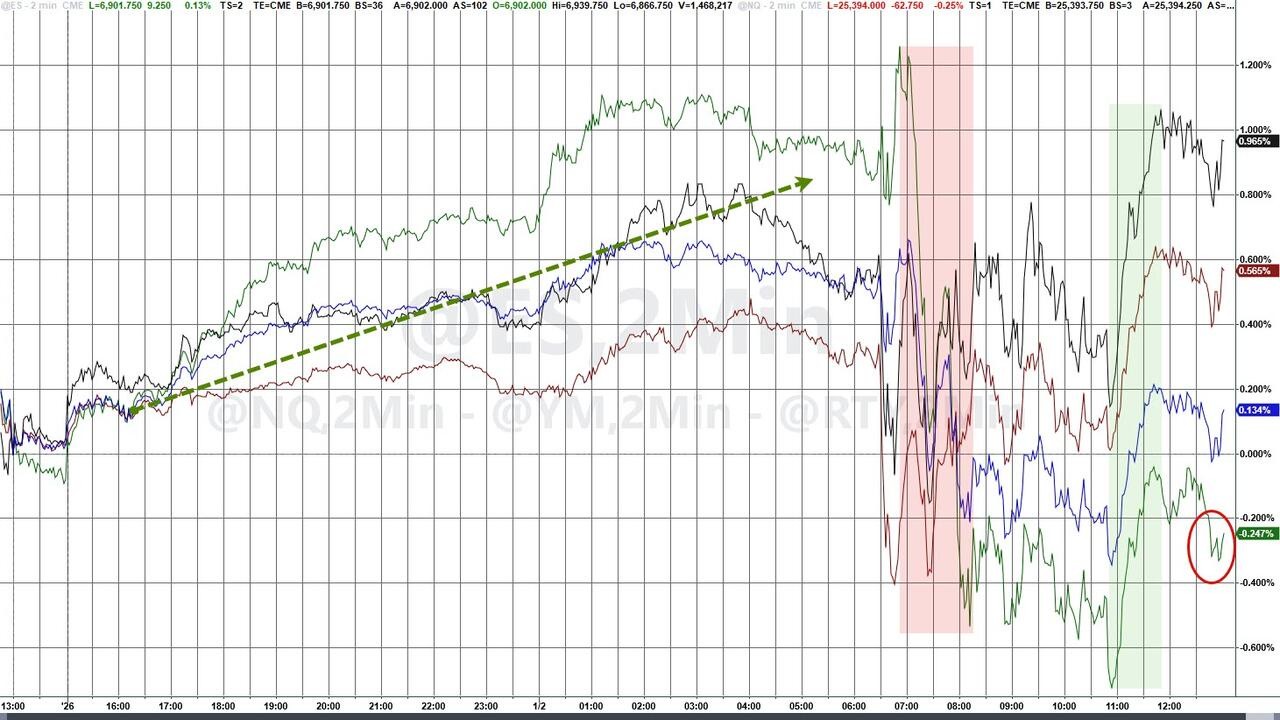
This market shift reflects ongoing investor concerns about the valuation and profitability of the artificial intelligence sector. Traders are moving from star stocks in the AI field to more defensive or diversified industry choices.
Technology Stocks Continue Weakness
Tech giants showed mixed performance in Friday's trading.
Amazon and Meta saw their stock prices retreat, while Tesla's stock price dropped by 2.6% after reporting another year of declining delivery numbers. Tesla's stock has now fallen for seven consecutive trading days, setting a record for the longest consecutive decline in over a year.
Chip manufacturers Nvidia and Micron Technology saw their stock prices rise, and data storage companies Western Digital and SanDisk also experienced price increases, becoming the few bright spots in the tech sector.
The precious metals market experienced significant volatility this week. Silver prices rose by 0.6% on Friday, while gold accumulated a 4.9% decline this week, marking the largest weekly drop since 2021.
AI Boom Faces Challenges
After three years of strong gains in the stock market, whether artificial intelligence can drive major indices to new heights in 2026 has become a core concern for investors. In the last few weeks of 2025, concerns about AI spread on Wall Street, with critics pointing out that technology stock valuations are too high and expressing worries about the cyclicality of certain transactions among major industry players.
David Bahnsen, Chief Investment Officer of Bahnsen Group, stated, "The theme entering 2026 is a continuation of what we saw at the end of 2025—a very interesting and somewhat unexpected dispersion in the market. There is a lot of uncertainty surrounding how AI will be profitable."
Jed Ellerbroek, portfolio manager at Argent Capital Management, noted that investors experienced a similar panic early last year when Chinese company DeepSeek launched a low-cost AI model, but the stock market rebounded quickly after a rapid sell-off and continued to rise throughout the year. "At that time, it was more fear than fact," Ellerbroek said.
Market Outlook Cautiously Optimistic
Despite relatively light trading this week and the impact of the New Year holiday, the rotation of investors is clearly visible. The Dow Jones index has outperformed the Nasdaq and S&P 500 indices in November and December, with traders shifting towards more defensive or diversified industry allocations Many investors still expect the stock market to continue rising in 2026. According to Dow Jones market data, the "January Barometer" hypothesis has been validated in the past four years—when the S&P 500 index rises in January, the probability of finishing the year higher reaches 79%.
However, Bahnsen believes that the market needs more clarity on AI concerns and economic direction to see a clear upward trend in the first few weeks of 2026. "Most market participants are neither overly bullish nor overly bearish," he said, "which often leads to market consolidation."
