Profits triple! Samsung expects Q4 profit of 20 trillion won and revenue of 93 trillion won, both hitting record highs, as AI triggers "out-of-control" price increases in storage

Wallstreetcn
2026.01.08 00:42
portai
I'm PortAI, I can summarize articles.

The company released its Q4 earnings guidance: operating profit is expected to reach 20 trillion won, tripling year-on-year and surging 64% quarter-on-quarter, setting a historical record, while sales are also soaring to a historical high of 93 trillion won. With the strong boost from the AI frenzy, Samsung is declaring the arrival of the strongest seller's market for memory chips to Wall Street through a "runaway" increase in both volume and price. The company is expected to release its complete financial report later this month

Storage is heating up, and Samsung Electronics' profits are expected to hit a record high amid the AI wave.

On January 8 local time, Samsung Electronics released its earnings guidance for the fourth quarter of 2025, with the world's largest memory chip manufacturer expected to deliver results far exceeding market expectations.

According to preliminary data released by Samsung, the company's operating profit for the December quarter is expected to reach 20 trillion won (approximately 13.8 billion USD). This figure not only represents a year-on-year surge but also breaks the historical record of 17.6 trillion won set in the third quarter of 2018. In contrast, analysts' previous average expectation was only 17.8 trillion won. In terms of revenue, it is expected to grow by 23% year-on-year, reaching a historic high of 93 trillion won.

  • Operating Profit: Expected to reach 20 trillion won, up threefold year-on-year, an increase of 208%, and a quarter-on-quarter surge of 64%.

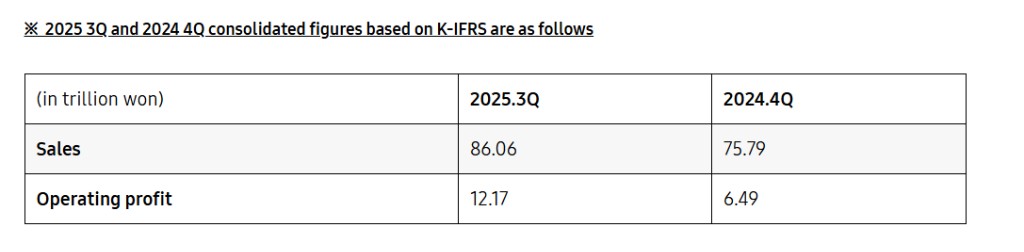
  • Sales: Compared to 75.79 trillion won in the fourth quarter of 2024, a year-on-year increase of about 23%; compared to 86.06 trillion won in the previous quarter, a quarter-on-quarter growth of about 8%.

The logic behind the data is very clear: This is not a story of a comprehensive recovery in demand; it is a story of supply being forcibly squeezed by AI.

To meet the insatiable demand for high-bandwidth memory (HBM) and enterprise-grade SSDs from AI giants like NVIDIA, memory manufacturers such as Samsung are aggressively shifting production lines from ordinary consumer-grade chips to high-profit high-end chips. This structural shift in capacity has directly led to a severe shortage of standard memory chips used in laptops and servers.

  • DRAM (Dynamic Random Access Memory): According to Sanjeev Rana, head of Korean research at CLSA Securities, the average selling price (ASP) of DRAM in the fourth quarter surged by over 30% quarter-on-quarter.

  • NAND (Flash Memory): Prices increased by approximately 20% quarter-on-quarter.

  • Year-on-year data is even more astonishing: According to market tracking agency TrendForce, the contract price of a certain type of DRAM chip skyrocketed by 313% year-on-year in the fourth quarter.

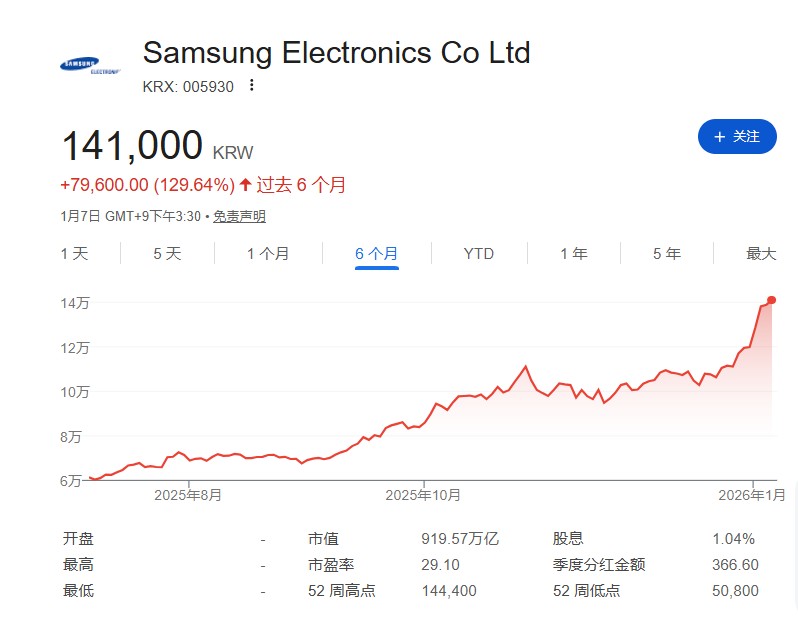
For the market, the expectation gap here is that while the market had previously anticipated price increases, it underestimated the willingness of "hyperscalers" to pay a premium for DRAM resources and the severity of this supply crisis. Samsung's stock price has doubled in the past six months and continues to soar this month, reflecting strong bullish sentiment in the market regarding the storage cycle.

Wall Street Bets: Storage Chip Prices Will Rise "Out of Control"

Currently, Wall Street is still betting on "out of control" price increases for storage chips.

According to an article from Wallstreetcn, Citigroup's latest report shows that analysts believe the market will enter an extremely severe seller's market. Citigroup warns that by 2026, the world will face a "serious supply shortage" of storage chips, and has provided highly aggressive forecasts:

  1. Out of Control Prices: The average selling price of server DRAM is expected to soar by 144% year-on-year in 2026 (previously forecasted at 91%); enterprise SSD prices are expected to rise by 87%.

  2. Upward Revision of Profit Expectations: Based on this, Citigroup expects Samsung Electronics' operating profit in 2026 to skyrocket to 155 trillion won, a year-on-year increase of 253%.

Analysts at CLSA also pointed out that hyperscale cloud service providers are willing to pay a premium to secure supplies, and strong pricing will persist throughout 2026, possibly continuing into the first half of 2027.

Catching Up with HBM: From Lagging to Counterattack

In this round of the AI feast, Samsung had previously lagged behind competitors SK Hynix and Micron Technology in the HBM field. However, the latest signals indicate that Samsung is narrowing the gap.

Reports indicate that Samsung delivered its cutting-edge HBM4 samples to Nvidia for qualification testing last year. This has sparked optimistic expectations in the market that Samsung is likely to begin mass production in the first half of this year to support Nvidia's upcoming Rubin processor. CLSA expects that as HBM4 enters the commercial supply stage, Samsung's total HBM shipments will double by 2026.

If Samsung can successfully pass verification and achieve mass production, it will lead to another revaluation of its valuation logic—from merely benefiting from cyclical price increases to becoming a key player in the AI core supply chain.

Downstream Pain: The Double-Edged Sword of Price Increases

However, the flip side of the coin is the severe inflation of downstream hardware costs.

TM Roh, Co-CEO of Samsung Mobile, TV, and Home Appliances, publicly acknowledged that the impact of rising storage chip prices is "inevitable," and did not rule out the possibility of raising product prices. DB Securities analyst Seo Seung-yeon predicts that due to rising component costs, Samsung's mobile business profits in the fourth quarter may decline year-on-year.

Counterpoint Research predicts that DDR5 memory prices for computers and servers will rise another 40% this quarter and continue to rise 20% in the second quarter. This means that while Samsung's semiconductor division is making substantial profits, its consumer electronics division and clients like Apple are facing severe margin pressures Samsung will release its complete financial report, including net profit and detailed breakdowns by department, later this month (expected on January 29).