Trump's record $15 trillion military spending to fight a "world war"? Defense stocks rebound significantly, drone manufacturers surge by double digits

Trump stated that the U.S. military budget for fiscal year 2027 should be raised to $1.5 trillion, which is an increase of over 50% compared to this year's budget. On Thursday, Lockheed Martin's stock rose over 9%, and drone company Kratos saw a 20% increase. American media personnel believe that Trump's increase in military spending indicates that the U.S. may be preparing for a "world war," and a budget of $1.5 trillion reflects "the characteristics of a country preparing for global or regional warfare." Although there is uncertainty regarding this military spending, analysts generally agree that the direction of U.S. defense spending growth is clear
The recent statements by U.S. President Trump have triggered a massive shock in U.S. defense stocks. After Trump threatened to limit dividends and buybacks for defense contractors, defense giants saw a broad decline on Wednesday. Following his announcement of a significant increase in military spending, several defense stocks rebounded strongly on Thursday, reflecting investors' bets that the U.S. government's potentially record defense budget will bring more orders to the industry.
According to Xinhua News Agency, Trump stated on social media on Wednesday evening, July 7, that U.S. military spending for fiscal year 2027 should be raised from $1 trillion to $1.5 trillion. This means that U.S. military spending will surge by more than 50% compared to this year's record budget of $901 billion. Trump claimed that this move would help the U.S. build a "dream army" and ensure national security during "turbulent and crisis-ridden" times.
Trump's massive military spending proposal has raised alarms among U.S. media figures. According to Xinhua, former Fox News host Tucker Carlson stated on July 7 that Trump's increase of military spending to $1.5 trillion indicates that the U.S. may be preparing for a "world war." Such a budget scale reflects "the characteristics of a country preparing for global or regional war."
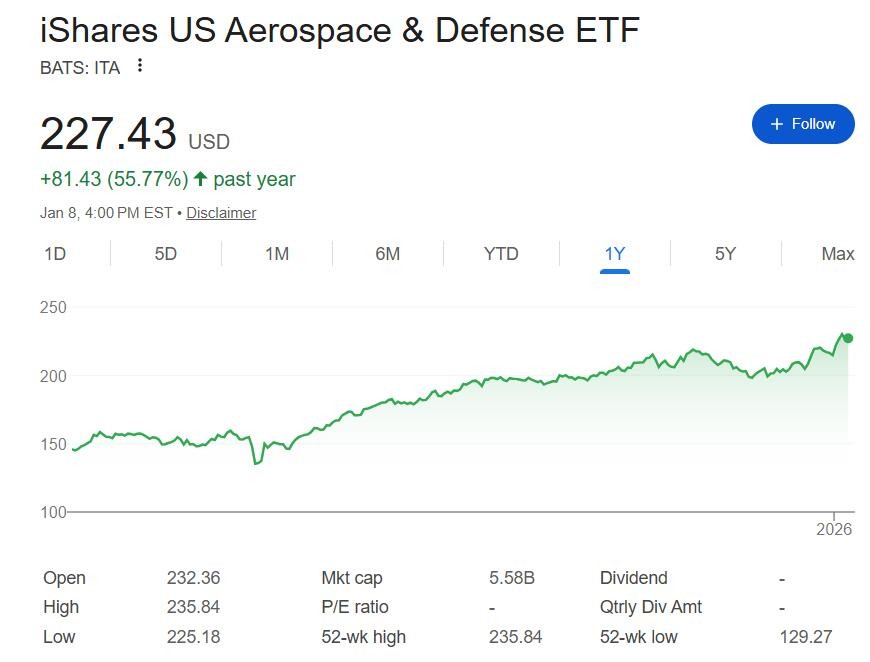
The dramatic fluctuations in defense stocks highlight the direct impact of Trump's policy statements during his second term on the market. From seizing Russian oil tankers to raiding Venezuela, and considering the use of U.S. military control over Greenland as an option, the Trump administration has increasingly utilized the military to achieve foreign policy objectives, leading to a new round of revaluation in the defense sector. The U.S. defense sector has performed strongly over the past 12 months, with the iShares U.S. Aerospace & Defense ETF (ITA) up more than 50% as of Thursday.

Strong Rebound in Defense Stocks
On Thursday, U.S. defense stocks rose across the board, partially or fully recovering losses from the previous trading day.
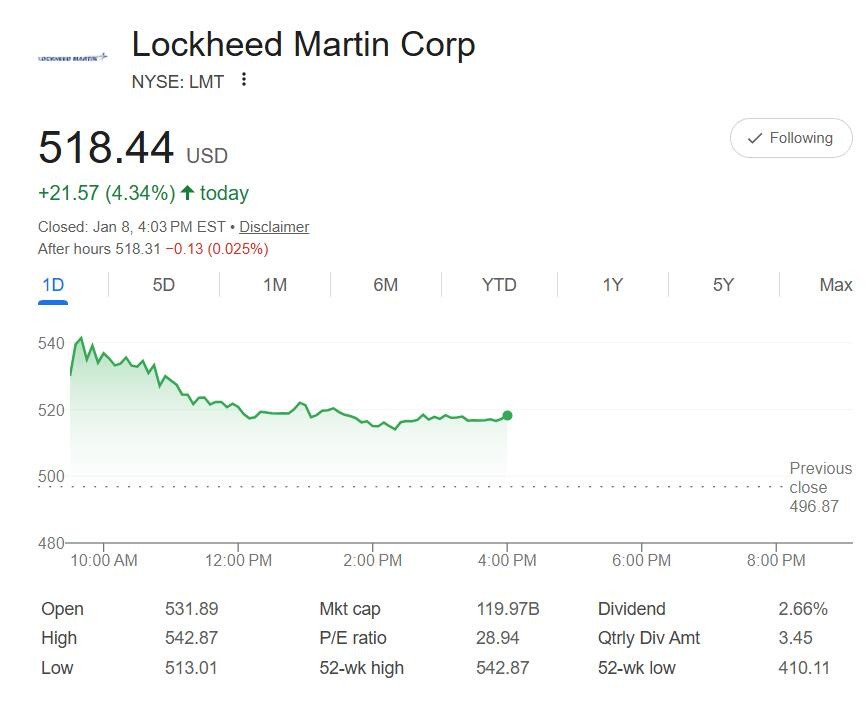
Lockheed Martin (LMT) rose more than 9% at one point during Thursday's morning session, Northrop Grumman (NOC) was up nearly 11%, L3Harris (LHM) rose nearly 9%, Raytheon Technologies (RTX) increased by nearly 6%, and General Dynamics (GD) was up over 6%, although all later retraced some gains. By the close, Lockheed Martin was up over 4.3%, Northrop Grumman rose more than 2.4%, L3Harris increased over 5%, Raytheon was up nearly 0.8%, and General Dynamics rose nearly 1.7%.

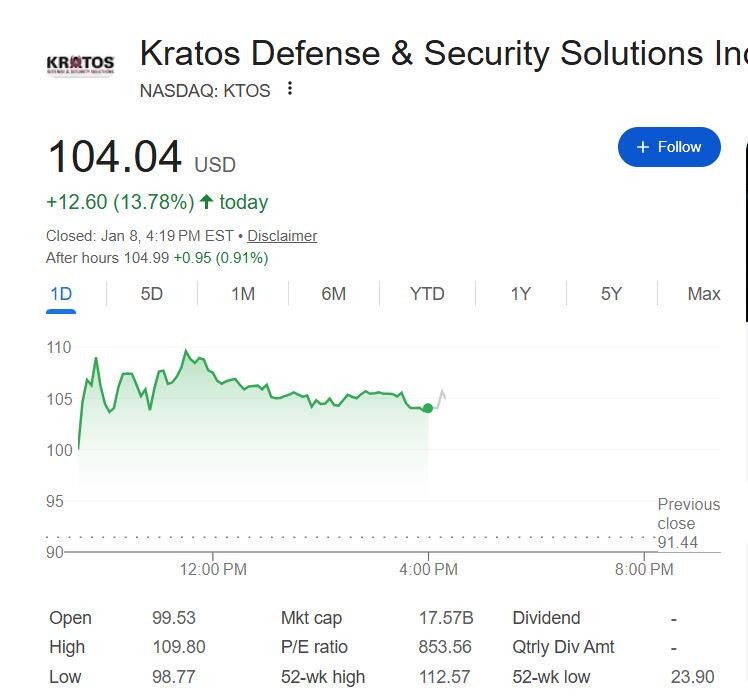
The small drone technology company Kratos Defense & Security Solutions (KTOS) opened with a nearly 9% increase, reaching a peak gain of 20% towards the end of the morning session, and closed up 13.8%. Additionally, three military drone manufacturers, AeroVironment (AVAV), Ondas (ONDS), and Red Cat (RCAT), reached daily highs of nearly 17%, nearly 24%, and nearly 22% respectively during the morning session, ultimately closing up 8.3%, 15%, and 13.2%

This rebound came swiftly and fiercely. On Wednesday, Trump demanded that defense contractors halt stock buybacks and dividend distributions before responding to his requests for faster and more reliable production of military equipment, specifically naming Raytheon and stating, "Either step up and start making more upfront investments in factories and equipment, or you will no longer do business with the Department of Defense."
This statement led to Lockheed Martin falling 4.8%, Northrop Grumman dropping 5.5%, Raytheon declining 2.5%, and General Dynamics decreasing 4.2% on Wednesday.
The global defense sector rose in unison on Thursday. Goldman Sachs' basket of European defense stocks tracking military stocks saw an increase of up to 3.8% on Thursday, with a cumulative increase of about 15% this week. UK’s BAE Systems saw its stock price rise over 7%, while Germany's Rheinmetall rose over 4%, reaching its highest level since October last year. In Asia, defense stocks such as South Korea's Hanwha Aerospace, Taiwan's Aerospace Industrial Development Corporation, and Japan's ShinMaywa Industries all increased.
Budget Increase Raises Questions
Trump's proposed 50% budget increase is historically rare. Byron Callan, an analyst at Capital Alpha Partners, pointed out that the last time the U.S. government's annual defense budget grew by 50% was during the Korean War in 1951, and the increases during the Reagan administration in 1981 and 1982 only exceeded 20%.
The feasibility of this proposal faces multiple challenges. The U.S. Congressional Budget Office (CBO) estimates that the budget deficit this year will account for 5.5% of GDP, and the agency predicted last November that tariff revenues over the next 11 years would only bring in $2.5 trillion, averaging about $230 billion per year, far below the projected $500 billion increase in defense spending.
Wallstreetcn mentioned that Trump claimed on Wednesday that the "huge revenue" from tariffs allows the U.S. to "easily reach" the $1.5 trillion military spending target, stating that the revenue from trade tariffs not only covers the increase in military spending but also allows the U.S. to reduce national debt and pay "substantial dividends" to middle-income Americans. However, tariff revenues are expected to be around $400 billion by 2026, highlighting a significant gap between the new military spending and other commitments.
On the political front, without a budget and reconciliation process, the $1.5 trillion budget would need to achieve a 60-vote support threshold in the Senate to pass. If it goes through the budget reconciliation process, the relevant bill would only need to secure 50 votes in the Senate for approval, but it requires cost offsets. Callan noted that even if the growth is spread over the fiscal years 2027 to 2030, "we are still unclear whether defense contractors have the capacity to absorb this scale of growth."
Wall Street Cautiously Optimistic
Despite the uncertainties, analysts generally believe that the direction of U.S. defense spending growth is clear. Bernstein analyst Douglas Harned stated, "The direction of spending is clear — that is, higher." At the same time, the scrutiny of enterprises will also be stricter."
Morgan Stanley analyst Kristine Liwag stated in a research report that limiting capital returns is "an incremental negative factor, but the scale is controllable." She added that if dividends and buybacks are restricted, this could free up billions of dollars in capital for investments such as capacity expansion or mergers and acquisitions.
JP Morgan analyst Seth Seifman said on Wednesday, "Overall, the comments from this administration can sometimes be quite tough, while also conveying core intentions. In this context, the comments on buybacks and dividends, along with the subsequent executive orders signed, reinforce the efforts that have already been clearly communicated to encourage large defense companies to increase investments, which may yield some results."
L3Harris CEO Chris Kubasik sent a message to all employees shortly after Trump's post, stating, "The demand for military capabilities is increasing, and our industry and our expectations are higher than they have been in decades. We are not sitting on the sidelines; we are in the thick of it, and what we do matters."
Tony Bancroft, portfolio manager of the Gabelli Commercial Aerospace and Defense ETF, stated, "1.5 trillion dollars is a big number, but at the same time, the world is changing." He pointed out that geopolitical instability is driving spending growth, "the world is becoming a dangerous place."
Saxo Markets UK investment strategist Neil Wilson stated, "Geopolitics is the unavoidable story of 2026 so far."