Is the US CPI about to start a retaliatory rebound?

The U.S. December CPI is expected to rebound significantly due to statistical technical factors, with Morgan Stanley predicting a month-on-month increase of 0.36%. This rebound is mainly attributed to statistical distortions during the government shutdown, rather than real inflationary pressures. If the data meets expectations, tariff-related price transmission will contribute approximately 45 basis points to the year-on-year growth rate of core CPI. Statistical distortions include bi-monthly sampling bias and holiday discount bias, which are expected to have an upward impact on the December core CPI
Affected by statistical technical factors, the U.S. December CPI may see a significant rebound, while the December inflation data will also serve as a key verification of the transmission effects of U.S. tariffs.
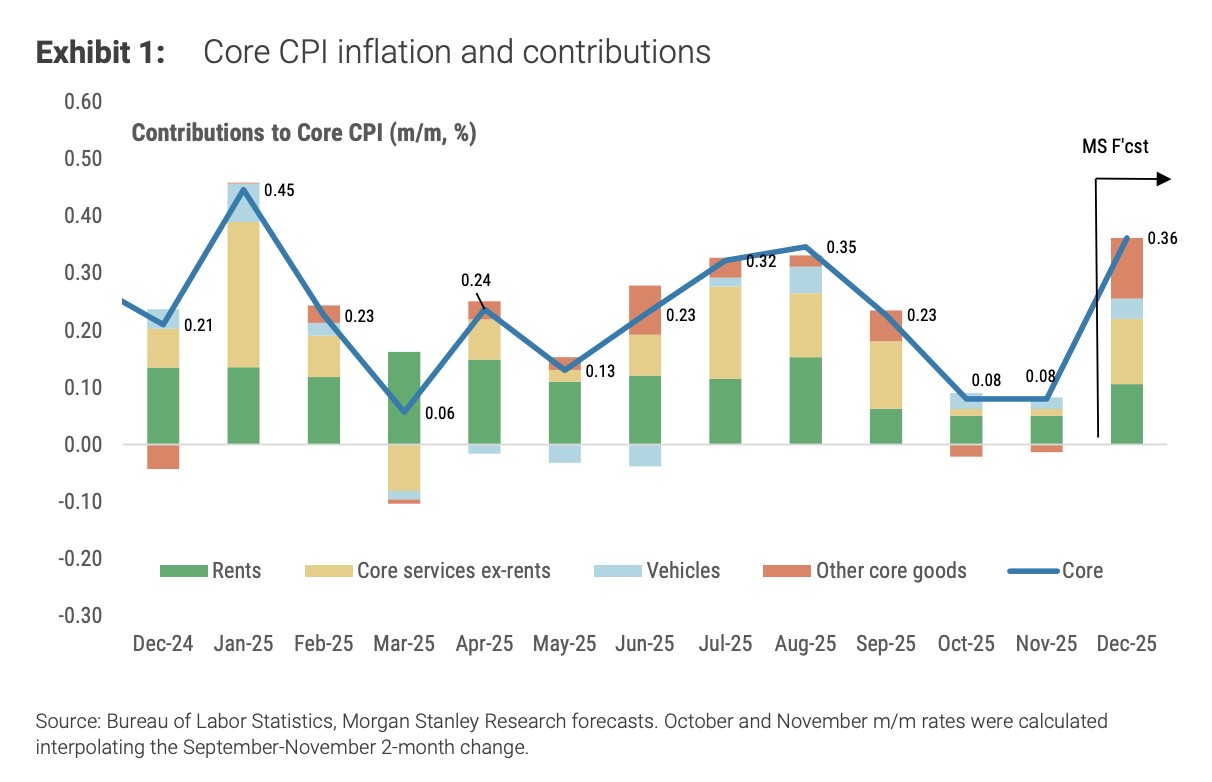
According to the Wind Trading Desk, Morgan Stanley expects a notable rebound in the U.S. core CPI for December, with a month-on-month increase of 0.36%, far exceeding the average of 0.08% for October and November. This rebound is primarily due to statistical distortions during the government shutdown, rather than a genuine rise in inflationary pressures.

Morgan Stanley stated, for investors, strong data may be viewed as technical noise and discounted, while weak data could become a strong signal of cooling inflation. Morgan Stanley believes the core CPI is equally likely to round to 0.3% or 0.4%, but the risk of hitting 0.5% is higher than that of 0.2%.
It is noteworthy that there were almost no signs of tariff transmission to commodity prices in the October-November data, and the December data will more clearly reveal the situation of tariff transmission. Morgan Stanley believes that if the December data meets expectations, the price transmission related to tariffs this year will contribute about 45 basis points to the year-on-year growth rate of the core CPI.
"Revenge" Rebound Due to Statistical Distortion
Morgan Stanley indicated that the December CPI data will reflect two major statistical biases caused by the government shutdown:
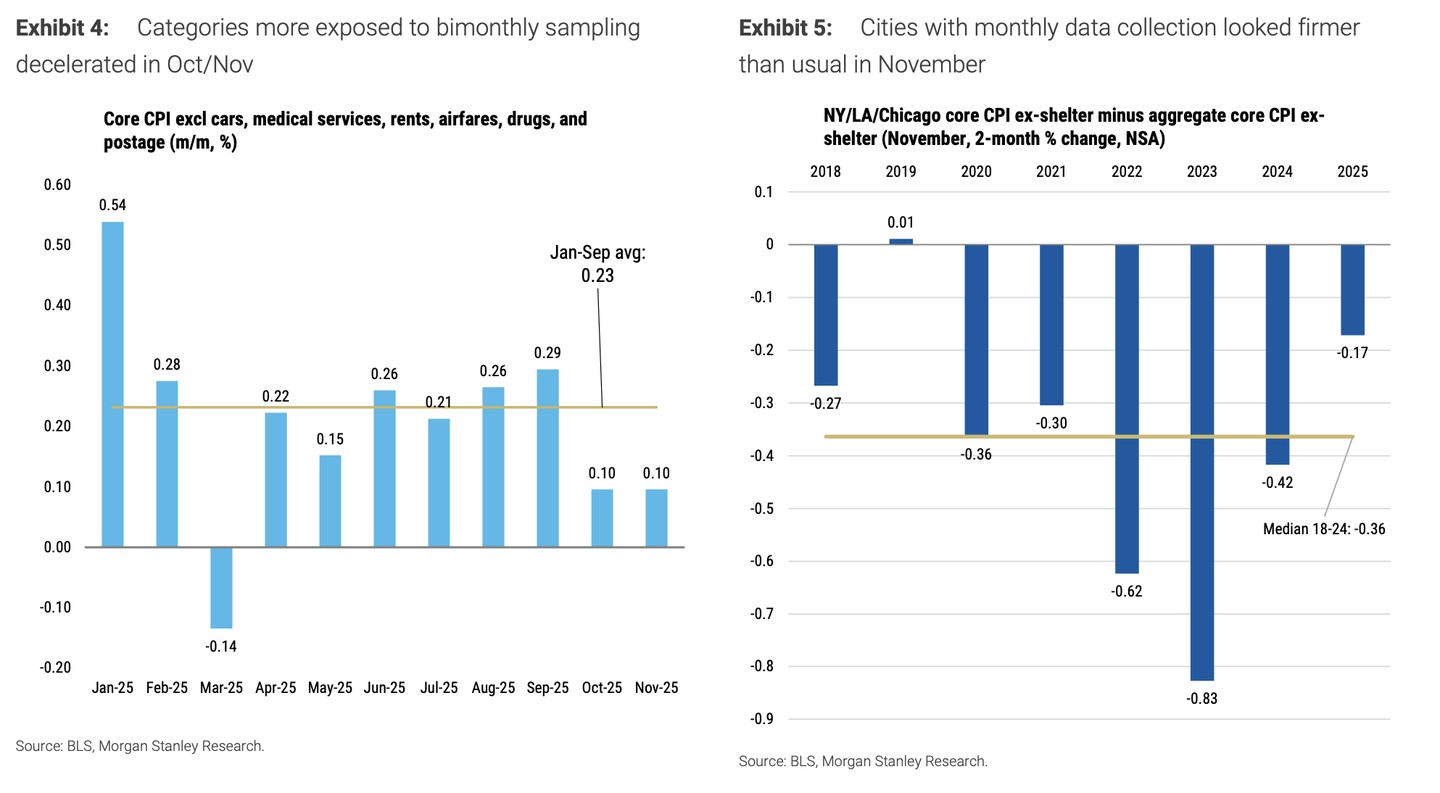
Bi-monthly Sampling Bias: Except for the three major cities of Chicago, Los Angeles, and New York, some prices of goods and services are collected bi-monthly. Due to the absence of October data, the U.S. Bureau of Labor Statistics carried over August prices to October, effectively assuming zero inflation for these cities in October. December will re-survey these cities, leading to a lower price comparison base. Morgan Stanley estimates that CPI categories significantly affected by bi-monthly sampling averaged only 0.10% month-on-month in October-November, while the underlying trend was 0.23%. By comparing the differences between the three major cities and the overall data, the firm expects bi-monthly sampling to contribute about 8 basis points of upward bias to the December core CPI.
Holiday Discount Bias: The collection of November prices was delayed until the end of the month, implicitly over-weighting holiday promotional discounts, which artificially suppressed prices of core goods (excluding automobiles). This bias has historically existed but was amplified this year due to the delayed survey timing. Morgan Stanley has added an additional 3 basis points to its core CPI forecast for this reason.
Inflation Accelerates Overall, Core Goods Lead
From the perspective of various components, Morgan Stanley pointed out:
Core Goods Inflation Hits Year-to-Date High: The core goods are expected to increase by 0.59% month-on-month in December, marking the highest monthly increase since 2025. Among them, new car prices are expected to rise by 0.21%, used cars by 0.80%, clothing by 1.00%, and other core goods by 0.70%. JD Power data shows that car prices maintained positive growth in December, and seasonal factors will further push up used car prices
Normalization of Rent Inflation: In October, the Owner's Equivalent Rent (OER) was assumed to be 0% due to data absence, and November has shown signs of normalization. Morgan Stanley expects a month-on-month increase of 0.27% in OER for December, with housing rent increasing by 0.18%, roughly in line with November levels. In the coming months, OER and housing rent are expected to average a month-on-month increase of about 0.26%, with a rebound expected after April.
Core Services Excluding Housing Category Rebound: It is expected that this subcategory will see a month-on-month increase of 0.34% in December, significantly higher than the average of 0.08% in October and November. Airfare prices are expected to decrease by 0.50% month-on-month (but the decline is narrowing), hotel prices will turn to positive growth of 0.30%, medical services will grow by 0.25%, and auto insurance will increase by 0.10%.
Overall CPI Synchronization Rebound: It is expected that the overall CPI will increase by 0.37% month-on-month in December, with a year-on-year increase of 2.7%. Energy inflation is slowing but remains positive (month-on-month 0.43%), while food inflation accelerates to 0.37%, partly affected by bi-monthly sampling distortions.
Focus on Three Major Issues
- Uncertainty of the Rebound Magnitude
While it is certain that there is an upward bias in December, it is extremely difficult to accurately distinguish "signals" from "noise." Morgan Stanley admits that its forecast may be conservative, with a higher probability of actual data showing a month-on-month increase of 0.5% than 0.2%.
- Can Housing Inflation Slowdown Be Sustained?
December will be the second "clean" observation after the significant decline in September data, which will help determine whether housing inflation has truly entered a lower operating trajectory.
- When Will the Tariff Transmission Effect Become Apparent?
The data for October and November did not clearly reflect the transmission of tariffs to commodity prices. Morgan Stanley believes this is due to statistical noise masking the real effect, and December data will be a key verification window—tariffs have cumulatively pushed up core inflation by 35 basis points this year, and it is expected to increase to 45 basis points this time, exceeding half of Morgan Stanley's expected total impact (assuming tariff levels remain unchanged).
The Game of Signals and Noise
Based on CPI forecasts, Morgan Stanley expects a month-on-month increase of 0.37% in core PCE for December, significantly higher than the average of 0.13% in October and November. Since 70% of the prices in the PCE basket come from the CPI index, the upward bias in CPI will directly transmit to PCE. Financial services will slow down due to lower stock market returns in November (0.35%), airfare prices will be relatively weak (month-on-month 0.25%), and medical services will be close to potential trends (0.19%).
Morgan Stanley specifically points out that strong data is likely to be discounted by the market as "statistical distortion," while weak data may become a strong signal for cooling inflation This asymmetry means that if the December CPI is lower than expected, it could provide a more significant boost to interest rate-sensitive assets; conversely, data that meets or slightly exceeds expectations may not trigger a strong market reaction.
Overall, the December CPI data will be a reading filled with technical noise, and investors need to see through the statistical distortions to understand the true trend of inflation, while closely monitoring the more substantive clues of tariff transmission and housing inflation.
Risk Warning and Disclaimer
The market carries risks, and investment should be cautious. This article does not constitute personal investment advice and does not take into account the specific investment objectives, financial situation, or needs of individual users. Users should consider whether any opinions, views, or conclusions in this article align with their specific circumstances. Investing based on this is at one's own risk