


In December, the U.S. non-farm payrolls increased by 50,000, falling short of expectations, while the unemployment rate dropped to 4.4%, marking the lowest annual growth since 2020

More news, ongoing updates
In December, U.S. non-farm employment growth fell short of expectations, and the data for the previous two months was significantly revised downward, leading to the weakest annual employment growth since the pandemic in 2025. Although wage growth remained robust, the three-month moving average of employment data has slipped into negative territory, highlighting a significant decline in labor market momentum.
On the 9th, the U.S. Bureau of Labor Statistics (BLS) released data showing:
- U.S. non-farm employment increased by 50,000 in December, expected 65,000, previous value 64,000
- U.S. unemployment rate at 4.4%, expected 4.5%, previous value 4.6%.
After the data was released, traders still expect the Federal Reserve to cut interest rates by about 50 basis points in 2026, believing the likelihood of a rate cut in January is almost zero.
Record Weak Year
The Bureau of Labor Statistics stated that the non-farm employment increase in October was revised from a decrease of 105,000 to a decrease of 173,000; the non-farm employment increase in November was revised from 64,000 to 56,000. After revisions, the total increase in employment for November and December was 76,000 lower than before the revisions.
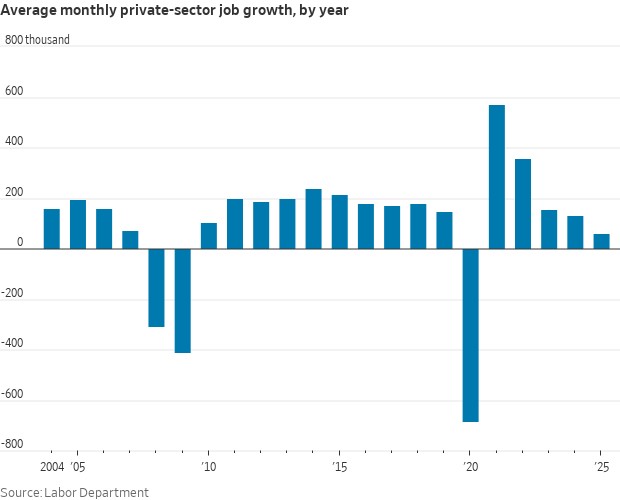
For the entire year, U.S. non-farm employment increased by a total of 584,000. Analysts pointed out that this is the weakest annual growth since a sharp decline of 9.2 million jobs due to the COVID-19 pandemic in 2020. Excluding the abnormal fluctuations during the pandemic, even looking back at the entire economic expansion cycle from 2010 to 2019, such weak annual employment growth data has never been seen.
The magnitude of the data revisions has drawn significant market attention. The October data was further revised down from a previous decrease of 105,000 to a decrease of 173,000, while the November data was revised down from an increase of 64,000 to an increase of 56,000. Bloomberg reporter Chris Anstey warned that the three-month moving average data showed a contraction of 22,000, and even considering the factors of reduced labor supply, this is not a positive signal for future consumer spending.
Although the employment data fell short of expectations, the decline in the unemployment rate became another focal point of the report. Media analysis indicated that the decline in labor force participation rate suggests that the overall labor force is shrinking. Part of the reason for the decline in the unemployment rate is that job seekers have completely exited the labor market and are no longer counted as "actively seeking work."
Analysis suggests that although ADP data had shown some temporary signs of stability, the three-month moving average growth rate of non-farm data remains negative, which does not paint a convincing picture that the labor market has stopped deteriorating.
Weak Employment Growth in the Private Sector, Manufacturing Jobs Continue to Shrink
By industry, employment growth in the private sector is weak, and manufacturing jobs continue to shrink. The healthcare sector once again became the main driver of hiring, adding 21,000 jobs. According to media statistics, this sector averaged an increase of 34,000 jobs per month last year, although this growth rate is lower than the average increase of 56,000 jobs per month in 2024.
Nick Timiraos from the "New Federal Reserve News Agency" analyzed that in 2025, private sector employers are expected to add an average of 61,000 jobs per month, the weakest level of private sector employment growth since the so-called "job recovery stagnation" in 2003, without the economy falling into recession. **
However, the performance in terms of wages remains relatively strong. The average hourly wage increased by 0.3% month-on-month, with the previous value revised up to 0.2%. Over the past 12 months, wages have grown by 3.8%, which is about 1 percentage point higher than the inflation rate.
January Rate Cut Expectations Shattered
This report completely shatters market expectations that the Federal Reserve will cut rates in January. Analysts believe that the decline in the unemployment rate has closed the door on a January rate cut, with the interest rate swap market currently showing a zero probability of such an event occurring. Although the December data performed poorly and there was a downward revision of 76,000 jobs over two months, indicating weakness in employment growth, the decline in the unemployment rate has become a key support for the Federal Reserve to maintain patience.
Christopher Hodge, Chief Economist for the U.S. at Natixis, stated:
“Given the influential leadership of the Federal Reserve is firmly committed to curbing any further weakness in the labor market, this report should provide ammunition for hawks advocating for a greater focus on inflation. Powell believes that due to systemic overcounting and demographic changes, one should be skeptical about the payrolls, thus policymakers are more focused on labor market ratios.”
Market Reaction
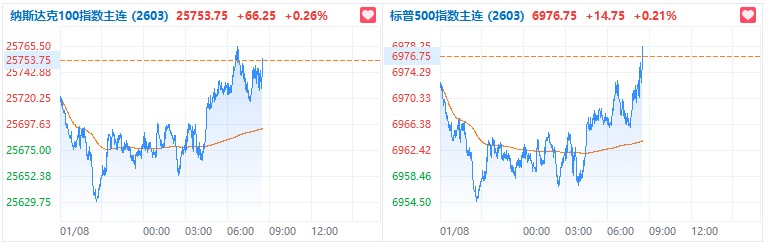
Driven by the news, U.S. stock futures surged briefly, with Nasdaq futures up 0.43% for the day, S&P 500 futures up 0.33%, and Dow futures up 0.28%; U.S. Treasury bonds fell, and the dollar index dipped briefly.
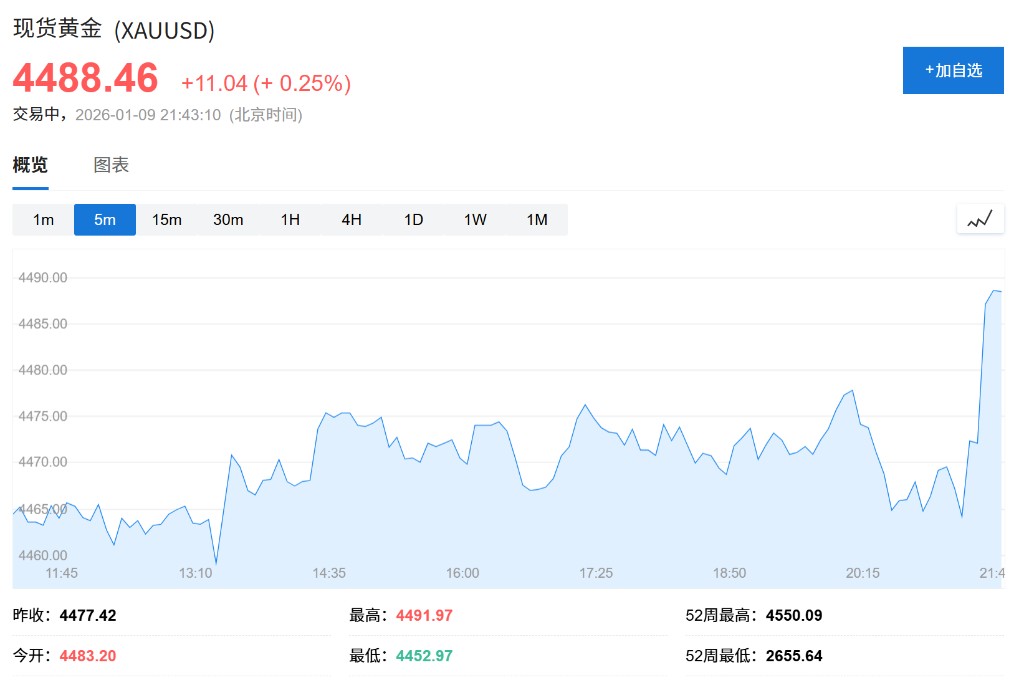
Spot gold surged briefly, reaching $4,490 per ounce, up 0.30% for the day.
More news will be updated continuously
