Report: SK Hynix halts production of consumer-grade memory chips, reallocating resources to the B2B and AI server markets

According to media reports, following Micron, South Korean chip manufacturer SK Hynix is planning to stop production of certain consumer-grade DRAM and NAND Flash products, focusing core resources on the B2B and AI server markets
The global semiconductor industry is undergoing a profound structural transformation driven by demand for artificial intelligence (AI), with storage giants aggressively restructuring their businesses and adjusting capital expenditures to seize the high ground of AI computing power.
On the 14th, according to media reports, following Micron, South Korean chip manufacturer SK Hynix is planning to stop production of some consumer-grade DRAM and NAND Flash products, concentrating core resources on the B2B and AI server markets.
As a key initiative in this strategic transformation, SK Hynix officially announced on Tuesday that it will invest 19 trillion won (approximately USD 12.9 billion) to build an advanced packaging factory in Cheongju, South Korea, to meet the surge in orders for high-bandwidth memory (HBM) from tech giants like NVIDIA.
As major companies shift production capacity significantly towards AI-driven high-end products, signs of tight supply in traditional storage chips have emerged, significantly driving up product prices. Research firm TrendForce estimates that the average price of DRAM, including HBM, will increase by 50% to 55% quarter-on-quarter this quarter. Samsung Electronics and SK Hynix also plan to further raise server DRAM prices by 60% to 70% in the first quarter of 2026, a trend that may continue for several years.
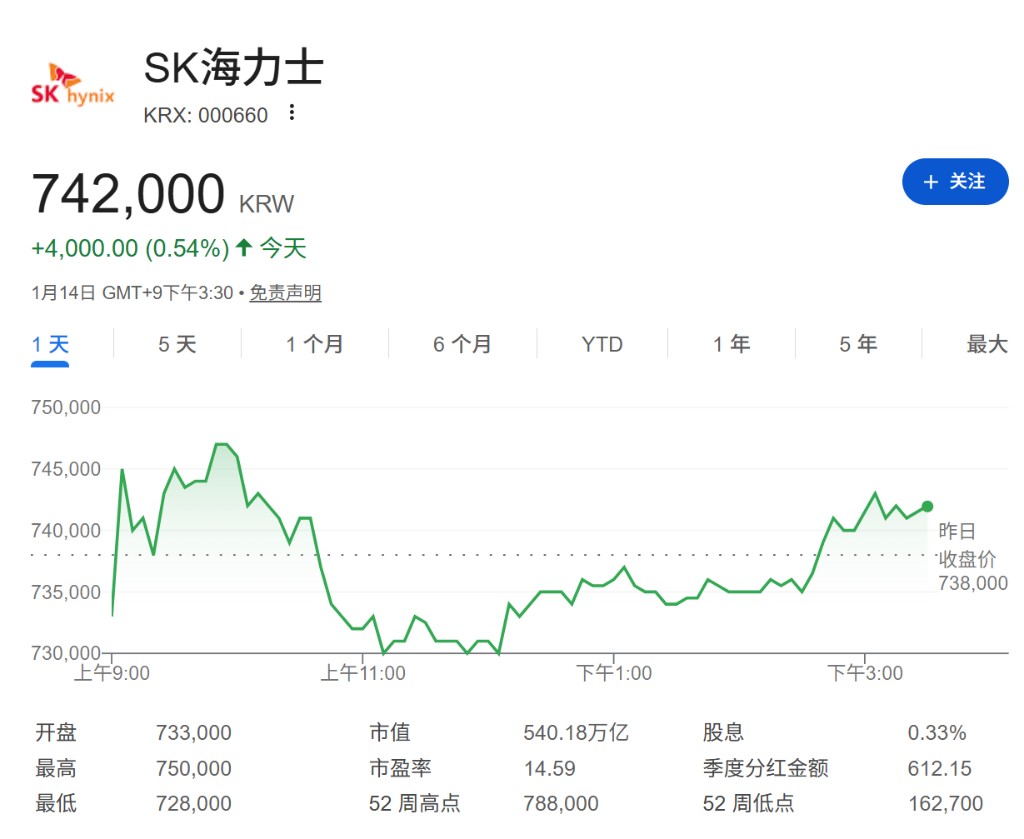
SK Hynix closed today at 742,000 won per share, up 0.54%.

Unexpectedly Strong AI Demand, Memory Super Cycle Expected to Last at Least Until 2027
SK Hynix's investment plan of up to USD 12.9 billion is not only aimed at expanding production capacity but also at overcoming technological bottlenecks. According to the statement, the new factory will primarily focus on advanced packaging technology, which is a key link in enhancing chip performance and energy efficiency. The facility is located in Cheongju, South Korea, with construction plans starting in April this year and expected to be completed and put into production by the end of 2027.
By then, the new factory will significantly enhance SK Hynix's ability to integrate multiple storage chips into a single high-density unit. This advanced packaging process can significantly improve data processing speed and energy efficiency while reducing the overall size of the chips, which is crucial for meeting the stringent bandwidth and energy consumption requirements of next-generation AI processors.
Market analysis indicates that capital expenditures in the semiconductor industry are shifting towards AI-related infrastructure. Nomura believes that due to unexpectedly strong demand for DRAM from AI servers and a surge in demand for enterprise solid-state drives (eSSD), the global memory industry's "super cycle" will last longer than expected, with this upward cycle expected to continue at least until 2027 Given that the large-scale capacity release on the supply side will not occur until at least 2028, Nomura expects the memory market to remain in a state of supply shortage in the coming years. As a result of this positive outlook, Nomura has reiterated its "Buy" ratings on Samsung Electronics and SK Hynix. Nomura raised the target price for Samsung Electronics by 6.7% to 160,000 KRW and increased the target price for SK Hynix by 4.8% to 880,000 KRW, believing that the valuations of both companies remain attractive compared to industry peers, and with significant improvements in profitability, there is still about a 45%-50% upside potential in their stock prices