Qianwen connects Alibaba's entire ecosystem, seizing the global AI super entrance

Break down the last wall
Author | Zhou Zhiyu
Editor | Zhang Xiaoling
A real transformation regarding the commercialization of AI has reached a critical point.
On January 15th, Alibaba's AI assistant Qianwen is no longer satisfied with being a "chatting" robot. After announcing that its monthly active users have surpassed 100 million, Alibaba revealed a long-prepared trump card: teaching AI to "get things done."
Alibaba Group Vice President Eric Wu announced at the event that Qianwen has entered the era of AI task execution.
In the latest version, Qianwen is no longer just a simple dialogue box; it directly connects the underlying systems of Ele.me, Fliggy, and Taobao. With a single command, the AI can penetrate the barriers of the apps to complete tasks such as ordering takeout, booking flights, and purchasing products.
Insiders close to Alibaba indicated that these are just part of the new features, and more functionalities will be launched at today's press conference.
This move by Alibaba indicates that large models cannot remain at the level of showcasing technology; they must have the capability for a commercial closed loop.
In the past, AI agents were often seen as a distant technological concept in the landscape of tech giants, and the market even regarded them as "PPT vocabulary" used for storytelling in the secondary market. However, Alibaba's actions clearly aim to tell the market: the AI that helps you get things done has arrived.
01 Saying Goodbye to "Illusions"
In the past two years, the large model sector has been bustling. From the hundred-model battle to the price-cutting frenzy, all players faced an awkward "illusion": no matter how high the parameters, if no transactions are generated, it ultimately amounts to nothing.
Although the large models of 2025 excited the industry for an entire year, by the beginning of 2026, investors in the primary market began to calm down. They realized that after burning billions in computing power, what they often got in return was merely a user asking, "Help me write an acrostic poem" or "Generate an image."
Such interactions cannot support a trillion-level valuation.
The K-line chart of the capital market is the most honest. Large model manufacturers urgently need to find a scenario that can convert massive traffic into real GMV (Gross Merchandise Volume). This sense of urgency instantly awakened the "muscle memory" of internet giants—the iron law that whoever controls the transaction entry from the PC era to the mobile era is the king.
Alibaba is well aware of the pain of unmonetized traffic. Therefore, it chose to unveil its killer move this year.
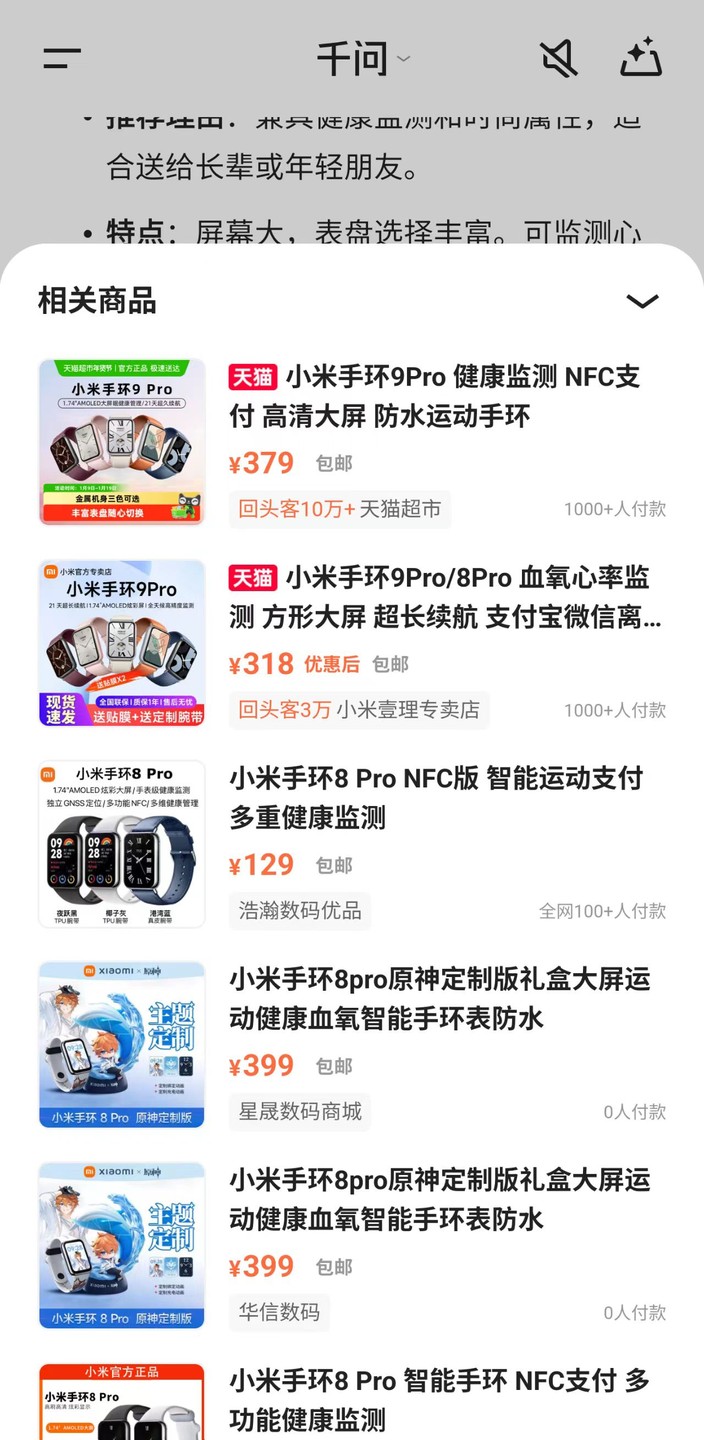
Unlike most models on the market that can only "give suggestions" or "check strategies," Alibaba's logic is to integrate its own app ecosystem. Wall Street News found in practical tests that Qianwen can already invoke features including Taobao Flash Sale for ordering food, Fliggy's ticketing system for booking, and price comparison for Taobao products during conversations.

It's like giving the large model arms and legs. In one dialogue box, there is the Qwen large model responsible for deep thinking to understand your intentions, and Alibaba's vast service ecosystem responsible for execution This "front store and back factory" model allows Alibaba to bypass cumbersome app transitions and directly engage in the core of transactions. When a user says, "I want to book a flight to Beijing tomorrow," they no longer need to open Fliggy, input dates, and filter flights. The AI directly pushes the final payment card in front of them.
02 Route Competition
Of course, in this trillion-level super entrance competition, Alibaba never lacks competitors.
Zhang Yiming's ByteDance is the "challenger" that keeps everyone awake at night.
Doubao has already surpassed everyone in daily active user data, becoming the de facto "national-level AI." However, in facing the question of how to make AI "get things done," Doubao and Alibaba have taken two completely different directions.
Because Alibaba has its own children like Ele.me, Fliggy, and Amap, it has control over the service end. It doesn't need to seek help from others; it can directly connect data interfaces internally. The advantage of this approach is stability, high order success rates, real-time data synchronization, and almost no delays.
On the other hand, Doubao is taking a more aggressive and geeky "Auto-UI" (automated interface operation) approach.
Through the Doubao mobile assistant, ByteDance attempts to give AI a pair of "eyes." It uses visual models to recognize every pixel and button on the mobile screen, then simulates human fingers to click and swipe.
In Doubao's logic, AI does not need app developers to open interfaces; it directly takes over your phone at the system layer. When you say "hailing a taxi," it opens Didi for you; when you say "ordering food," it opens Meituan for you.
However, the challenge for the Doubao mobile assistant is that it needs to overcome the barriers of cross-application operations imposed by the mobile system. It bets that AI can become a "super operating system" that transcends all apps.
Whoever can cultivate user habits first will hold the ticket to the next decade.
03 Global Consensus
This leap from "chatting" to "getting things done" is not unique to China. Across the ocean, a similar business alliance is also timely.
The collaboration between Google Gemini and retail giant Walmart can be seen as a global mirror of the Alibaba model.
Google has the strongest brain, but it still fears Amazon's e-commerce dominance. Therefore, it has partnered with Walmart, which has the strongest offline network. Under the cooperation framework, based on the Universal Commercial Protocol (UCP), Google Gemini can directly access Walmart's real-time inventory data.
When American users ask, "What do I need to buy for a barbecue party?" the AI can not only provide a menu but also directly lock in products on Walmart's shelves and complete payment using Google Pay, even arranging for curbside pickup.
The logic behind this is identical to Alibaba's: using the certainty of services to hedge against the uncertainty of technological iterations.
This also explains why OpenAI is also busy preparing a browser proxy product codenamed "Operator." Because Silicon Valley elites have also realized that the pure SaaS subscription model has hit a ceiling, only by entering the transaction flow of the real economy can AI tell a story larger than the internet
The Twilight of the App Era
As the competition for large models in the C-end enters a deep-water zone, the market begins to return to rationality. Alibaba chooses this moment to feed the "family bucket" to AI, hoping to take the lead in running through the business model amidst current traffic anxiety.
However, it will still take some time to truly integrate intelligent assistants into people's lives.
Xiong Wei, a China Internet industry analyst at UBS Securities, also stated to Wall Street Insights on January 14 that the large-scale launch, popularization, and monetization of AI agents will still require time. This involves not only ensuring accuracy and stability from a technical standpoint but also includes the time users need to accept it, the integration of the upstream and downstream of the industry chain, the establishment of cooperative relationships, the redistribution of economic benefits, and regulatory considerations.
In Xiong Wei's view, having an intelligent agent within the ecosystem of a large company, connecting the internal resources of the large company, is an important stage in the evolution of intelligent agents. The next stage will involve an intelligent agent connecting all different cross-platform operations. Achieving more comprehensive assistance for users, helping with actual decision-making, and even collaboration between intelligent agents are all matters for the final stage.
The so-called tasking AI is essentially aimed at stabilizing the fluctuations of large models that "burn money without making money," seeking long-term stability.
Using the universality of services to resolve the homogeneity of technology, and filling the void of dialogue with the tangible experience of transactions. This is what the real application of AI should look like