Super Cycle of Power Grid Equipment: "14th Five-Year Plan" Investment of 4 Trillion, Orders from Europe and America Ready to Surge

The super cycle of power grid equipment is approaching, with the State Grid Corporation planning to invest 4 trillion yuan during the "14th Five-Year Plan" period to promote the high-quality development of the power system. In the next 10 years, Europe needs to invest 3 trillion euros, while the United States is expected to invest 700 billion dollars to upgrade the grid. The global power grid equipment faces structural shortages, and Chinese power equipment companies are expanding into the global market with high delivery efficiency and cost advantages. Goldman Sachs pointed out that investment in the power grid will continue to grow, especially in distribution infrastructure
Electricity is power!
Domestically, the "14th Five-Year Plan" with an investment of 4 trillion ensures a leading position; internationally, Europe will need 3 trillion euros to upgrade its power grid over the next 10 years, and the United States is expected to invest 700 billion dollars in grid upgrades before 2030, signaling the arrival of a super cycle.
Which companies in specific segments have competitive advantages during this super cycle?
1. What happened? "14th Five-Year Plan" 4 trillion
Electricity is power!
According to the State Grid Corporation, during the "14th Five-Year Plan," the fixed asset investment of the State Grid Corporation is expected to reach 4 trillion yuan, a 40% increase compared to the "13th Five-Year Plan," aimed at expanding effective investment to drive the high-quality development of the new power system industry chain and supply chain. During the "14th Five-Year Plan," the State Grid will anchor the national self-contribution emission reduction targets, serving an average annual increase of about 200 million kilowatts in installed capacity of wind and solar new energy in its operating areas, promoting the proportion of non-fossil energy consumption to reach 25% and the proportion of electricity in terminal energy consumption to reach 35%. It will support the construction of zero-carbon factories and zero-carbon parks, meet the needs for 35 million charging facilities, and improve the electrification level of terminal energy use.
Stimulated by positive news, power grid equipment surged over 2% in the afternoon. 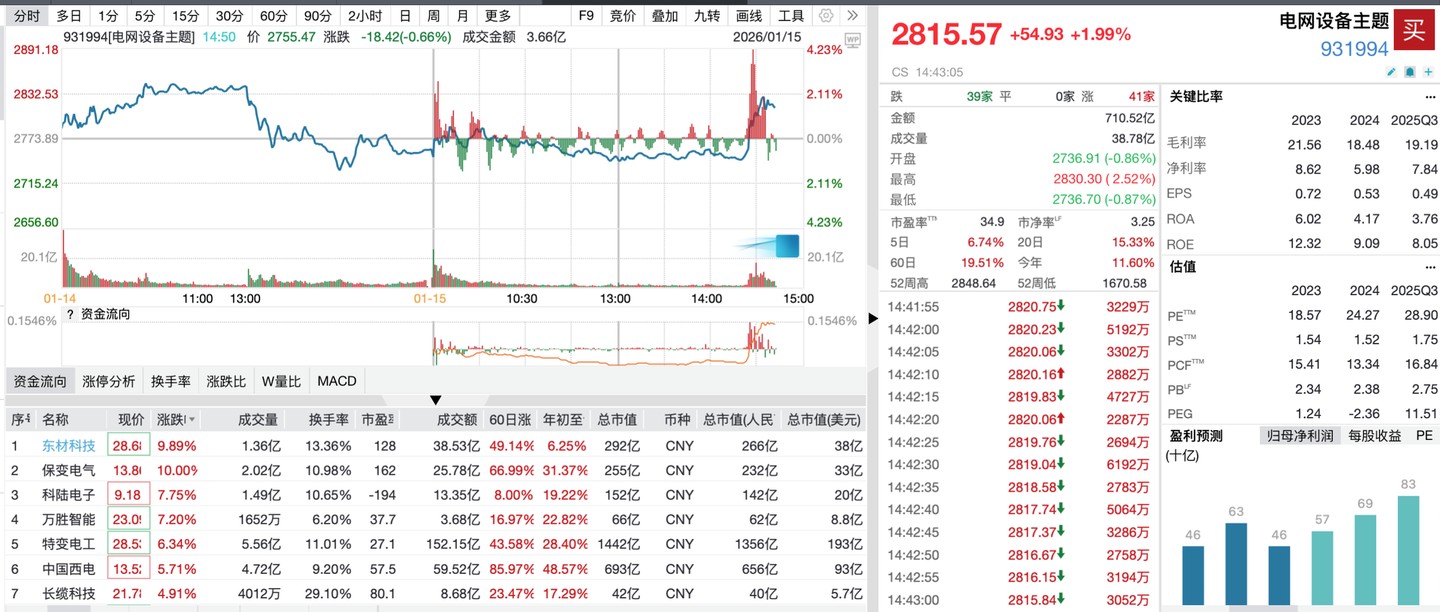 Source: WIND
In the next five years, the global energy transition and the wave of AI will drive a super new cycle of "Chinese power equipment premium." The global power system is undergoing the most profound paradigm shift since the Edison era. Goldman Sachs pointed out in its latest research that global grid equipment is in a state of "structural shortage," which is not only due to the replacement of aging grids in Western countries but also due to the explosive growth of AI data centers (AIDC) leading to new electricity loads. In this context, Chinese power equipment companies, with their high delivery efficiency, cost advantages across the entire industry chain, and pioneering technology in ultra-high voltage (UHV) fields, are transforming from "domestic suppliers" to "global challengers."
Goldman Sachs previously noted in its research report that the impact of AI and non-AI workloads on data center electricity demand is significant. The expected investment in the U.S. grid by 2030 has been raised from 720 billion dollars in July to 780 billion dollars, with an average annual increase of over 10 billion dollars, focusing on distribution infrastructure, while transmission capital expenditures are growing faster to maintain the supply growth of data centers.
CITIC Securities believes that domestic power equipment going overseas will face long-cycle investment opportunities, with three main logical points:
① The construction of AI data centers, the upgrading of existing infrastructure in Europe and the United States, and the integration of a high proportion of renewable energy will drive longer-cycle and sustainable capital expenditures for power sources and grids;
② Leading overseas electrical equipment companies have orders that are several times their annual revenue, making delivery efficiency difficult to guarantee; ③ Domestic leading companies are continuously deepening their penetration in niche markets, strengthening their overseas capabilities
II. Why is it Important? The Super Cycle under Three-Dimensional Resonance
The macro narrative of global power grid investment can be summarized as a super cycle under three-dimensional resonance.
The first dimension - Stock Replacement: The "Debt Repayment Period" of Aging Power Grids in Europe and America
According to data from Goldman Sachs and the International Energy Agency (IEA), approximately 60%-70% of transmission and distribution lines and transformers in the United States and Europe have been in operation for over 30 years, nearing or exceeding their design life. This long-term underinvestment has been exacerbated by the pressure of renewable energy integration. In 2025-2026, many countries in Europe and America passed large-scale power grid modernization bills, with the core logic being to enhance the flexibility and resilience of the grid.
The second dimension - AIDC Demand: The "Energy Black Hole" Behind AI Computing Power
The end of artificial intelligence is electricity. The rack power density of AIDC (Artificial Intelligence Data Center) has surged from the traditional 6-10kW to 30kW or even 100kW (in liquid cooling mode). This ultra-high-density load places extremely high reliability and immediate delivery requirements on the power supply and distribution systems of data centers (transformers, UPS, switchgear). AIDC demand is a significant driver exacerbating the global transformer shortage.
The third dimension - Energy Transition: The Construction Logic of New Power Systems
As the world's largest country in renewable energy installed capacity, China faces the challenge of transitioning from "source following load" to "load following source." This requires massive investments in the grid for "flexible transmission," "large-capacity energy storage," and "digital perception." As 2026 marks the early stage of the "14th Five-Year Plan," the total investment in the grid is expected to achieve double-digit growth compared to the "13th Five-Year Plan," with a focus on ultra-high voltage, smart distribution networks, and digital transformation.
Why can Chinese manufacturing enjoy this round of premium?
① Delivery Cycle: The "Time Dimension" of Core Competitiveness
Goldman Sachs pointed out in its research on Sieyuan Electric that the delivery cycle for transformers from leading Chinese companies is about 6-9 months, while global competitors (such as Hitachi Energy, Siemens Energy, GE Vernova) have extended their delivery cycles to 2-3 years. In the current race against time for AIDC construction, this delivery capability gap constitutes a substantial competitive barrier.
② Vertical Integration of the Entire Industry Chain and Cost Premium
The Chinese power equipment industry has a complete chain from raw materials (oriented silicon steel, copper materials) to core components (tap changers, bushings, insulation materials) to complete machine integration. Against the backdrop of global inflation and labor shortages, the manufacturing costs of Chinese companies are 30%-40% lower than similar products in Europe and America, while maintaining a high gross margin, reflecting strong cost transfer capabilities.
III. What to Focus on Next? Value Logic of Segmented Links and Leading Companies
In the past, the market viewed power equipment as a low-margin manufacturing industry, but data from 2025 refutes this view. As the proportion of overseas orders increases (overseas gross margins are typically 10-15 percentage points higher than domestic), leading companies like Sieyuan and Huaming are entering an upward channel for comprehensive gross margins. Let's look at which segmented link companies have the window of industrial dividends ① Core links of power transmission and transformation: transformers and switchgear
Value logic: Transformers are the "heart" of the power grid, and under the backdrop of global shortages, they have the greatest premium space.
② The core "throat" of transformers: on-load tap changers
Value logic: On-load tap changers (OLTC) are the core regulating components of transformers, with extremely high technical barriers, and only a few companies globally master this technology.
Leading enterprises have a domestic market share of over 90%, second only to Germany's MR globally. Their business logic is similar to "blade + blade holder," where stock maintenance and spare parts replacement contribute to high cash flow and profit margins.
③ Ultra-high voltage (UHV) and the brain of the power grid: secondary equipment and general contracting capabilities
Value logic: UHV is China's "golden business card" for going global with its power grid and is key to solving the mismatch of energy resources.
Leading enterprise NARI-TECH is the king of power grid digitalization and dispatching. Its core advantage lies in being the absolute main force of the national team, possessing monopolistic technology in power grid dispatching, substation automation, and direct current transmission (high voltage direct current relay protection). With the construction of new power systems, the demand for "software-defined" and "digitalization" in power grids has surged. NARI-TECH not only benefits from the increase in domestic UHV bidding but also has irreplaceability in overseas high-end market power grid integration and control system bidding.
④ Distribution networks and AIDC specialized equipment: new direction for going overseas
Value logic: As distribution networks transition from "unidirectional power reception" to "bidirectional interaction," there is enormous upgrade potential for distribution network equipment.
The construction of power grids in emerging overseas markets is in the process of going from 0 to 1. Haixing Electric has extended from smart meters to microgrids, energy storage, and EPC general contracting, creating a closed loop of "products + services." Leading enterprises have delivery advantages in overseas production capacity.
In summary, the power equipment industry is currently in a state of "low debt, high cash, full orders." Compared to the 30-40 times PE valuation of American peers (such as Eaton, Schneider), Chinese leading companies generally have a PE between 15-25 times. As global funds recognize the "super cycle of power equipment," Chinese enterprises still have dividends to look forward to in the future.
Embracing the "power version" of infrastructure madness, at the intersection of global energy transition and the AI revolution, Chinese power equipment companies are not only suppliers but also the underlying support for the reconstruction of the global energy order.
Companies that have entered the localization operation phase in overseas terminal markets or have deeply integrated into the supply chains of large overseas enterprises will gain excess growth opportunities. Siyi Electric's overseas business accounted for 34% in the first half of 2025, a year-on-year increase of 9 percentage points; Jinpan Technology's overseas business accounted for 28% in the first half of 2025; EAGLERISE secured orders from the United States and Japan in the first half of the year, with factories in Thailand and Mexico, and its U.S. transformer factory is expected to be put into production within the year, helping to further open the U.S. market; SANXING has been deeply cultivating the electric meter industry in Europe, the Middle East, and other markets for over 10 years, with 5 major production bases and 11 sales centers, covering more than 70 countries and regions; Shenma Electric's overseas revenue accounted for over 47% in the first half of 2025, with new overseas orders of 462 million yuan, a year-on-year increase of 39.5%, setting a historical high Risk Warning and Disclaimer
The market has risks, and investment should be cautious. This article does not constitute personal investment advice and does not take into account the specific investment goals, financial situation, or needs of individual users. Users should consider whether any opinions, views, or conclusions in this article are suitable for their specific circumstances. Investment based on this is at one's own risk.