HuaChuang Zhang Yu: Re-discussing the strength of exports in the midstream, 2026 electromechanical exports may continue to thrive

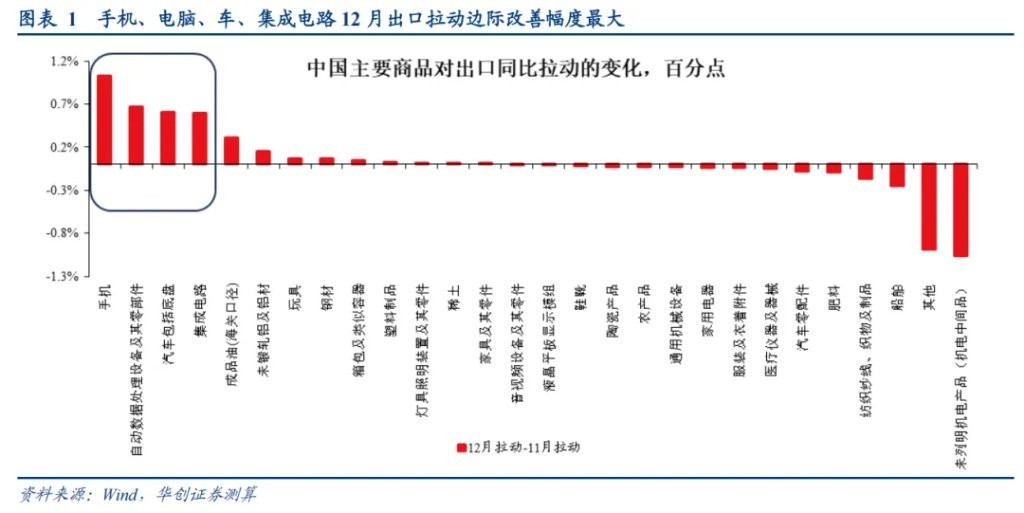
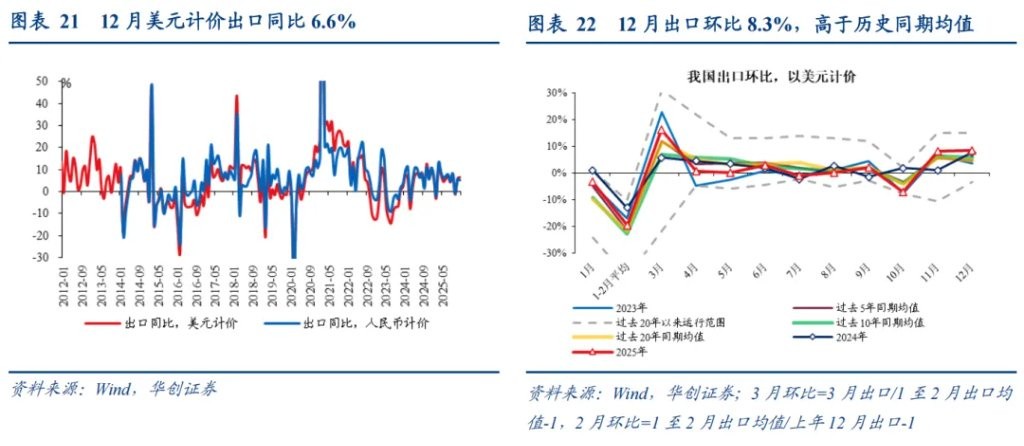
In December, China's exports in US dollars increased by 6.6% year-on-year, exceeding the expected 3%. The main driving factors were four categories of electromechanical products: mobile phones, automatic data processing equipment, automobiles, and integrated circuits. Looking ahead to 2026, the export of midstream electromechanical products is expected to continue to be strong, benefiting from the demand for technology imports, growth in handheld orders, and market share gains brought by electrification
Matters
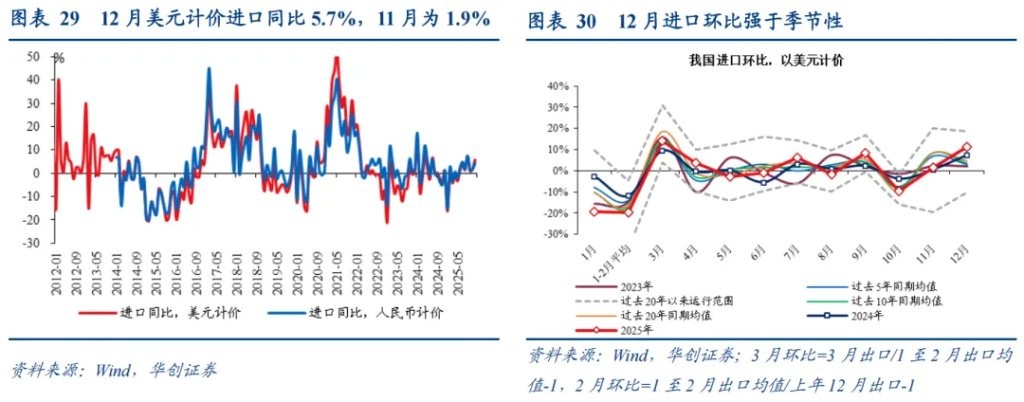
In December, China's exports in USD terms increased by 6.6% year-on-year, expected at 3%, previous value 5.9%; imports in USD terms increased by 5.7% year-on-year, expected at 0.9%, previous value 1.9%.
Core Views
- In December, China's exports did not decline due to base effects but instead rebounded by 0.7 percentage points compared to the previous month. This corresponds with a significant rebound in PMI new export orders, possibly driven by both external demand recovery and certain production front-loading factors before the year-end holiday.
Breaking down by product, the marginal improvement mainly comes from four categories of electromechanical products: 1) Mobile phones: possibly mainly due to last year's low price base; 2) Automatic data processing equipment and its components, with weak equipment but strong accessories, possibly benefiting from the tech import demand boom under the AI trend; 3) Vehicles: mainly driven by strong demand for new energy vehicles, possibly benefiting from competitive advantages and market demand expansion; 4) Integrated circuits: similar to computer accessories, possibly mainly benefiting from high growth in tech import demand.
- Outlook for 2026: We believe that the strength in the midstream may continue. First, from the product structure perspective, the four chains of electromechanical products may have supportive logic for prosperity: 1) Information and communication technology (ICT) products: possibly benefiting from the tech import demand boom; 2) Ships: export resilience comes from continued high growth in backlog orders; 3) Automobiles: export resilience may benefit from improved competitiveness and market share growth brought by electrification; 4) Other electromechanical products may benefit from a moderate recovery in global industrial production.
Report Summary
2026 Electromechanical Exports May Continue Prosperity—Revisiting Export Strength in the Midstream
(1) December Exports: The Core of Marginal Improvement Lies in Four Categories of Electromechanical Products
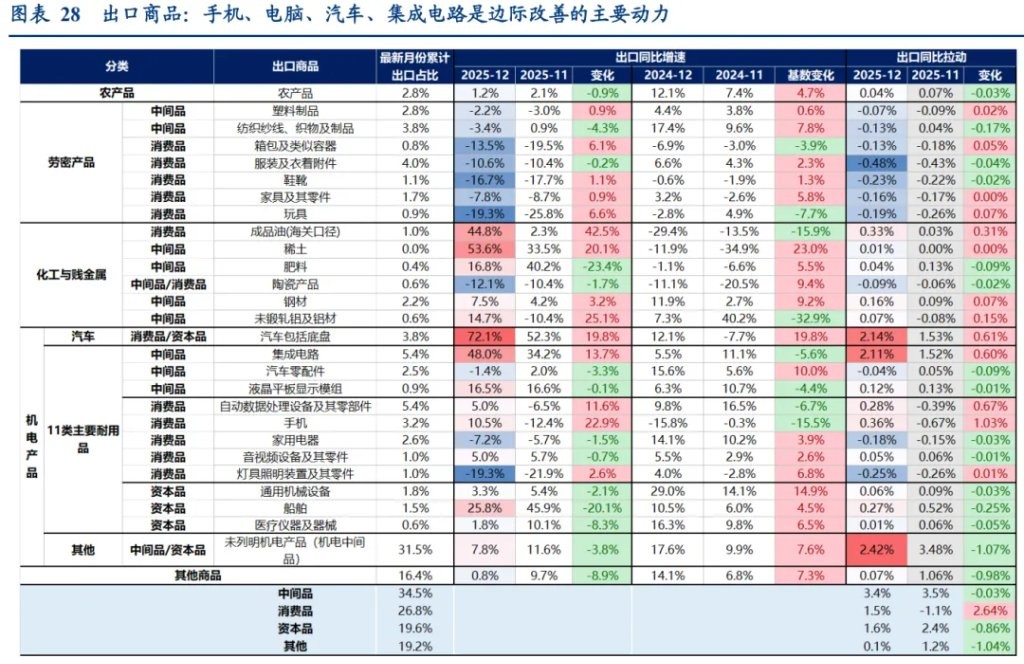
From the year-on-year contribution changes, the incremental contribution to the export growth in December mainly comes from four categories of electromechanical products: mobile phones, computers (here as a proxy for "automatic data processing equipment and its components"), vehicles, and integrated circuits.
-
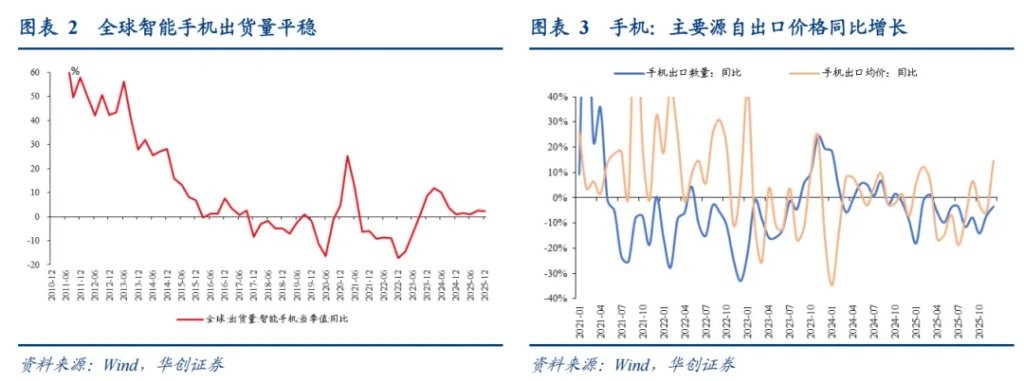
For mobile phones, from a global demand perspective, there has been no significant expansion in overall demand for smartphones in the fourth quarter; meanwhile, China's mobile phone export volume is still in negative growth, with the increase in export value mainly coming from price. We found that the average export price of mobile phones in December 2024 is significantly lower than the average level since 2022.
-
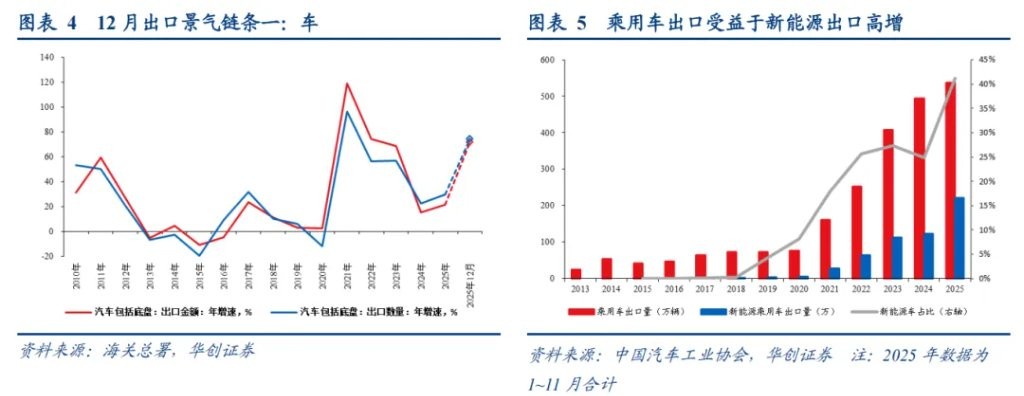
For automobiles, according to the China Passenger Car Association: "In December, new energy passenger car exports reached 273,000 units, a year-on-year increase of 119.8%, accounting for 46.4% of passenger car exports, an increase of 15.4 percentage points compared to the same period last year."
-
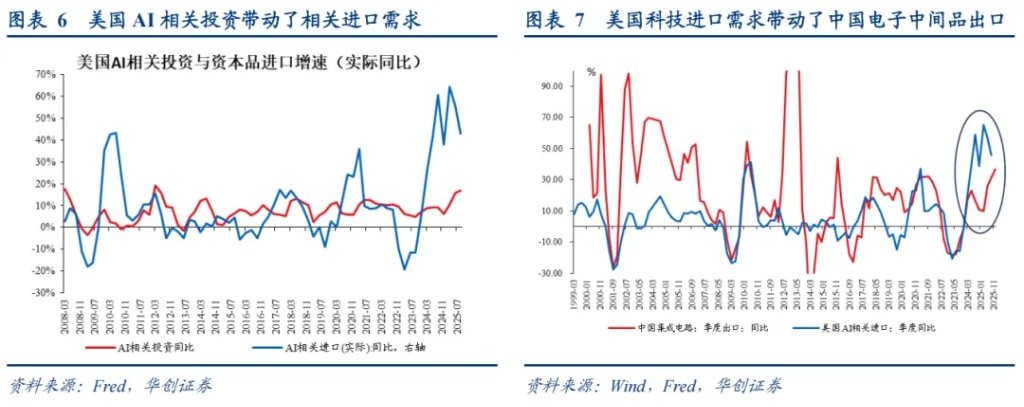
For integrated circuits, it may benefit from AI import demand driven by AI investments in developed markets led by the United States. In the first three quarters of 2025, the actual year-on-year growth rate of AI-related investments in the U.S. reached 14.4% (8.2% in 2024), and the actual import volume of AI technology capital goods increased by 53.2% year-on-year (41.8% in 2024). In this process, China's exports may benefit from "indirect exports" through the global supply chain, manifested as strong exports of electronic intermediates (represented by integrated circuits)
-
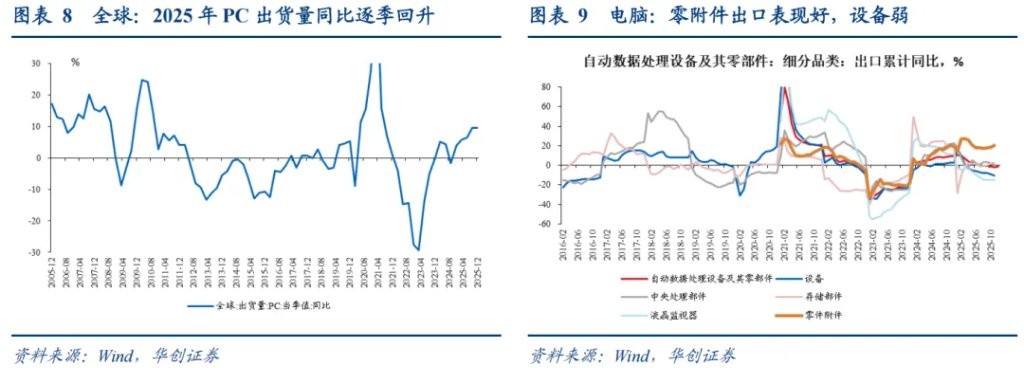
For computers, the equipment is relatively weak, while the export of parts and accessories is relatively strong. Among automatic data processing equipment and its components, the export of automatic data processing equipment accounts for 42%, with the latest cumulative year-on-year growth rate from January to November at -10.8% (3% for 2024); the export of parts and accessories accounts for 26%, with a cumulative year-on-year growth rate from January to November reaching 20.7% (19.1% for 2024). Computer parts and accessories are estimated to be similar to integrated circuits, belonging to intermediate products in the electronic supply chain, which may reflect China's indirect benefits from the technology import demand of developed markets through the global supply chain.
(2) Export products in 2025: Strong in the midstream
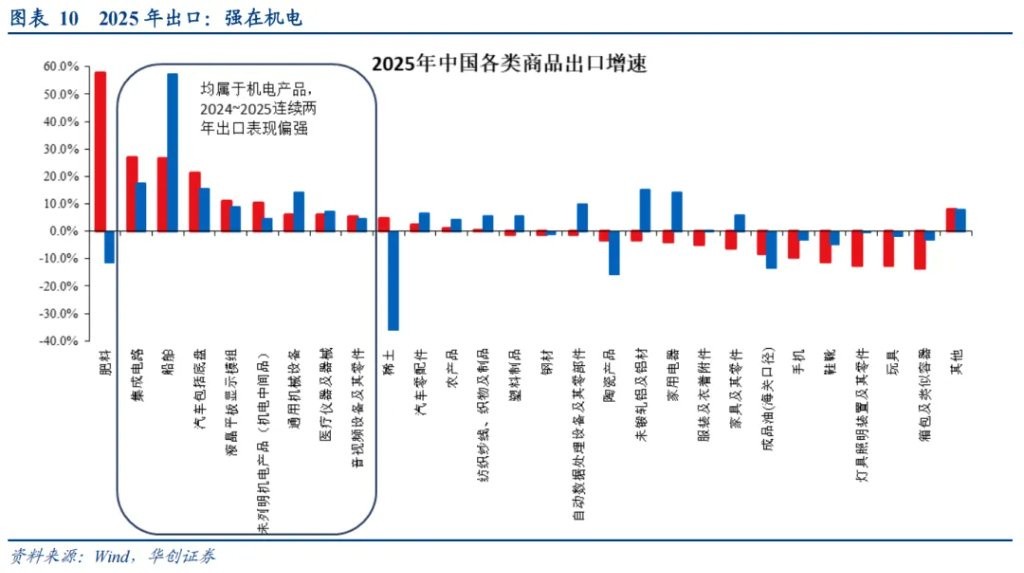
On one hand, the export of electromechanical products is strong. In terms of specific products, many electromechanical products, including integrated circuits, ships, automobiles, liquid crystal display modules, and electromechanical intermediate products, are expected to maintain high prosperity for two consecutive years in 2024-2025 (Figure 10).
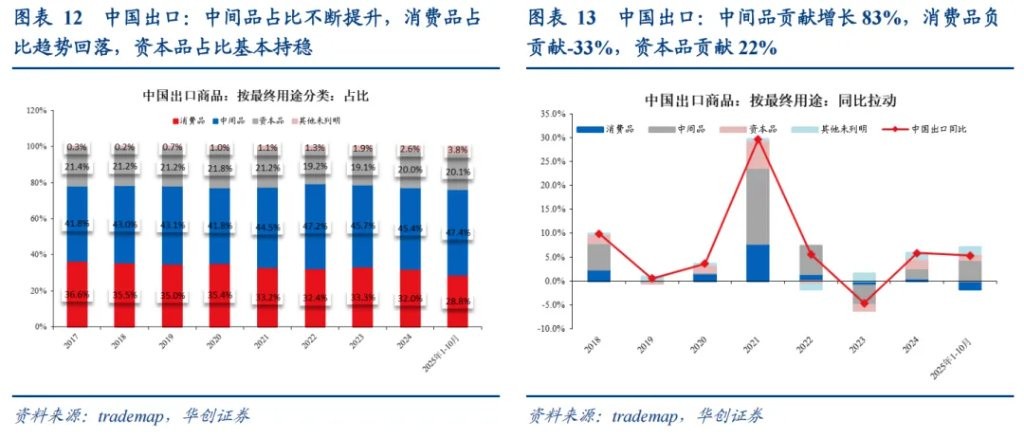
On the other hand, by usage, intermediate products contribute significantly, capital goods remain stable, and consumer goods have a negative contribution. In terms of proportion, from 2017 to the first ten months of 2025, the proportion of intermediate products in China's exports increased from 41.8% to 47.4%, with an average annual increase of 0.7 percentage points; the proportion of consumer goods decreased from 36.6% to 28.8%, with an average annual decline of about 1 percentage point; the proportion of capital goods slightly decreased from 21.4% to 20.1%, with an average annual decline of about 0.2 percentage points.
(3) Outlook for 2026: Strong midstream may continue
-
From the product structure perspective, the four chains of electromechanical products may have prosperity logic support.
-
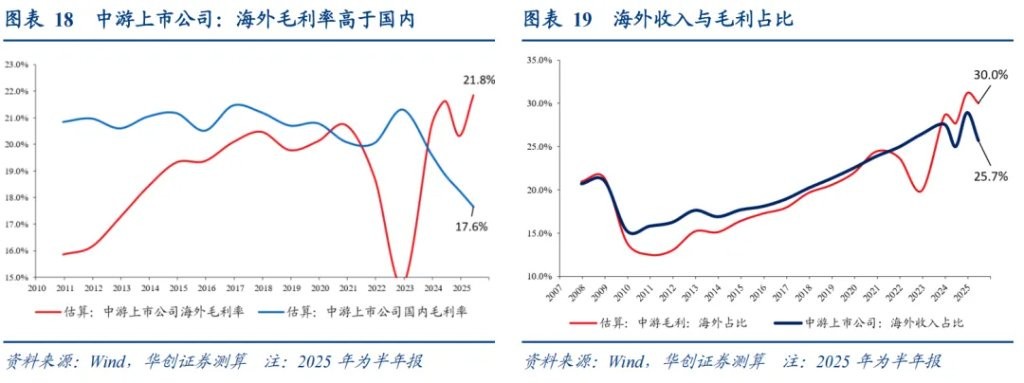
From the profitability perspective, the overseas gross profit margin of midstream manufacturing has exceeded that of the domestic market, which may reflect the improvement of the comprehensive competitiveness of Chinese products in overseas markets, allowing enterprises to obtain reasonable pricing and profit margins.
II. For detailed import and export sub-item data, see the main text.
Report Body
Electromechanical Exports in 2026 May Continue Prosperity - Re-discussing Export Strength in the Midstream
(1) December Exports: Marginal Improvement Core in Four Types of Electromechanical Products
In December, China's overall export growth rate significantly exceeded market expectations, recording 6.6%, with a year-on-year growth of 3.8% in the fourth quarter and an annual growth of 5.5% in 2025, slightly lower than 5.8% in 2024. Among them, the export of electromechanical products maintained high growth, with a year-on-year growth rate of 12.1% in December and an annual growth of 8.4% in 2025, higher than 7.4% in 2024.
From the perspective of year-on-year driving changes, the incremental contribution to the export growth rate in December mainly came from four types of products in electromechanical products: mobile phones, computers (here as a proxy for "automatic data processing equipment and its components"), vehicles, and integrated circuits.

- Mobile Phones: May Mainly Stem from Last Year's Low Price Base
Firstly, we find that the improvement in mobile phone exports may mainly stem from the base effect of the low average export price in the same period of 2024, and the driving logic on the demand side has yet to be validated. In December, China's mobile phone export value increased by 10.5% year-on-year (previous month -12.4%), driving exports up by 0.4% year-on-year (previous month -0.7%); the full-year mobile phone export forecast for 2025 is -9.4%, further declining from -3.1% in 2024.
From a global demand perspective, there was no significant expansion in overall smartphone demand in the fourth quarter. The full-year smartphone shipment volume for 2025 is expected to remain relatively stable, with an average year-on-year growth rate of around 1.85% in the first to fourth quarters, and a year-on-year growth of 2.3% in the fourth quarter, slightly higher than the 2.6% in the third quarter.
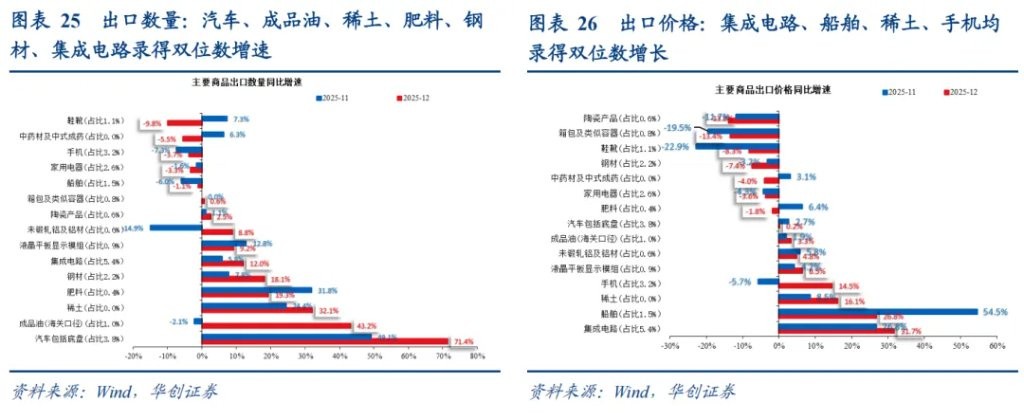
From the perspective of China's mobile phone export volume and price, the growth rate of mobile phone exports in December remained in the negative range, down 3.6% year-on-year, but the average export price of mobile phones rose to 14.7% year-on-year. The average export price of mobile phones in December was $183.7 per unit, which is actually lower than November's $197.2 per unit, but in December 2024, the average export price was only $160.2 per unit, the lowest for the same period since 2020, and also lower than the average export price of $166.75 per unit since 2022.

- Automotive: Mainly driven by the expansion of the overseas market for new energy vehicles
The relative advantages of new energy vehicles and the expansion of market demand have driven strong performance in automotive exports.
In terms of value, in December, China's automotive exports, including chassis, increased by 72.1% year-on-year (previous month 52.3%), with a full-year growth forecast of 21.4% for 2025, contributing 0.7% to exports, compared to 0.5% in 2024.
In terms of quantity, in December, the number of automotive exports, including chassis, was 994,000 units, with a year-on-year growth rate of 74.4%, contributing 104% to the growth of automotive export value; the full-year automotive export volume, including chassis, for 2025 is expected to be 8.324 million units, a year-on-year increase of 29.9%, contributing 140% to the annual growth of automotive export value.
Among them, the prosperity mainly comes from the expansion of the overseas market for new energy vehicles.
1) Looking only at the passenger car market (in 2024, passenger car exports accounted for about 77% of total automotive exports including chassis): According to data from the China Association of Automobile Manufacturers, from January to November 2025, China's passenger car export volume was 5.36 million units, with new energy vehicles (pure electric + plug-in hybrid + fuel cell) exports at 2.21 million units, accounting for 41.2%, a significant increase of 16.3 percentage points from 24.9% in 2024. According to the China Passenger Car Association: "In December, new energy passenger car exports reached 273,000 units, a year-on-year increase of 119.8%, accounting for 46.4% of passenger car exports, an increase of 15.4 percentage points compared to the same period last year."
- Focusing on the internal dynamics of new energy vehicle exports, according to the China Passenger Car Association: "China's new energy vehicle exports from January to November 2025 performed better than expected, mainly due to plug-in hybrids and regular hybrids replacing pure electric vehicles as new growth points for exports… …China's new energy vehicle exports are showing high-quality development towards the Middle East and developed countries. Mainly exporting to Western Europe and Asian markets.

- Integrated Circuits: Likely to Benefit from High Growth in Technology Import Demand
In December, integrated circuit exports increased by 48% year-on-year, driving overall exports up by 2.1% year-on-year (compared to 1.5% last month); for the entire year of 2025, integrated circuit exports are expected to grow by 26.8%, higher than the 17.4% growth in 2024.
The prosperity of integrated circuit exports is likely to benefit from the high growth in technology import demand supported by industrial logic. The high capital expenditure of American technology companies has driven a significant increase in technology import demand. We combine computer investment, power and communication investment, and software investment as "AI-related investment," and consider the imports of computers and related equipment in capital goods as corresponding "AI-related imports." In the first three quarters of 2025, the net AI-related investment in the U.S. (excluding price factors) is nearly $3.7 trillion, with net AI-related imports reaching $783.4 billion, accounting for about 21.2%; in the first three quarters of 2025, the actual year-on-year growth rate of AI-related investment is as high as 14.4% (compared to 8.2% in 2024), and the actual import volume of AI technology capital goods increased by 53.2% year-on-year (compared to 41.8% in 2024). In this process, China's exports may benefit from "indirect exports" through the global supply chain, reflected in the strong performance of electronic intermediate goods (represented by integrated circuits).

- Computers: Mainly Strong Performance in Accessories
In the export of automatic data processing equipment and its components, the equipment is weak, while the export of parts and accessories is strong. In December, the year-on-year export of automatic data processing equipment and its components rebounded from -6.5% last month to 5%, with the contribution to year-on-year export growth changing from -0.4% to 0.3%; the annual export growth rate for 2025 is only -1.4%, significantly lower than the 9.9% in 2024.
From a global demand perspective, the growth rate of PC shipments in 2025 is expected to steadily recover quarter by quarter, averaging 7.8% year-on-year over four quarters, with a year-on-year growth rate of 9.6% in the fourth quarter.
However, from the perspective of China's exports, the export of equipment is not strong, mainly due to the strong performance of accessories. In automatic data processing equipment and its components, the export of automatic data processing equipment accounts for 42%, with the latest year-on-year export in November showing only -23.3%, and the cumulative year-on-year growth rate from January to November at -10.8% (compared to 3% in 2024); the export of parts and accessories accounts for 26%, with the latest year-on-year export in November at 36.6%, and the cumulative year-on-year growth rate from January to November reaching 20.7% (compared to 19.1% in 2024), maintaining high prosperity for two consecutive years

(2) 2025 Exported Goods: Strong in Midstream
From the perspective of commodity structure, the "strength in midstream" of exports can be understood from two dimensions:
- Dimension One: Strong Electromechanical Exports, Distinguishing Four Chains
The first dimension: Strong electromechanical exports can be divided into vehicles, ships, electronics, machinery, and other electromechanical intermediate products.
As demonstrated by the characteristics of exports in December, throughout 2025, the prosperity of electromechanical products will be the core support for exports, and the export of electromechanical products corresponds to the external demand of midstream manufacturing [1].
1) Overall, in 2025, the export of electromechanical products is expected to grow by 8.4%, higher than the 7.4% in 2024.
2) In terms of major commodities, those with high export growth and maintaining high prosperity for two consecutive years from 2024 to 2025 are also mostly electromechanical products, including integrated circuits, ships, automobiles, liquid crystal display modules, and electromechanical intermediate products, etc. (See Figure 10).
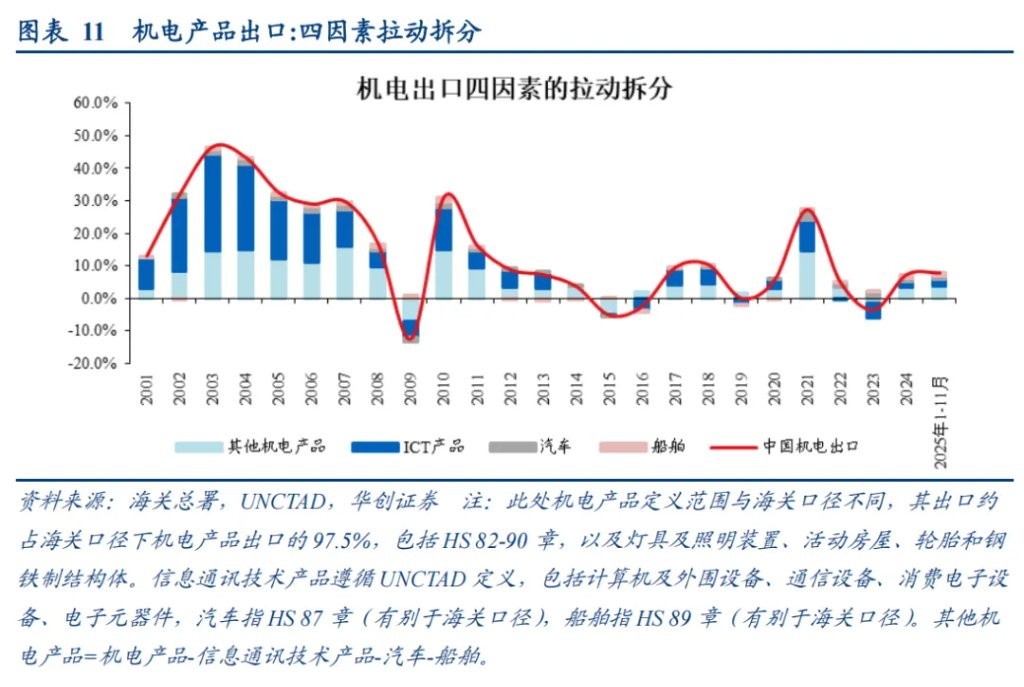
3) According to different product characteristics or demand logic, electromechanical products can be further divided into four sectors: automobiles, ships, ICT (Information and Communication Technology products), and other electromechanical products (mainly composed of machinery and electromechanical intermediate products). For statistical convenience, the "electromechanical products" examined here differ from the customs-calibrated electromechanical products (the former accounts for about 97.5% of the latter). Currently, data can only be updated until November 2025. In terms of composition, from January to November 2025, the electromechanical products under my definition accounted for about 59.2% of total exports, with the four sectors accounting for the export proportions of electromechanical products as follows: ICT products 35.7%, automobiles 11%, ships 2.9%, and other electromechanical products 50.4%. In terms of growth rate, the cumulative year-on-year export growth of electromechanical products under my definition is approximately 7.8% (7.3% in 2024), with ICT products contributing 2%, automobiles 1.3%, ships 0.8%, and other electromechanical products 3.8%. (See Figure 11)


- Dimension Two: Strong Intermediate Goods Exports, Negative Contribution from Consumer Goods
The second dimension: By purpose, intermediate goods contribute prominently, consumer goods have a negative contribution, and capital goods remain stable.
According to BEC classification, when goods are divided into intermediate goods, capital goods, and consumer goods, it is found that: the core position of intermediate goods as the "basic plate" of exports is becoming increasingly prominent, with their export share continuously rising and the contribution rate to export growth trending upward. **
-
In recent years, the proportion of intermediate goods in China's exports has fluctuated upward, with a particularly significant increase expected by 2025, while the proportion of consumer goods has notably declined. From 2017 to the first ten months of 2025, the proportion of intermediate goods in China's exports rose from 41.8% to 47.4%, with an average annual increase of 0.7 percentage points; the proportion of consumer goods fell from 36.6% to 28.8%, with an average annual decline of about 1 percentage point; the proportion of capital goods slightly decreased from 21.4% to 20.1%, with an average annual decline of about 0.2 percentage points, remaining relatively stable.
-
In terms of contribution to growth rates, the contribution rate of intermediate goods to export growth has increased in recent years, while the contribution rate of consumer goods has shown a downward trend, and the contribution rate of capital goods has remained basically stable. From 2018 to the first ten months of 2025, the contribution rate of intermediate goods to export growth rose from 55.5% to 82.5%, while the contribution rate of consumer goods fell from 24.7% to -32.7%, and the contribution rate of capital goods slightly increased from 19.4% to 22.4%.

(3) Outlook for 2026: Midstream Strength May Continue
We believe that, from two dimensions, the prosperity of electromechanical exports in 2026 may continue, corresponding to a more certain macroeconomic prosperity in midstream manufacturing.
- From the product structure perspective, the four chains of electromechanical products may have supportive logic for prosperity.
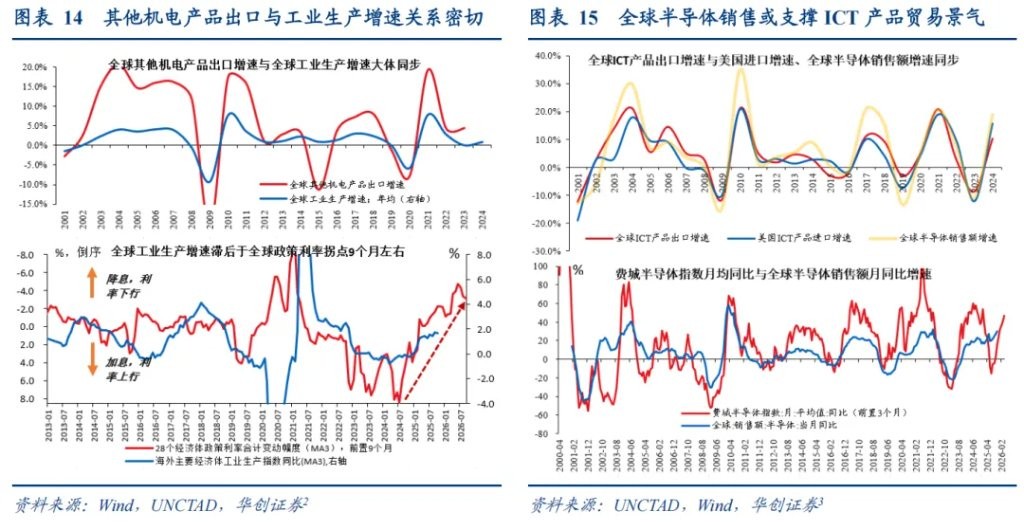
First, other electromechanical products may benefit from a mild recovery cycle in industrial production driven by global monetary policy easing.
Second, information and communication technology (ICT) products may benefit from the prosperity of technology import demand. Tracking indicators show that the trade growth rate of global ICT products is synchronized with the growth rate of global semiconductor sales, while the Philadelphia Semiconductor Index's monthly average year-on-year leads the global semiconductor sales growth rate by about three months. Currently, global semiconductor sales are expected to maintain an upward trend until early next year.
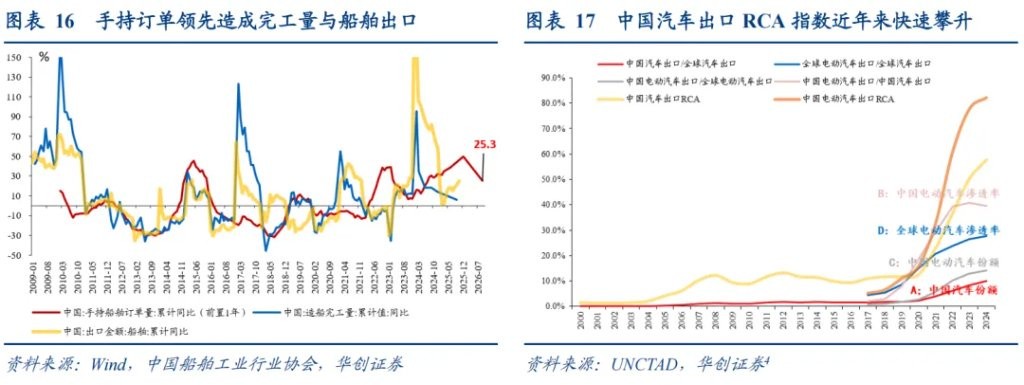
Third, shipbuilding resilience comes from the continued high growth of orders on hand. In the first nine months of this year, China's shipbuilding orders on hand reached 24.224 million deadweight tons, a year-on-year increase of 25.3%, continuing to maintain a high growth rate, which leads China's shipbuilding completion volume and ship export growth rate, supporting ship export growth to remain at a relatively high level.
Fourth, automobiles may benefit from enhanced competitiveness and market share growth brought by electrification. Breaking down China's automobile export share, China's automobile export share (A) = China's electric vehicle export share (C) * global electric vehicle export penetration rate (D) / China's electric vehicle export penetration rate (B). It is expected that the subsequent increase in automobile export share will come from C and D. Regarding D, it represents the global electrification process, which has risen from 8.5% in 2019 to 27.8% in 2024, still having significant room for improvement. Regarding C, it reflects the improvement of China's electric vehicle RCA index, which has risen from 0.11 in 2019 to 0.82 in 2024, correspondingly, China's electric vehicle share has increased from 1.7% in 2019 to 14.2% in 2024 Compared to China's overall share of global electromechanical exports (around 20%), there is still significant room for improvement in the share of electric vehicles.


- From the perspective of profitability, the overseas gross margin of the midstream manufacturing sector has already surpassed that of the domestic market.
This may reflect the improvement in the comprehensive competitiveness of Chinese products in overseas markets, allowing companies to achieve reasonable pricing and profit margins.
We used data from listed companies to calculate the gross margins and revenue scales of the midstream sector domestically and internationally. In terms of gross margin, the mid-year report for 2025 shows that the gross margin for overseas business reached 21.8%, significantly better than the domestic figure of 17.6%. Prior to 2023, the gross margin for domestic business was higher for most periods. In terms of revenue and gross margin proportions, the mid-year report for 2025 indicates that the overseas revenue share of the midstream sector is 25.7%, and the gross margin share is 30.0%, both trending upwards.

Import and Export Sub-item Data
(1) Exports
- Overall Exports: Unexpected Recovery
The year-on-year growth rate of exports in December exceeded expectations. In December, China's exports in US dollars increased by 6.6% year-on-year, compared to an expectation of 3% and a previous value of 5.9%. Month-on-month, December exports increased by 8.3%, higher than the average month-on-month growth rates for the same period over the past 5 years/10 years/20 years, which were 4.7%/5.9%/4.6%. The cumulative year-on-year export growth for the entire year was 5.5%, with a cumulative year-on-year growth of 5.8% expected for 2024.

- Export Volume and Price: Quantity May Rebound Significantly
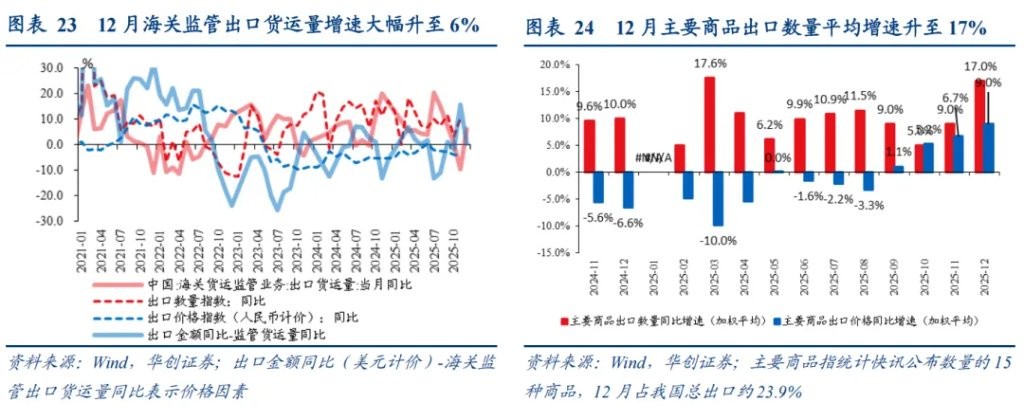
Two indicators tracking the growth rate of export quantity point to a significant recovery in export quantity growth. 1) Statistical flash report on 15 major commodities, in December (accounting for 23.9% of China's total exports in December), the weighted average year-on-year growth rate of export quantity rebounded significantly to 17%, up from 9% in November, with an average of 12.6% expected for 2024; the weighted average year-on-year growth rate of export prices for the 15 major commodities rebounded to 9%, up from 6.7% in November, with an average of -1.9% expected for 2024. 2) Customs-regulated export freight volume, which significantly increased to 6% year-on-year in December, compared to -9.7% in November, with an average of 7.9% expected for 2024 By deducting the growth rate of customs-regulated export cargo volume from the growth rate of export value, the year-on-year price in December was 0.6%, compared to 15.6% in November. 3) Looking back at November, the year-on-year growth rate of the export price index (in RMB) slightly declined, recording -4.2%, down from -3.9% in October. The year-on-year export quantity index in November, however, surged to 10.3%, up from 3.2% in October.


- Export Regions: Weak in the U.S., Strong in Non-U.S. Markets
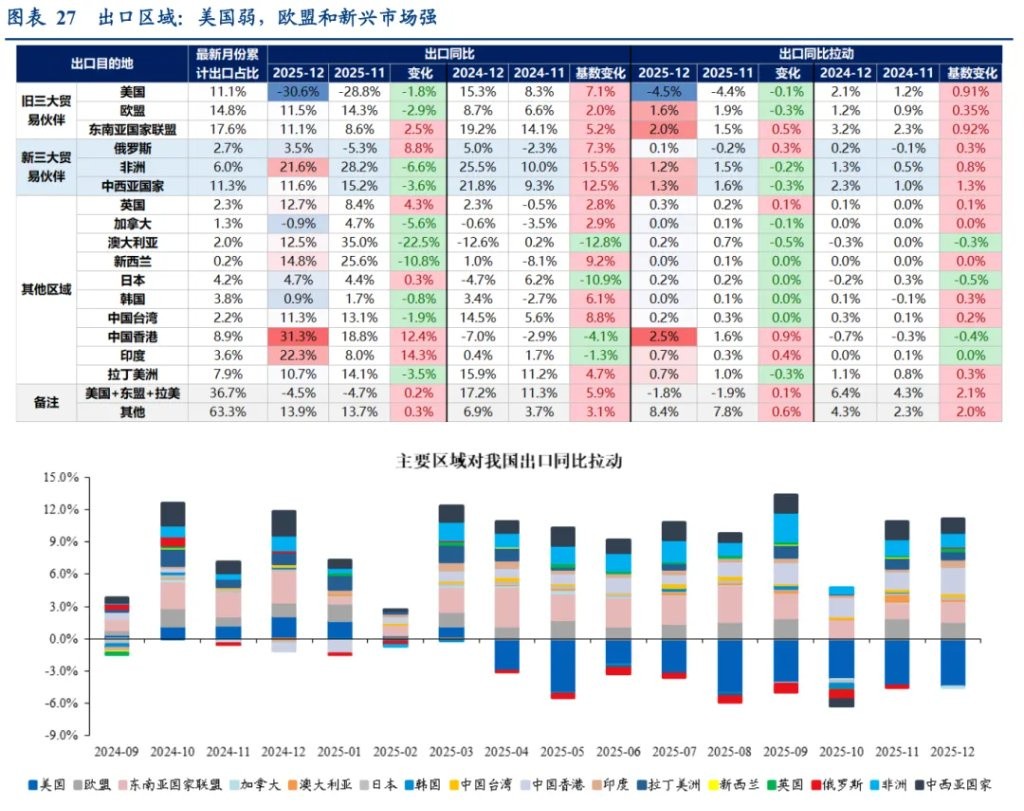
In December, major developed economies collectively contributed 0.7 percentage points to China's year-on-year export growth, unchanged from November, while emerging economies contributed 5.9 percentage points (up from 5.2% in November)[5].
The weakness in developed markets is largely due to the negative drag from the U.S., while non-U.S. developed markets provided a hedge. December exports to the U.S. were down 30.6% year-on-year, slightly lower than November's -28.8%. Non-U.S. developed markets performed well, with exports to the EU + UK in December up 11.8%, slightly down from 14% in November; other developed regions outside of Europe and the U.S. saw a year-on-year increase of 15% in December, compared to 13.1% in November.
Among emerging markets, ASEAN, Africa, and Central Asia performed outstandingly. Together, they contributed 4.5 percentage points to year-on-year export growth in December, down from 4.6% in November.


- Export Products: Mobile Phones, Computers, Cars, and Integrated Circuits are the Main Drivers of Marginal Improvement
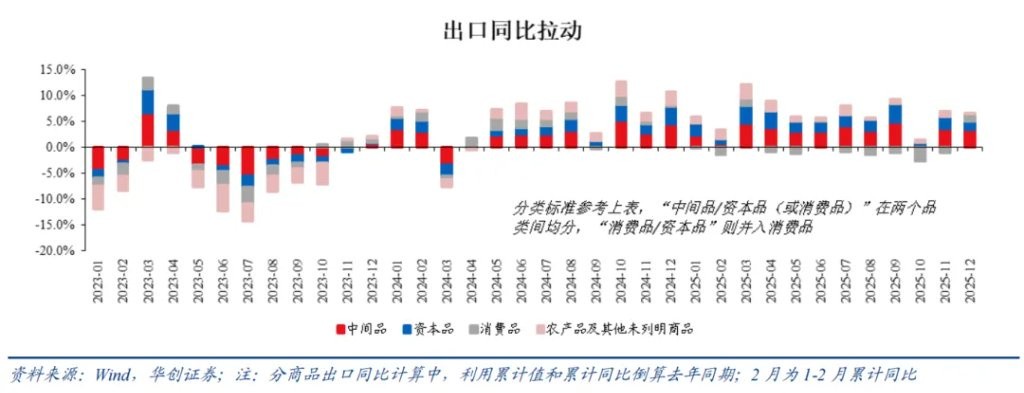
By usage, intermediate goods remained resilient, consumer goods rebounded from the bottom, and capital goods saw a marginal decline. In December, the year-on-year contribution of intermediate goods among major products slightly decreased from 3.5% last month to 3.4%, while consumer goods increased from -1.1% to 1.5%, and capital goods decreased from 2.4% to 1.6%.

(2) Imports
- Overall imports: Significantly rebounded beyond expectations
Import growth rate significantly rebounded beyond expectations. In December, imports measured in US dollars increased by 5.7% year-on-year, compared to an expectation of 0.9% and a previous value of 1.9%. On a month-on-month basis, December imports increased by 11.4%, significantly higher than the average month-on-month growth rates of 3.1%/3.6%/4.5% for the same period over the past 5/10/20 years. Cumulative imports for the entire year of 2025 are expected to be 0% year-on-year, while cumulative imports for 2024 are expected to be 1%.

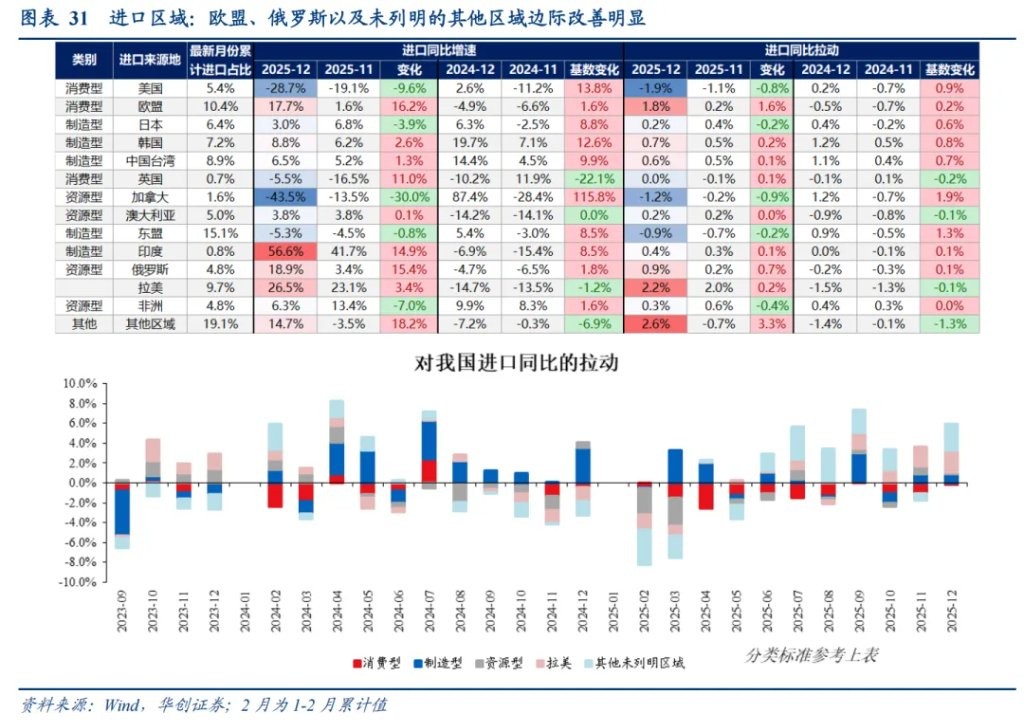
- Import regions: The EU, Russia, and other unspecified regions are the main drivers of marginal improvement
Breaking down the main import regions, the EU, Russia, and other unspecified regions are the main drivers of marginal improvement. In December, imports from consumption-oriented, manufacturing-oriented, and resource-oriented economies contributed -0.2%, 0.9%, and 0.2% respectively to the overall year-on-year growth in imports, compared to -1.1%, 0.9%, and 0.7% in November. In December, imports from Latin America increased by 26.5% year-on-year, up from 23.1% in November, with the contribution to year-on-year import growth rising from 2% in November to 2.2% in December.

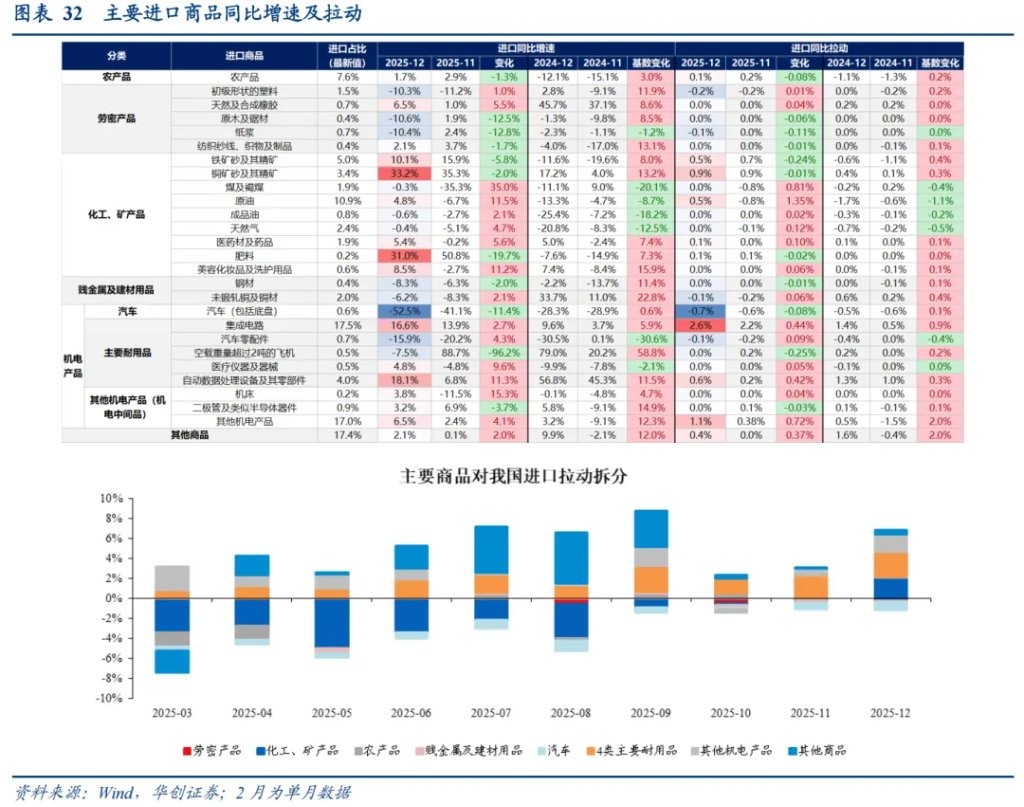
- Imported goods: The electronics chain and chemical mineral products are the main drivers of marginal improvement
In December, imports increased by 5.7% year-on-year, with the electronics chain (integrated circuits, computers and components, semiconductor devices) contribution rising from 2.5% last month to 3.3%, while other electromechanical products increased from 0.5% to 1.1%. The contribution from chemical mineral products (mainly crude oil, iron, and copper ore) surged from -0.1% to 2.1%.

(3) Trade balance: Trade surplus slightly widened
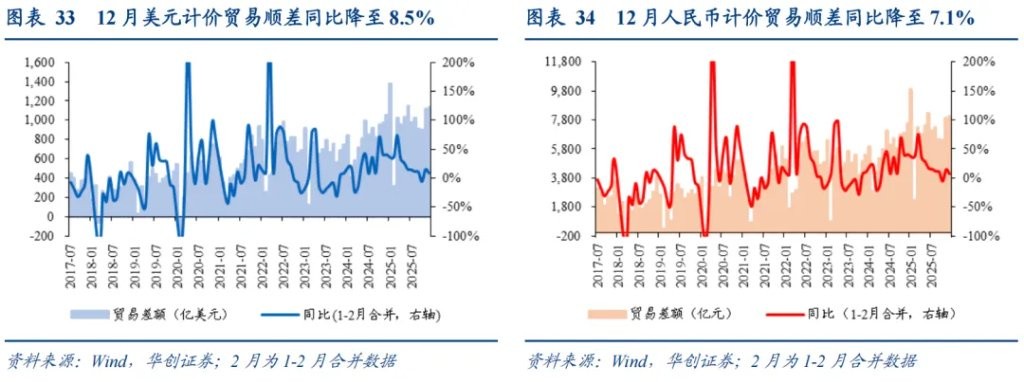
China's trade surplus slightly widened. In December, China's trade surplus measured in US dollars was $114.1 billion, a year-on-year increase of 8.5%, compared to $111.7 billion in November, which was a year-on-year increase of 14.7%. The cumulative trade surplus for the entire year of 2025 is expected to approach $1.2 trillion, with a cumulative year-on-year increase of 19.8%, while the year-on-year increase for 2024 is expected to be 20.7%.
Risk Warning and Disclaimer
The market has risks, and investment should be cautious. This article does not constitute personal investment advice and does not take into account the specific investment goals, financial situation, or needs of individual users. Users should consider whether any opinions, views, or conclusions in this article are suitable for their specific circumstances. Investment based on this is at one's own risk.