Breakfast | US stocks stop falling and rebound, most chip stocks rise

U.S. stocks stopped falling and rebounded, with most chip stocks rising. TSMC surged over 4% after earnings, reaching a record high. SanDisk rose over 5%, Goldman Sachs increased by more than 4% after earnings, and Morgan Stanley and BlackRock both rose nearly 6% after their earnings reports. Precious metals experienced a full-scale pullback, with spot silver plunging by as much as 7% during the session
Market Overview
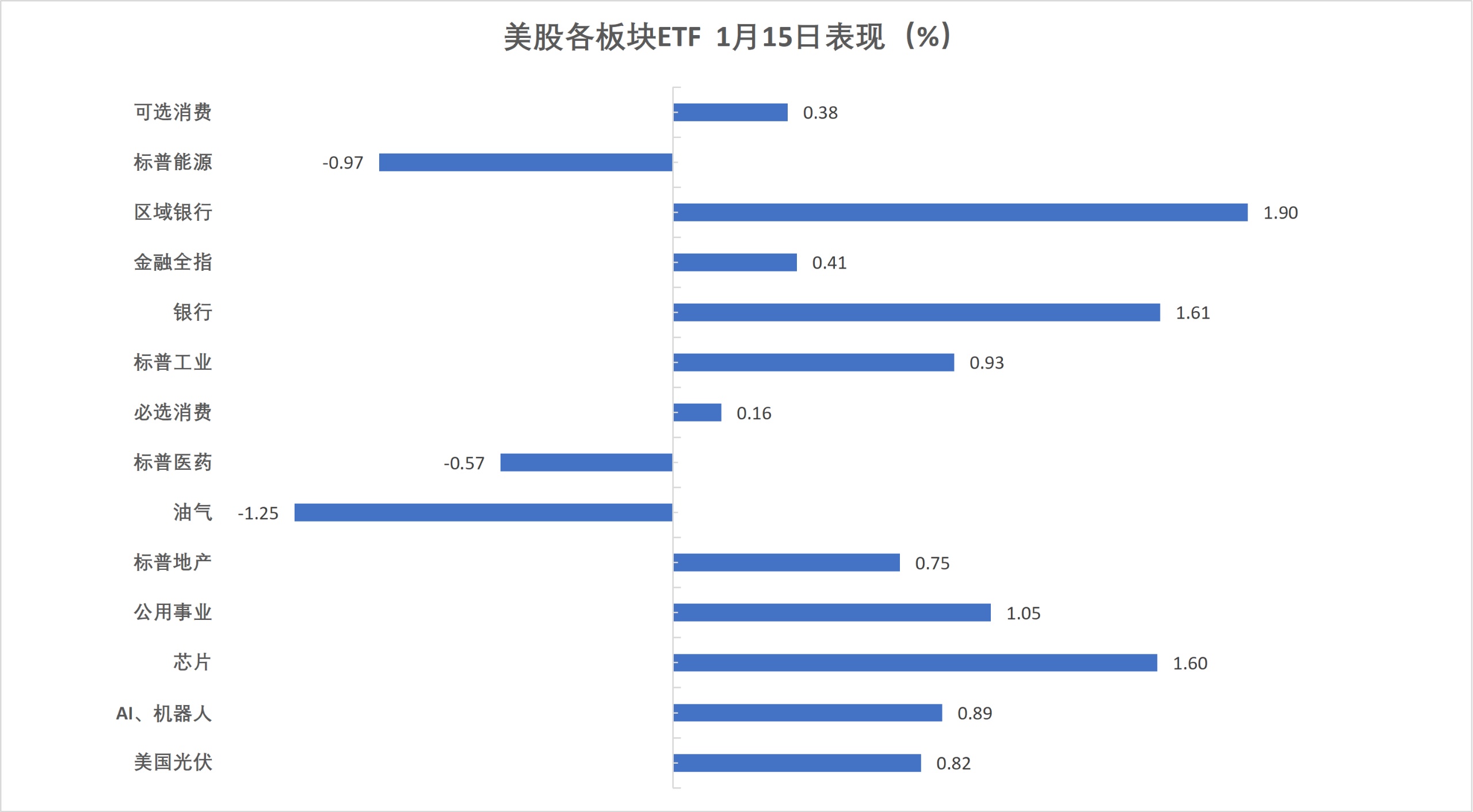
U.S. stocks rebounded, with the three major U.S. stock indices reversing two consecutive declines. TSMC's performance boosted chip stocks, with the chip index closing up nearly 2%. TSMC's U.S. stock rose over 4%, reaching a historic high, while memory chip giant SanDisk rose 5.5%, and NVIDIA rose over 2%. ASML's European stock rose 6%; after earnings reports were released, Goldman Sachs rose 4.6%, and Morgan Stanley and BlackRock rose nearly 6%.
After the U.S. unemployment data was released, U.S. Treasury yields accelerated their rebound; the U.S. dollar index accelerated its rebound, reaching a new six-week high. The offshore RMB rebounded by over 100 points during the day, breaking 6.97, and reached a 20-month high on the second day of this week; cryptocurrencies fell back, with Bitcoin dropping over 2% from its daily high, falling below $96,000.
Metal frenzy takes a pause: Gold, silver, copper, and tin fell from their record highs during the day, with gold dropping over 1% and spot silver falling over 7%. London tin closed down nearly 3%, but silver futures later turned up, continuing to set new highs. Crude oil plummeted, closing down over 4%, marking the largest decline in nearly seven months, falling from a three-month closing high.
During the Asian session, A-shares saw trading volume shrink to over 1 trillion, with TSMC significantly raising its capital expenditure, igniting computing hardware stocks. The commercial aerospace sector collectively plummeted, with the Hang Seng Index falling over 1%, and Trip.com plummeting 20%.
Key News
The People's Bank of China has decided to lower the re-lending and rediscount rates, lower the interest rates on monetary policy tools by 25 basis points, stating that there is still room for further cuts in reserve requirement ratios and interest rates this year.
In 2025, China's social financing scale is expected to increase by over 35 trillion yuan, with financing methods outside of bonds and loans accounting for over 50% of the increase, and RMB loans increasing by 16.27 trillion yuan. The central bank stated: Maintain relatively loose social financing conditions and guide reasonable growth in the total financial volume; the loan quota for technological innovation and technological transformation will be increased from 800 billion yuan to 1.2 trillion yuan.
China Aerospace Science and Technology Corporation: Aiming to fully break through reusable rocket technology by 2026.
The Trump administration has not yet imposed tariffs on critical minerals, leading to a pause in the silver frenzy, with spot silver prices dropping over 7% at one point, later narrowing most of the decline.
Trump: Although he is investigating Powell, he has no plans to directly dismiss him.
The job market continues to show resilience, with the number of first-time unemployment claims in the U.S. decreasing to 198,000, a new low since November last year; the dollar rebounded to a new high in over a month.
Reports: Bipartisan support in the U.S. Congress for a $2.5 billion critical mineral strategic reserve plan.
U.S. aircraft carrier strike groups are heading to the Middle East, with Trump reportedly hoping for a "quick resolution". The U.S. Treasury Department announced new sanctions against Iran; Iran has entered a state of maximum readiness, temporarily closing its airspace for five hours. Iranian experts claim that about 2,000 missiles can cover U.S. and Israeli bases; multiple international flights are rerouting around Iranian airspace
U.S. Treasury: In November, overseas investors' holdings of U.S. Treasury bonds rebounded to a record high, with Japan's holdings reaching a three-year high, while China's holdings hit a new low since 2008.
Alibaba Qianwen APP launch event: Fully integrates with Taobao, Alipay, Taobao Flash Sale, and other Alibaba ecosystem businesses.
Demand for AI chips remains strong, TSMC's Q4 net profit increased by 35% year-on-year, significantly exceeding expectations, with full-year capital expenditure of $40.9 billion in 2025; during the earnings call: capacity is very tight, capital expenditure will significantly increase over the next three years, with 2026 capital expenditure guidance raised to as much as $56 billion.
Vanke's 5.7 billion medium-term notes holder meeting proposal released: includes four repayment plans, with a maximum proposed repayment of 40% of principal, scheduled for repayment on January 28.
OpenAI is focusing on robots and AI devices, reportedly looking for U.S. suppliers.
Goldman Sachs Q4 net revenue decreased by 3% year-on-year, with stock trading revenue breaking Wall Street records, and net profit increased by 12%, exceeding expectations. Driven by wealth management business, Morgan Stanley's Q4 net revenue increased by 10% year-on-year, with bond underwriting revenue soaring by 93%.
Market Closing Report
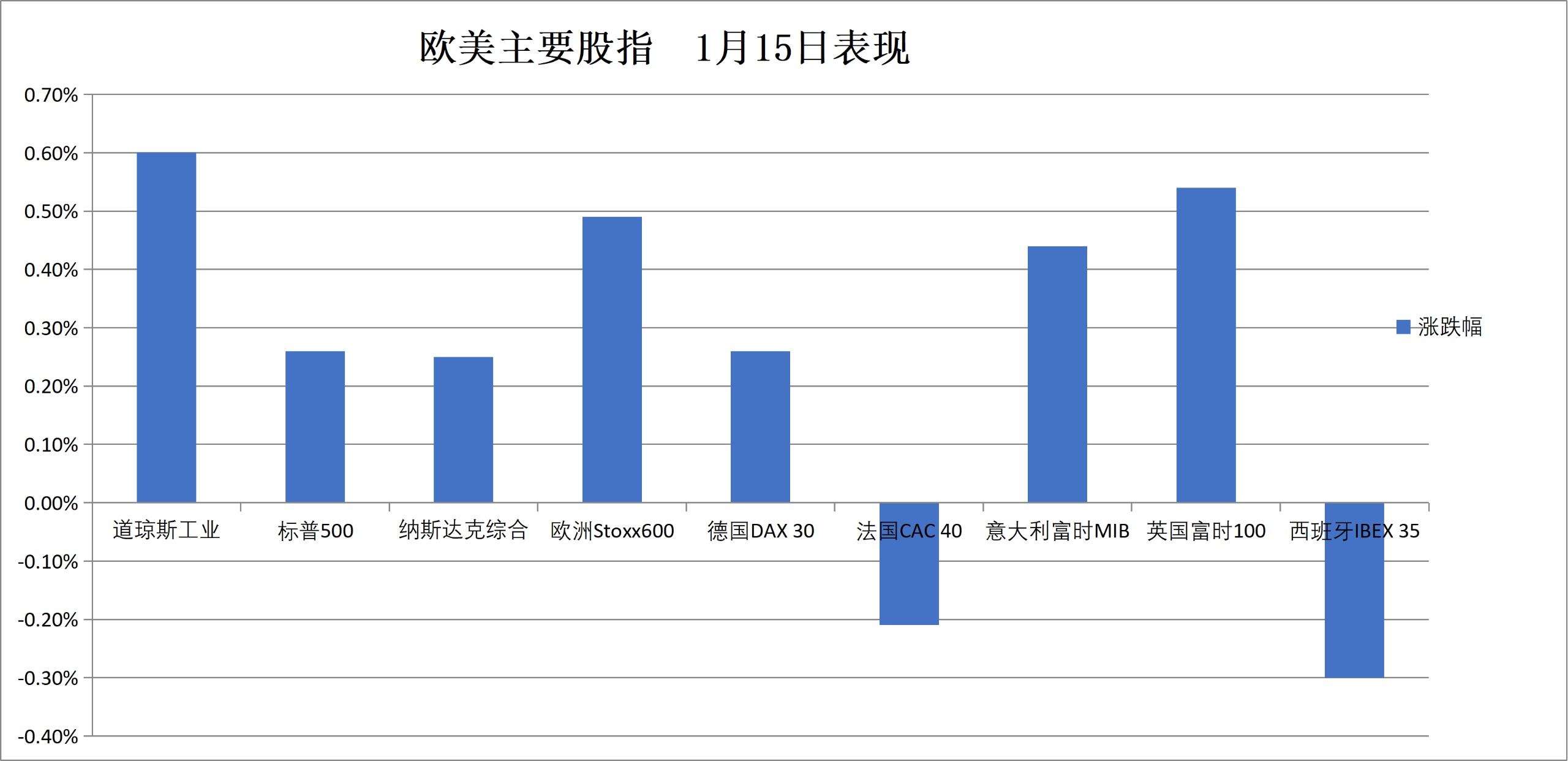
U.S. and European Stock Markets: S&P 500 rose 0.26%, closing at 6944.47 points; Dow Jones rose 0.60%, closing at 49442.44 points; Nasdaq rose 0.25%, closing at 23530.022 points. The European STOXX 600 index rose 0.49%, closing at 614.57 points, marking a record high for two consecutive days.
A-shares: The Shanghai Composite Index fell 0.33%, closing at 4112.60 points. The Shenzhen Component Index rose 0.41%, closing at 14306.73 points. The ChiNext Index rose 0.56%, closing at 3367.92 points.
Bond Market: By the end of the bond market, the yield on the U.S. ten-year benchmark Treasury bond was about 4.17%, up about 4 basis points during the day; the two-year Treasury yield was about 3.56%, up about 5 basis points during the day.
Commodities: WTI February crude oil futures fell 4.56%, closing at $59.19 per barrel; Brent March crude oil futures fell 4.15%, closing at $63.76 per barrel. COMEX February gold futures fell 0.26%, closing at $4623.7 per ounce. COMEX March silver futures rose 1.05%, closing at $92.347 per ounce. LME copper futures fell about 0.6%, closing at $13106 per ton. LME tin futures fell nearly 2.7%, closing at $52031 per ton.
News Details
Global Highlights
The People's Bank of China decides to lower the re-lending and rediscount rates. Starting from January 19, 2026, the re-lending and rediscount rates will be lowered by 0.25 percentage points. After the adjustment, the re-lending rates for supporting agriculture and small enterprises for 3 months, 6 months, and 1 year will be 0.95%, 1.15%, and 1.25%, respectively, the rediscount rate will be 1.5%, the mortgage supplementary loan rate will be 1.75%, and the rate for special structural monetary policy tools will be 1.25%.
- The central bank: Lowering the monetary policy tool rates by 0.25 percentage points, there is still room for further cuts this year. The rates for various structural monetary policy tools will be lowered by 0.25 percentage points, with the one-year re-lending rate dropping to 1.25%, and rates for other terms adjusted accordingly. At the same time, the minimum down payment ratio for commercial housing loans will be lowered to 30% in conjunction with the Financial Regulatory Administration. Zou Lan emphasized that there is still room for further cuts in reserve requirement ratios and interest rates this year. Currently, the average statutory reserve requirement ratio for financial institutions is 6.3%, indicating room for reduction.
In 2025, China's social financing scale increased by over 35 trillion yuan, with RMB loans increasing by 16.27 trillion yuan. According to Xinhua News Agency, the People's Bank of China released financial statistics on January 15, showing that the cumulative increase in the social financing scale for the entire year of 2025 was 35.6 trillion yuan, an increase of 3.34 trillion yuan compared to the previous year. By the end of December 2025, the broad money (M2) balance was 340.29 trillion yuan, a year-on-year increase of 8.5%; the RMB loan balance was 271.91 trillion yuan, a year-on-year increase of 6.4%. The moderately loose monetary policy has effectively supported stable growth in the real economy.
- The People's Bank of China: Non-loan financing methods such as bonds account for over 50% of the increase in social financing; significant results from financial supply-side structural reforms. Zou Lan, deputy governor of the People's Bank of China, stated at a press conference on January 15 that in 2025, non-loan financing methods such as bonds accounted for over 50% of the increase in social financing, indicating significant results from financial supply-side structural reforms.
- The central bank: Merging the establishment of risk-sharing tools for technology innovation and private enterprises' bonds. Zou Lan stated that the risk-sharing tools for technology innovation and private enterprises' bonds will be merged for management, combining the previously established private enterprise bond financing support tools and technology innovation bond risk-sharing tools, providing a total re-lending quota of 200 billion yuan
- Central Bank: Maintain relatively loose social financing conditions and guide reasonable growth of total financial volume. Zou Lan stated that based on the domestic and international economic and financial situation and the operation of the financial market, promoting stable economic growth and a reasonable rebound in prices is an important consideration for monetary policy. The central bank will flexibly and efficiently use various monetary policy tools, including reserve requirement ratio cuts and interest rate reductions, to maintain ample liquidity, keep social financing conditions relatively loose, guide reasonable growth of total financial volume, and ensure balanced credit allocation. The dual functions of monetary policy in terms of total volume and structure will be effectively utilized, accelerating the implementation of a series of recently launched structural monetary policy tools to guide financial institutions to strengthen support for expanding domestic demand, technological innovation, and key areas such as small and micro enterprises.
- Central Bank: Increase the loan quota for technological innovation and technological transformation from 800 billion yuan to 1.2 trillion yuan. Zou Lan stated that the quota for re-loans for technological innovation and technological transformation will be increased, and the support scope will be expanded, raising the loan quota for technological innovation and technological transformation from 800 billion yuan by 400 billion yuan to 1.2 trillion yuan, and including private small and medium-sized enterprises with high levels of R&D investment in the support areas.
Ceres-1 sea-launched remote sensing rocket successfully launched. This mission marks the 23rd flight of the Ceres-1 launch vehicle.
China Aerospace Science and Technology Corporation: Strive to break through reusable rocket technology by 2026. The China Aerospace Science and Technology Corporation held its 2026 annual work meeting in Beijing on Thursday, listing several key tasks for this year, including coordinating the implementation of major aerospace projects with industrial transformation, advancing major projects such as manned lunar landings and deep space exploration, and striving to break through reusable rocket technology to accelerate the construction of a strong aerospace nation.
Silver frenzy temporarily pauses, Trump administration has not yet imposed tariffs on key minerals, spot silver price once fell over 7%. The Trump administration decided not to impose comprehensive tariffs on key minerals, including silver and platinum, and instead seeks bilateral negotiations while considering setting price floors. This decision significantly alleviated market concerns about the U.S. taking comprehensive tariff measures. Wall Street is optimistic about the medium-term outlook for silver, believing that supply gaps, industrial consumption, and spillover demand from gold will continue to support silver prices, but warns of short-term risks.
Trump: Although investigating Powell, there are no plans to directly dismiss him. Trump stated that there are currently no plans to directly dismiss Powell, but he remains watchful of him and emphasizes that the president should have a say in central bank policies At the same time, the selection of successors is accelerating, with two "Kevins" favored, and the independence struggle of the Federal Reserve is entering deeper waters.
The job market continues to show resilience, the number of first-time unemployment claims in the U.S. decreased to 198,000 last week, a new low since November last year. The number of first-time unemployment claims in the U.S. has remained below the critical level of 200,000 for several weeks, indicating that the labor market remains resilient. Meanwhile, the four-week moving average has dropped to 205,000, a two-year low. Although several large companies have announced layoff plans, the actual data does not show a widespread wave of layoffs, and the number of continuing claims remains low at 1.884 million, indicating a stable pattern of "slowing hiring but no increase in layoffs" in the job market.
Report: Bipartisan support in the U.S. Congress for a $2.5 billion critical minerals strategic reserve plan. The new bill will establish a critical minerals trading center, operating in a manner between the Strategic Petroleum Reserve and the Federal Reserve: on a physical level, it will create storage facilities similar to the Strategic Petroleum Reserve; on a governance level, it will set up a regulatory committee similar to the Federal Reserve to oversee the reserves and release of critical materials.
The Pentagon is moving aircraft carrier strike groups towards the Middle East, Iran announces temporary closure of its airspace. According to Global Times, NewsNation reported that the Pentagon is moving an aircraft carrier strike group from the South China Sea to the U.S. Central Command area, including the Middle East, with the move expected to take a week. RIA Novosti reported that U.S. reconnaissance aircraft approached the Iranian border. Iran announced a temporary closure of its airspace. According to CCTV, Iran began temporarily closing its airspace at 6:15 AM Beijing time on Thursday. Subsequently, media reported that Iran's airspace reopened after being closed for nearly 5 hours.
- U.S. aircraft carrier strike group heading to the Middle East, Trump reportedly wants a "quick resolution"; Iran enters a state of highest readiness, Iranian experts claim about 2,000 missiles can cover U.S. and Israeli bases; flights from multiple countries are rerouting around Iranian airspace. According to Xinhua News Agency, citing media reports from Wednesday the 14th, Trump expressed to his national security team that he hopes any military action against Iran will be a "quick and decisive strike," rather than a prolonged conflict lasting weeks or months.
- The U.S. Treasury Department announces new sanctions against Iran. According to Xinhua News Agency, sanctions have been imposed on multiple individuals and entities in Iran, as well as several foreign companies associated with Iran. Those sanctioned include Ali Larijani, the Secretary of Iran's Supreme National Security Council. The updated sanctions list on the Treasury Department's website includes 11 individuals and 13 entities U.S. Treasury: In November, the scale of foreign investors holding U.S. Treasury bonds rebounded to a record high, Japan's holdings reached a three-year high, while China's bond holdings hit a new low since 2008. According to data from the U.S. Treasury, in November, foreign holdings of U.S. Treasury bonds increased by $112.8 billion month-on-month to $9.36 trillion, rebounding after two consecutive months of decline; among the top ten foreign "creditors" of the U.S., Japan, which ranks first in total holdings, saw an increase of $2.6 billion month-on-month to $1.2026 trillion, marking 11 consecutive months of growth; China's holdings have decreased for three consecutive months to $682.6 billion.
Alibaba Qianwen APP launch event: Fully integrated with Alibaba ecosystem businesses such as Taobao, Alipay, and Taobao Flash Purchase. Alibaba held a launch event for the Qianwen App on Thursday, announcing full integration with ecosystem scenarios such as Taobao, Alipay, Fliggy, and Amap. The core of this update is system-level connectivity. The Qianwen App has achieved deep integration with Taobao Flash Purchase and Alipay's "AI Payment," allowing users to complete the entire process from decision-making to payment within the chat interface, without needing to switch to other applications, provided they authorize it.
- Alibaba enters the AI Agent era, Qianwen for booking tickets and ordering takeout. The new version of Alibaba Qwen integrates with ecosystem applications, enabling actions from inquiries. Evaluation shows that ordering takeout has smoother API call interactions, but application connectivity is still needed. Currently, the Taobao shopping feature has not been implemented.
AI chip demand remains strong, TSMC's Q4 net profit increased by 35% year-on-year, significantly exceeding expectations, with full-year capital expenditure of $40.9 billion in 2025. Earnings call: Capacity is very tight, capital expenditure will significantly increase in the next three years
- TSMC's Q4 net profit increased by 35%, far exceeding expectations, with gross margin soaring to 62.3%. AI demand has ignited the HPC business, with revenue from 3nm/5nm processes approaching 70%, solidifying its position as the global foundry leader. Despite concerns over storage chip shortages in the smartphone business, the extraordinary profitability under the AI boom has excited the market. TSMC's U.S. stock surged nearly 2% in after-hours trading.
- TSMC CEO C.C. Wei stated that such a massive investment, if not handled cautiously, would be a disaster for TSMC. "So over the past few months, I have spent a lot of time communicating with customers and their customers," it is essential to confirm that the demand is real, and "the answers have been quite satisfactory to me."
- Wall Street comments on TSMC's financial report: Capital expenditure and profit margin guidance are too "explosive," anyone hoping for a pullback will be disappointed. TSMC's gross margin in the fourth quarter broke 60% for the first time, net profit exceeded expectations, and it significantly raised its 2026 capital expenditure guidance to $52-56 billion, far exceeding market estimates The company has also raised its long-term gross margin and revenue growth targets, clearly betting on the sustained explosion of AI demand. Goldman Sachs analysts bluntly stated that "anyone hoping for a pullback will be disappointed." The consensus on Wall Street believes that TSMC has completely shattered its conservative image as a bottleneck for AI capacity through capital expenditures and profit margin guidance that far exceeded expectations, demonstrating absolute confidence in long-term industry demand.
Vanke's 5.7 billion medium-term note holder meeting proposal released: includes four repayment plans, with a maximum proposed repayment of 40% of principal, repayment on January 28. According to The Paper, regarding Vanke's two maturing medium-term notes totaling 5.7 billion yuan, Shanghai Pudong Development Bank and Bank of Communications, as conveners, have released a holder meeting proposal that includes four plans, including extending the principal repayment to the end of 2026 and a maximum early repayment of 40% of the principal, with Vanke providing project company receivables as collateral for credit enhancement. All proposals require over 90% of voting rights to agree to take effect.
OpenAI is focusing on robots and AI devices, reportedly looking for American suppliers. Reports indicate that OpenAI has issued a request for proposal (RFP) to hardware manufacturers in the U.S., covering components such as chips, motors, packaging materials, and data center cooling equipment. OpenAI's Chief Global Affairs Officer compared AI to a catalyst for America's "re-industrialization," stating that the company believes the development speed of the robotics industry will exceed some people's expectations.
Goldman Sachs Q4 net revenue decreased by 3% year-on-year, stock trading revenue breaks Wall Street record, net profit increased by 12% exceeding expectations. Goldman Sachs achieved a net profit of $4.617 billion in the fourth quarter, a year-on-year increase of 12%, revealing a milestone achievement—its stock trading business recorded quarterly revenue of $4.31 billion, setting a historical high on Wall Street. The transfer of Apple's credit card business led to a net negative income of $1.676 billion in Goldman Sachs' platform solutions business in the fourth quarter, dragging down overall net revenue. Excluding this impact, Goldman Sachs' fourth-quarter performance was actually stronger.
Driven by wealth management business, Morgan Stanley Q4 net revenue increased by 10% year-on-year, bond underwriting revenue soared by 93%. Morgan Stanley's Q4 net revenue for 2025 was $17.9 billion, a year-on-year increase of 10%; debt underwriting revenue soared by 93%, mainly driven by financing for AI data centers like Meta. The wealth management business attracted $122.3 billion in a single quarter, with total assets reaching $9.3 trillion. Although fixed income business slightly declined, annual net profit still reached a historical high Is a Super Merger in Shale Oil Coming? Coterra Considers Merging with Devon Energy, Stock Price Surged Over 10% at One Point. According to reports, Coterra Energy and Devon Energy are negotiating the terms and structure of a potential merger, one option being an all-stock transaction. Both companies hold significant oil and gas assets in the Permian Basin, and a merger would enhance their ability to compete with giants like ExxonMobil.
Research Report Highlights
Goldman Sachs: The Dollar is Still Overvalued by About 15% in 2026, Reassessment of Tech "Exceptionalism" is a Major Downside Risk. Goldman Sachs noted in its 2026 foreign exchange outlook that the dollar's hegemony is experiencing a "slow retreat," but it will not collapse immediately; the downward process will be driven by global growth convergence. The report specifically warns that the biggest tail risk comes from structural changes: if the belief in U.S. tech stock "exceptionalism" wavers (such as encountering disruptive technological iterations), leading to a reversal of capital inflows, the dollar may face a severe depreciation far exceeding expectations.
Bernstein Raises SanDisk Target Price by 93% to $580: AI is Creating an Unprecedented Storage Supercycle. Wall Street's focus on AI hardware is shifting from computing power to storage, with Bernstein significantly raising the target price for SanDisk, believing that the demand for long context in AI will drive a surge in NAND demand, initiating a storage supercycle. However, JP Morgan holds a conservative view, believing that current high prices are a cyclical phenomenon and may return to normal after capacity expansion.
Citi's Latest Commodity Judgment: "Tactically Bullish" on Oil and Precious Metals, "Structurally Bullish" on Aluminum, Copper Prices "May Peak Within a Month". Citi's research report indicates that the commodity market is at a turning point. Oil is short-term driven by geopolitical factors targeting $70, but faces long-term oversupply pressure. Precious metals are bullish, with silver targeting $100 and gold $5000. Among industrial metals, aluminum has the most opportunity due to supply shortages, targeting $3400-3500. Copper prices are expected to reach $14,000, but January may become the annual peak.
This Round of "Lithium Price Bull Market" is Different from History. Deutsche Bank pointed out that the lithium market is entering a new rational cycle. The core driving force behind this round of price increases has shifted from past policy-driven factors to the rigid demand for energy storage driven by AI and data centers, combined with improved market tools and production discipline in China, indicating that lithium prices are breaking away from previous irrational fluctuations and entering a new phase characterized by fundamentals and resilience Signs of yen intervention are emerging, and the market may face a "surprise" action, closely monitoring "rate checks". Nomura warns that the rules of the game for the Japanese Ministry of Finance's intervention in the yen are changing. On Wednesday during the UK session, the USD/JPY suddenly fell without any apparent positive news, which is highly likely to be a result of a "rate check" by the Ministry of Finance. This informal inquiry often precedes actual intervention.
Deutsche Bank: By 2030, the cost of space data centers will match that of ground-based centers. Deutsche Bank believes that although the current cost of space deployment is high, this gap is closing at an astonishing rate. With the plummeting launch costs and optimization of satellite design, the cost of building a space data center will approach parity with ground construction costs within the next decade. This means that the energy and heat dissipation bottlenecks troubling ground data centers may find ultimate solutions in space.
Domestic Macro
Qiushi magazine publishes an important article by the General Secretary of the Communist Party of China, "Speech at the Central Urban Work Conference". According to Xinhua News Agency, the speech proposed focusing on building comfortable and convenient livable cities. It emphasized integrated planning for population, industry, urban areas, and transportation, optimizing urban spatial structure, and improving transportation infrastructure systems. It called for accelerating the construction of a new model for real estate development to better meet the rigid and diversified housing improvement needs of the public, steadily advancing the transformation of urban villages and dilapidated housing. It also advocated for the vigorous development of health, housekeeping, and other life service industries, improving the elderly care service system, strengthening the forward-looking layout of educational resources, and implementing foundational projects in medical and health services.
Li Qiang meets with Canadian Prime Minister Carney. According to Xinhua News Agency, the Chinese side is willing to strengthen strategic alignment with the Canadian side, continue to restore and promote exchanges at all levels and in various fields, make good use of the dialogue mechanisms between the two governments in trade, technology, agriculture, etc., promote stable growth in bilateral trade, enhance trade facilitation, deepen cooperation in clean energy, digital technology, modern agriculture, aerospace, advanced manufacturing, finance, and cultivate more new economic growth points.
Financial Supervision and Administration Bureau: Effectively and orderly advancing risk resolution for small and medium-sized financial institutions. The meeting required that, first, efforts be made to effectively and orderly advance the risk resolution for small and medium-sized financial institutions. Focus on addressing existing risks, resolutely curb new risks, and firmly maintain the bottom line of not having "thunder" incidents. Second, closely prevent and resolve risks in related fields. Promote the normalization of the urban real estate financing coordination mechanism to assist in constructing a new model for real estate development. Third, a strong regulatory atmosphere is gradually taking shape. Fourth, comprehensive measures are leading industry reform and transformation. Fifth, precise and effective support for the economy to stabilize and improve Former Director of the Technology Supervision Department of the CSRC, Yao Qian, engaged in power-for-money transactions by accepting 2,000 Ether at once. According to Shanghai Securities News and CCTV News, Yao Qian, the former director of the Technology Supervision Department of the CSRC and former director of the Digital Currency Research Institute of the People's Bank of China, engaged in power-for-money transactions, accepting 2,000 Ether (with a peak market value exceeding 60 million yuan) at once, using hardware wallets and "vested accounts" to cover up corruption. However, virtual currencies ultimately need to be cashed out, and the special investigation team utilized blockchain technology to penetrate layers of confusion, locking in solid evidence during the home purchase process.
A surge in trading volume for broad-based ETFs, with the CSI 500 hitting a record high, and the CSI 300 and A500 also seeing massive volumes. The combined trading volume of the top three broad-based ETFs exceeded 66.8 billion yuan.
Domestic Companies
Shuibei's silver merchants face a crisis, with multiple merchants losing tens of thousands to hundreds of thousands, and police have intervened. According to Daily Economic News, the crisis involves a silver shop named "Hechengxing"; many affected merchants have reported to the police, with over 350 people in a rights protection group. Several netizens reported that the silver shop suddenly closed, and many were unable to cash out the precious metal materials purchased there. Several involved merchants revealed that rumors of "running away" are untrue; the owner has not fled but indeed cannot provide money and goods.
The first 100 billion yuan gold ETF is born! As international gold prices break through 4,600 USD per ounce, the Huaan Gold ETF's scale has surpassed 100 billion yuan, becoming the first gold ETF in China to reach this level, indicating that investors are actively allocating gold through ETFs. Institutions generally believe that under the backdrop of the Federal Reserve's interest rate cuts, geopolitical risks, and de-dollarization trends, the long-term logic for gold's price increase remains solid, although short-term volatility is intensifying, and investors are advised to consider low-cost allocations.
Signals of Moutai's pricing reform! Goldman Sachs: The liquor industry accelerates price clearing, expected to bottom out and rebound in the second half of the year. Moutai has recently accelerated its direct sales and pricing reforms, with the iMoutai officially launching the Feitian series and adjusting the prices of non-standard products. Goldman Sachs believes this move marks a signal of the liquor industry's bottoming out, which will accelerate destocking and price normalization. Although demand remains weak and finances are under pressure in the short term, the industry is expected to see a recovery in the second half of 2026.
CATL's counterattack faces setbacks? Rongbai Technology's over 120 billion yuan order is questioned, where is the "big game" of lithium iron phosphate heading?. Recently, CATL signed a massive procurement agreement worth over 120 billion yuan with Rongbai Technology. However, this agreement immediately triggered inquiries from the Shanghai Stock Exchange regarding its performance capability, as its existing production capacity of only 60,000 tons is far below the promised annual delivery volume of 500,000 tons Despite Rongbai Technology claiming that its one-step new process has cost advantages, its technological maturity and mass production feasibility remain in question.
What does the antitrust investigation mean for Trip.com? Analysts from UBS, JP Morgan, and other institutions pointed out that, referencing the precedents of Alibaba and Meituan, this investigation may last 4-6 months, with fines expected to be in the range of 3%-4% of the previous year's sales. Trip.com's stock price may face long-term consolidation and valuation pressure over the next 4-6 months. In terms of business model, the core "pricing tool" is facing rectification, which may lead to enhanced bargaining power for suppliers, a decline in platform monetization rates, and a slowdown in advertising revenue growth.
Due to fluctuations in the pig market prices, Muyuan Foods expects a year-on-year decline in net profit of 14.93%-20.21% in 2025.
Overseas Macro
Senior central bank reporter: To win the election, Trump is using "three major levers" to stimulate the economy, and this year it is "very likely to succeed," but the consequences will emerge later. According to reports, Trump has unprecedentedly activated three major stimulus levers simultaneously: injecting $200 billion in tax cuts, relaxing bank regulations to promote lending, and pressuring the Federal Reserve to significantly lower interest rates. Analysts expect this could boost economic growth by 0.5 percentage points in the first half of this year. However, the cost is uncontrolled debt, accumulated financial risks, and loss of central bank independence, which could trigger future debt crises and market collapses.
Bitcoin approaches $100,000, U.S. digital currency regulatory plan faces key vote, Wall Street and the crypto world in "intense game". The fate of the U.S. digital currency regulatory plan is uncertain, with yield payments on stablecoins being the biggest point of contention. Banking lobby groups believe that while banning stablecoin issuers from directly offering yields to users, loopholes remain for providing rewards to partners and third parties. Coinbase CEO criticized the draft amendment in a statement, saying it "will stifle stablecoin rewards, allowing banks to eliminate competitors." The decentralized finance restrictions that may allow the government "unrestricted access" to users' financial records are also a point of controversy.
Will the sharp decline of the yen force the central bank to raise interest rates early? Reports: Japanese officials are more concerned about the impact of a weak yen on inflation. The Bank of Japan is closely monitoring the transmission effect of the weak yen on inflation, which may force it to reassess the pace of interest rate hikes and even consider taking action earlier. Although the January meeting is expected to maintain interest rates, if the exchange rate continues to weaken and exacerbates price pressures, the central bank may adjust its planned interest rate hikes originally scheduled for summer, indicating that its policy path is significantly affected by exchange rate fluctuations Overseas Companies
Storage chip costs surge by 230%, iPhone 18 high-end models may see significant price increases. Key memory module prices have risen by about 230% since the beginning of the year, leading to a potential increase of $50-100 for high-storage versions, while the base model is expected to maintain its original price. Industry analysis indicates that this cost pressure may prompt more consumers to shift towards entry-level models.
- The cost of the storage feast: Behind Samsung's doubled profits, Apple and HP's "profit defense battle" has just begun. The global tech hardware industry is experiencing a divide due to soaring storage chip prices: upstream storage manufacturers (such as Samsung and Micron) are seeing profits skyrocket, while downstream device manufacturers (such as Apple and HP) face dual pressures of profit squeeze and demand suppression. Analysis points out that this round of shortages is a structural capacity redistribution triggered by AI demand, and hardware manufacturers' cost dilemmas are unlikely to ease in the short term, forcing them to continue footing the bill for this "storage feast."
The battle for physical assets has begun: Amazon to acquire the first new copper production in the U.S. in over a decade for data center construction. Amazon has signed a two-year copper supply agreement with Rio Tinto, procuring new copper capacity produced using bioleaching technology in Arizona to meet the explosive demand brought about by AI data center construction. Current copper prices have reached historic highs, and the rapid growth of the AI industry may continue to intensify resource competition.
Musk's cunning plan: FSD subscription only, no outright purchase, a storm is coming. Musk announced that Tesla's FSD will eliminate one-time purchases starting February 14, fully transitioning to a monthly subscription model. This move aims to lower the usage threshold, increase penetration, and create continuous revenue, but it is also interpreted as Tesla's avoidance of legal and financial risks associated with the short-term realization of "full self-driving," as well as a redefinition of its long-term asset value.
Musk: Starship launch frequency will exceed once per hour within three years. Musk stated on social media that the launch frequency of Starship will exceed once per hour within three years, clarifying that SpaceX's ultimate goal is to produce 10,000 Starships annually.
Today's News Preview
Germany's December CPI.
U.S. December industrial production and manufacturing output.
U.S. January NAHB housing market index.
Federal Reserve Governor Bowman and Federal Reserve Vice Chairman Jefferson will speak.
2026 Nuclear Fusion Energy Technology and Industry Conference