Behind the depreciation of the Korean won: South Korean retail investors are frantically buying overseas stocks

The South Korean won returned to a depreciation trend in early 2026, due to retail investors in South Korea frantically purchasing overseas stocks, especially U.S. stocks. In just the first 10 days of 2026, retail investors net bought $2 billion in foreign stocks, leading to severe capital outflows. Bank of America believes that the exchange rate of the won is closely related to retail investors' cross-border investments, and its future trend will no longer solely depend on macroeconomic data. Unless the government takes measures or U.S. stocks correct, the won will continue to be under pressure. In early 2026, the retail buying frenzy for U.S. stocks like Tesla exacerbated the depreciation of the won
The South Korean won's New Year is not peaceful. After a brief rebound due to government intervention at the end of 2025, the won returned to a depreciation track in early 2026.
According to news from the trading desk, on January 15, the Bank of America research team published a report indicating that after a fleeting rebound in early 2026, the won returned to a downward trend, fundamentally due to South Korean retail investors resuming their frenzied purchases of foreign stocks, especially U.S. stocks.
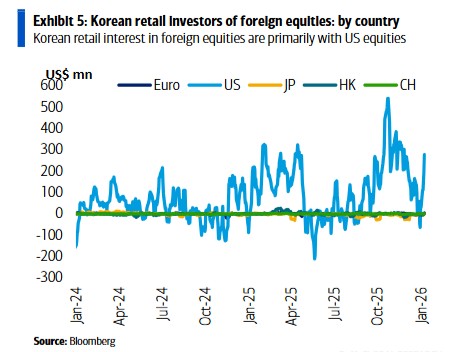
(South Korean retail investors' interest in overseas stocks is mainly focused on U.S. stocks)
In just the first 10 days of 2026, there was a net purchase of $2 billion in foreign stocks. The scale of this capital outflow is so large that it cannot be offset by South Korea's trade surplus or the public concerns of the U.S. Treasury.
Bank of America believes that the won's exchange rate is deeply tied to the cross-border investment impulses of South Korean retail investors, and its future trend will no longer simply depend on macroeconomic data.
Unless the South Korean government reverses the flow of retail funds through tax policies, or there is a significant correction in the U.S. tech sector triggering a capital inflow, the won will continue to be under pressure. Although the USD/KRW recently rose to 1473.56, Bank of America maintains a year-end target exchange rate of 1395.
South Korean Retail Investors, Undisputed Exchange Rate Dominators
After trading resumed in 2026, South Korean retail investors immediately returned to their buying frenzy of U.S. stocks.
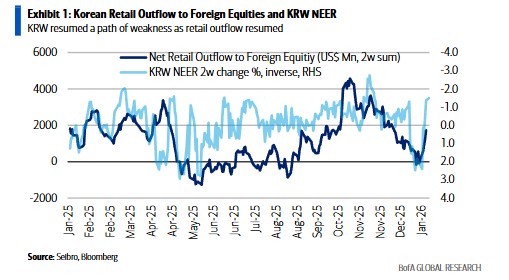
The brief rebound of the won at the end of December last year coincided with a slowdown in retail fund outflows during the Christmas period. Once trading resumed in the New Year, the return of retail stock purchases quickly reversed the won's upward momentum.
(As retail funds continued to flow out, the won resumed its weak trend)
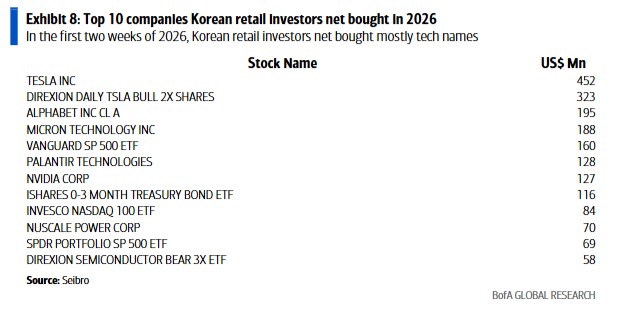
The purchase list for the first two weeks of 2026 shows that Tesla topped the list with $452 million, followed by Direxion's 2x leveraged Tesla ETF ($323 million), Google Class A shares ($195 million), Micron Technology ($188 million), and Vanguard S&P 500 ETF ($160 million).
(The top 10 listed companies with the highest net purchases by South Korean retail investors in 2026)
International balance of payments data further confirms the supply-demand imbalance in the foreign exchange market.
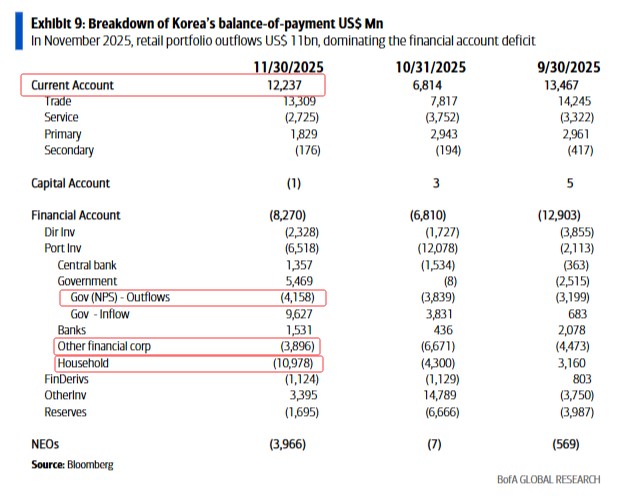
Data shows that South Korea has a strong current account surplus, amounting to $12.2 billion as of November 2025. However, the scale of dollar sales by exporters through trade surpluses cannot match the enormous dollar purchasing power formed by retail investors and institutions like the National Pension Service During the same period, the outflow of securities investments by retail investors in South Korea reached USD 11 billion, making it the largest single contributor to the financial account deficit for the month, far exceeding the outflows of USD 4.2 billion from the National Pension Service (NPS) and USD 3.9 billion from asset management companies.
(Detailed data on South Korea's balance of payments)
At the same time, foreign investors purchased USD 9.6 billion in South Korean government bonds in November, but ultimately had little help for the Korean won, as the vast majority of transactions would be hedged through foreign exchange forward contracts, thus not creating substantial demand for the Korean won.
In contrast, retail purchases of foreign stocks typically involve no hedging, constituting a direct purchase of USD.
The Turning Point for the Korean Won Lies in Taxation and the U.S. Stock Market Crash
By the end of 2025, the South Korean government temporarily boosted the Korean won through verbal intervention and monetary support, and U.S. Treasury Secretary Scott Pessen publicly stated during a meeting with the South Korean Deputy Prime Minister that the weakness of the Korean won "does not align with South Korea's strong economic fundamentals."
However, these external pressures and policy actions proved to be short-lived.
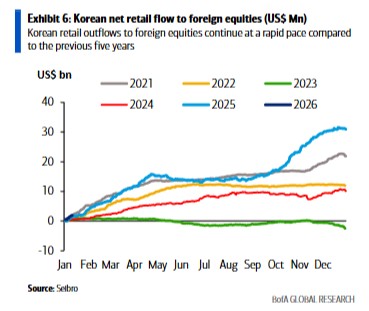
The report suggests that as long as the core drivers of retail fund outflows remain unchanged, any intervention can only temporarily delay the upward trend of USD/KRW, without reversing its direction.
(Compared to the past five years, the scale of South Korean investors flowing into overseas stocks continues to maintain a rapid growth momentum)
The real significance of political pressure is that it increases the likelihood of the South Korean government implementing more substantive policies and reduces the tail risk of USD/KRW breaking through key psychological levels such as 1500.
The report clearly states that the most effective way to change the current situation is through tax policy.
Currently, South Korean retail investors are required to pay a 22% capital gains tax on the sale of foreign stocks. On December 23, 2025, the government reduced the relevant tax rate. If further tax reduction incentives (such as exempting part of the tax when selling) can be introduced subsequently, it may encourage fund inflows.
Another potential "catalyst" comes from the market itself: South Korean retail investors' holdings of foreign stocks are highly concentrated in U.S. tech stocks.
Therefore, any significant correction in the U.S. tech sector could automatically trigger large-scale profit-taking and fund repatriation, thereby suddenly and forcefully boosting the Korean won.
The above wonderful content comes from the Chasing Wind Trading Platform.
For more detailed interpretations, including real-time analysis and frontline research, please join the【**Chasing Wind Trading Platform ▪ Annual Membership**】

Risk Warning and Disclaimer
The market has risks, and investment should be cautious. This article does not constitute personal investment advice and does not take into account the specific investment goals, financial situation, or needs of individual users. Users should consider whether any opinions, views, or conclusions in this article are suitable for their specific circumstances. Investment based on this is at one's own risk.