


Surge in metal prices, what is the next upside risk for the US CPI?

The surge in industrial metal prices is becoming a new concern for inflation in the United States. Deutsche Bank stated that the LMEX index has skyrocketed nearly 20% in recent months, combined with the rebound in oil prices and tariff costs, multiple pressures may push future CPI higher. With the Supreme Court ruling imminent, the volatility of inflation trends has increased sharply, and market alarms have been sounded
The continuous rise in industrial metal prices is becoming a potential threat to the inflation outlook in the United States. With recent rebounds in oil prices, the transmission of tariff costs, and resilient economic growth, multiple factors may drive upward pressure on the CPI in the coming months. The Supreme Court's upcoming ruling on tariff issues also adds uncertainty to the short-term inflation trend.
According to the Wind Trading Desk, Deutsche Bank analyst Markus Heider stated in a report released on the 15th that the metal market is experiencing a strong upward trend. The LMEX Industrial Metal Index has risen nearly 20% since last December, with a cumulative increase of 30% since September. This upward trend, which began last autumn, has clearly accelerated in recent weeks.

Inflation risks are accumulating. The November Producer Price Index (PPI) report released this week has shown signs of accelerating core consumer goods inflation. Meanwhile, energy prices, which had previously served as an important offsetting factor, have recently stopped falling and rebounded, with oil prices rising in the past week, weakening the buffer space on the cost side.
This risk is particularly pronounced for the U.S. market. Tariff policies have added pressure to the cost side in recent months. If oil prices remain at current levels and economic growth remains strong, the rise in metal prices will more significantly pose an upward risk to the U.S. CPI.
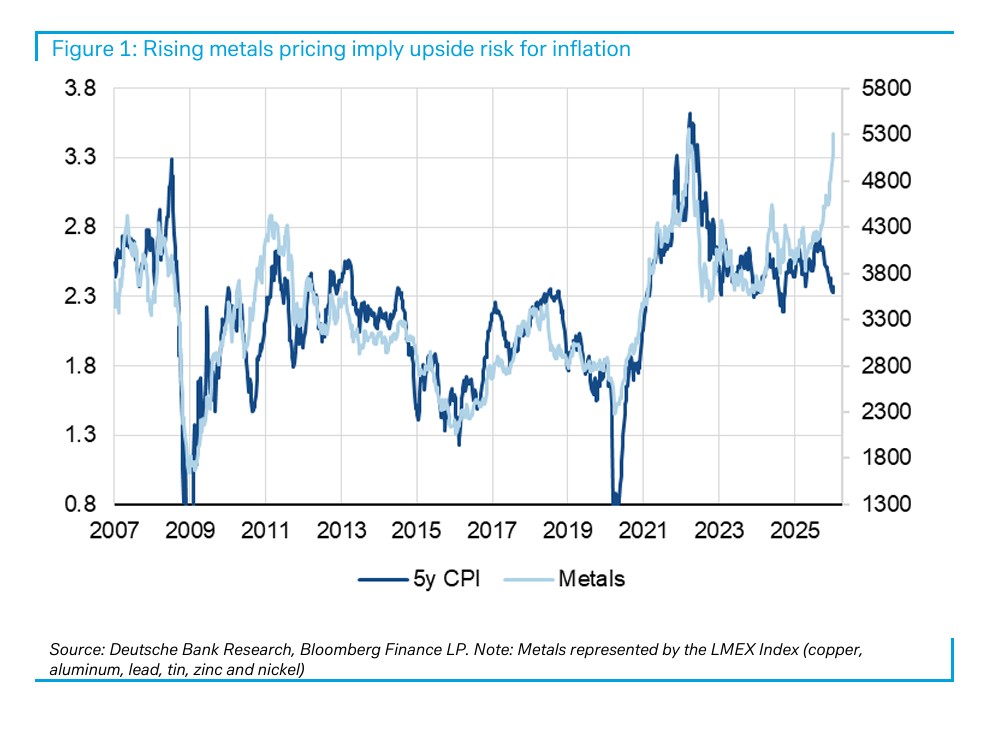
Accelerating Rise in Industrial Metal Prices
Deutsche Bank believes that the industrial metal rally that started last autumn has further accelerated recently. The performance of the LMEX index shows that the market has recorded nearly a 20% increase in just a few months from last December to now, while the cumulative increase since September has reached 30%. This price trend reflects changes in the supply and demand dynamics of the industrial metal market.
There is a significant positive correlation between metal prices and inflation market valuations, which is based on two foundations. First, base metals are important drivers of production costs, and price increases will directly transmit to manufacturing costs, thereby affecting end consumer prices. Second, metal prices and inflation share some underlying driving factors. For example, both tend to perform well during periods of strong global economic growth, and this common macro backdrop often leads to synchronous fluctuations between the two.
Multiple Cost Pressures Converging
Deutsche Bank believes that the accumulation of upward inflation risks stems from the cumulative effects of multiple factors. At the commodity level, there has been a significant shift in energy price trends. Previously declining energy prices had been an important factor offsetting other cost increases, but the recent rebound in oil prices has changed this situation.
For the U.S., the cost-side pressures are more complex. Tariff policies have increased cost pressures in recent months, and the November PPI data released this week confirms this trend, showing a certain degree of acceleration in core consumer goods inflation If oil prices stabilize at current levels while economic growth remains strong, the rise in metal prices will more clearly manifest as an upside risk to the U.S. CPI.
The Supreme Court is about to make a ruling on tariff issues related to the International Emergency Economic Powers Act (IEEPA), which poses a downside risk to the short-term inflation path while also constituting an upside risk to short-term real yields. Deutsche Bank believes that in the current environment, market strategies may lean towards a combination of paying short-term real yields and going long on mid-term CPI, such as a 2-year 1-year (2y1y) allocation. Once the Supreme Court makes a ruling, the risks may again shift more clearly to the upside
