


Deutsche Bank: The weakness of the yen is a choice made by both policy and funds, and the likelihood of short-term government intervention is low

Deutsche Bank AG's latest report points out that the continued weakness of the yen is the result of a combination of "policy acquiescence" and "persistent capital outflow." Despite Japan's current account surplus reaching a record high, indicating that the yen is significantly undervalued, policymakers tend to maintain a loose environment, and corporations and institutional investors are still accelerating their allocation of overseas assets. The report believes that due to the moderate exchange rate fluctuations and the lack of excessive concentration in speculative positions, the likelihood of the Japanese government intervening in the foreign exchange market in the short term is low
Deutsche Bank's latest report points out that the continuous weakening of the yen is the result of both "policy acquiescence" and "capital outflow," and the likelihood of foreign exchange intervention in the short term is low.
According to the Chase Wind Trading Desk, the report analyzes that although Japan's current account surplus has risen to a historical high of 6% of GDP and the basic international balance of payments is also performing strongly, indicating that the yen is significantly undervalued, policymakers tend to maintain a loose environment, while domestic companies and institutional investors continue to allocate funds to overseas assets. This dual logic of "capital outflow + policy easing" may continue in the coming months.
The undervaluation of the yen is particularly evident in external account data: the current account surplus is mainly supported by growth in the income account, while net securities investment has also turned positive, partly due to foreign capital increasing its holdings of Japanese assets due to rising Japanese government bond yields and a strong stock market. However, Japanese companies' foreign direct investment remains close to 2% of GDP, and institutional investors continue to increase their holdings of foreign stocks and bonds, highlighting insufficient domestic confidence.
The report further points out that the current USD/JPY exchange rate is 7-8% higher than the implied level of the U.S. 10-year Treasury yield, reflecting that the market has factored in a significant "policy risk premium." Although the yen's weakness diverges from the fundamentals, the urgency for government intervention is not high due to moderate volatility and the lack of excessive concentration in speculative positions.
Record Current Account Surplus Highlights Yen Undervaluation
The report states that Japan's current account surplus has climbed to a historical high, clearly indicating the significant undervaluation of the yen. Driven by yen-denominated factors, both income and trade scales have expanded simultaneously, with growth mainly stemming from contributions to the income account dominated by foreign direct investment, while the trade deficit has basically dissipated. 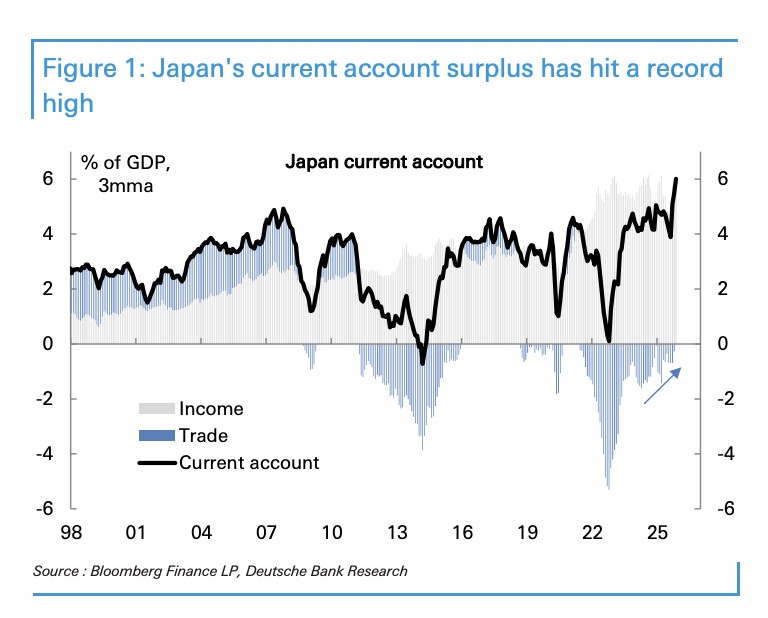
The basic international balance of payments also remains robust, with net securities investment turning into an inflow state. This change is mainly due to the increased exposure of foreign investors to Japanese assets: as Japanese government bond yields rise and the stock market performs strongly, international funds, including those from various reserve management agencies, are continuously increasing their holdings of Japanese bonds and stocks.
Japanese Companies and Institutional Investors Continue to Withdraw from Domestic Market
Despite the strong performance of Japan's external account data, domestic companies and institutional investors in Japan still lack confidence in the local market. Japanese companies continue to direct funds overseas, with net foreign direct investment close to 2% of GDP, at a historical high range, while external economic and trade pressures may further reinforce this trend.
It is noteworthy that the direct investment income obtained by Japanese companies from overseas has not fully returned to yen assets. Data shows that about half of the overseas income is used for reinvestment, and even the portion considered "repatriable" retains a considerable proportion in foreign currency in corporate accounts.
The behavior of institutional investors also points to capital outflow. In the fourth quarter of 2025, driven by NISA (Nippon Individual Savings Account) funds, investment trusts continued to increase their holdings of foreign stocks; although pension funds reduced some assets, the funds mainly shifted to foreign bonds At the same time, life insurance companies have not significantly increased their holdings of Japanese government bonds, indicating that there has not been a structural return to domestic fixed-income assets by institutions as a whole.
Policy Preference Maintains a Loose Stance
Even though the trend of capital outflow from Japan is evident, its strong broad-based international balance of payments still reflects that the market has factored in a significant policy risk premium in the exchange rate. Currently, the USD/JPY exchange rate is about 7-8% higher than the implied level of the US 10-year Treasury yield, and when measured by relative interest rates, this deviation is even more pronounced.
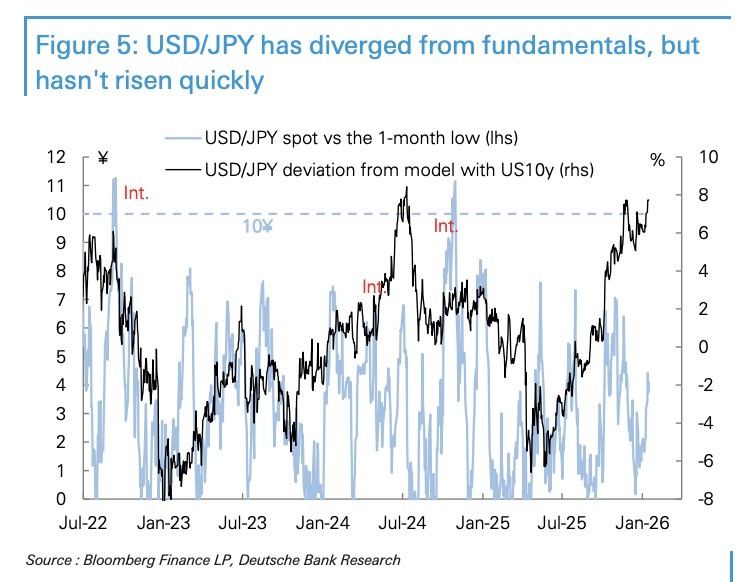
The report analysis indicates that the likelihood of Japanese authorities intervening in the foreign exchange market in the short term is low. The intervention conditions that policymakers are concerned about mainly include the degree of deviation between the exchange rate and fundamentals, the speed of volatility, and the level of speculative positions, and currently, only the first condition is preliminarily met. Deutsche Bank's composite "overshoot indicator," constructed from these three factors, currently does not show that the exchange rate is in a state that urgently requires intervention.
In the current political environment, Japanese policymakers clearly prefer to maintain a loose fiscal and monetary policy, and this stance is expected to remain unchanged in the short term. As long as the continued weakness of the yen does not trigger significant dissatisfaction among domestic voters, the existing policy direction and exchange rate trend may continue.
