The trading revenue of the five major Wall Street banks reached a record high for the year, but is this just the beginning?

Wallstreetcn
2026.01.16 16:01
portai
I'm PortAI, I can summarize articles.

The five major banks on Wall Street set a record of $134 billion in trading revenue last year, and executives generally believe that the growth wave is far from over. Morgan Stanley's CEO described the market landscape as "very ideal," while Goldman Sachs' CEO stated that "historical highs are not a ceiling." Policy fluctuations and regulatory easing have injected momentum into trading and investment banking businesses. Despite the industry's optimism, several leaders also warned of high asset prices and potential risks

After experiencing a record year in trading business, executives from the five major banks on Wall Street unanimously believe that this wave of enthusiasm has not yet subsided. Morgan Stanley CEO Ted Pick described the current landscape as "very ideal."

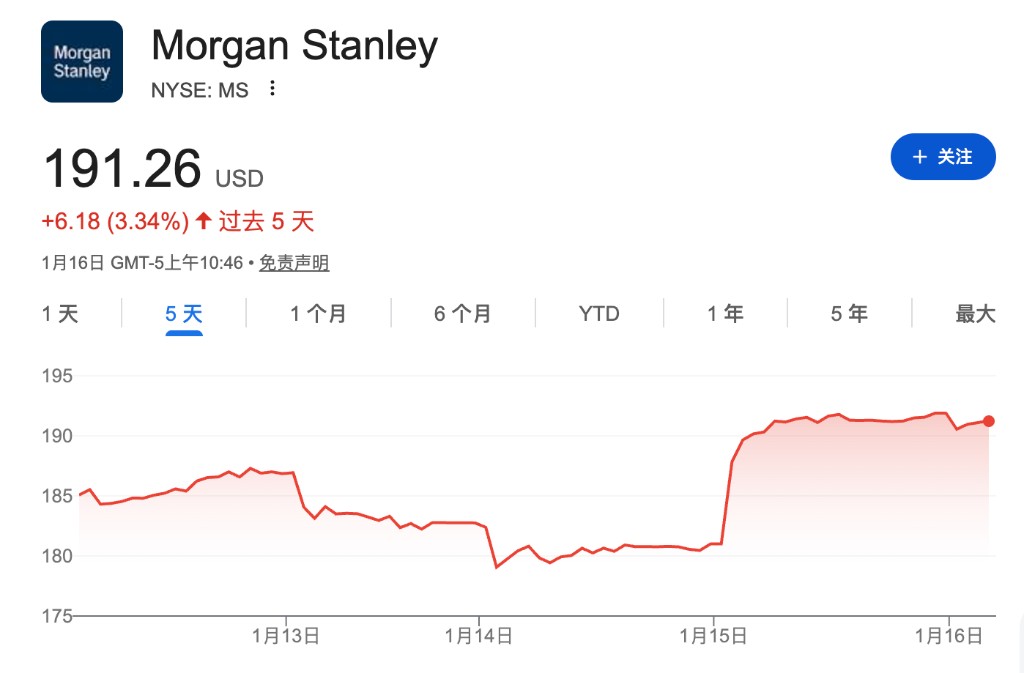
Last year, the total trading revenue of the five major Wall Street banks reached $134 billion, setting a historical record, and merger and acquisition activities also rebounded simultaneously. Despite ongoing market uncertainties, several executives predict that 2026 will be "a very, very good year." Following the strong quarterly results announced by Morgan Stanley and Goldman Sachs on Thursday local time, the stock prices of both banks rose by 5.8% and 4.6%, respectively, marking the largest single-day gains since April.

Although the unpredictable policies of the Trump administration and the progress of trade negotiations have intensified market volatility, they have also created significant opportunities for bank trading businesses, with investors frequently adjusting their positions, driving trading activity to continue rising. Meanwhile, the moderate relaxation of the regulatory environment and expectations of interest rate cuts by the Federal Reserve are revitalizing a once-weak merger and acquisition market, injecting new vitality into investment banking.

The combined profits of six major U.S. banks, including JPMorgan Chase, Bank of America, Citigroup, and Wells Fargo, have risen to their highest level since 2021. Last year, they returned over $140 billion to shareholders, also breaking the historical record set in 2019. Behind this series of strong data, the banking industry seems to be heading towards another high prosperity cycle.

The Trading Boom is Still in the "Middle Game," Supported by Policy Environment

Morgan Stanley CEO Ted Pick used a vivid metaphor to describe the outlook to analysts: the current trading boom is like the "middle game" of a baseball game, and "we are in the best batting position." He specifically pointed out that the prosperity of the trading business is out of sync with the investment banking business, which "is still in an earlier stage of development."

Goldman Sachs revealed that its consulting, bond, and equity underwriting business's backlog has climbed to its highest level in recent years, even reaching one of the strongest historical ranges. Its CEO David Solomon clearly stated that the current global situation creates a favorable environment for merger and acquisition and capital market activities in 2026.

On the policy front, the Trump administration's regulatory easing and the Federal Reserve's interest rate cut path are reshaping the market ecology. Although the volatility stemming from presidential policy swings and the progress of trade negotiations still leaves investors cautious, the resulting market fluctuations have instead created opportunities for trading businesses, forcing clients to continuously adjust their positions in response to changes.

This situation stands in stark contrast to other sectors of the banking industry. For example, the credit card business is facing threats from the Trump administration's demands to limit interest rates, and industry executives are still struggling to explore coping strategies while closely monitoring subsequent developments from the White House.

Peers Generally Optimistic About the Outlook

Other large banks are also conveying similar positive signals. JPMorgan Chase CFO Jeremy Barnum stated:

"There are constructive market dynamics, which are reflected in our business reserves."

Alastair Borthwick, Chief Financial Officer of Bank of America, also pointed out that "investment banking fees are showing good growth momentum."

However, several executives also issued warnings. They noted that current asset prices are at historical highs, suggesting that a significant correction in the value of stocks and other assets could dampen trading activity. Jamie Dimon, CEO of JP Morgan, specifically warned that despite the economy appearing robust, there are still "significant potential risks" that could suddenly change the market landscape.

Cautiously Maintain Existing Targets

Despite the overall positive outlook, banking leaders remain cautious about specific profit forecasts. Executives at Morgan Stanley revealed that the company has not yet raised its performance targets, and any adjustments may need to be considered later this year. Pick admitted:

"There is a certain pressure to catch up with targets. Once the original targets are met, the market often expects higher standards to be set."

It is worth noting that the six major banks laid off approximately 10,600 employees last year, setting a record high for nearly a decade, and some institutions have hinted that they may continue to push for cost optimization. Despite ongoing investments in technology upgrades, many banks have clearly stated that their current operational focus has shifted to improving operational efficiency