


Hasset "exits," but why do U.S. Treasuries "fall instead of rise"?

Due to Hasset being seen as the most dovish and likely candidate to promote interest rate cuts, his "exit" triggered a sell-off in U.S. Treasuries, with the 10-year U.S. Treasury yield soaring to 4.23%, reaching a new high since September of last year. Prediction websites show that the nomination probability for former Federal Reserve Governor Waller has risen to nearly 60%. Analysts believe that Waller's policy tendencies are harder to predict and may lean hawkish in the long term, leading to a reassessment of market interest rate expectations
Trump showed hesitation towards nominating Hassett as the Chairman of the Federal Reserve, breaking the recent silence in the U.S. Treasury market.
Wall Street Insight mentioned that on Friday, January 16, local time, Trump stated that if Kevin Hassett were to leave his position as Director of the National Economic Council, the government would lose one of its most influential "spokespersons" on economic issues.
At an event in the White House, Trump looked at Hassett and said:
You are doing great. If you want to know the truth, I actually want you to stay in your current position.
Shortly after Trump's remarks, users on the prediction website Polymarket quickly bet that Hassett would not receive the nomination for Chairman of the Federal Reserve. Bettors currently believe that former Federal Reserve Governor Warsh has nearly a 60% chance of becoming the nominee for Chairman of the Federal Reserve.
 (The probability of Hassett being nominated for Chairman of the Federal Reserve dropped to 17%, while Warsh's probability also slightly increased.)
Hassett had previously been seen as a leading candidate to succeed current Federal Reserve Chairman Powell, and was regarded as Trump's most loyal candidate, most likely to advocate for interest rate cuts. His "exit" means that a more hawkish candidate may take over.
The U.S. Treasury market reacted with a knee-jerk response. The yield on the benchmark 10-year U.S. Treasury bond soared to 4.23%, the highest level since September 2 of last year. The yield on the 2-year U.S. Treasury bond rose to its highest point since December 9 of last year.
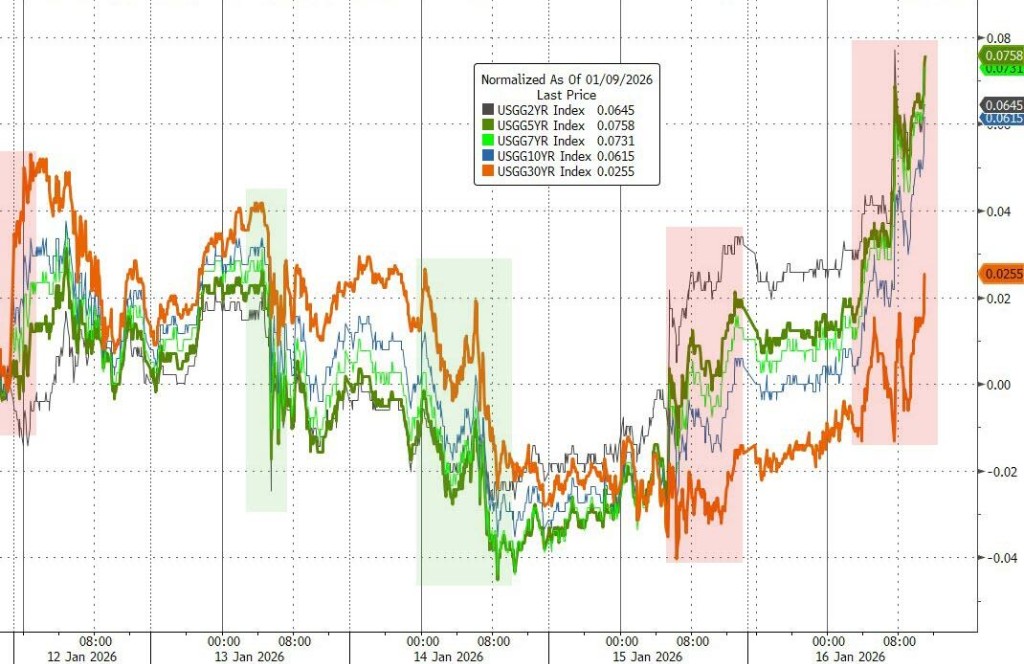 (U.S. Treasury yields across major maturities rose sharply on Friday.)
Interest Rate Path Undergoing Reevaluation
One important reason for the sell-off in U.S. Treasuries is that investors are reassessing the interest rate direction under different candidates.
Although Trump has repeatedly expressed a desire for the Federal Reserve to cut interest rates, Warsh's policy inclinations are more difficult to predict than Hassett's.
Ian Lyngen, Head of Interest Rate Strategy at BMO Capital Markets, noted in a research report that among the candidates Trump might nominate, Hassett is widely seen as the most loyal, which also makes him the most likely to advocate for interest rate cuts, even if the data suggests otherwise.
In contrast, Warsh is a "greater variable."
During his tenure at the Federal Reserve, Warsh was a hawkish figure concerned about inflation, even calling for interest rate hikes during the financial crisis. Wall Street Insight mentioned that although Warsh began advocating for interest rate cuts at the end of last year, he still leans hawkish on balance sheet issues.
The Wells Fargo strategist team wrote in an earlier research report this year:
Given Walsh's past hawkish stance and recent dovish remarks, his policy orientation is somewhat elusive.
Krishna Guha from Evercore summarized:
We believe that from the short term until the end of 2026, based on an optimistic view of the supply side, Walsh's position will be more or less dovish like Hassett's; the difference is that if the economy overheats in 2027/2028, he is more likely to revert to his previous hawkish stance.
Calm Markets Suddenly Stirred
Friday's rise came after bond prices had remained basically flat for several weeks.
Despite the U.S. forcibly controlling Venezuelan leaders earlier this month, there are still potential conflicts involving Trump with Iran and Denmark.
However, bond prices continued to fluctuate within a narrow range. As of Thursday, the trading range for the 10-year U.S. Treasury yield this year has only been 8 basis points.
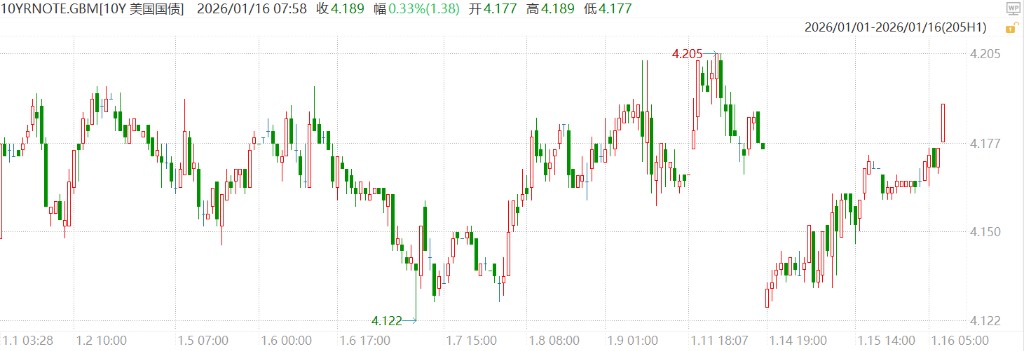 (10-year U.S. Treasury yield trend this year)
The recent slump in the U.S. Treasury market has also been influenced by the sharp decline in the ICE BofA MOVE Index. This index measures the expected volatility of U.S. Treasuries and fell to 56.14 on Thursday, marking the lowest closing price since September 2021.
The days of market sluggishness may be coming to an end. Analysts believe it is currently unclear when Trump will make a decision regarding the Federal Reserve, but it is likely to happen in the coming weeks.
The U.S. Supreme Court is expected to rule this year on the Trump administration's International Emergency Economic Powers Act (IEEPA) tariffs, which could trigger a new wave of selling.
