


"AI Cloud" is back! From 2026 to now, CoreWeave has risen over 40%, and Nebius has increased nearly 30%

AI cloud trading makes a strong comeback, with funds flowing back to the computing supply side. This year, CoreWeave has risen approximately 42%, Nebius has risen approximately 28%, and IREN has risen over 53%. The rebound is driven by improved profit expectations and technical breakthroughs. TSMC's better-than-expected earnings report and capital expenditure adjustments validate the continued expansion of AI demand, with a gross margin of 62.3% alleviating concerns about a bubble
After experiencing the last round of rapid rises and falls, the "AI cloud" trading around AI infrastructure, data centers, and high-performance computing is returning, with funds flowing back to more pure computing supply-side targets.
Since 2026, CoreWeave has risen over 40%, Nebius has increased nearly 30%, while Iren, which covers high-performance data centers and Bitcoin mining, has surged over 53%.
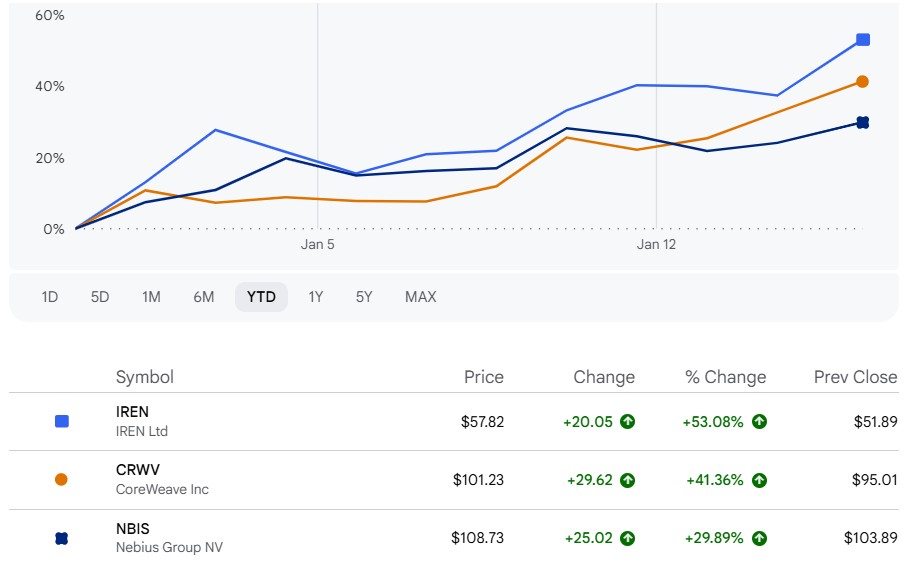
The key clues driving this rebound focus on two points: the improvement in profit expectations and the "upward breakout" of price trends. More importantly, strong signals from the chip side are providing external endorsement for the "AI cloud."
According to Zacks Research, TSMC's better-than-expected quarterly performance and the upward adjustment of capital expenditures for 2026 have reinforced the judgment that AI demand is still expanding, alleviating the most sensitive risk points of the AI cloud service model on both the supply and demand sides, leading to a return of market risk appetite to more segmented AI computing cloud tracks.
Funds Return to the Computing Supply Side
By the end of 2025, Iren, Nebius, and CoreWeave were among the most aggressive winners in the AI infrastructure boom, each recording triple-digit increases within months.
As risk appetite cooled and funds withdrew from speculative sectors, these stocks experienced steep corrections. However, according to Zacks Investment Research, this trend has recently begun to change. Stock prices have stabilized and turned upward, with profit expectations and forward outlooks beginning to improve.
Iren is defined as a vertically integrated digital infrastructure company, covering high-performance data centers and Bitcoin mining, supported by renewable energy generation. Its scalable infrastructure directly benefits from the rising demand for computing power and electricity driven by AI and data-intensive workloads.
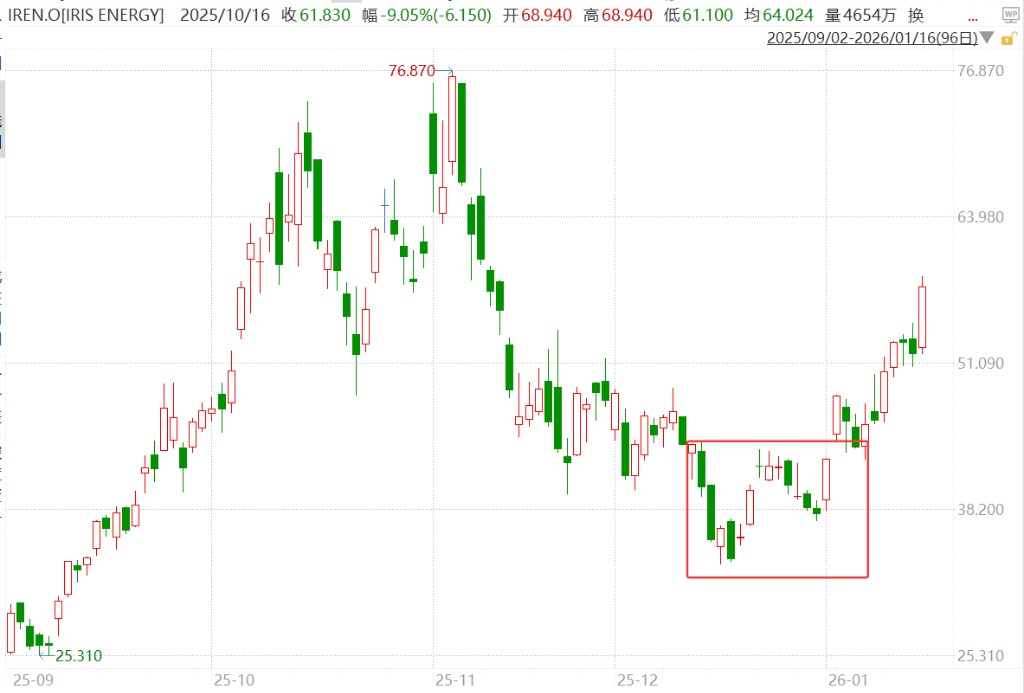
Zacks Research indicates that Iren's sales are expected to grow by about 120% this year, with an additional increase of about 151% next year. Technically, the stock price has formed a W-bottom and broken upward, which is seen as one of the typical characteristics of the early stage of an upward trend.
Positioned as an AI-oriented infrastructure and cloud service provider, Nebius is supported by upward revisions in profit expectations. Looking ahead, the market expects its sales to grow by 376% next year.
As the trigger for last year's "AI crash," CoreWeave has completed its first batch of chip deliveries for OpenAI at its Texas data center. Wall Street Journal mentioned that according to CoreWeave executives, the company has rapidly increased from "several racks delivered in mid-November last year" to over 16,000 GPUs by the end of December This progress marks that CoreWeave is emerging from the revenue hit caused by delays from data center suppliers in the fourth quarter of last year.
TSMC's Financial Report Provides Fundamental Support
For new cloud service providers like CoreWeave and Nebius, TSMC's performance validates their business model.
As the entire value proposition of AI cloud service providers relies on acquiring cutting-edge AI chips, TSMC's explosive quarterly performance and forward guidance alleviated two major risks.
On the supply side, TSMC's record manufacturing yield and capacity expansion mean that CoreWeave and Nebius can fulfill their multi-billion dollar backlog orders.
In terms of demand strength, when the world's largest foundry raised its capital expenditure for 2026 to between $52 billion and $56 billion, it indicated that tech companies are still placing large-scale, long-term orders for AI chips.
TSMC's gross margin reached 62.3%, proving that the industry is not only growing but also has extremely high profit margins, thereby fundamentally calming concerns about an "AI bubble."
Zacks Investment Research pointed out that volatility in the "AI cloud" segment remains the norm, but based on stock price behavior and changes in expectations, market risk appetite is returning to the crowded trading ranges of AI infrastructure and "AI cloud," with signs of capital rotation worth continuous tracking
