


3nm production capacity is in crisis, TSMC's major customers are forced to divert, are opportunities coming for Samsung and Intel?

Deutsche Bank stated that TSMC's 3nm capacity is fully booked until 2027, forcing it to significantly raise its 2026 capital expenditure guidance to USD 52-56 billion. Capacity bottlenecks have led six major clients, including Apple and NVIDIA, to seek alternatives in Samsung and Intel, potentially causing TSMC's advanced process market share to slightly decline to 90%. The bank has also raised TSMC's target price by 10% to NT$ 2,200
Under the wave of AI, chip demand has surged. Due to TSMC's capacity being fully booked until 2027, major clients like Apple and NVIDIA are forced to consider shifting some orders to Samsung and Intel.
According to the Wind Trading Platform, a recent report from Deutsche Bank indicates that global semiconductor foundry giant TSMC is facing a "happy trouble." Due to the extreme shortage of 3nm process capacity, with orders already filled for all of 2026 and extending into 2027, TSMC has had to significantly raise its capital expenditure plans.
This capacity bottleneck is reshaping the market landscape, forcing top clients who originally relied on TSMC to seriously consider Samsung and Intel as alternatives.
Deutsche Bank analysts, including Robert Sanders, pointed out in the report that TSMC's capital expenditure guidance for 2026 is as high as $52 billion to $56 billion, significantly exceeding the bank's expectation of $50 billion and the market consensus of $46 billion.
Analysts believe this is essentially TSMC acknowledging that its 2025 capital expenditure plan was "too conservative" in the face of soaring AI demand. The current situation is no longer simply a surplus in CoWoS packaging capacity, but a severe supply-demand imbalance in core wafer manufacturing capacity—especially for the 3nm process.
This supply-demand imbalance is creating direct market spillover effects. The report emphasizes that although Samsung and Intel have a "chequered record" in foundry services, the "six major clients"—Apple, NVIDIA, AMD, Broadcom, Qualcomm, and MediaTek—currently have no choice but to seek alternative capacity. As a result, TSMC's market share in advanced process foundry is expected to decline from 95% to 90%.
Capital Expenditure Soars to $56 Billion, 3nm Capacity "In High Demand"
The most striking figure in TSMC's fourth-quarter financial report is its capital expenditure guidance for 2026. The scale of $52 billion to $56 billion indicates that the company is fully committed to addressing the capacity crisis.
Deutsche Bank notes that considering TSMC's capacity for the entire year of 2026 is likely already fully booked, with order backlogs extending into 2027, this surge in expenditure is not surprising.
Previously, in the face of the explosion in AI demand, the initial bottleneck was mainly concentrated in the CoWoS packaging segment, leading to some orders spilling over to companies like ASE and Amkor. However, the current situation is more severe: demand far exceeds supply, especially for the 3nm process.
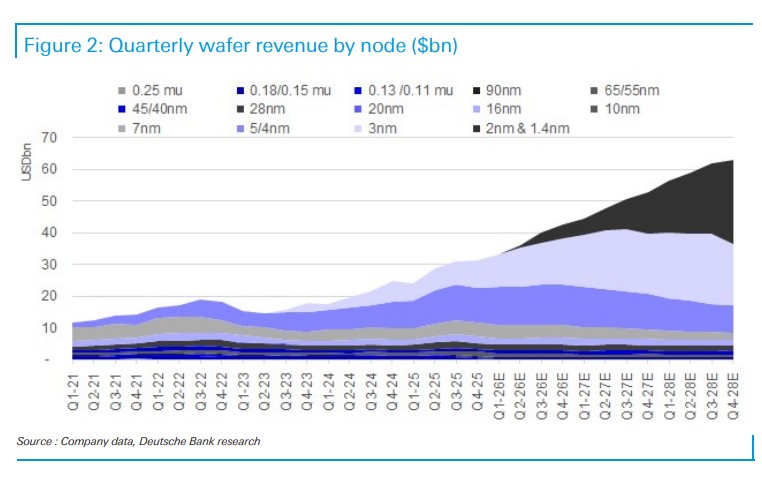
Report data shows that although TSMC plans to increase its 3nm capacity to 190,000 wafers per month by the end of 2026, it still cannot meet customer appetite.
Deutsche Bank mentioned in the report: "It is normal for customers to want more capacity under TSMC's high utilization, but reaching this level is unprecedented."
Six Major Clients Forced to "Divert," Samsung's Taylor Factory May Become the First Choice
The extreme tightness of capacity is forcing TSMC to adopt a more aggressive strategy. According to reports, TSMC is delaying the launch of new 3nm development projects and instead guiding clients to plan more for 2nm GAA processes for products to be mass-produced in 2027/28. At the same time, TSMC is also using pricing strategies to "push" clients to make this transition, as evidenced by its strong guidance for the first quarter of 2026.
This suboptimal situation is forcing the world's six largest chip design companies—Apple, NVIDIA, AMD, Broadcom, Qualcomm, and MediaTek—to turn their attention to competitors.
Deutsche Bank analysts believe that in this capacity competition, Samsung's factory in Taylor (SF2P) may be favored over Intel.
The report states: "For clients seeking alternative suppliers, Samsung's Taylor factory is more likely to become the first port of call."
Specifically, Qualcomm and AMD are most likely to consider Samsung; while, according to previous discussions, Apple and Broadcom are reportedly considering Intel. However, analysts also added that although Intel has the potential story of the 14A process, "there is still a lot of work to be done."
AI-Driven Long-Term Growth Expectations Raised, Gross Margin Target Increased to 56%
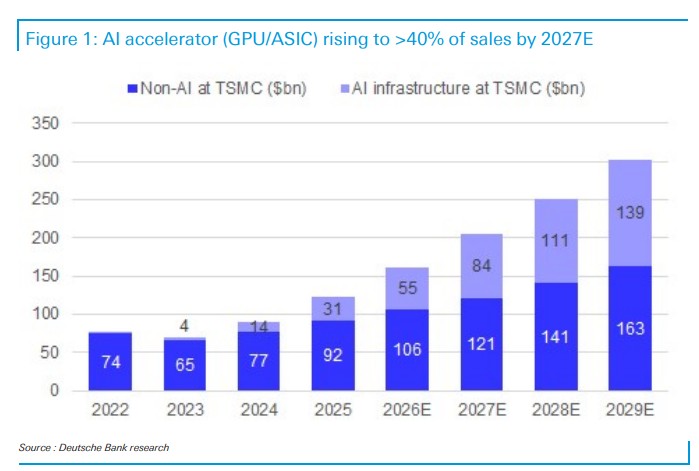
Despite facing challenges in capacity allocation in the short term, the long-term growth dividends brought by AI are highly certain. TSMC confirmed that it expects AI-related growth to accelerate, raising the compound annual growth rate (CAGR) expectation for 2024 to 2029 from the mid-40s to the mid-to-high 50s.
Driven by this, TSMC has raised its long-term overall growth forecast to a 25% CAGR, and the long-term gross margin target has also been raised to 56%. Deutsche Bank believes that given the latest dynamics of AI development and TSMC's pricing actions, these upward adjustments are "not surprising."
Regarding overseas capacity expansion, the report mentions that TSMC's Arizona factory is currently in a low-output phase (Phase 1 4nm, monthly capacity of 20,000 wafers), and it is expected to generate its first 3nm revenue by the end of this year in Phase 2. Although building factories overseas will lead to a 2-4% dilution in gross margins and face challenges such as talent, infrastructure, and yield, the market's focus remains on its core profitability.
Based on the profitability improvement brought by higher wafer pricing, Deutsche Bank has raised TSMC's (2330.TW) target price by 10% to NT$2,200. This target price corresponds to a 20 times price-to-earnings ratio based on the expected earnings per share (EPS) for 2027, in line with industry levels.
Analyst Robert Sanders stated that this valuation reflects TSMC's solid position and strong growth rate before 2028. However, the report also highlights potential risks, including geopolitical risks and potential resistance from Intel's attempts to bring production back in-house In addition, if AI-related spending suddenly slows down, or if the execution of CoWoS capacity enhancement is ineffective, it will also pose a risk.
The above wonderful content comes from [Chasing Wind Trading Platform](https://mp.weixin.qq.com/s/uua05g5qk-N2J7h91pyqxQ).
For more detailed interpretations, including real-time analysis and frontline research, please join the【 [Chasing Wind Trading Platform ▪ Annual Membership](https://wallstreetcn.com/shop/item/1000309)】
[](https://wallstreetcn.com/shop/item/1000309)