


The AI network supercycle will arrive by 2026, with the biggest winner shifting from "Yi Zhongtian" to "Zhongtian Tai Chang"?
Global AI infrastructure investment has entered a new round of super cycle, expected to last until 2026 or 2027. Nomura Securities research shows that the shipment of 800G optical modules and 1.6T optical modules will significantly increase, with technological upgrades becoming a key driving force. Major AI companies such as NVIDIA, Alphabet, and Meta are advancing network architecture upgrades, and supply chain bottlenecks will further strengthen the market advantages of leading enterprises
Global AI infrastructure investment is entering a new super cycle. According to the latest research from Nomura Securities, driven by multiple technology upgrade roadmaps and a shortage of key component supplies, the growth momentum of the global AI network market is expected to continue until 2026 or even 2027, with core sectors such as optical modules, optical fiber cables, and high-speed copper cables welcoming structural opportunities.
According to news from the Chasing Wind Trading Desk, the Nomura Securities Bing Duan team stated in a research report released on January 9 that the shipment volume of 800G optical modules will increase from 20 million units in 2025 to 43 million units in 2026, and the shipment volume of 1.6T optical modules will surge from 2.5 million units to 20 million units. The penetration rate of silicon photonics (SiPh) technology in the 800G/1.6T market is expected to reach 50-70%. The supply tightness of optical chips (laser chips/materials) will continue, providing leading manufacturers with upward space for prices and gross margins.
The accelerated evolution of technology roadmaps has become a key driving force. Global AI giants, including NVIDIA, Google, Meta, and Amazon AWS, are actively promoting network architecture upgrades, covering multiple technology paths such as silicon photonics (SiPh), co-packaged optics (CPO), optical circuit switching (OCS), active electrical cables (AEC), and hollow core fibers (HCF). NVIDIA plans to launch the Rubin platform in 2026, equipped with a 1.6T network interface; Google’s TPU v7 adopts 800G optical modules and OCS technology; Meta has scaled up the deployment of customized network architecture in its 18K card cluster.
Supply chain bottlenecks will strengthen the advantages of leading enterprises. According to Nomura's estimates, the advanced optical chip production capacity (CW+EML+VCSEL) of major global optical chip suppliers will grow by over 80% year-on-year by 2026, but will still lag behind demand by 5%-15%. Among major companies, Zhongji Xuchuang maintains a leading global share in the 800G/1.6T optical module market, Tianfu Communication has core competitiveness in optical engines and FAU segments, Taicheng Light has a solid position in the high-end connector market such as MPO, and Yangtze Optical Fibre and Cable is accelerating global penetration in AIDC-related optical fiber and cable products.
Multiple Technology Upgrades: The Evolution Path from Pluggable to CPO
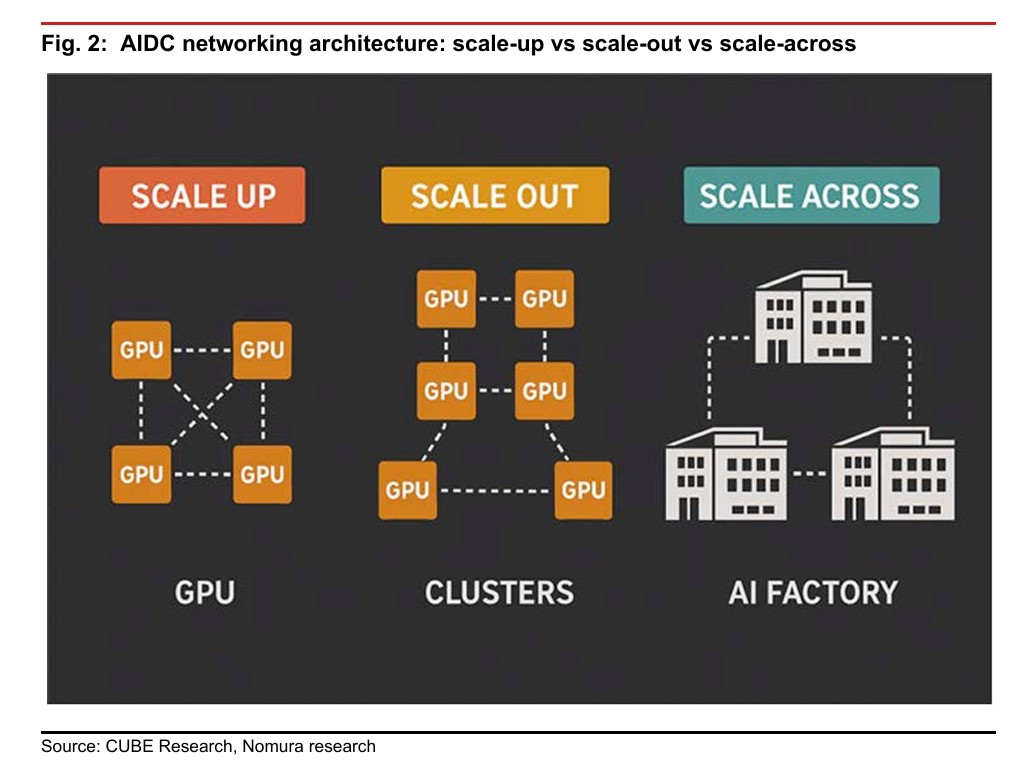
Nomura Securities stated that AI data centers need to expand computing power and interconnectivity at different levels, forming three key levels: scale-up (interconnect within racks), scale-out (interconnect between racks/clusters), and scale-across (interconnect across data centers).
In scale-up networks, copper cables still play an important role. NVIDIA's GB200 NVL72 uses NVLink 5.0 and PCIe 6.0 protocols, utilizing custom copper cable boxes to interconnect 72 computing nodes, with a total of 5,184 copper cable connections. However, as the scale of GPU clusters continues to expand, the effective transmission distance limitation of copper cables at high speeds (less than 10 meters) has become a bottleneck, highlighting the increasing importance of optical communication solutions In scale-out networks, pluggable optical modules remain the mainstream solution, but technological iteration is accelerating. Product innovations include silicon photonics (SiPh), LPO/LRO, NPO/CPO, focusing mainly on higher performance, lower energy consumption, and cost. Nomura analysis believes that the 1.6T upgrade and SiPh migration are key drivers for 2026, with SiPh optical modules expected to account for 50-60% of the 800G market and 60-70% of the 1.6T market in 2026.
CPO technology is expected to accelerate commercialization starting in 2026. By integrating the optical engine directly with the switching ASIC, CPO can significantly enhance bandwidth density and port density while reducing power consumption per bit. Broadcom has released a 102.4T CPO switching chip based on the Tomahawk 6 platform, and NVIDIA will also launch the Quantum-X CPO switch based on IB networks at the 2025 GTC conference. Nomura expects that the adoption rate of CPO in scale-out networks will accelerate in the medium term, benefiting from the bundling sales strategies that global AI giants may adopt.
Analysis of Major Cloud Service Providers' Network Architecture Roadmaps
Nomura Securities states that NVIDIA continues to lead the evolution of AI network technology. Its Rubin series platform will adopt NVLink 6.0 technology (3600GB/s), equipped with CX9 network cards (1.6Tbps) and Spectrum 6 CPO switches (102T). In scale-up networks, Rubin Ultra NVL576 will use orthogonal backplanes (PCBs) instead of copper cable backplanes; in scale-out networks, 1.6T IB/Ethernet switches will be deployed. The company may also disclose more details about Spectrum-X Ethernet version CPO products at the GTC event in March 2026.
Google TPU v7 adopts a 3D toroidal topology, using copper cables for intra-rack TPU interconnections and optical modules for inter-rack interconnections, with OCS technology for cluster-level connection scheduling. Meta employs a hybrid interconnection architecture: strengthening copper cables on the scale-up side and deploying high-speed optical modules on the scale-out side, while testing CPO switches to enhance reliability.
AWS's Trainium3 + NeuronLink uses PCB+ backplane + AEC hybrid interconnection and replaces RoCE v2/IB with its self-developed EFA protocol to improve cluster scale and congestion control
Optical Communication Market: Supply and Demand Tightness Supports Prices and Margins
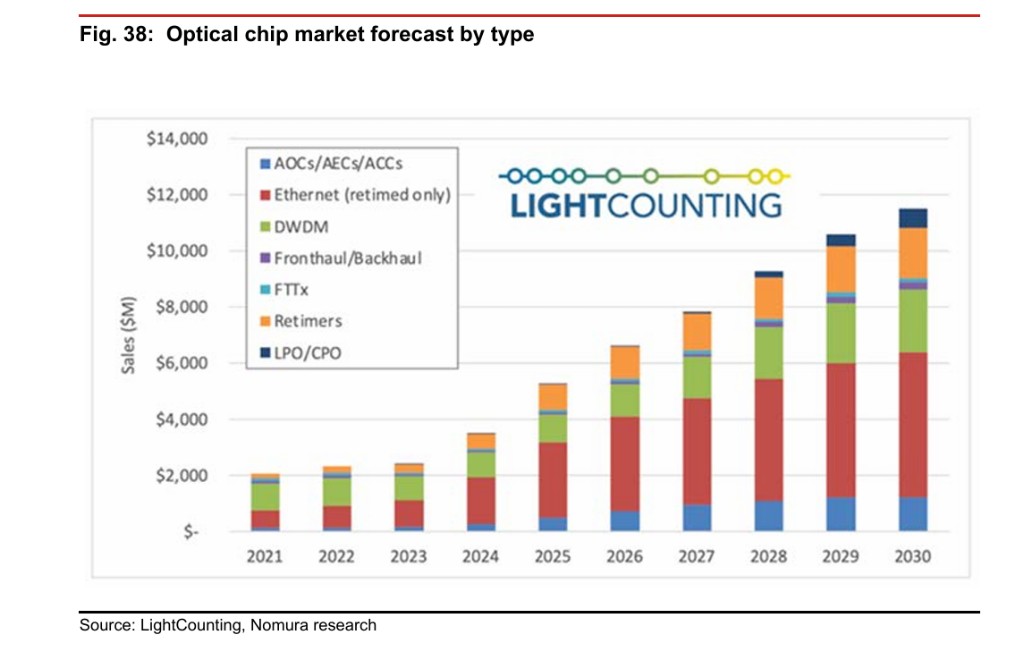
Nomura Securities stated that the optical module market is experiencing structural growth opportunities. According to market research firm LightCounting, the revenue of the Ethernet optical module market is expected to surge by 93% year-on-year in 2024, with anticipated growth of 48% and 35% in 2025 and 2026, respectively. Nomura emphasized that this growth is constrained by the production capacity of EML laser chips.
Supply chain bottlenecks are reshaping the competitive landscape. The main cost components of optical modules include TOSA (transmitter optical subassembly, including lasers), ROSA (receiver optical subassembly, including photodetectors), and electronic chips (such as DSP), which together account for 56-61% of the total cost of 800G/1.6T optical modules. The high-end chip market is still dominated by American and Japanese companies such as Broadcom, Coherent/Finisar, Cisco/Acacia, Mitsubishi Electric, and Sumitomo Electric.
Chinese companies are continuously making breakthroughs in the mid-to-lower reaches of the industry. Zhongji Xuchuang, as the world's largest data center optical module supplier, is expected by Nomura to maintain a market share of 25-30%/35-40% in the 800G/1.6T market, respectively. Tianfu Communication (TFC), as a high-end optical engine supplier, will benefit from the 1.6T upgrade and is expected to secure orders in the CPO market's FAU (fiber array unit) products.
The optical fiber and cable market is showing a differentiated trend. The demand in the domestic traditional telecom market is under pressure, but the demand from AI data centers is strong. According to CRU data, the demand for optical cables in AI applications is expected to grow by 138% year-on-year in 2024, with a continued growth of 77% expected in 2025. Yangtze Optical Fibre and Cable's AI data center business (including hollow-core fibers, active optical cables, active electronic cables, and MPO) is accelerating its expansion into the global market.
CPO Market Outlook: From Pilot to Large-Scale Commercialization
CPO technology is on the brink of commercialization. Nomura expects that the penetration rate of CPO switches (by shipment volume) will increase from 3% in 2026 to 20% in 2030, with the market size growing from $1.6 billion in 2026 to $13.1 billion in 2030.
The technical roadmap has become clearer. The NVIDIA Quantum X800 CPO switch includes four 28.8T switching ASIC chips, each equipped with six subcomponents, with each subcomponent containing three 1.6T CPO optical engines. The entire switch requires 144 FAUs, 72 1.6T optical engines, and 18 external laser sources (ELS), with Nomura estimating the total cost to be around $80,000 to $90,000 According to the partner list announced by NVIDIA at GTC 2025, the CPO switch supply chain includes: optical engine and FAU suppliers (Tianfu Communication, Corning, Senko, etc.), EIC+PIC packaging (TSMC), optical engine packaging (ASE, Fabrinet), CW laser chips (Lumentum, Sumitomo Electric), MPO and optical fibers (Corning, T&S Communication under Tianfu Communication), switch assembly (Foxconn) and more. Nomura Securities stated that Tianfu Communication, with its position as an FAU supplier in the pluggable optical module market, is expected to secure CPO orders through customer relationships and technological accumulation.
High-Speed Copper Cables: An Indispensable Scale-Up Solution
There is a misunderstanding in the market that optical communication will replace copper cables. Nomura emphasizes that copper cables will still play an important role in scale-up and some scale-out networks, and their speed and efficiency advantages are crucial for handling large-scale AI tasks. Despite transmission distance limitations, copper cables have cost advantages over optical modules, and AEC (Active Electronic Cable) can extend transmission distances up to 10 meters.
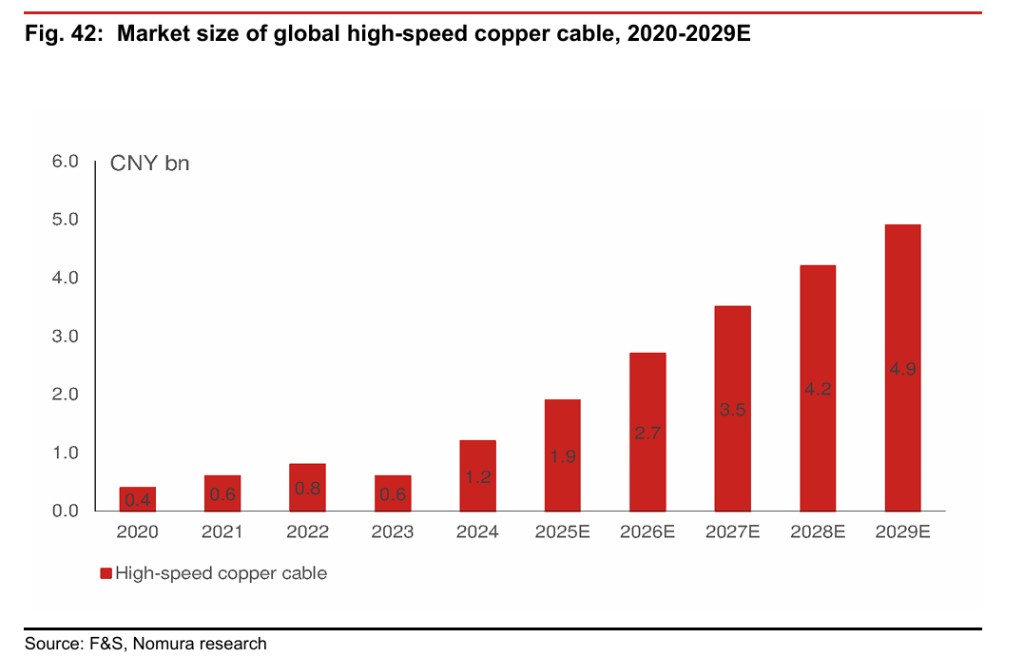
Market size expectations are optimistic. According to market research firm Light Counting, sales of high-speed copper cables are expected to double in the next five years, reaching $2.8 billion by 2028. NVIDIA was the first to adopt DAC (Direct Attach Copper) in the Blackwell NVL72 system and may continue to use copper cables in the Rubin platform in 2026. Major AI customers such as Amazon AWS, Meta, and Microsoft are also using copper cables in their AIDC projects.
The supply chain landscape is showing a trend of consolidation. Major participants in the copper cable supply chain include Amphenol, Credo, and companies like Zhenwei Precision and Wolong Nuclear Materials that have entered the global AI customer copper cable supply chain.
Switch Market: White Box and CPO/OCS Trends Running Parallel
The Ethernet switch market continues to grow strongly. According to IDC data, global Ethernet switch market revenue reached $14.7 billion in the third quarter of 2025, a year-on-year increase of 35.2%, with the data center segment growing by 62.0% year-on-year. Revenue from 800G switches increased by 91.6% quarter-on-quarter, accounting for 18.3% of the data center market revenue.
Nomura Securities stated that the ODM direct sales model continues to expand. In the third quarter of 2025, ODM direct sales (compared to branded switches) revenue increased by 152.4% year-on-year, accounting for 30.2% of the data center market revenue (up from 19.6% in the previous quarter) This reflects the global trend among cloud service providers to increasingly prefer "white box" switch products to reduce costs and increase flexibility. This trend may negatively impact the profit margins of brand switch manufacturers with proprietary IP and software.
CPO and OCS technologies are competing for development. Broadcom continues to promote the application of CPO technology based on its TomaHawk 6 platform, while NVIDIA's Quantum-X (IB) and Spectrum-X (Ethernet) switches may also launch CPO versions. At the same time, Google's OCS technology has gained attention for its strong performance in large TPU training clusters. The Open Compute Project Foundation (OCP) has established an OCS sub-project, led by iPronics and Lumentum, with Coherent, Google, Microsoft, NVIDIA, and others as founding members.
According to IDC data, the market size of China's data center switch market will exceed 21.15 billion yuan in 2024, and is expected to reach 22.68 billion yuan in 2025, with AI computing network construction contributing over 45%. 400G ports have become mainstream (market share 38%), and 800G switches are expected to achieve mass production by 2025, while 1.6T ports are expected to be commercially available by 2026. In the switch chip market, international manufacturers such as Broadcom and Marvell dominate the high-end market, but domestic companies like Shengke are also making continuous progress.
The above exciting content comes from the Wind Chaser Trading Platform.
For more detailed interpretations, including real-time analysis and frontline research, please join the【 **Wind Chaser Trading Platform ▪ Annual Membership**】

The above exciting content comes from the Wind Chaser Trading Platform.
For more detailed interpretations, including real-time analysis and frontline research, please join the【 Wind Chaser Trading Platform ▪ Annual Membership】
Risk warning and disclaimer
The market has risks, and investment should be cautious. This article does not constitute personal investment advice and does not take into account the specific investment objectives, financial conditions, or needs of individual users. Users should consider whether any opinions, views, or conclusions in this article are suitable for their specific circumstances. Investment based on this is at their own risk.
