Precise escape? Ahead of Trump's threat to impose tariffs on Europe, hedge funds have already shorted the euro

Before the escalation of geopolitical risks, hedge funds have proactively shifted their euro positions from long to short, demonstrating their keen anticipation of potential policy risks. This move not only resonates with the deterioration of technical indicators but also highlights the market's deep concerns about the European economy and the euro's trajectory under the threat of Trump's tariffs. However, if it evolves into a broader issue of trust in the dollar, it could also trigger a capital return to Europe, thereby providing unexpected support for the euro
In the days leading up to U.S. President Trump threatening to impose new tariffs on European countries over Greenland, hedge funds have sharply exited their bullish bets on the euro. This timely position adjustment indicates that some market funds have preemptively hedged against the escalation of this geopolitical tension.
Data from the U.S. Commodity Futures Trading Commission (CFTC) shows that in the week ending January 13, leveraged funds have shifted to a slight net short position on the euro. This marks the first bearish turn in positions since late November last year. This shift occurred before the public announcement of the tariff threat, which may further exacerbate downward pressure on the euro.
On the news front, according to CCTV News, President Trump stated that he would impose a 10% tariff on eight European countries opposing his acquisition of Greenland, which would increase to 25% months later until an agreement on the "complete and thorough purchase of Greenland" is reached, raising market concerns about a trade war.
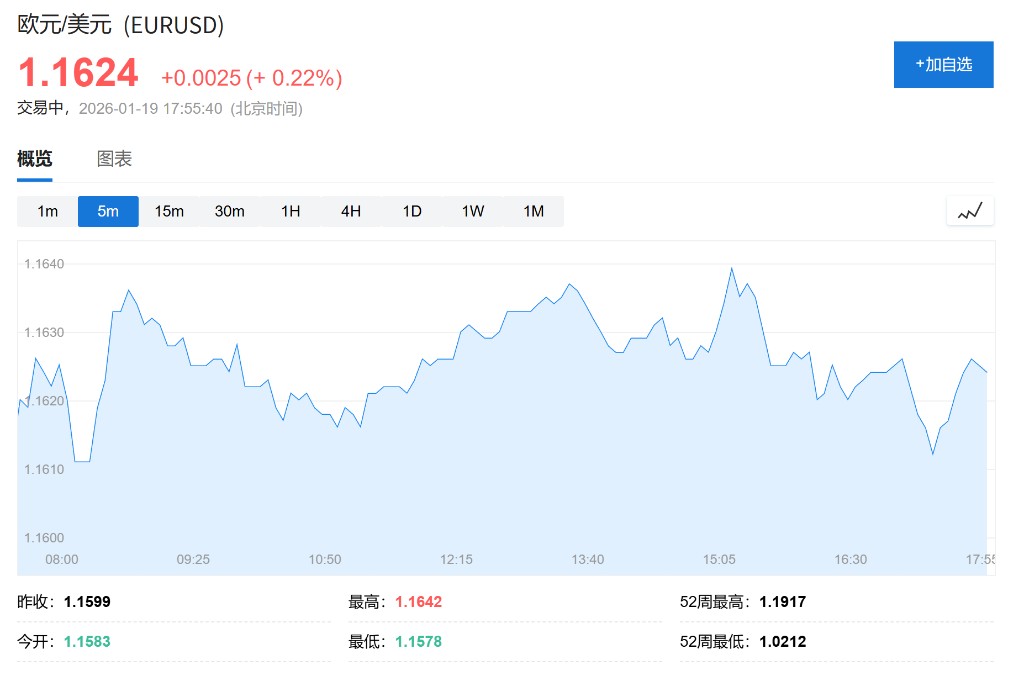
Concerns about a rekindled trade war are heating up, and investors are beginning to assess the potential damage this could cause to European economic growth. Affected by this uncertainty, the euro initially fell 0.2% after the news but rebounded 0.4% to $1.1641, while the Bloomberg Dollar Spot Index dropped 0.2%.

Morgan Stanley had previously warned that traders are currently underestimating the risks of extreme scenarios, which could trigger significant volatility in major currencies, especially the euro.
Capital Shift and Deteriorating Technicals, Geopolitics Have a Double-Edged Sword Effect
CFTC data reveals a significant reversal in market sentiment. Leveraged funds have flipped from long to short at a critical moment, indicating that some institutional investors are avoiding potential policy risks. Nick Twidale, chief analyst at AT Global Markets, pointed out that hedge funds would be satisfied with their current net short positions, and if this "dispute" appears likely to escalate into a full-blown trade war, they may even seek to increase their short positions.
Meanwhile, technical indicators have also begun to align with the bearish position shift. The long-term momentum signal for the euro turned negative last week for the first time in nearly a year, ending a previous bullish trend that lasted for 43 consecutive weeks. Historical analysis shows that while such a signal reversal does not necessarily guarantee a sell-off, it often indicates significant declines when the signal persists, suggesting that the euro faces asymmetric downside risks.
Regarding future trends, market views are cautiously pessimistic. Strategists Joseph Capurso and Carol Kong from the Commonwealth Bank of Australia wrote in a report that due to the tense situation, the euro against the dollar may test the support level of 1.1499 this week. They believe that this trade dispute centered around control of Greenland is likely to escalate before it cools down. Bloomberg market strategist Conor Cooper also noted that the moderate decline of the euro may indicate that traders are simultaneously wary of the negative impact on the dollar. **
Despite the bearish market sentiment, the spillover effects of geopolitical issues could be a double-edged sword. If this situation evolves into a broader dollar problem, the euro may gain some support. According to an analysis by a strategist at Deutsche Bank, President Trump's trade threats regarding Greenland have increased the likelihood that European governments may reduce their holdings of U.S. assets, which would benefit the euro. The potential for capital repatriation could limit the downside for the euro, although options market data shows that traders' confidence in the euro's upside appeal is waning