Holding 10 trillion US dollars in US stock and bond assets, can Europe dare to fight a "capital war"?

European countries holding U.S. bonds and stocks have intensified speculation about the "weaponization of capital." However, most of these assets are held by private funds that are beyond government control, making it difficult for policymakers to enforce sales. Any attempt to weaponize U.S. assets held by Europe would constitute a serious escalation of the situation, potentially expanding a trade war into a financial conflict
As Trump threatens a tariff war, how Europe utilizes its over $10 trillion in U.S. assets has become a market concern.
According to CCTV News, U.S. President Trump stated that starting February 1, a 10% tariff will be imposed on all goods exported from Denmark, Norway, Sweden, France, Germany, the United Kingdom, the Netherlands, and Finland to the United States until an agreement is reached on the "complete and total purchase of Greenland."
Wall Street Insight mentioned that Trump has transformed tariffs into "island ransom," and Deutsche Bank has warned that the situation may escalate into the "weaponization of capital." According to data from the U.S. Treasury, the total U.S. assets held by the EU exceed $10 trillion, with the UK and Norway holding even more such assets.
The vast majority of U.S. assets held by Europe are owned by private funds that are beyond government control. If Europe were to weaponize its U.S. assets, it would mean a serious escalation of the situation. This would effectively extend the trade war into a financial conflict that directly impacts capital markets.
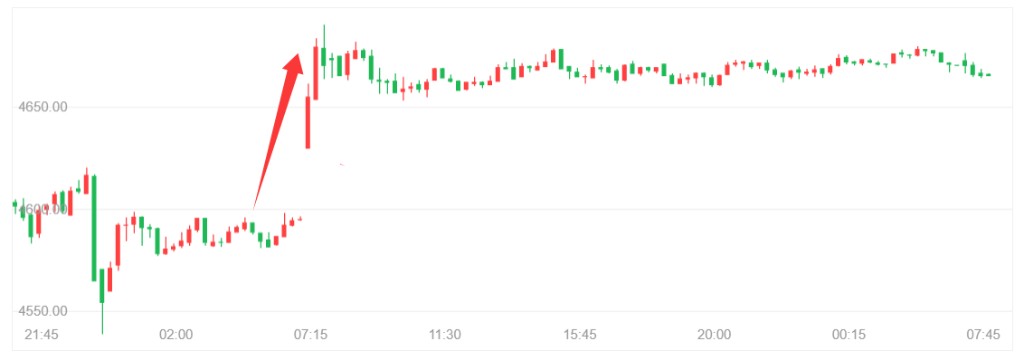
On Monday, market tensions emerged, with U.S. stock futures, European markets, and the dollar under pressure, while gold, safe-haven currencies like the Swiss franc, and the euro became major beneficiaries. This is similar to the market reaction after Trump imposed tariffs last April, indicating that the "sell America" trade may resurface.
(Spot gold prices surged significantly, nearing $4,700)
Obstacles to Implementing "Weaponization"
According to U.S. Treasury data, the total U.S. assets held by the EU exceed $10 trillion, with the UK and Norway holding even more such assets. These assets include U.S. Treasury bonds and stocks, some of which are held by public sector funds.
Although some U.S. assets are held by the public sector, the largest of which is Norway's $2.1 trillion sovereign wealth fund, the vast majority are held by numerous private investors.
A research team led by Carsten Brzeski at ING stated:
The EU can hardly force European private sector investors to sell dollar assets; it can only attempt to incentivize investment in euro assets.
From the perspective of policymakers, even public sector funds like sovereign wealth funds face a dilemma as holders. For example, the primary benchmark for Norway's sovereign wealth fund is commercial and risk factors, rather than political considerations.
Whether the funds are public or private, the market effect of large-scale, strategic sell-offs of U.S. assets would be economically a "negative-sum game," where "harmful to others and harmful to oneself" is a natural concern and primary obstacle for decision-makers in implementing strategic actions.
**Most strategists believe that given Europe's general reluctance to confront Trump since his return to power, the likelihood of policymakers ultimately taking such extreme measures is low. This action could also harm the interests of European investors themselves **
Juckes from Société Générale stated on Monday:
American asset investors in the European public sector may stop increasing their holdings or start selling, but the situation needs to escalate significantly further before they would harm investment performance for political purposes.
More Likely Options: Traditional Trade Tariffs
Wall Street Journal mentioned that a Goldman Sachs report pointed out that the EU may have three levels of response pathways.
The mildest option is to suspend the previously agreed EU-U.S. trade agreement. This agreement requires approval from the European Parliament, and in the current context, several European Parliament members have clearly stated that "the conditions for approval are not met at this time."
The second option is to use the prepared reciprocal countermeasure list from last year to impose tariffs on U.S. goods.
EU leaders are discussing the possibility of imposing tariffs on U.S. goods worth €93 billion ($108 billion), with the German Finance Minister urging Europe to prepare the strongest trade countermeasures.
However, this approach is not unfamiliar to the market, and its economic and political marginal effects are limited.
The third option is the Anti-Coercion Instrument (ACI). This tool is designed for "third countries attempting to coerce the EU or member states through economic means."
Unlike traditional tariffs, the ACI is not a single trade retaliation tool. According to Goldman Sachs, it allows the EU to take a series of non-tariff countermeasures, including but not limited to: restricting investments, limiting access to public procurement markets, taxing foreign assets and services, and even involving digital services and intellectual property.
It is important to emphasize that initiating the ACI does not mean immediate implementation of countermeasures. Goldman Sachs pointed out that this process itself requires multiple steps. However, the signal of initiation is very significant: it indicates that the EU is no longer limited to the "you raise, I raise" tariff game, but is beginning to consider responses at the capital, regulatory, and institutional levels.