


Three Potential Expectations Gaps for POP MART
Huatai Securities believes that the decline in POP MART's overseas online data has been overestimated, and the overall channels are actually maintaining resilience. Secondly, the new IP tier has taken shape, with Labubu's share dropping to 30-50% in multiple markets. Finally, the layout of POP MART's transformation into an IP ecosystem company has not been priced in. The report gives a 27 times PE for 2026, optimistic about the rarity and globalization potential of its "artist IP incubation platform" model
Recently, POP MART has fallen into market concerns about the sustainability of its growth due to fluctuations in some high-frequency data and discussions about second-hand market prices.
Huatai Securities pointed out in a report on January 20 that the current market divergence is creating a valuation attractiveness window, believing that the market's pessimistic expectations overlook at least three key expectation gaps.
First, the decline in overseas online data is overestimated, while the actual performance across all channels remains resilient. Second, a new IP tier has taken shape, with Labubu's share dropping to 30-50% in multiple markets. Finally, POP MART's transition to an IP ecosystem company (film and television content, park expansion, etc.) has not been priced in.
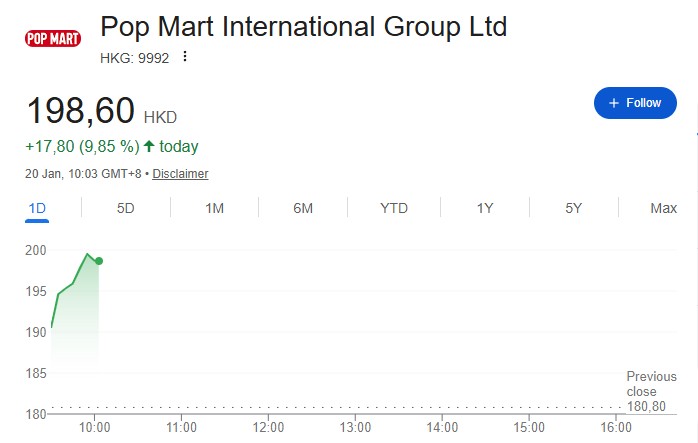
On January 20, Tuesday, the Hong Kong stock market opened, and POP MART surged 10%, closing at HKD 198.60. The previous day, the company repurchased 1.4 million shares for HKD 251 million, sending a message of confidence to the market with real capital.
Expectation Gap One: The Resilience of Overseas Markets is Masked by Single Online Data
Huatai Securities believes that the market's anxiety largely stems from tracking sales figures from online channels like TikTok Shop.
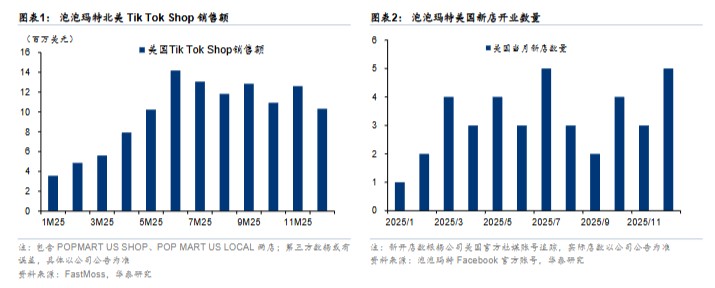
For example, data shows that sales on the U.S. TikTok Shop fell by about 10% quarter-on-quarter in the fourth quarter. However, this observation overlooks the dynamics of all channels.
In the third quarter, North American offline stores faced severe stock shortages, leading to an abnormally high online sales ratio, possibly reaching 60-70%. As we entered the fourth quarter, with increased production capacity, store supply has basically recovered, and sales are returning from online to physical stores.
Therefore, despite the decline in online numbers, combined with the recovery of offline stores (with a net increase of about 12 stores in North America in the fourth quarter), the total sales across all channels are likely to be flat compared to the third quarter, or even show slight growth. Maintaining such a quarter-on-quarter trend in a non-hot product quarter itself indicates that the underlying demand is more solid than imagined.
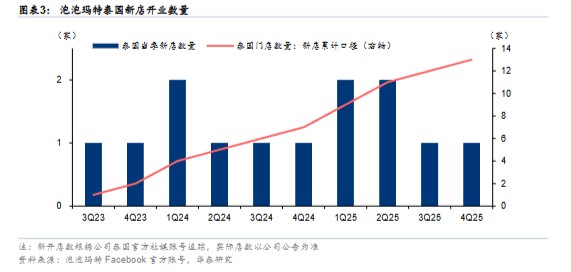
The situation in Southeast Asia is similar. In Thailand, TikTok sales are indeed under pressure, but during the same period, the number of the company's offline stores doubled. The shift of sales from online to flagship stores in larger areas and better locations is a result of channel structure optimization, not a dissipating popularity. Equating online data with overall performance can misjudge the true engine of growth.
The second-hand prices that the market is keen to discuss are not considered a reliable indicator of IP popularity in the report.
Previously, the high premium of the Labubu 3.0 series was mainly caused by short-term supply-demand mismatches due to production capacity bottlenecks. When the company's monthly production capacity of plush toys increased from 300,000 units at the beginning of the year to over 30 million units in August, the decline in premium is a natural process of supply and demand moving towards health
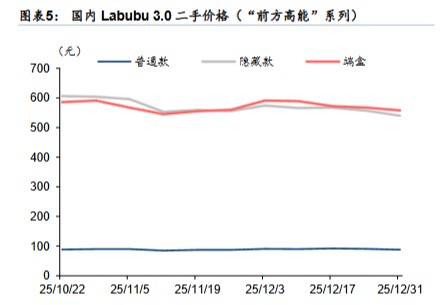
POP MART's core business strategy is "art equity," which aims to make products more accessible through ample supply, fundamentally conflicting with maintaining high premiums in the secondary market. Being entangled in the fluctuations of second-hand prices may obscure the understanding of the company's long-term strategy.
Expectation Gap 2: The new IP echelon has taken shape, not just one Labubu
Another common misconception is that POP MART overly relies on the single IP of Labubu. However, internal data shows that the diversification process of its IP matrix is faster than perceived externally.
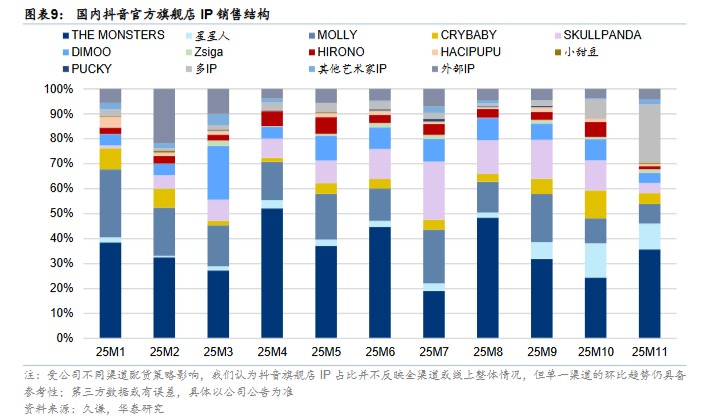
In the official flagship store on Douyin in China, Labubu's sales proportion has dropped to around 30% in the fourth quarter, while the shares of new IPs like Star People and Crybaby are rapidly rising.
In the more mature Southeast Asian market, this trend is even more pronounced. In Indonesia's TikTok bestsellers list, Labubu's share has fallen below 40%, while the combined share of the two new IPs, Star People and Crybaby, can reach over 50%.
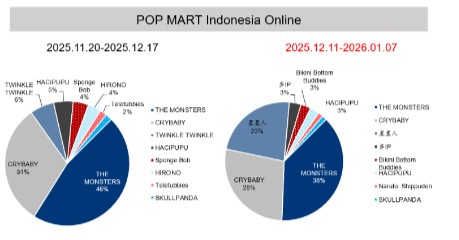 (Labubu's online sales share in Indonesia has fallen below 40%)
In Europe and America, Labubu still holds a high share in online sales, but the report suggests this reflects issues with the development stage of the channels.
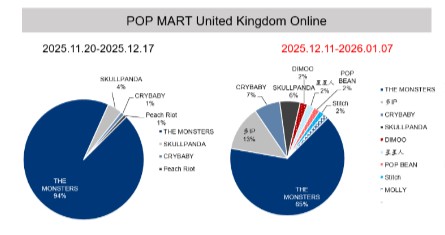 (Labubu's share in online sales in the UK remains high)
When the store network is not yet complete, consumers' online shopping often involves "searching" for known hot-selling items, while "experiencing" and "getting into" a new IP is more critical in offline scenarios.
As stores expand in Europe and America, the potential of new IPs is expected to be released. The company launched an artist recruitment initiative in Europe last September, aiming to create the next "Crybaby" that can resonate with local consumers.
Expectation Gap 3: The leap from a toy seller to an IP ecosystem company has not been priced in
Finally, Huatai Securities points out that the current market tends to value POP MART using a toy company model, closely monitoring monthly sales data while ignoring its key layout towards evolving into a content-driven IP group.
POP MART's content plan has entered a substantial phase. An animated series titled "LABUBU and Friends" is currently in production.
More notably, Sony Pictures has acquired the film adaptation rights for Labubu and has invited Paul King, who directed "Paddington," to take charge Referring to the experience of Sanrio (the parent company of Hello Kitty), it successfully revitalized its classic IP after 2020 by embracing content platforms like Netflix and YouTube, which also boosted the sales of its diverse character series.
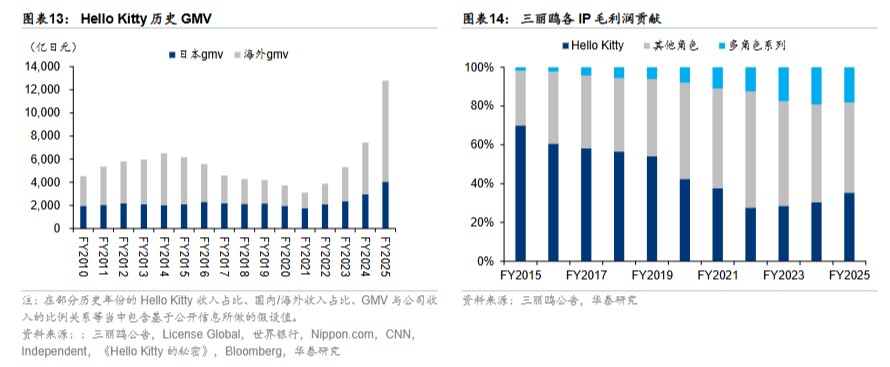
The report indicates that content is expected to become the core lever for POP MART to break through barriers and extend the IP lifecycle in the future.
At the same time, the upgrade and expansion of Beijing Park, along with new business attempts in desserts and accessories, are all building a more three-dimensional ecosystem that connects more deeply with fans' emotions. The investments required for these layouts and the potential value they may bring have not yet been reflected in the current stock price.
Analysts give the company a price-to-earnings ratio of 27 times the forecast for 2026, with the core logic being the rarity of its business model.
The report emphasizes that POP MART is almost the only company globally with a core model of "artist IP incubation and operation platform." It has built a complete closed loop from IP discovery, product design, supply chain management to omnichannel sales and fan operation.
Huatai Securities is optimistic about POP MART's ability to fully leverage the exclusivity of its business model under its globalization and IP group strategy, driving performance to maintain rapid growth and move towards becoming a world-class leader in the trendy toy IP platform
