Extreme Greed Moment! Bank of America Fund Manager Survey: Global Economy "No Landing" Becomes Consensus for the First Time, Stock Hedging Strategies Near Collapse

The latest survey from Bank of America shows that market sentiment has reached its highest point since 2021, with the "no landing" expectation replacing the "soft landing" for the first time, driving cash holdings down to a historical low and stock allocations soaring. Amid extreme optimism, contradictory signals emerge: "going long on gold" has surpassed technology stocks to become the most crowded trade, indicating that while funds are chasing risk, they are also purchasing "hedge insurance" against persistently high geopolitical risks
Global investors are falling into a state of "extreme greed," with market sentiment pushed to its highest level since mid-2021. According to the latest global fund manager survey released by Bank of America, as fund managers aggressively chase risk assets, the cash levels in their portfolios have plummeted to historic lows, with the market broadly betting on a "no landing" scenario for the global economy.
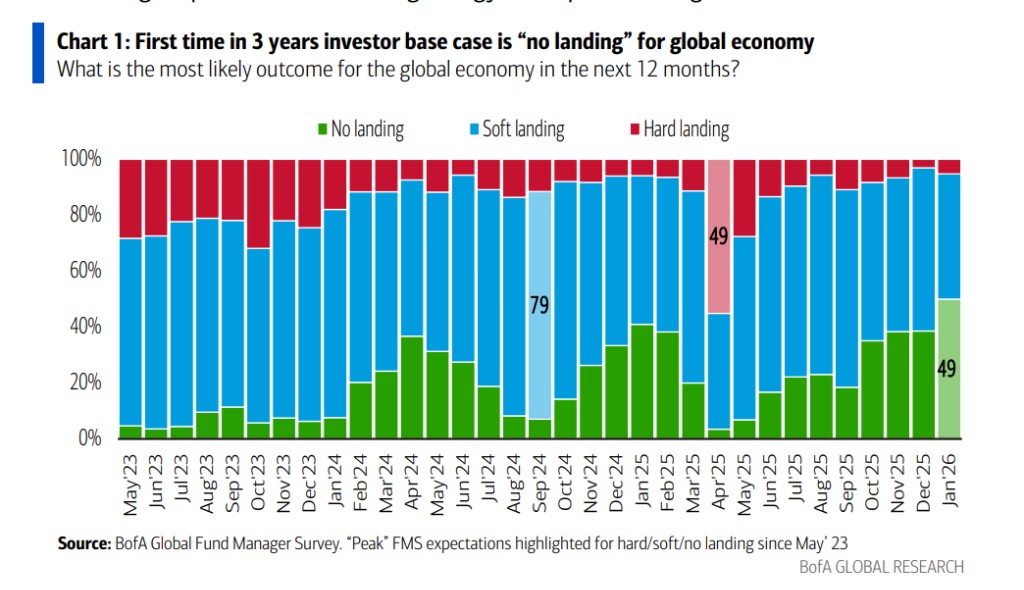
According to the Wind Trading Desk, a survey released by Bank of America on January 20 shows that the macro expectations benchmark has undergone a decisive shift, with "no landing" replacing "soft landing" for the first time in three years as the baseline expectation for investors. This extreme optimism has driven Bank of America's "Bull-Bear Indicator" to soar to a level of 9.4, indicating "extreme bullishness," which is typically seen as a contrarian sell signal.

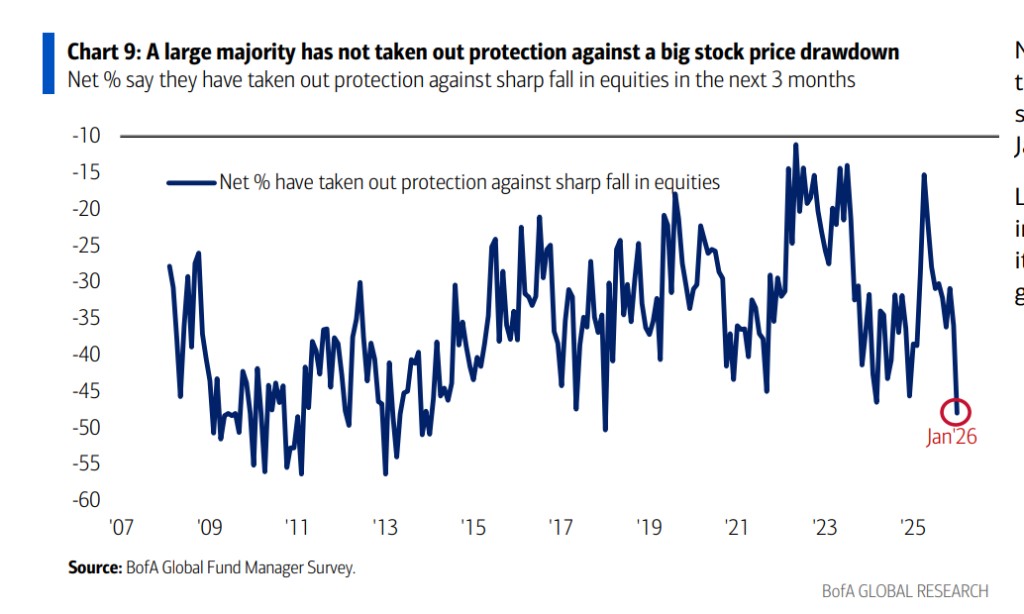
Driven by strong risk appetite, stock allocations have surged significantly, while the demand for hedging against stock market declines has collapsed to its lowest point since January 2018. Notably, despite the high market risk appetite, "long gold" has unexpectedly surged, replacing technology stocks as the most crowded trade, indicating that while funds are chasing returns, they remain highly vigilant about geopolitical risks.
According to Bloomberg and Bank of America reports, this survey was conducted from January 8 to 15, 2026, with 227 fund managers participating, managing a total of $646 billion in assets. The survey results depict a market landscape characterized by ample liquidity and overflowing confidence, but also increasingly sensitive to potential shocks due to the disappearance of defensive buffers.
"No Landing" Consensus Established, Recession Concerns Fade
The optimistic sentiment at the macro level is the core driving force of this survey. The survey shows that a net 38% of investors expect the global economy to strengthen over the next 12 months, the highest level since July 2021. More critically, 49% of investors now believe that "no landing" (strong economic growth with inflation not fully receding) is the most likely outcome, surpassing both "soft landing" and "hard landing" for the first time.
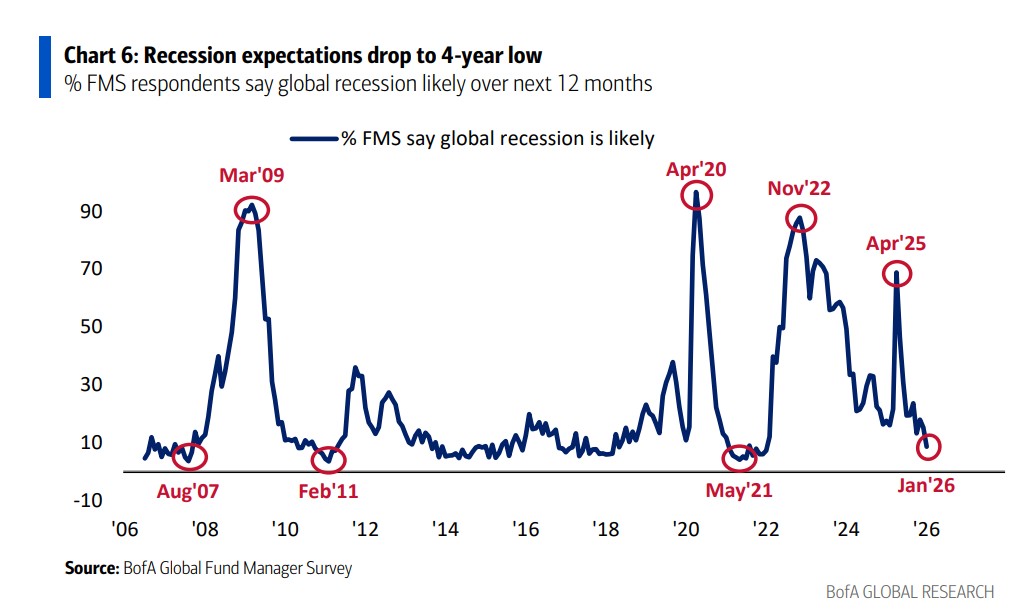
Meanwhile, concerns about an economic recession have dropped to a freezing point. Only 9% of respondents believe a global recession is likely in the next 12 months, the lowest level since January 2022. In contrast, the proportion of investors expecting an economic "boom" (i.e., growth above trend and inflation above trend) has risen to 34%, the highest level since September 2021. Investor expectations for corporate profits have also improved, with a net 44% of respondents expecting global profits to grow.

Cash Positions at Historic Lows, Defensive Mechanisms "Running Naked"
Driven by the fear of missing out (FOMO), investors are deploying their available funds at an unprecedented pace. A Bank of America survey shows that fund managers' cash levels have further decreased from 3.3% last month to 3.2%, marking an all-time low. Meanwhile, the Bank of America's financial market stability risk indicator does not show excessive tension, which further fuels risk-taking behavior.
This optimism has led to a comprehensive withdrawal of defensive positions. A net 48% of investors indicated that they currently have no hedging measures against a significant decline in the stock market, the highest level in eight years. Investors generally believe that the current liquidity situation is extremely favorable, with a net 66% of respondents giving a positive assessment of market liquidity, the best level since the peak of the Federal Reserve's quantitative easing (QE) policy in September 2021.

Stock Allocation Soars, Bank Stocks in High Demand
In terms of asset allocation, the net overweight ratio for stocks has risen by 6 percentage points to a net 48%, the highest level since December 2024. In contrast, bond allocation has significantly decreased to a net underweight status of 35%, the lowest since September 2022.
In sector rotation, funds are flowing from defensive sectors to cyclical sectors. Bank stocks have become the most overweight sector globally, with a net overweight ratio of 34%. In stark contrast, the consumer staples sector has faced heavy selling, with a net underweight ratio reaching 30%, the lowest since February 2014. The degree of overweight in bank stocks relative to consumer staples stocks has reached an all-time high, highlighting the market's aggressive bet on economic growth prospects.
Regionally, investors are not overwhelmingly bullish on U.S. stocks. The survey shows that U.S. stock allocation has dropped to a net underweight of 3%, while Eurozone stocks (net overweight 25%) and emerging market stocks (net overweight 40%) are more favored, indicating that funds are seeking more attractive valuation opportunities globally.
"Long on Gold" Becomes the Most Crowded Trade, Geopolitical Risks at the Forefront
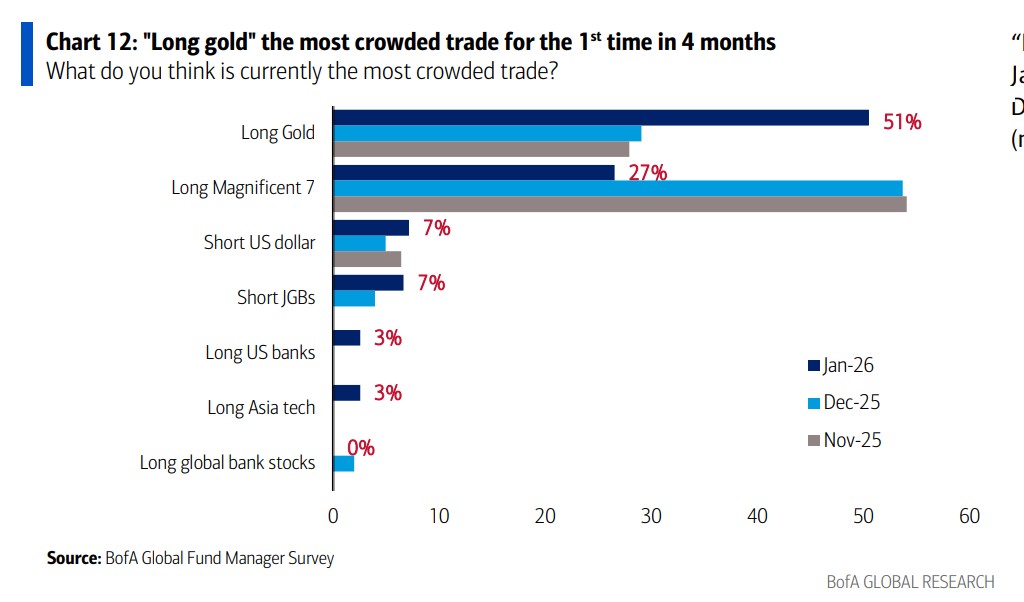
Despite the market being filled with risk appetite, the safe-haven asset gold has seen an unusual level of crowding. 51% of investors believe that "long on gold" is currently the most crowded trade, a significant increase from last month, replacing the long-standing top position of "long on the seven giants of U.S. stocks" (which has dropped to 27%).

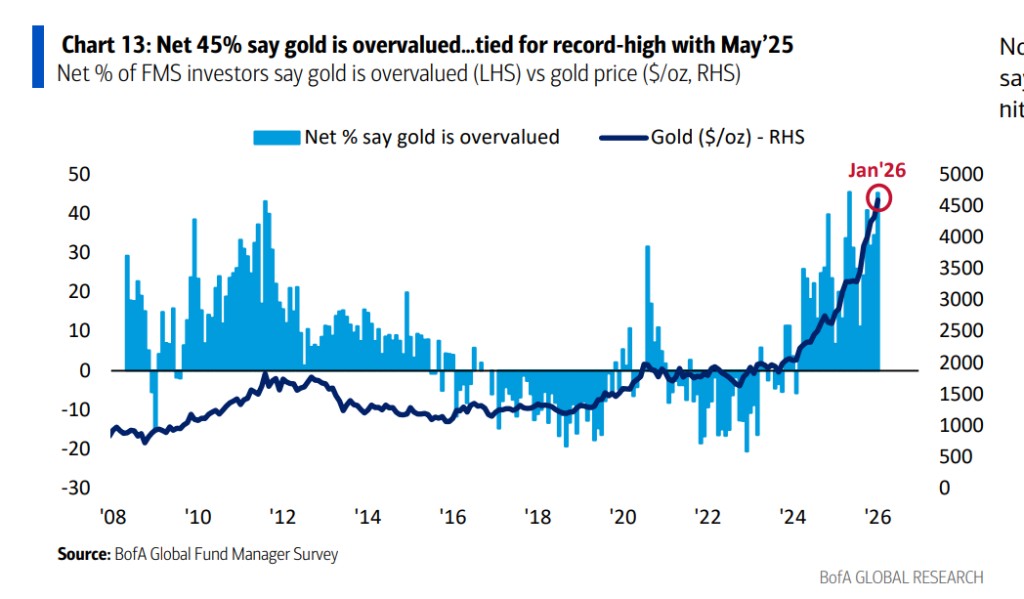
This phenomenon reflects a subtle contradiction in investor psychology: on one hand, there is extreme optimism about economic growth, while on the other hand, there is unease about potential tail risks. The survey shows that "geopolitical conflict" has been identified as the biggest tail risk (28%), surpassing "AI bubble" (27%) and "disorderly rise in bond yields." Alarmingly, a net 45% of investors believe that gold is currently overvalued, matching the historical high set in May 2025 **

U.S. Midterm Elections and Federal Reserve Personnel Expectations
In terms of politics and policy, investors' baseline expectation for the 2026 U.S. midterm elections is a "divided Congress." 60% of respondents expect the Democratic Party to control the House of Representatives, while the Republican Party will control the Senate.
Regarding the future leadership of the Federal Reserve, the market has also provided clear expectations. 44% of investors expect Kevin Hassett to be nominated as the next Federal Reserve Chairman, although this percentage has decreased from last month. Kevin Warsh and Christopher Waller follow with support rates of 19% and 6%, respectively. For the AI sector, although it is the second-largest tail risk source, 55% of investors believe that AI stocks are currently not in a bubble.