


Triple kill in stocks, bonds, and currencies! The "Sell America" trade returns, why has the market that got used to TACO suddenly changed?

Japan's fiscal crisis triggers concerns over the unwinding of arbitrage trades, compounded by Trump's continuous provocation of geopolitical tensions, leading to a breaking point for investors' "patience." The U.S. financial market faces a "triple whammy" of stocks, bonds, and currencies. Some analysts also suggest that Europe may be deliberately creating market turmoil to pressure Trump, who is most concerned about the stock market
As the geopolitical disputes over Greenland intensify and Japan's domestic fiscal concerns trigger a global bond market sell-off, the strange calm on Wall Street over the past few weeks has been completely shattered, with the "Sell America" trade making a fierce return to the market.
After the market opened on Tuesday, the U.S. financial markets faced a triple whammy of stocks, bonds, and currencies. The S&P 500 index plummeted more than 2%, erasing all gains for the year and marking the largest single-day drop in over three months.
The VIX index, which measures market panic, surged to its highest level since November of last year. Meanwhile, safe-haven sentiment pushed gold prices to a historic high of over $4,700 per ounce, U.S. Treasury yields rose significantly, and the dollar exchange rate subsequently fell.
This global market sell-off was initially triggered by domestic issues in Japan. The yield on Japan's 30-year government bonds soared more than 25 basis points in a single day, raising concerns that Prime Minister Fumio Kishida's tax cuts and spending plans could jeopardize the country's finances. This volatility threatens the arbitrage trades that involve purchasing global assets with low-interest yen loans and pushes bond yields higher in other regions.
Investors had previously adopted a "don't care" attitude towards the actions of the Trump administration—including its interventions in Venezuela, threats to neighboring countries, and criticisms of the Federal Reserve—but now that patience is waning. Trump's demand for U.S. control over Greenland has sparked market fears of worst-case scenarios, including a potential breakdown of the NATO alliance or a full-blown trade war.
In the face of escalating tensions, some analysts point out that creating market turbulence may be one of the means for Europe to cope with pressure. Michael Krautzberger, Chief Investment Officer at Allianz Global Investors, stated, "If I were an advisor to certain European governments, I would say you almost need to create some market volatility because Trump cares about this very much, perhaps even more than other political figures."
Farewell to TACO trades, volatility returns
Over the past month, the volatility of U.S. bonds, stocks, and the dollar had fallen to its lowest level since at least 1990. Wall Street Insights previously mentioned that this unusual calm was partly due to traders becoming immune to Trump's rhetoric, betting that he would always back down at the last moment, a strategy known as "TACO" trading.
However, Tuesday's market movements marked a reversal of this sentiment. As the trading session progressed, the S&P 500 index's losses widened, hitting new lows as Trump delivered a speech at the White House listing his achievements in his first year. In the U.S. Treasury market, long-term bonds were hit hardest, with the yield on 30-year Treasuries rising 8 basis points to 4.92%, nearing the highs of the end of 2023.
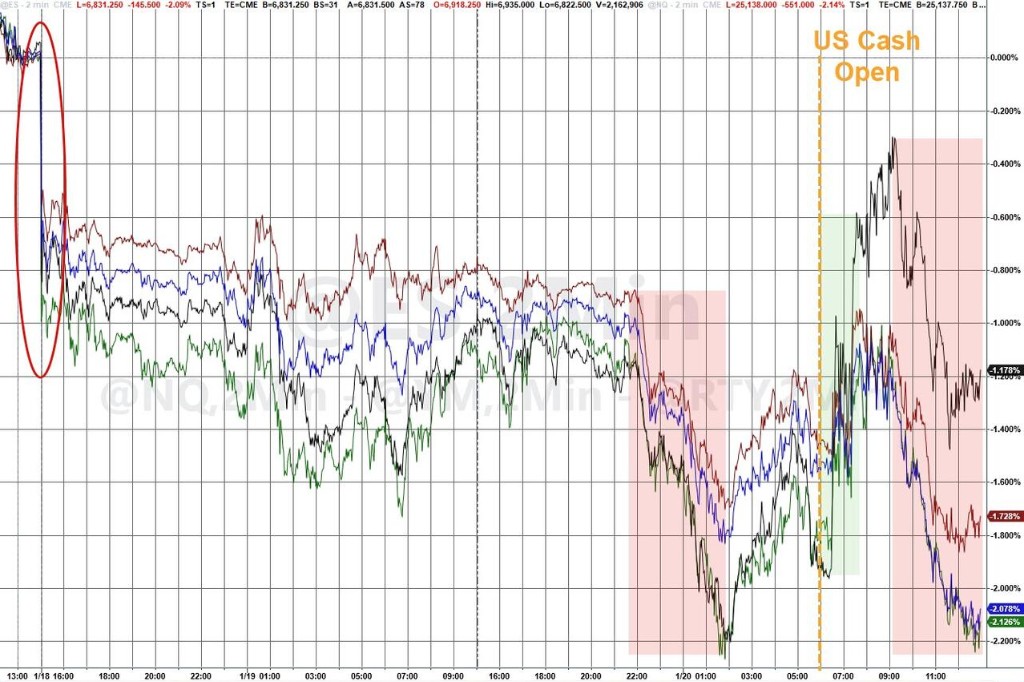 All major U.S. stock indices fell sharply, with the Nasdaq and S&P 500 leading the decline.
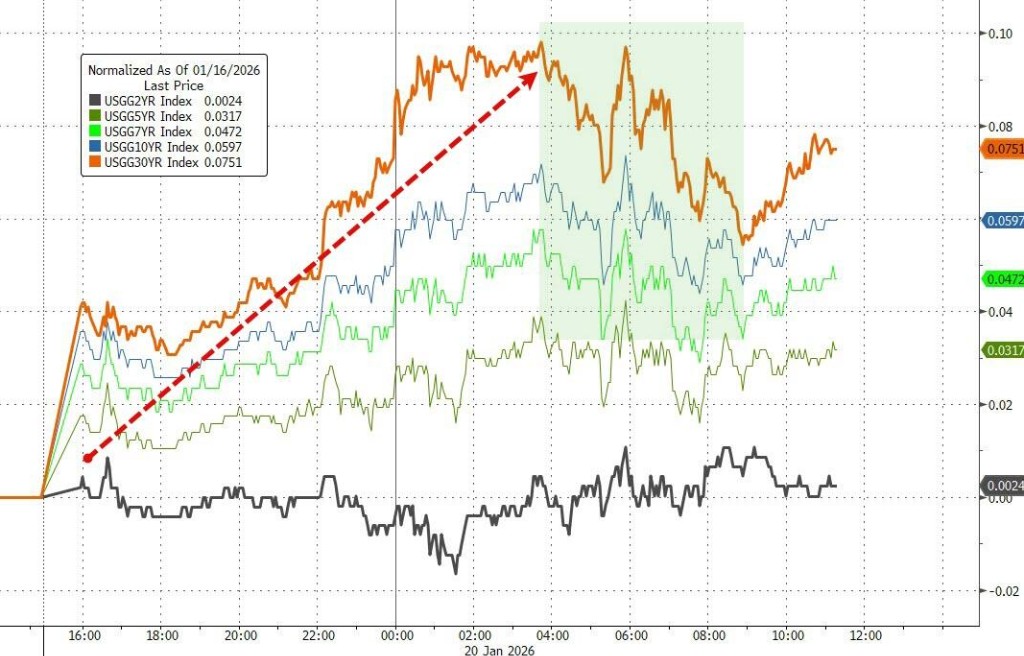
(U.S. Treasury yields rebound)
The recent global market sell-off was initially triggered by domestic issues in Japan. Concerns over the Japanese Prime Minister's tax cuts and increased spending plans caused the yield on Japan's 30-year government bonds to surge more than 25 basis points. This spike threatens the so-called arbitrage trades—strategies that involve borrowing low-interest yen to purchase global assets—and has pushed bond yields higher in other regions around the world.
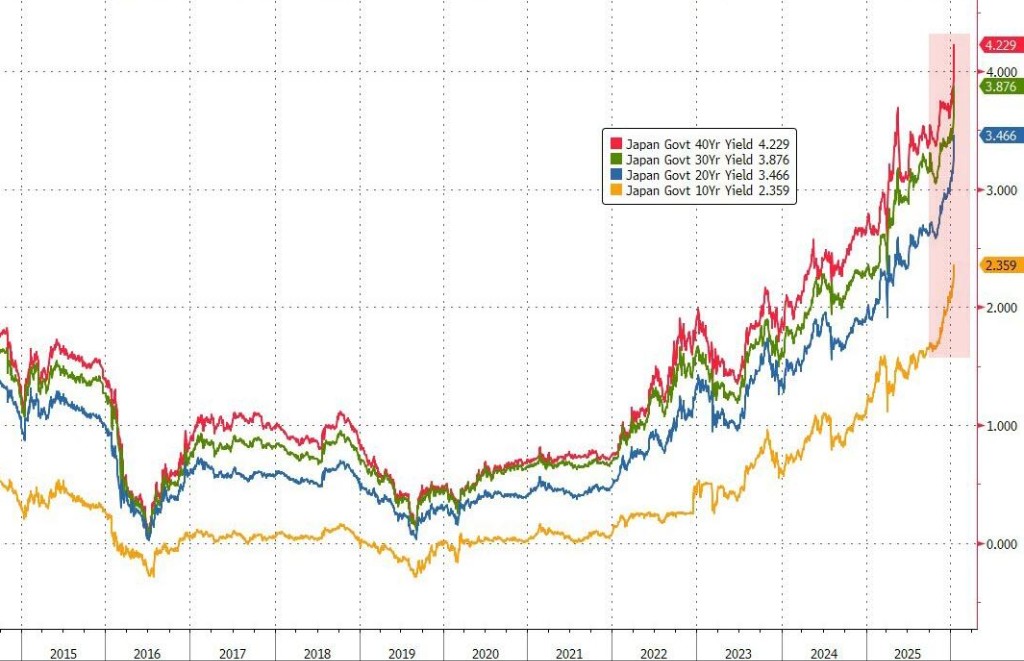
(Japanese government bond yields rise across the board)
At the same time, Trump's belligerent stance towards European allies has heightened investor concerns, providing another reason for the market to withdraw from U.S. Treasuries. Danish pension fund AkademikerPension announced that it would liquidate its U.S. Treasury holdings by the end of this month due to concerns over the significant credit risk posed by the Trump administration.
Anders Schelde, Chief Investment Officer of AkademikerPension, told Bloomberg: “The U.S. is basically not a good credit risk; the U.S. government's finances are unsustainable in the long run.”
Rising Market Uncertainty Amid Geopolitical Games
Although the general view among investors is that the U.S. and Europe will eventually reach a diplomatic solution regarding Greenland, the chaotic negotiation style of the White House—including Trump's addition of French champagne to the tariff threat list—is cooling market confidence.
Previously, U.S. stock market investors paid little attention to geopolitical frictions, as the AI boom and strong earnings outlook drove U.S. stocks to continue rising since early January. A recent survey by Bank of America Corp. showed that investor sentiment had reached its most optimistic level since July 2021, with cash holdings dropping to historic lows.
However, the market now has to face uncertainty. Jefferies strategist Mohit Kumar speculated, that while an agreement may ultimately be reached to ease tensions, it could take months, during which the market will face increased volatility. He noted: “The beneficiaries of escalating geopolitical tensions will be defense stocks, financial stocks, and gold, and we have gone long on these assets in our portfolio.”
Alexis Bienvenu, a portfolio manager at La Financière de l’Échiquier, also expressed similar concerns: “The market is a bit worried about how far he will go with new types of threats. While we know that in many cases, Trump has threatened companies and countries with extremely high tariffs, he ultimately does negotiate.” Evercore ISI's central bank strategy head Krishna Guha wrote in a report: "Our baseline forecast is that as investors bet on some form of compromise, the severity of the situation will ultimately be contained. However, if the situation spirals out of control, the impact will be very serious and will have long-term consequences, including on the dollar."
